Labeling Machines for Bottles and Flat Packs

For a wraparound label, the bottle turns as the label is applied. Separate front and back labels need both faces aligned. For a lid, carton or pouch, start with the surface that will carry the label.

Comwin reviews your pack and label roll to decide how to hold the pack, apply the label and hand off to your line.

    Comwin catalog labeling unit with display and adjustable machine frame
    Comwin catalog labeling unit. The pack handling, label head and line connection are specified for your application.

    Choose the labeling setup by pack shape

    Start with the real pack and the point where the label starts or ends. A flat label and a seal folded over an opening need different contact points.

    Pack and labelFinished resultEquipment to assessWhat changes the choice
    Round bottle or jarA label wrapped around the bodyBottle spacing and controlled roll-onDiameter, taper, seam position and container stability
    Flat-sided or oval bottleDistinct labels on the front and backPack alignment, support and two applicatorsAsymmetry, label height and orientation before the heads
    Flat carton, tray lid or stable pouchLabel inside the designated panelTop or side head and guided transportFace movement, product bulge and release timing
    Carton with a tuck flapA label bridging the opening edgePack support, edge wrapping and pressureFlap profile, label material and contact area on each face

    Wrap a label around a bottle or jar

    For cylindrical containers with a stable labeling area on the body.

    1. Space the containers
    2. Guide and rotate the bottle
    3. Apply the label across the body
    4. Check height and seam

    Compare an inline wrap belt with an indexed roller station. An indexed setup gives a defined place to hold the bottle for an oriented label, if the container has a feature that can be detected.

    A tapered bottle can lift or wrinkle a rectangular label. Test the finished bottle and label together, including the required gap or overlap at the seam.

    See bottle filling lines when the labeler needs to receive filled and capped bottles.

    Label faceSeam
    Two views of a labeled cylindrical bottle showing aligned label ends
    Left: Label face. Right: Seam. This sample shows one wrap label and the gap at its ends. Placement illustration.

    Label the front and back of a bottle

    For square, rectangular or oval bottles with separate label artwork on opposing faces.

    1. Separate incoming bottles
    2. Align the two faces
    3. Apply front and back labels
    4. Check both labels on the same pack

    Hold the bottle orientation through both application points. Confirm whether the base needs guides or the bottle needs top support. Set both label positions from the same pack reference.

    An uneven base or a bottle that shifts under guide pressure can turn before it reaches the heads. Run the smallest and tallest filled samples after a format change and measure the two positions on each sample.

    FrontBack
    Front and back views of a flat-sided bottle carrying different labels
    Left: Front. Right: Back. Front and back labels sit on separate faces of the same bottle format. Placement illustration.

    Apply a label to a flat pack face

    For retail cartons, flat tray lids and supported pouches with a defined label panel.

    1. Present the face to the head
    2. Support the label area
    3. Trigger label application
    4. Verify position and adhesion

    Choose a top or side head after checking how the pack arrives. For a pouch, support the film at the label zone and keep it clear of seams and folds.

    Soft packs settle differently as fill changes. Run the fullest and least-filled normal packs to find the usable area. For variable labels, verify the correct print job and barcode at the agreed inspection point.

    For variable marks, compare packaging coding equipment and barcode reading and verification.

    Label position and support on a filled pouchLabel areaSupport below the film
    Keep the label clear of the seals. A side view shows how the filled pouch bulges where the head will apply pressure.
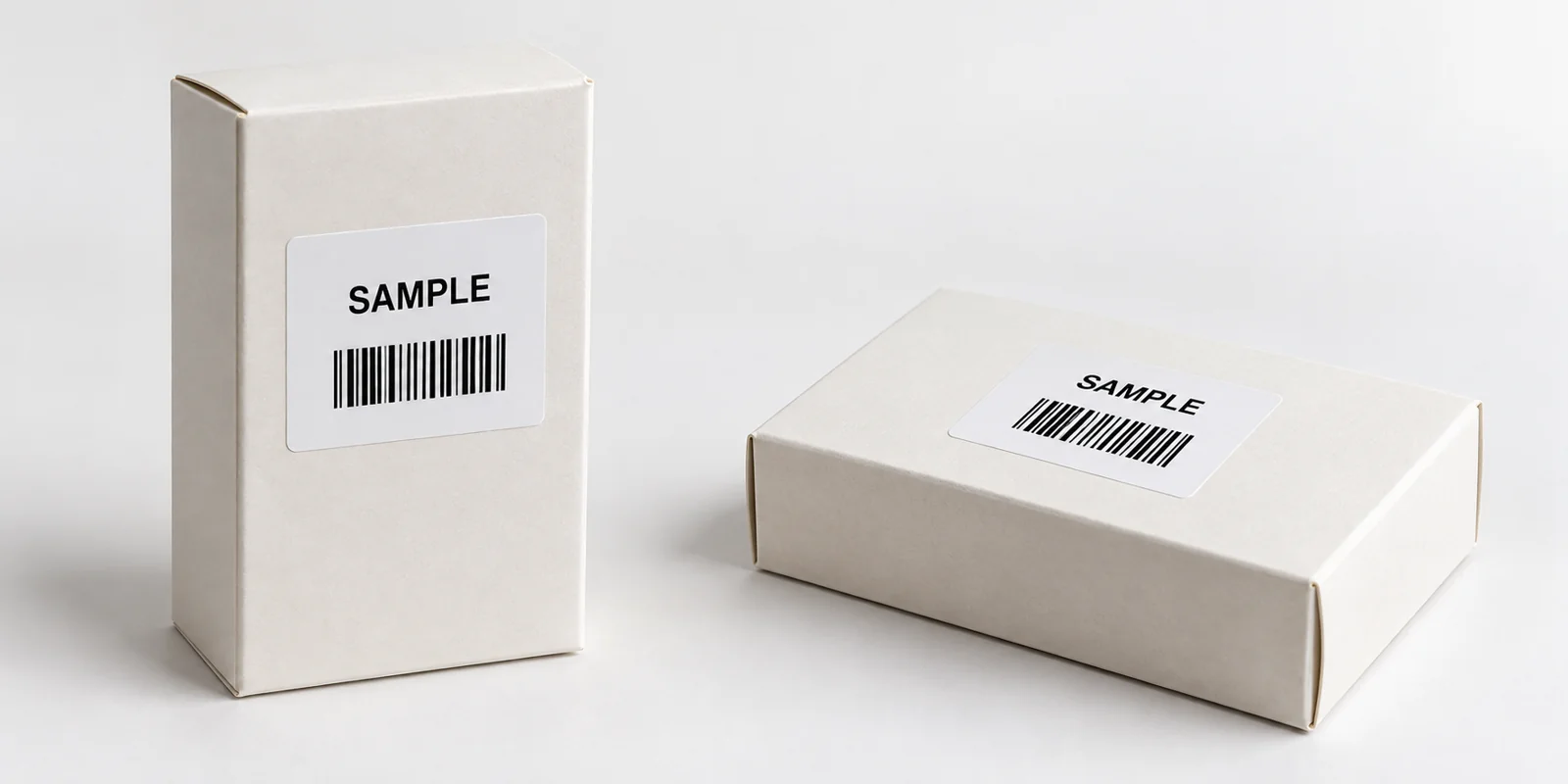
    Folding cartons with sample labels on flat panels
    These folding cartons show labels kept within their flat panels. Placement illustration.

    Apply a seal label across a carton opening

    For retail cartons that require an adhesive closure label across a flap or corner.

    1. Locate the opening edge
    2. Hold the closed flap
    3. Press the label onto both faces
    4. Check the seal after handling

    Support the closed carton while a dedicated applicator presses the label over the edge. Agree how much label must contact each face and whether an opening test must show tearing or a visible change.

    A top-only head may leave the leg over the flap unpressed. Check adhesion after the carton has been handled and stored as planned, using the real board, adhesive and closure.

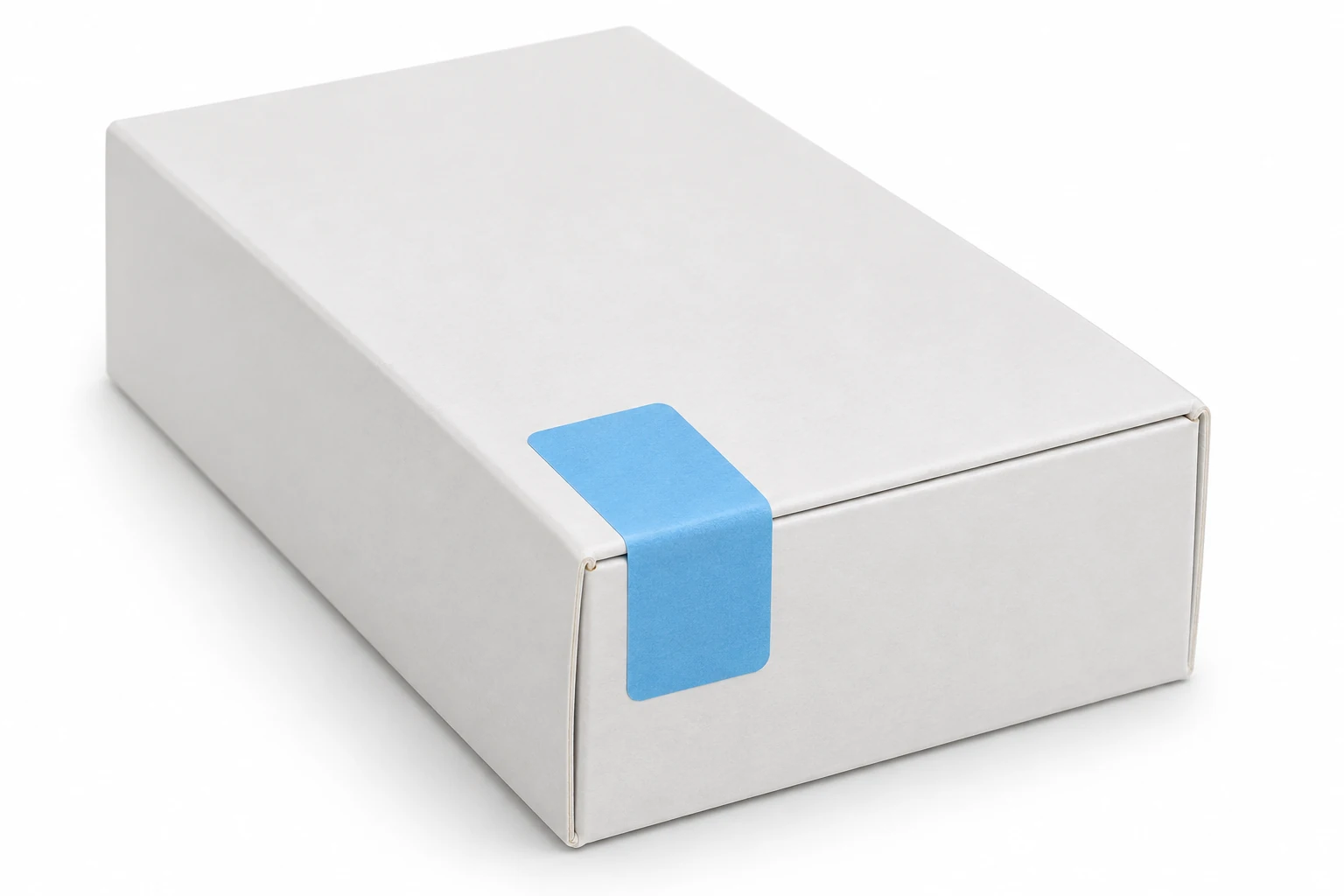
    Folding carton with a single blue label bridging the opening edge
    The label bridges the carton opening and contacts both faces. Placement illustration.

    Check a full label roll and a format change

    Use saleable filled packs and production label stock. Check the first good pack after threading and repeat after a stop, a roll change and a pack change.

    Match the roll to the head
    Send the web width, core size, maximum roll diameter and unwind direction. Mark the leading edge. A roll that feeds the wrong edge can invert the artwork or place it on the wrong side.
    Set a visible placement tolerance
    Mark the reference point and acceptable movement on the approved pack. Compare wrap seam height, front and back alignment or the amount that bridges a closure.
    Agree what to detect and how to handle it
    Decide whether the line must identify a missing label, wrong job or unreadable code. If a reject is specified, challenge it with known faults and confirm where rejected packs go.

    Put the labeler where the pack is stable

    The same finished label can be applied at an operator station or on a conveyor. Compare the work of presenting the pack, changing the roll and clearing a fault.

    SetupOperator tasksChangeover and handoffWhat to prove
    Operator-fed stationPresent the pack and replenish label rolls.Agree the fixture and the pack reference for every size.Check placement and accepted output through a normal short run.
    Inline labeling machineReplenish rolls and respond to machine stops.Agree conveyor height, pack spacing, orientation and signals to adjacent stations.Test the first acceptable pack after a stop and the first pack of the next format.
    Inline application with variable print or inspectionLoad the correct job and manage rejects.Confirm the data source, code inspection point and responsibility for rejection.Run a wrong job, missing label and unreadable-code challenge as applicable.

    Compare labeling machine proposals

    Give each supplier the same set of packs, label rolls and placement rules.

    CompareWhat to agree with ComwinWhat to match in other offers
    Supply scopeIdentify the feeder, label heads, fixtures and any printer or reader.Check what is included between the infeed and discharge points.
    OutputSet accepted labeled packs per minute by format and number of labels.Compare on the same product, stock and reject conditions.
    Format changesList the guides, roll threading, fixtures and stored settings each format needs.Time a change from last good pack to first approved next pack.
    SupportAgree training, spare parts and access to threading and routine cleaning.Identify the service contact for the applicator and any printer or reader.
    DeliveryAgree sample quantity, approval criteria and line interface checks.Confirm responsibility for pack supply, installation and acceptance.

    Labeling machine questions

    Can one machine wrap round bottles and label both sides of a square bottle?

    Some configurations can share a conveyor and change the pack handling or head arrangement. Confirm which guides, supports and applicators are used for each format and trial both filled samples.

    Will an applicator check the barcode?

    A label head applies the label. Add an appropriate reading or verification station if the result must be checked. Specify whether the requirement is a successful scan, correct job data or a print-quality grade.

    What if I label sealed shipping cases?

    Specify case orientation, case size range, and the label face. See the case erecting, sealing and labeling line when the labeler is one station in a shipping-case line.

    Show us your pack and label position

    Photos, dimensions, label artwork and target packs per minute are enough for an initial review. For a retrofit, include conveyor height and travel direction. We can arrange filled samples and production label rolls for a trial.

    Round bottles and jars

    Send first
    Start with bottle photos, diameter, taper and wrap artwork. Mark the desired gap or overlap. Include unwind direction if the roll is already specified.
    What Comwin checks
    The container contact surface, rotation method and label seam repeatability.
    Inquiry subject to copy
    Round bottles and jars

    Front and back bottle labels

    Send first
    Send front and back photos, filled bottle dimensions and both label designs. Mark the height and orientation of each label.
    What Comwin checks
    Pack orientation through both heads and the fit of any guides or top support.
    Inquiry subject to copy
    Front and back bottle labels

    Labels on a flat pack face

    Send first
    For a pouch, send front and side photos at normal fill. Mark the label footprint and show how the pouch is supported. For a lid or carton, send the panel dimensions and travel direction. Include label artwork for either setup.
    What Comwin checks
    Support and triggering at the label point. If data varies, confirm where to read the code and what failure should trigger.
    Inquiry subject to copy
    Labels on a flat pack face

    Labels bridging a carton closure

    Send first
    Send photos of the closed carton and opening edge, seal-strip dimensions and the contact area required on each face.
    What Comwin checks
    Carton restraint, contact across the edge, and adhesion after normal handling.
    Inquiry subject to copy
    Labels bridging a carton closure