Boxed Product Packaging Lines

For folding retail cartons, choose the cartoner from how the product fits through the opening. A rigid bundle can be pushed through an end flap. A soft sachet or insert that must lie flat can be placed from above.

Comwin matches the infeed and sealing to the retail carton. If the closed cartons also need a corrugated shipping case, we can specify that stage around the agreed case pattern.

    Individually wrapped bars next to an end-opening paperboard retail carton
    Wrapped bars and an end-opening retail carton. The group must fit through the open end without distortion. Packaging illustration.

    Choose the carton and the loading direction

    Start from an assembled carton and the products or inserts that go inside it.

    What you need to packFinished resultEquipment to assessWhat changes the choice
    Wrapped bars or firm bundlesClosed end-load retail cartonHorizontal end-load cartonerClearance at the opening and group rigidity
    Loose sachets in a shallow boxTop-loaded retail cartonCarton former, placement and top closureLayer position, insert, loaded height and lid swing
    Examples of an end-opening carton on the left and a top-opening carton on the right
    The left carton loads through the open end. The right example opens from above for placement. Packaging illustration.

    End-load cartoning for repeatable groups

    For wrapped bars, stable pouch stacks or other packs that keep their shape as they enter the narrow end.

    1. Open the carton
    2. Collate the packs
    3. Support and insert
    4. Close the end flaps

    A horizontal cartoner opens the flat folded blank and presents it to a supported group. Repeatable groups can be inserted at a steady pitch, which reduces hand loading and lets the carton close squarely.

    Use the thickest pack and least stiff paperboard in the trial. If a soft pouch folds or the group needs an insert that shifts on insertion, assess top loading.

    See the automatic cartoning machine for the retail carton stage.

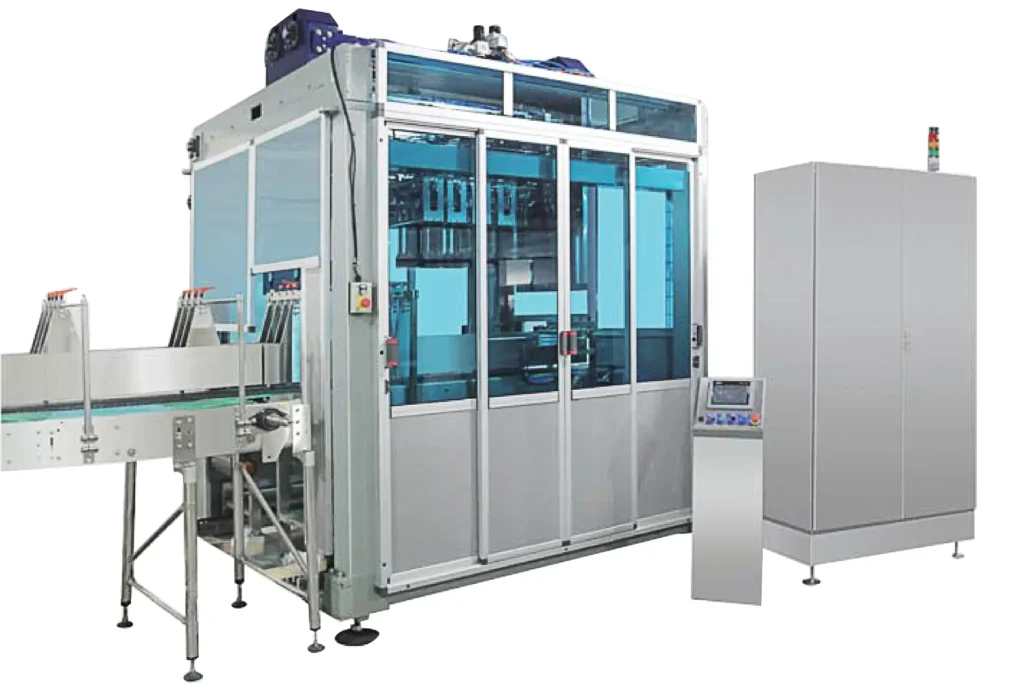
    Horizontal Comwin cartoner platform with product transport
    A horizontal end-load cartoner platform. Guides and pushers follow the real product and carton.

    Top-load cartoning for flat sachets and inserts

    For packs that need to lie in a particular layer, with a shallow carton open across the top.

    1. Form the shallow carton
    2. Arrange unit packs
    3. Place from above
    4. Close lid and check

    Place each pack or insert from above. Open access makes the order and position of a soft sachet or insert easier to control. Automatic placement is useful when each layer repeats and incoming units arrive individually oriented.

    Test the fullest pack before choosing the tools. Check that the top closes with the sachet at its normal limits of movement and that the tuck clears both the sachet and the insert.

    Two pillow sachets placed flat below the rim of an open paperboard retail carton
    Top access lets the sachets settle flat before the lid closes. Packaging illustration.

    Keep the retail box square and complete

    A carton controls product presentation and keeps a multi-piece sale unit together. The layout should protect that result from feeding through closure.

    Crushed edges at insertion
    Check how far the group can move before it catches the carton. A supported track and suitable lead-in can reduce contact pressure at the edge.
    Missing items or loose inserts
    Set the pack order and detection point before close. Confirm the reject carries the incomplete group out of the line, including after a stop.
    Boxes that buckle in transit
    Keep folding-carton fit and case stacking separate. Verify the shipping pattern and closure with loaded cases under the intended handling.

    Add a shipping case after retail cartoning

    Specify this stage if dispatch requires a set number of closed retail cartons in each corrugated case.

    Pack retail cartons into corrugated cases

    For shipping orders with an agreed case count, layer pattern and handoff to closing.

    1. Align closed cartons
    2. Build the case pattern
    3. Load open case
    4. Transfer to closing

    A separate case packer groups closed retail cartons into a transport box. Select top or side loading against the pattern and how much pressure the individual retail cartons can take.

    If cases bow after loading, check case dimensions and the pattern before adjusting closing equipment. Confirm how the case is supported where it transfers to the next machine.

    Compare automatic case packing equipment for transport cases. For the closing step, see case erecting, sealing and labeling lines.

    Closed folding retail cartons grouped inside a corrugated shipping case
    The outer case carries the grouped retail cartons. Packaging illustration.
    Guarded automatic case-packing platform with conveyor
    The case packer is selected around the agreed loading pattern.

    Decide where handling becomes repetitive

    A cartoner can be fed by staff for short varied runs. A connected loader is useful when groups arrive regularly and locating the product by hand becomes the limit.

    Production setupWhat operators doChangeover and interfacesWhat to prove in a run
    Operator-fed cartoningStaff prepare and insert the group or supply positioned product.Compare the carton tooling and required manual adjustments.Inspect the closed box, count and accepted cartons per hour.
    Linked pack and carton feedStaff replenish blanks, film and inserts.Set the wrapper discharge, buffer, orientation and cartoner pitch.Run from primary pack through carton closure after a stop.
    Cartoning with case packingStaff load board and track separate rejects.Change product and carton tooling, then the shipping case pattern.Check first good carton and first complete case across a planned change.

    Compare cartoning and case packing quotes

    A supplier comparison is useful once both sides are quoting the same retail carton and shipping output.

    CompareWhat to agree with ComwinWhat to match in other offers
    Supply scopeIdentify carton forming, product collation and feed, leaflet insertion, closing, and any case packing equipment included in the proposal.Check who provides blanks, optional inserts and plant interfaces.
    OutputConfirm accepted cartons and cases using the actual product group.Use a sustained run at the agreed pack count.
    Change formatsList carton tools, guides and settings for the smallest and largest pack.Compare what can be adjusted and what needs a change part.
    SupportAssign training, line controls and wear-part support.Ask who diagnoses a handoff that backs up.
    DeliveryAgree site layout, access and the method of acceptance.Check commissioning and site responsibilities against the same drawing.

    Cartoning questions

    Can I end-load a soft pouch into a retail carton?

    Sometimes. Trial the pouch or pouch stack with the actual carton. Check whether guides can keep the group aligned and whether it goes through the opening without snagging, folding or pushing an insert out of place. If it needs to be laid flat in a particular order, test top loading.

    Can I use my existing primary packer?

    Often. Show us how the closed pack leaves the primary packer, including its direction and spacing. We can assess direct feed, accumulation or collating. See what to send to connect an existing packer.

    Send the product and the carton it goes into

    A carton sample or drawing helps us check the opening and closure. Include your target number of good cartons per minute if you have one.

    End-load a product or pack group

    Send first
    Send the product or grouped packs, an open carton or its drawing and the number to load per carton. Show where any insert goes.
    What Comwin checks
    Push direction, clearance at the carton opening and the guides needed to keep the group aligned.

    Place soft packs or inserts from above

    Send first
    Send the packs and an open carton, plus a photo or sketch of the layer order and insert position.
    What Comwin checks
    Placement of each layer and lid clearance with the fullest intended load.

    Pack finished cartons into a shipping case

    Send first
    Send the closed retail carton, the shipping-case dimensions and the required number and pattern of cartons in each case.
    What Comwin checks
    Carton grouping, load direction and where the full case passes to closing.

    Feed a new cartoner from existing equipment

    Send first
    Send a finished primary pack and a short clip of it leaving your packer. Include the normal speed and how the packs are spaced.
    What Comwin checks
    Whether packs can feed the cartoner directly or need a buffer or a collating stage.