
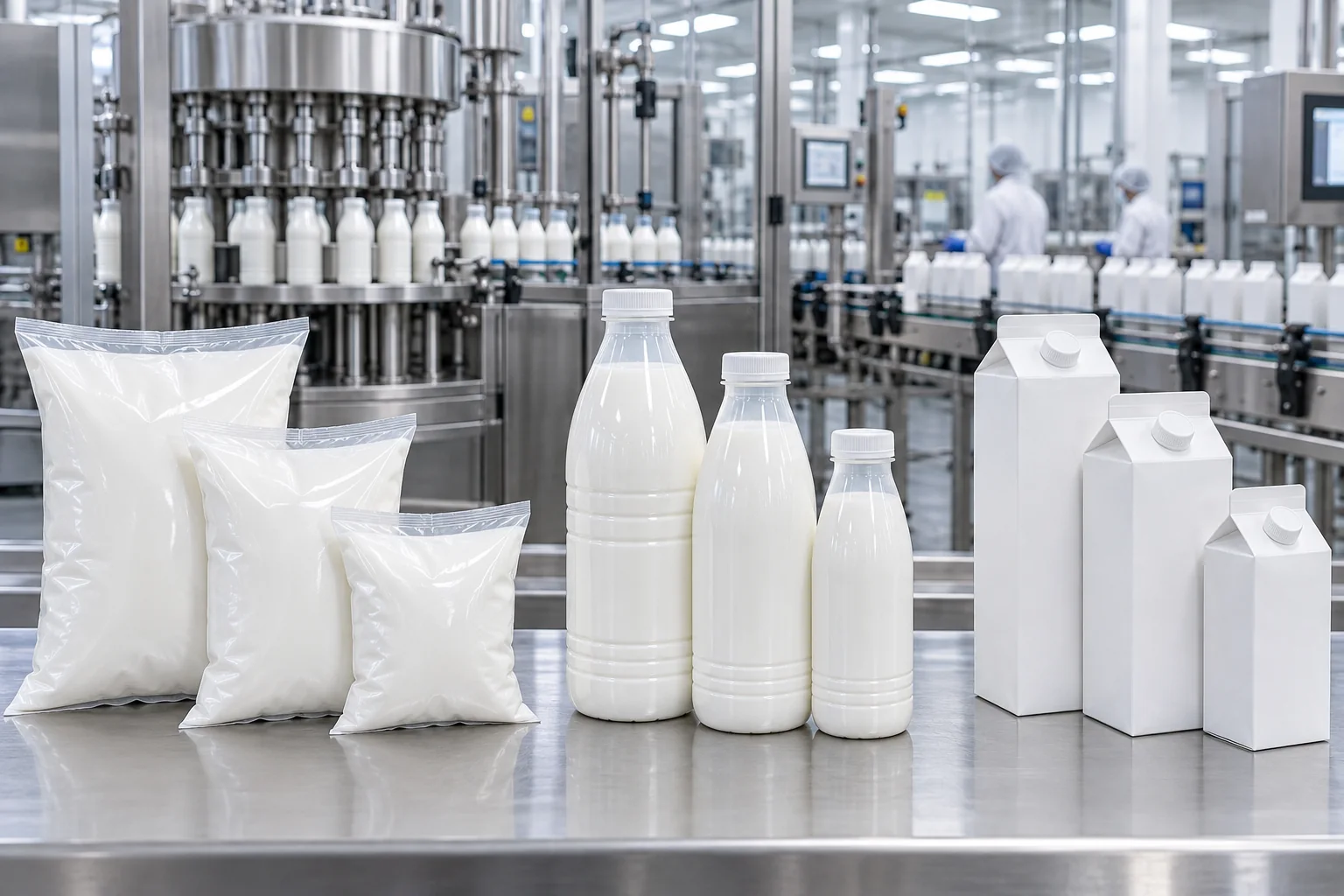
Choose the Milk Package Before the Machine
The filler does not determine shelf life by itself. Raw-milk quality, treatment, hygienic design, package decontamination where required, seal integrity and distribution conditions work as one validated system. Start with the finished package and whether the product will be sold chilled or at ambient temperature.
| Finished pack | Machine route | Typical project fit | Confirm |
|---|---|---|---|
| Pillow pouch | Liquid VFFS forms film, fills milk, heat-seals and cuts. | Cost-focused chilled milk distribution with established pouch handling. | Film, volume, seal method, cold chain and accepted pouches/hour. |
| HDPE or PET bottle | Bottle preparation, hygienic filling, cap feed/capping, coding and labeling. | Fresh or ESL milk where bottle convenience and reclosure matter. | Bottle/cap, preservation process, filling environment and case pattern. |
| Glass bottle | Bottle washing or preparation, filling and closure matched to returnable or one-way glass. | Premium, local or returnable distribution systems. | Bottle condition, washer scope, cap type, breakage and crate handling. |
| Chilled carton | Dedicated gable-top or carton-forming/filling platform. | Chilled dairy using a compatible carton system. | Licensed material system, closure, hygiene and distribution. |
| Aseptic carton | Integrated UHT and aseptic carton filling system. | Ambient shelf-life projects with validated sterile processing and package barriers. | Sterilization, aseptic boundaries, package supplier and regulatory validation. |
How a Milk Pouch Packing Machine Works
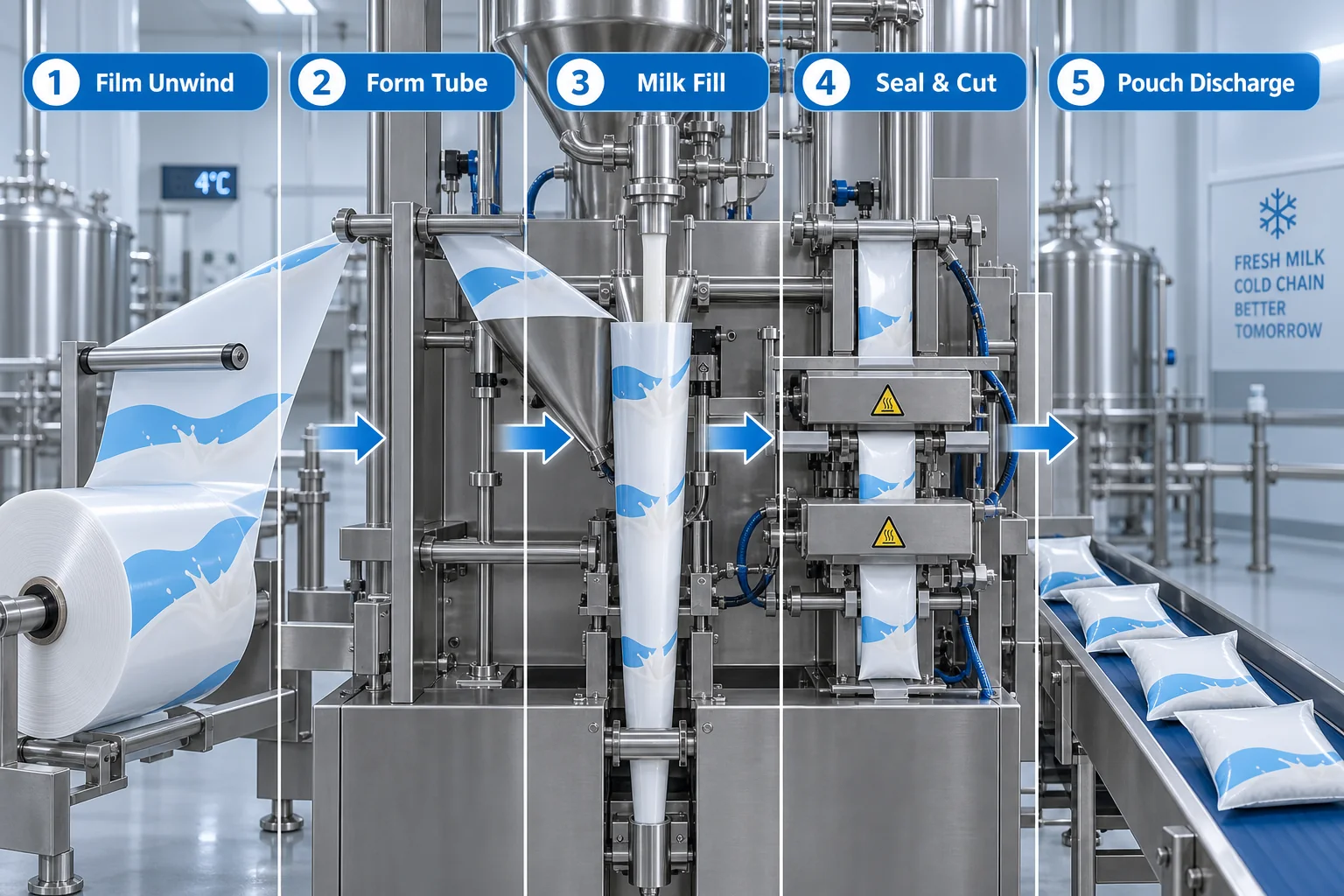
For buyers checking milk packing machine working, the key point is that one indexed cycle forms the film, meters the milk and creates the final transverse seal in the correct order. Roll film unwinds under tension and wraps around the forming collar. The longitudinal seal closes the tube. A sanitary gravity or controlled volumetric filler doses milk after the lower transverse seal is made; the next transverse seal closes the filled pouch and creates the bottom of the following pack. The machine cuts and discharges each pouch for inspection and crate or case handling.
Stable production depends on chilled product supply, film tracking, seal temperature or impulse timing, cooling support where required and protection of the seal area from milk. A nominal cycle rate is useful only when the machine can sustain accepted leak-tight pouches with the real film and fill volume.
| Step | Machine action | Acceptance point |
|---|---|---|
| Film feed | Unwind, tension and registration controls deliver film to the forming collar. | Centered print, repeatable bag length and no edge wandering. |
| Tube forming | Film wraps around the collar and the longitudinal seam closes. | Consistent overlap or fin seal without wrinkles. |
| Milk filling | Sanitary filler meters milk into the formed tube. | Specified dose, low foam and no product on the seal area. |
| Seal and cut | Transverse jaws close the top and bottom seams and separate the pouch. | Continuous seal width, clean cut and no pinholes. |
| Discharge | Finished pouches leave without impact or pileup. | Accepted output with no burst packs or conveyor damage. |
Milk Bottle Filling and Capping
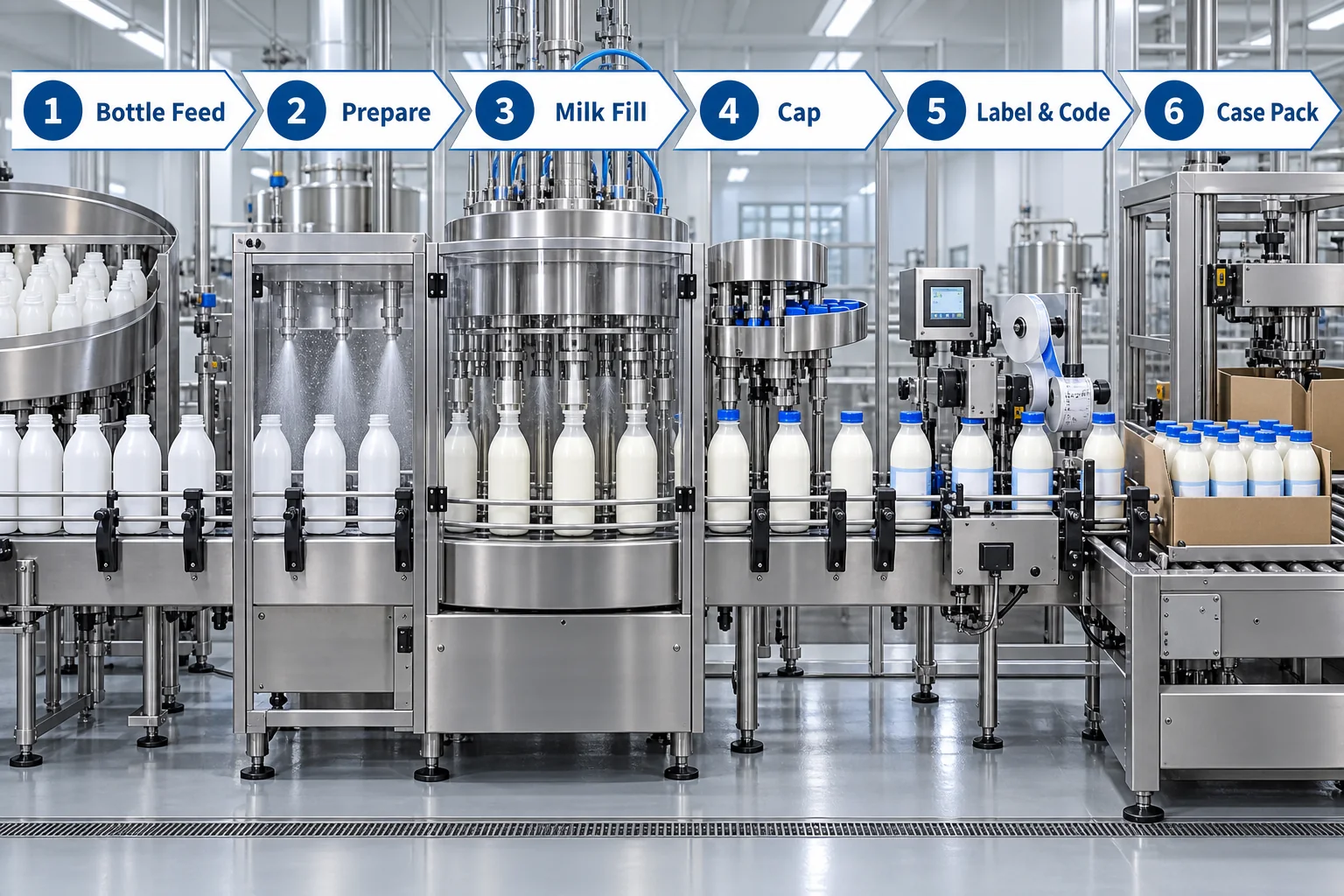
A bottle project starts with empty-container control. Depending on the shelf-life process, bottles may be rinsed, cleaned with filtered air or handled through a validated decontamination system. The filler operates inside the specified hygienic environment, after which caps are placed and tightened before label and date-code application.
Fresh short-shelf-life milk and ESL milk do not automatically use the same hygienic boundary. The required filler enclosure, bottle/cap treatment, clean-air system and cleaning program should come from the product risk assessment and target shelf life, not from a generic machine label.
| Requirement | Equipment implication | Buyer decision |
|---|---|---|
| Fresh chilled milk | Hygienic filler/capper with controlled product supply and validated cold chain. | Define target shelf life, bottle cleanliness and storage temperature. |
| Extended shelf life | Higher hygiene, controlled filling zone and possible package treatment. | Define microbial target and validate the complete process/package system. |
| Aseptic milk | Sterile product path, package decontamination and validated aseptic filling. | Use a specialist aseptic platform and documented validation plan. |
| Secondary packing | Code inspection, accumulation, case/crate packing and pallet interface. | Size modules from accepted bottles/hour and distribution pack. |
Manual, Semi-Automatic or Fully Automatic?
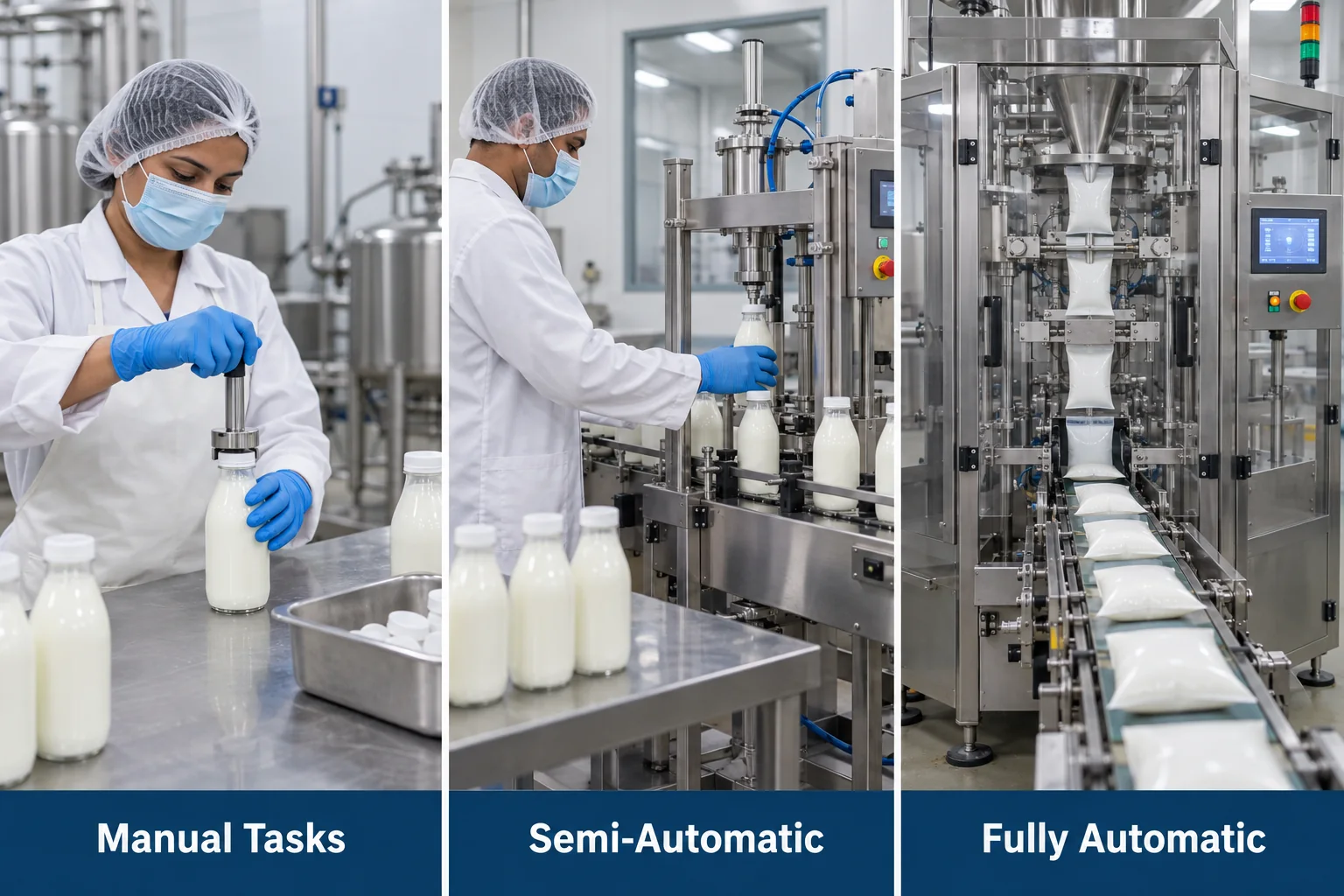
The phrase manual milk packing machine is often used for a hand-operated sealer, a single-head filler or a semi-automatic station. Ask which actions remain manual: container loading, filling trigger, cap placement, sealing, discharge and cleaning. A machine with an electric pump is not automatically a fully automatic line.
| Level | What the operator does | Best fit | Main limitation |
|---|---|---|---|
| Manual tools or bench equipment | Positions every package and initiates filling or sealing. | Laboratory trials and very small rigid-container batches. | High handling exposure, variable output and limited traceability. |
| Semi-automatic | Loads bottles, triggers or supervises filling and closes packs at separate/combined stations. | Low-volume bottle production with disciplined hygiene controls. | Labor balance and repeatability depend heavily on the operator. |
| Fully automatic pouch machine | Replenishes film and supervises automatic forming, filling, sealing and cutting. | Continuous milk-pouch production. | Requires validated film, stable product supply and seal checks. |
| Fully automatic bottle line | Replenishes caps/labels and supervises linked preparation, filling, capping and packing modules. | Higher-output bottle projects needing coordinated control. | Greater capital, integration and changeover scope. |
Milk Filling Machine Price
Searches for dudh packing machine price and milk packing machine low price often mix manual tools, compact pouch machines and complete dairy lines. The table starts with Comwin and keeps low-price marketplace products out of the budget anchor when they lack comparable hygiene, automation or package scope. Manual equipment remains quote-based because the phrase can mean a pump, bench sealer or several separate stations.
| Reference | Planning price | Scope | How to compare |
|---|---|---|---|
| Comwin liquid VFFS milk pouch machine | US$5,000–30,000. | Film forming, liquid dosing, heat sealing and cutting with project-specific food-contact and film setup. | Use after film, volume, seal criteria and accepted output are known. |
| Comwin bottle filling and capping machine | US$12,000–50,000. | Configured filler/capper; bottle preparation, advanced hygiene, labeling and inspection depend on scope. | Compare the exact hygienic level and closure functions. |
| Comwin coordinated filling-product packaging line | US$80,000–500,000+. | Selected treatment interfaces, filling, closing, coding, inspection and final packing. | Use for capital planning and require an itemized project boundary. |
| Manual or semi-automatic milk equipment | Quote-based. | May be a single filler, capper or bench sealer rather than a complete packing machine. | List every manual action; do not compare with automatic line prices. |
| Gengyang dairy line / China | US$10,000–500,000 advertised broad project range. | Supplier listing spans dairy processing and several package types. | Too broad for a machine price; obtain an itemized quote for one route. |
| GEA fresh milk bottle systems / Europe | Quote-based. | Hygienic filling for sensitive fresh milk and cold-chain plastic bottles. | Compare filling environment, hygiene, changeover and lifecycle support. |
| Winpak pouch systems / North America | Quote-based. | Industrial VFFS machinery for cold and free-flowing liquids. | Compare film, fill range, seal integrity, output basis and regional service. |
| Tetra Pak carton systems / Europe and North America | Quote-based. | Dedicated chilled and aseptic carton filling platforms. | Compare as a package system with material supply, processing and validation. |
What “Low Price” Should Mean
A low purchase price is useful only when the machine produces saleable milk packs and meets the intended hygiene plan. Compare the same package, fill volume and acceptance criteria. A cheaper listing may omit a sanitary tank, food-grade product path, date coder, film registration, cold-chain interfaces, commissioning, spare parts or a meaningful production test.
| Low-price claim | Verify | Commercial consequence |
|---|---|---|
| Base machine only | Filler, tank, pump, coder, compressor, film parts and conveyor inclusion. | Required extras can erase the apparent saving. |
| Highest nominal speed | Accepted leak-tight packs/hour with real milk and material. | Rejects and stops reduce saleable output. |
| Food-grade statement | Contact material, surface finish, drainability and cleaning access. | Weak hygiene design increases cleaning time and contamination risk. |
| Simple sealing | Film compatibility, seal window, cooling and leak-test method. | Leaking pouches can damage crates, cartons and cold rooms. |
| Remote sale only | FAT, training, spares, response route and warranty boundary. | Slow recovery from faults can cost more than the price difference. |
Milk Sealing and Cold-Chain Checks
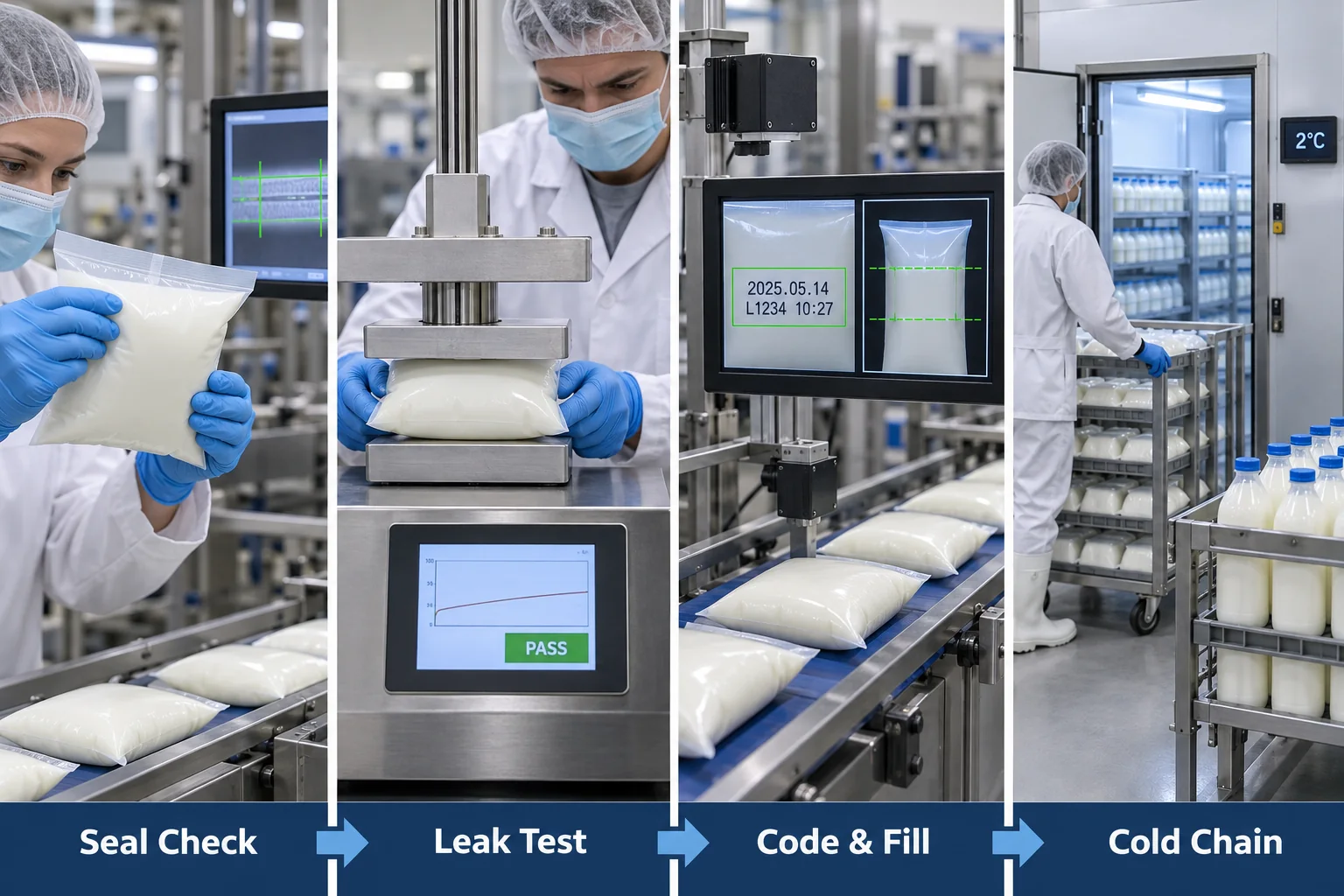
For pouches, confirm longitudinal and transverse seal width, seal appearance, burst or compression behavior and leakage after normal handling. For bottles, verify cap presence, application torque, tamper evidence where used and container deformation. Codes must remain readable through condensation and chilled distribution.
The filling machine cannot compensate for interrupted cooling. Fresh milk requires the validated cold chain from product supply through packing, storage and delivery. Record package temperature and hold times during the production test rather than assuming room conditions are harmless.
| Check | Method | Decision |
|---|---|---|
| Fill quantity | Calibrated volume or weight sampling at defined intervals. | Accept against agreed tolerance and investigate drift. |
| Pouch seal | Visual seal-width review plus defined leak, burst or compression test. | Reject channels, folds, contamination and weak bonds. |
| Bottle closure | Cap presence, torque and tamper-evidence check where specified. | Reject missing, loose, tilted or damaged closures. |
| Code and traceability | Camera or operator verification for batch/date readability. | Reject missing or unreadable information. |
| Cold-chain handoff | Measure product/package temperature and transfer time. | Release only within the validated distribution plan. |
What Does RMC Milk Packing Machine Mean?
RMC milk packing machine is a brand-specific search, not a generic machine category. Public dairy procurement and calibration records identify RMC Packaging Systems equipment used for double-head milk pouch packing. If you need original spares, drawings or service for an installed RMC machine, use the nameplate and serial information to contact the original supplier.
For a new or replacement project, compare an equivalent Comwin proposal from the actual film, pouch sizes, milk temperature, accepted pouches per hour, utilities and seal test. Comwin is not presented as affiliated with RMC, and an equivalent line should be judged by measured output and package quality rather than brand wording.
Information Needed for a Comwin Quotation
| Input | Provide | Effect on design |
|---|---|---|
| Milk and process | Fresh, pasteurized, ESL or UHT; filling temperature, foam and cleaning regime. | Defines hygienic boundary, filler, product path and interfaces. |
| Package | Film roll, pouch, bottle/cap or carton samples plus drawings and material data. | Defines forming, handling, closure and tooling. |
| Formats | Every fill volume and required accepted packs/hour. | Defines dosing range, head/lane count and change parts. |
| Utilities and plant | Power, air, cooling water if needed, floor plan and upstream supply conditions. | Defines controls, layout and installation boundary. |
| Quality and final pack | Fill tolerance, leak/torque test, code, crate/case pattern and cold chain. | Defines inspection, discharge and downstream equipment. |
Use representative milk or a validated test liquid plus production film, bottles and caps for free sample testing. The FAT should cover start-up, steady operation, a normal stop and restart, cleaning and every purchased format.
Supplier Positioning
| Supplier / region | Positioning | Suitable buyer |
|---|---|---|
| Comwin Group / China | Customized pouch or bottle project with optional inspection and final packing; free sample testing and real-factory visits. | Buyers seeking Chinese project economics and one contact from primary to secondary packaging. |
| Chinese export equipment market | Wide range from compact VFFS units to bottle and turnkey dairy lines. | Buyers prepared to define hygiene, FAT, documents, spares and commissioning contractually. |
| GEA / Europe and North America | Industrial fresh and ESL milk bottle filling platforms with controlled hygienic environments. | Plants prioritizing specialist sensitive-beverage engineering and lifecycle support. |
| Winpak / North America | Industrial liquid and semi-liquid VFFS pouch machinery plus packaging-material knowledge. | Buyers comparing high-output pouch equipment and regional service. |
| Tetra Pak / Europe and North America | Integrated chilled and aseptic carton package systems. | Projects committed to carton formats, package supply and validated processing/filling. |
Frequently Asked Questions
How much does a milk filling machine cost?
Comwin planning references are US$5,000–30,000 for liquid VFFS and US$12,000–50,000 for bottle filling and capping. A coordinated filling-product packaging line is normally planned at US$80,000–500,000+ according to the included processing interfaces, hygiene, inspection and final packing.
What is the manual milk packing machine price?
It remains quote-based because “manual” may describe a hand sealer, single-head filler or several separate stations. List the exact tasks and required food-contact design before budgeting; otherwise the price comparison is meaningless.
Can one machine pack milk in pouches and bottles?
No single primary machine normally handles both. Pouches need film forming and heat-sealing jaws; bottles need container transport, filling and capping. They may share upstream milk supply only when the hygienic design and changeover plan are validated.
Does fully automatic mean aseptic?
No. Automation describes material handling and machine control. Aseptic production requires validated sterile processing, package decontamination, a protected filling environment and documented controls.
How should milk sealing be tested?
For pouches, use defined visual, leak and burst/compression criteria after normal handling. For bottles, check cap presence, torque and tamper evidence. Test production materials with milk at the intended temperature.
Request a Milk Packing Machine Proposal
Send your milk process, package samples, fill volumes, accepted output and cold-chain or ambient shelf-life plan through our contact page. Comwin provides the most suitable packaging solution for your product, pack format and production requirements. Service includes a two-year machine warranty, three-year core-component warranty and remote response within 24 hours.