
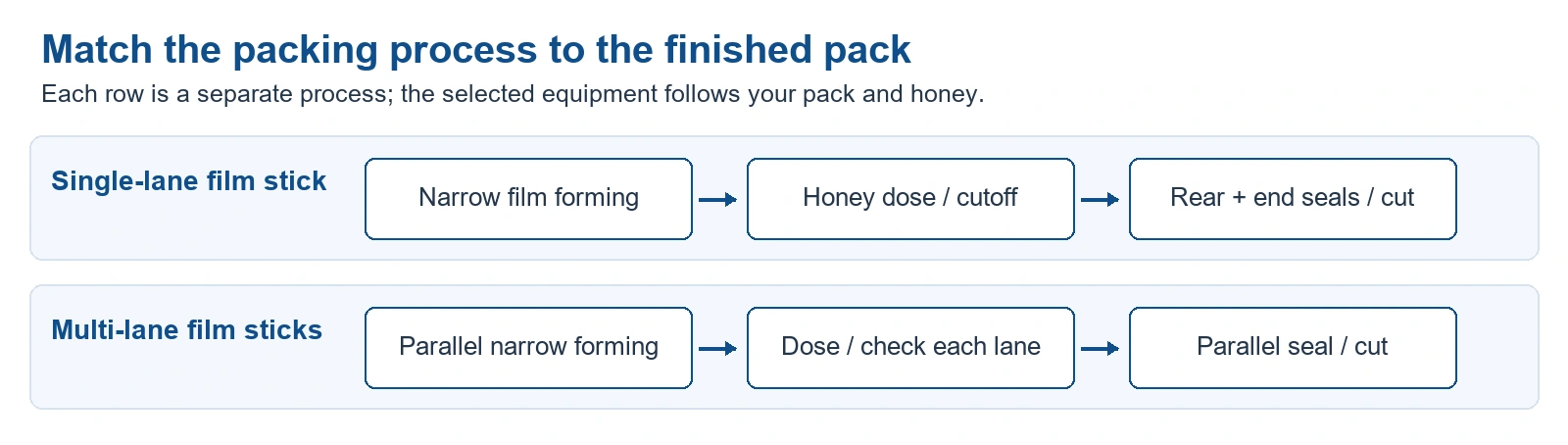
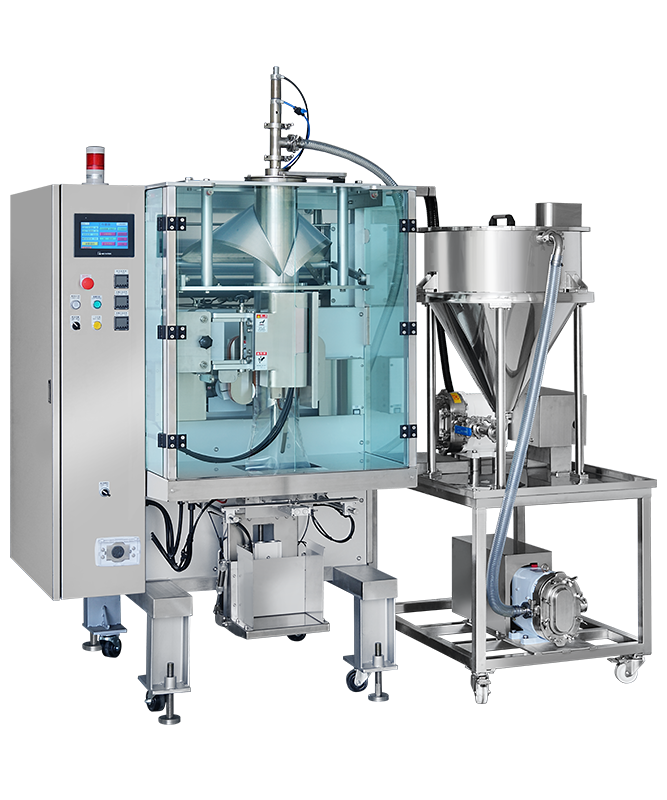
For flexible honey sticks made from roll film, choose a honey stick filling machine that forms the narrow pack, meters the honey and seals both ends. Start with a single-lane stick-pack configuration for varied or shorter runs. Use a multi-lane stick-pack system when an approved product and pack need more accepted output than the proposed single-lane machine can deliver.
Comwin matches the forming tools, filling path, nozzle cutoff and collection to your honey and sales format. Our general VFFS single-machine reference is US$5,000–$30,000. For early planning, allow US$30,000–$80,000 for a dedicated 4–6 lane honey stick-pack system. The product, pack and included functions determine the quotation. A rigid, preformed honey straw uses tube feeding and end sealing rather than film forming.
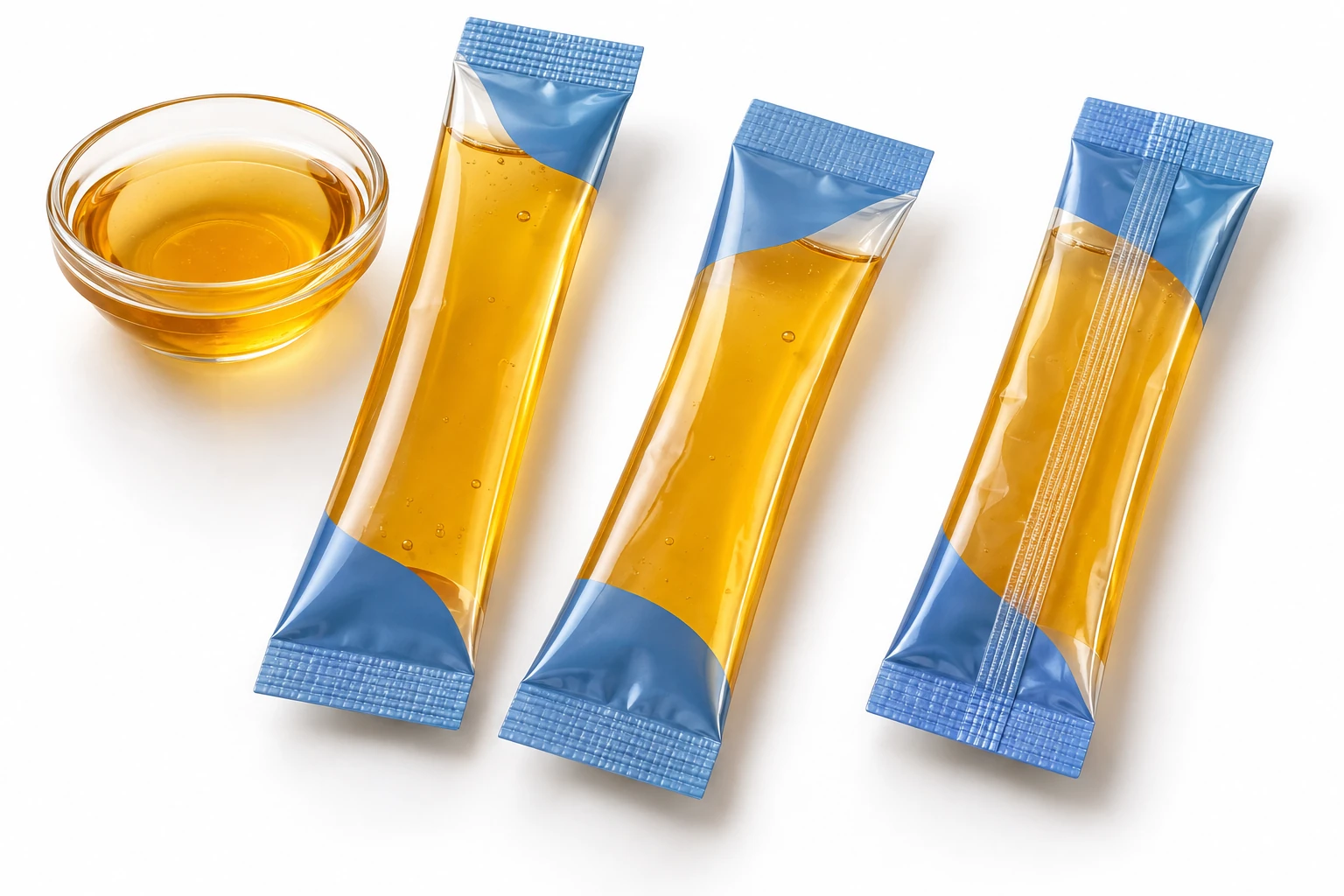
Choose a flexible-film honey stick machine by pack and production pattern
Send a filled pack or drawing first. The stick width, end seals, rear seam and opening feature determine the forming and sealing tools; the honey determines the filling path. We then size the machine around the accepted sticks required in your production window.
| Starting configuration | Recommended equipment | When it fits and when to change |
|---|---|---|
| Single-lane honey stick-pack machine | Narrow film forming, matched piston or positive-displacement dosing, coordinated cutoff, rear/end sealing and cutting. | Several varieties, trial formats or repeat demand that one lane can serve. Keep accessible cleaning and format changes visible in the decision. |
| Multi-lane honey stick-pack machine | Parallel stick forming with distributed dosing, coordinated seals and cutting, plus lane-specific product checks. | Longer repeat runs of approved sticks. Choose lanes from tested cycles and the schedule, then match honey supply and finished-stick collection. |
| Stick-pack machine with counted retail cartoning | The selected stick machine, pack collection/counting, a matched carton-loading method and carton closing. | The sales unit is a retail carton of sealed sticks. Add automatic loading when operator handling becomes the limiting step; quote downstream modules separately. |
For wider flat portions, compare the honey sachet packing machine guide. For bottles, jars and other formats, return to our honey packaging selection guide.
Check the “stick” versus “straw” structure before asking for a quote
A film stick pack is formed from flexible rollstock and has package seams. A honey straw starts as an empty rigid tube; it requires tube presentation, filling and end sealing. If your sample is a preformed straw, request that dedicated equipment route. A stick-pack film former does not provide tube feeding.
Solve the problems that affect accepted honey sticks
| Product or packing problem | Recommended stick-pack response | Verify before approval |
|---|---|---|
| Honey strings into the end-seal zone. | Matched metering and nozzle shutoff: coordinate filling completion, cutoff and cross-seal timing. Assess retracting or suck-back options only where compatible with the dosing system. | Clean end seals and leakage results at the agreed production conditions; additional clearance time can affect cycles. |
| Fill weight changes across a batch or lanes. | Stable supply and calibrated dosing: match pump/valve passages and feed conditions. For multi-lane machines, check distribution and calibration by lane. | Weights at start, middle and end, plus each lane. Overall average weight can conceal a lane problem. |
| Thick honey, crystals or inclusions restrict a narrow nozzle. | Product-path redesign where needed: select passages, valve and nozzle from representative samples. Adjust the pack/nozzle relationship if necessary. | Continuous dosing, clean cutoff and accessible cleaning with the most demanding expected honey batch. |
| Small sticks tear badly or cut across the filled cavity. | Matched opening and registration tooling: specify the printed repeat, seal margins, tear feature, cut position and any connected-stick perforation. | Consumer opening, print/cut alignment and the intact filled pack after normal handling. |
| A fast stick machine overwhelms manual collection. | Collection/counting and matched carton loading: balance the forming output with the required final sales unit. | Accepted sales units, collection stops and operator work at the last included station. |
Find the closest honey stick-pack project
The dose examples describe planning situations, not machine limits or customer cases.
| Product and sales situation | Start with | What determines the final configuration |
|---|---|---|
| Liquid-honey brand testing 5 g flexible sticks with several printed variants. | Single-lane stick-pack machine. | Common stick drawing, print change, small-dose cutoff and available production minutes. |
| Repeat foodservice orders for one approved 10 g flexible stick. | Multi-lane stick machine when one lane cannot meet demand. | Accepted sticks by lane, uninterrupted honey supply and collection workload. |
| Flavored honey in flexible sticks, with frequent product changes. | Changeover-focused stick platform and a sample-selected filling path. | Inclusions, cleaning, contact-path access and any permitted conditioning. |
| Retail cartons containing a specified count of completed sticks. | Stick machine plus counted collection and carton-loading/closing equipment. | Approved carton count, stick orientation, loading method and complete-sales-unit output. |
Example: several prints on one 5 g stick
Use one approved pack width and length where possible. We would start with narrow film forming → metered honey filling and cutoff → final end sealing → cutting → collection, with product feed and rear-seam sealing coordinated with the film path. Demonstrate the most different honey varieties and a print change. If one lane completes the real batch schedule, added lanes may create cleaning work without solving the current constraint.
Example: repeated 10 g sticks sold in retail cartons
Prove the stick first, then check how completed sticks reach a counted group and carton. For repeat high-volume campaigns, a multi-lane machine with coordinated collection may suit the job. If cartons wait for manual loading, extra filling capacity alone will not raise finished-carton output; automate the limiting collection/loading step.
Compare the whole single-lane and multi-lane job
| Decision | Single lane | Multi-lane |
|---|---|---|
| Production pattern | One automatic forming/filling/sealing stream; useful for varied shorter runs. | Several simultaneous streams for compatible approved sticks; useful when accepted-output demand warrants them. |
| Labor boundary | Honey/film replenishment, checks, cleaning and collection remain unless included. | More output makes feed and collection coordination important; automatic packing still requires operator tasks. |
| Changeover work | Clean the filling path, change film and adjust specified format parts. | Clean/service multiple filling points and sealing/cutting positions; compare minutes and parts for real SKUs. |
| Acceptance | Weight, clean seals, opening and accepted sticks across the agreed test. | The same checks by lane, plus the agreed collection or carton boundary. |
Upgrade when the complete tested job misses your schedule. Keep the simpler configuration when it meets required accepted output after replenishment, cleaning and SKU changes.
Convert sales demand into a stick and collection target
Illustrative planning: 30,000 accepted sticks in 360 available minutes require 83.3 accepted sticks/minute. If the retail carton contains 20 sticks, that order is 1,500 cartons. The pack count and schedule are assumptions; they do not specify a machine rating or a standard carton count.
For any candidate, calculate lanes × cycles/minute × sticks per lane per cycle × available minutes × operating fraction × accepted-stick fraction. Use trial measurements when comparing machines. State whether packs are counted after cutting, inspection, collection or cartoning.
Honey stick filling machine budget and scope
Comwin’s general VFFS single-machine category reference is US$5,000–$30,000. The multi-lane rows below are preliminary equipment allowances for ordinary pourable honey, one approved flexible-film stick format, matched metering/cutoff, parallel forming/sealing/cutting and specified controls. Lane count, drive and control choices, cleaning access and collection change the final scope.
| Equipment scope | Early reference | What must be specified |
|---|---|---|
| General single-machine VFFS platform | US$5,000–$30,000; Comwin category reference. | Stick forming/seals, honey dosing, cutoff, coding and the included pack format. |
| 4–6 lane honey stick-pack system | US$30,000–$80,000; early planning allowance. | One stick format, parallel honey dosing, film forming/sealing/cutting and basic discharge. Define drive/control choices, cleaning access and the production-material trial. |
| 8–12 lane honey stick-pack system | US$60,000–$150,000; early planning allowance. | Wider parallel forming and honey distribution for one format. Lane count alone does not determine price or accepted output; supply and counted collection need separate scope. |
| Optional counted retail-carton packing | Separate itemized scope. | Collection, count verification, stick grouping/loading, carton closure and line interfaces. |
The general VFFS reference comes from Comwin’s September 2026 equipment table; its trade terms and included extras require confirmation. The multi-lane allowances assume China export supply and exclude freight/taxes, overseas installation/training, honey/film, upstream conditioning or transfer pumps, advanced inspection, counted collection and cartoning. Extra formats and modules are itemized; scope beyond these assumptions can exceed the allowances. Compare the same product, pack and final-output boundary.
Add counted retail cartons only when the sales format requires them
For a carton of completed honey sticks, we match stick collection/counting → grouping and loading → retail carton closing. Manual loading can suit smaller campaigns. Automatic collection/loading is appropriate when handling limits the finished-carton target.
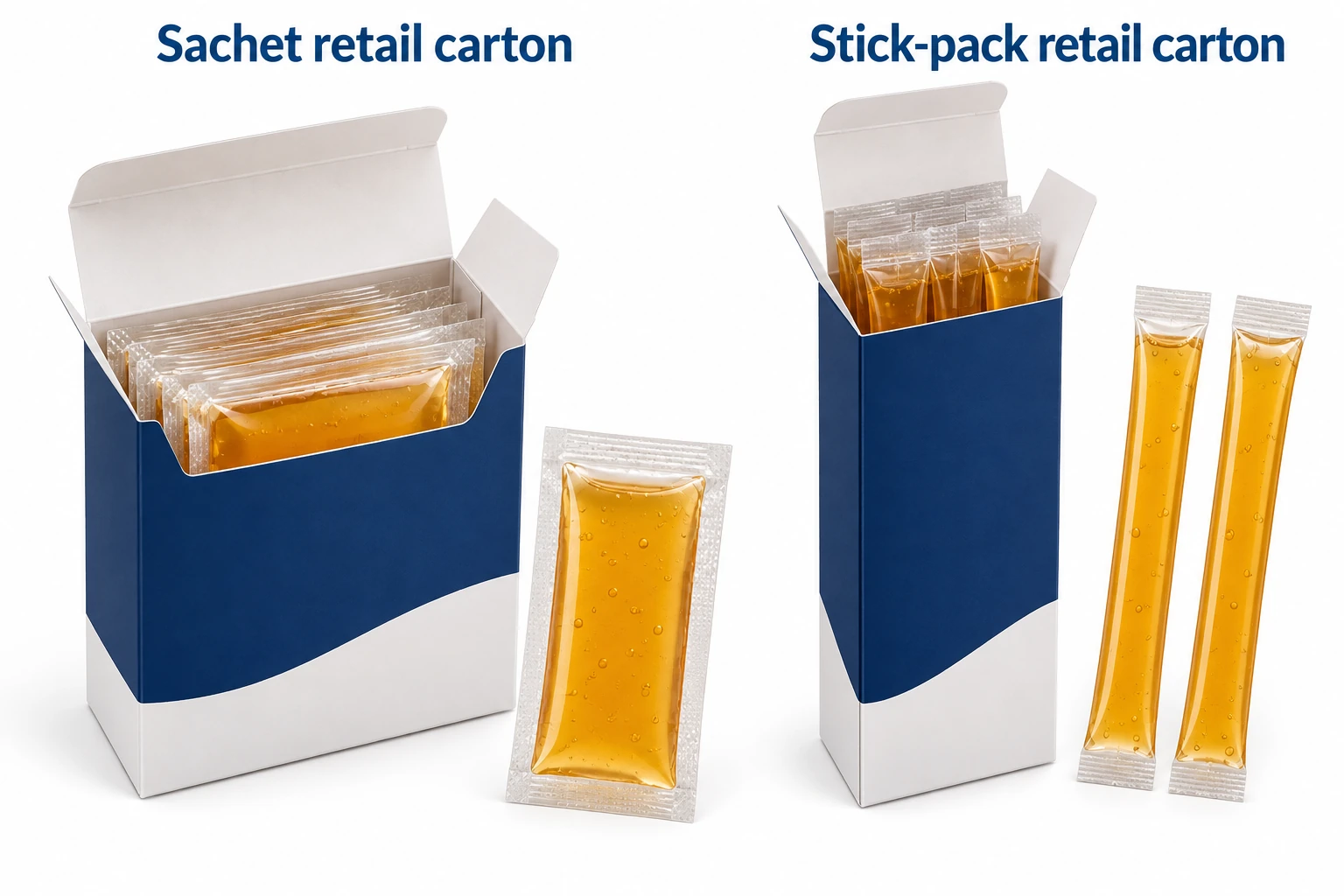
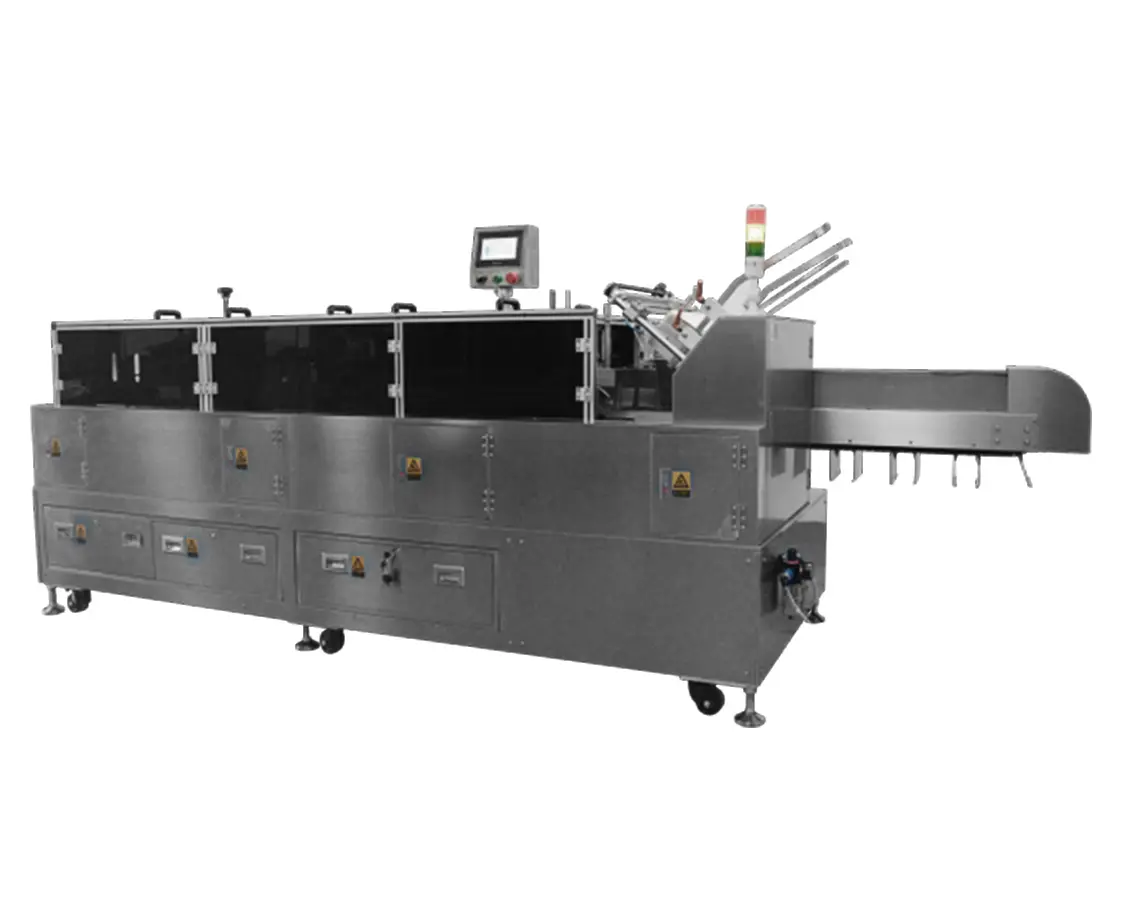
The stick-pack carton is shown on the right; the wider sachet carton on the left illustrates a different primary-pack shape. Carton loading, carton format parts and counting are separately specified downstream equipment, not implied parts of the stick machine.
Compare stick-pack proposals across five purchasing decisions
| Decision | Comwin proposal focus | Compare with every supplier |
|---|---|---|
| Budget and scope | Matched packing equipment with options and downstream stages itemized. | Same forming format, dosing, tooling, coding and delivery boundary. |
| Production scale | Single or multi-lane configuration sized to accepted sticks and operator work. | Real-honey output test, per-lane checks, replenishment and changes. |
| Customization | Pack, product path, controls and collection selected around the project. | Approved sample, drawing, change parts and interface responsibilities. |
| Support | Trial, operating/cleaning guidance, spare-parts and service scope. | Written support commitments and responsibilities across modules. |
| Delivery | Sample approval, configuration and acceptance milestones. | Confirmed availability and timetable for the specified machine. |
A suitable existing platform may complete the task; a different pack, honey condition or line interface may need adaptation. We make that configuration judgment from your product and factory information.
Test the production honey and finished stick
Use our free sample-testing service with representative honey and production film. Agree the product-condition range, fill tolerance, pack opening, leak checks, test duration and counting point.
- Weigh sticks at start, middle and end and by lane for parallel equipment.
- Inspect seal-zone contamination, seam alignment, cut position and opening behavior.
- Record accepted sticks, short stops, rejected packs and collection interruptions.
- Demonstrate the product/print change, contact-path cleaning and restart.
Honey stick filling machine FAQ
Is a honey stick a preformed straw?
If the pack is made from flexible roll film, select stick-pack forming, dosing and sealing equipment. If it arrives as an empty rigid tube, specify a dedicated straw filler/end sealer. Send a pack sample to settle the structure.
Can one machine run different honey varieties?
For varieties compatible with the same product path and pack format, plan calibrated settings and demonstrated cleaning/changeover. If crystals, inclusions or flow behavior exceed that path’s capability, revise the filling configuration rather than assuming a recipe change is enough.
How many lanes do we need?
When one measured stream falls short of accepted demand, compare additional lanes and the collection capacity together. For shorter campaigns, choose the configuration that finishes the normal schedule after all changes, not the one with the largest advertised lane count.
Can we pack honey without warming it?
If the product is to be packed at ambient conditions, trial the filler and cutoff there. Use controlled conditioning only within your permitted product process, then verify the resulting dose and seals.
Does a multi-lane machine replace carton packing?
When the sales unit is a counted carton, specify the separate collection, grouping, loading and closing tasks. Extra lanes increase primary-pack output; they do not define the carton operation.
Get a honey stick-pack recommendation and budget
- Honey: varieties, normal temperature/condition, crystals or inclusions, feed arrangement and cleaning needs.
- Stick: filled sample, width/length, rear/end seals, roll-film structure, print repeat and opening feature.
- Fill and seal: dose, permitted variation, seal/leak checks, cut style, coding and any connected-stick requirement.
- Production: accepted sticks per shift, available time, SKU changes, operators and any retail-carton count.
- Factory: layout, utilities, existing equipment and installation location.
We will recommend a forming/filling configuration, collection scope, trial plan and itemized quotation. Comwin offers a two-year machine warranty, three years for core components and remote response within 24 hours; the proposal defines coverage, training and installation responsibilities.