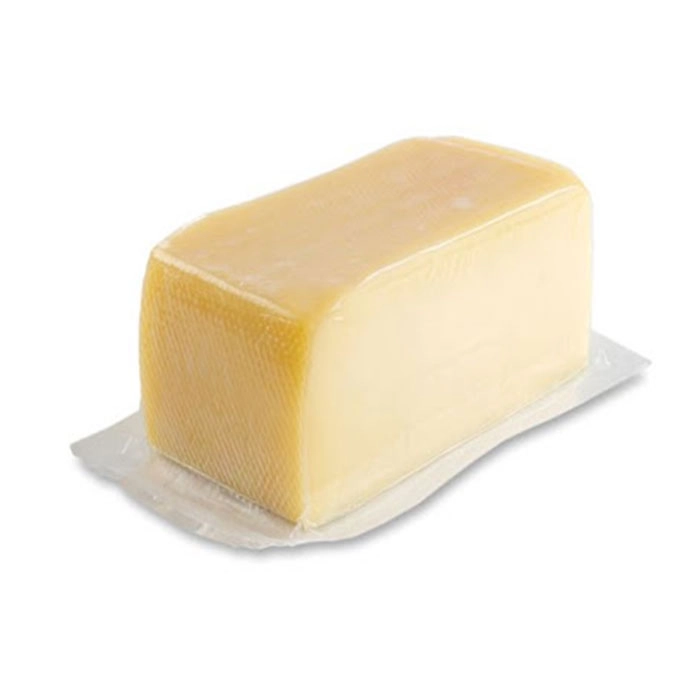
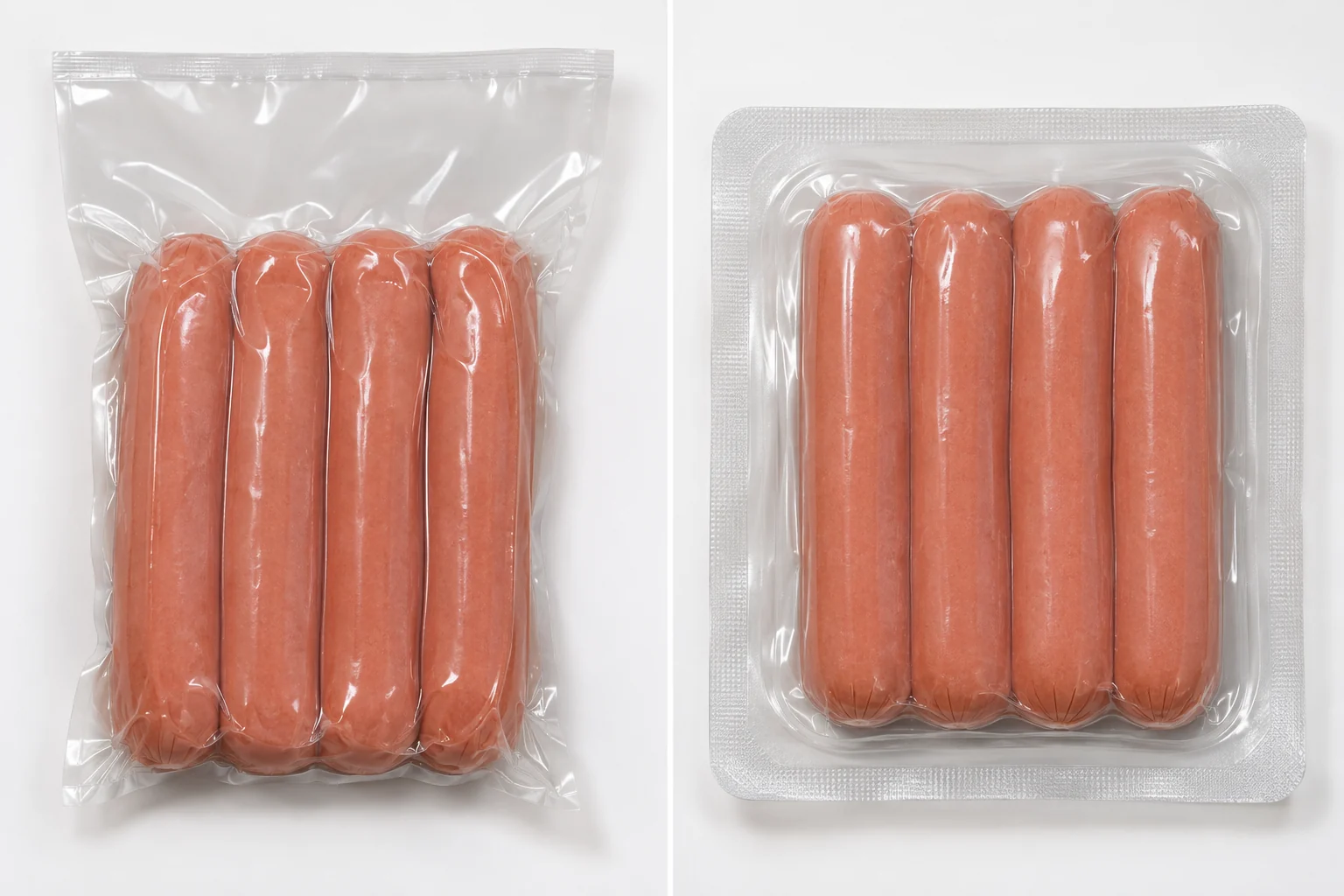
For sausages specified in vacuum pouches, a chamber sealer can close approved supplied bags without investing in a forming tool for each pack shape. Repeated formats can justify a thermoformer, which forms and closes the pack on one machine. Confirm whether the line also has to orient and load the links.
Indicative prices are US$3,000–15,000 for a compatible operator-loaded chamber vacuum sealer and US$30,000–120,000 for thermoforming equipment for an agreed format. Automatic link loading, special atmosphere equipment and additional tooling are specified separately.
Supplied vacuum bags or formed packs?
| Production requirement | Starting route | What can change the decision |
|---|---|---|
| Several pack counts or sausage sizes in smaller batches | Compatible supplied pouches and an operator-loaded chamber sealer. | Bag loading becomes too labour-intensive, or the required loaded pouch does not fit the usable chamber and seal arrangement. |
| A repeated retail arrangement through the shift | Thermoforming with suitable pockets, film and a defined loading method. | Frequent format changes require substantial tooling work, or loading cannot keep every required pocket supplied. |
Size a chamber around the loaded pouch
A chamber vacuum sealer needs room for the sausage arrangement and a flat pouch neck on the sealing bar. Confirm useful chamber space, not only the machine’s outside dimensions. Include the largest pack and enough empty bag length to position the closure cleanly.
Arrange the sausages so that a casing end or clip cannot puncture the bag. Keep the intended product presentation during loading and inspect the pack after the chamber returns to atmospheric pressure. Softer sausages can deform; the actual product and selected vacuum process must establish whether the required shape is retained.
Thermoforming connects the film layout with loading
A thermoforming vacuum packaging machine forms the lower pockets, presents them for product loading, then closes them with top film. Set the sausage count and orientation before specifying the cavity dimensions and tooling layout.
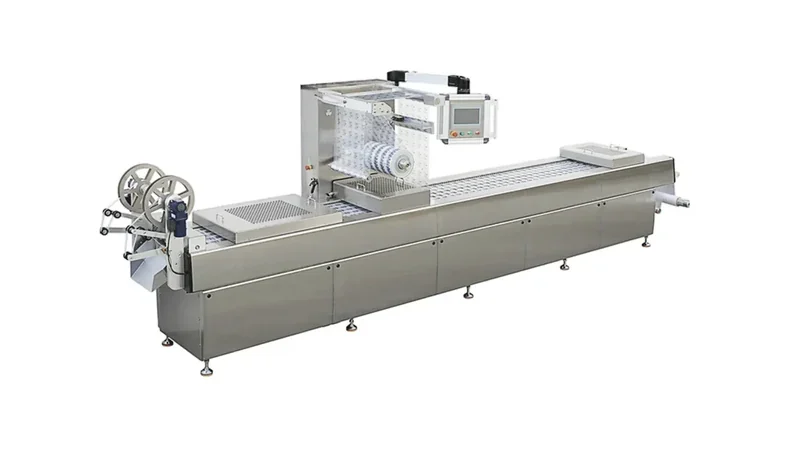
Check the clearance around curved bratwurst, long casing ends and normal size variation. Product lying across a seal band can prevent a sound closure. Show the intended pack opening and label position as well as the shape of the cavity.
Automatic film transport does not establish automatic sausage loading. A feeder may need to separate, orient and count the links before placing them into the pockets. Define how it handles a broken, short or misplaced sausage and what happens when a pocket is incomplete.
Keep moisture and fat out of the closure
Wet casings, surface fat or released liquid can contaminate a pouch neck or formed-pack flange. Observe the loading method using the wettest normal batch. Review how the product enters the pack and whether liquid reaches the closure before sealing.
Inspect the sealing surfaces and use the agreed package-integrity test after closing. A neat seam is not sufficient evidence of integrity. Product-contact parts and cleaning access should suit the actual food and the factory’s validated cleaning method.
Set the vacuum and sealing process with the chosen equipment, pouch or films and product. A setting published for another supplier’s machine is not a transferable recipe for your sausage pack.
Match the layout to how the sausages arrive
Short runs of several bratwurst packs
Arrange the required links → load the supplied bag → position a clean neck → vacuum and seal.
Compare bag-handling effort and the change between counts. Where manual loading meets demand, it can be a workable starting point without dedicated automatic arranging.
One repeated frankfurter retail pack
Supply the links consistently → arrange and load the pockets → vacuum seal → separate the packs.
Assess the loading task at every index. A faster forming cycle is useful only if the operator or feeder can supply the required pockets consistently.
Count finished packs over the complete work cycle
For a chamber machine, include bag loading, neck positioning, the chamber operation and unloading. Record how many acceptable packs leave each cycle. A large chamber may hold several bags, but their size and seal placement determine the usable arrangement.
For thermoforming, state saleable packs per film index and accepted packs per hour. Include empty pockets, loading stops, film changes and the actual format-change process. Ask who clears incomplete packs and how the line restarts after a supply interruption.
Sausage packing machine budgets with defined scope
| Equipment scope | Indicative USD reference | Items outside this reference |
|---|---|---|
| Compatible operator-loaded chamber vacuum sealer | US$3,000 to US$15,000 | Automatic bag loading, special atmosphere options and upstream sausage preparation. |
| Thermoforming packaging equipment for an agreed format | US$30,000 to US$120,000 | Automatic link arranging/loading, additional tooling, special atmosphere systems and further line equipment unless listed. |
These equipment planning references exclude stuffing, cooking, production consumables, freight, taxes and overseas installation. The final configuration depends on the loaded pack, material, utilities and accepted-output requirement.
For a supplier pricelist or factory offer, ask which loading method and tools are included. Compare quotations using the same sausage condition, pack count and operating tasks. Keep packaging equipment and any separate processing operations visible in the station list.
What a useful sausage-packaging trial includes
- The actual product at its intended packing condition, including normal variation in size, softness and surface liquid.
- The largest loaded pack and any sharp casing ends or clips, checked for damage after packing and handling.
- Clear seal areas and the agreed integrity assessment using the intended production material.
- A sustained accepted-output run, format change, cleaning access and restart with operator tasks recorded.
The product owner must validate the preservation process and storage conditions. Vacuum packaging alone does not establish microbiological safety or a storage-life claim.
A “sealant sausage” is a chemical product packed in a foil tube. Its filling and closing task is separate from the food-sausage packaging described here.
Send the sausage arrangement and finished pack
Provide product photos, raw or cooked state, length and diameter range, count per pack, package sample and required accepted packs per hour. Describe surface liquid, shape changes or punctures that your current packaging causes. Comwin can then recommend the bag or formed-pack route and a trial scope for the actual product.
Comwin offers free sample testing, a two-year machine warranty and a three-year warranty for core components. Remote support responds within 24 hours. Training, installation and spare-part responsibilities are agreed in the proposal.