Dry laundry detergent packaging
Washing Powder Packing Machine Price: Granules and Fine Powder
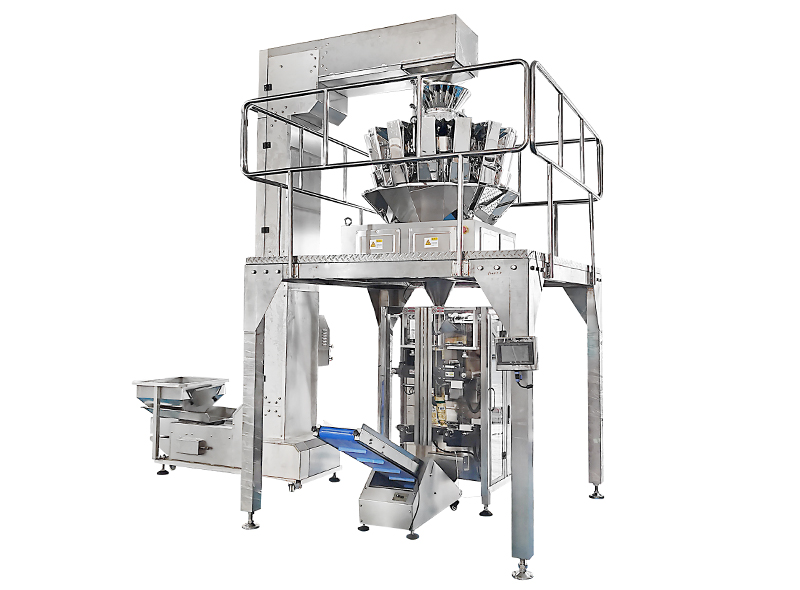
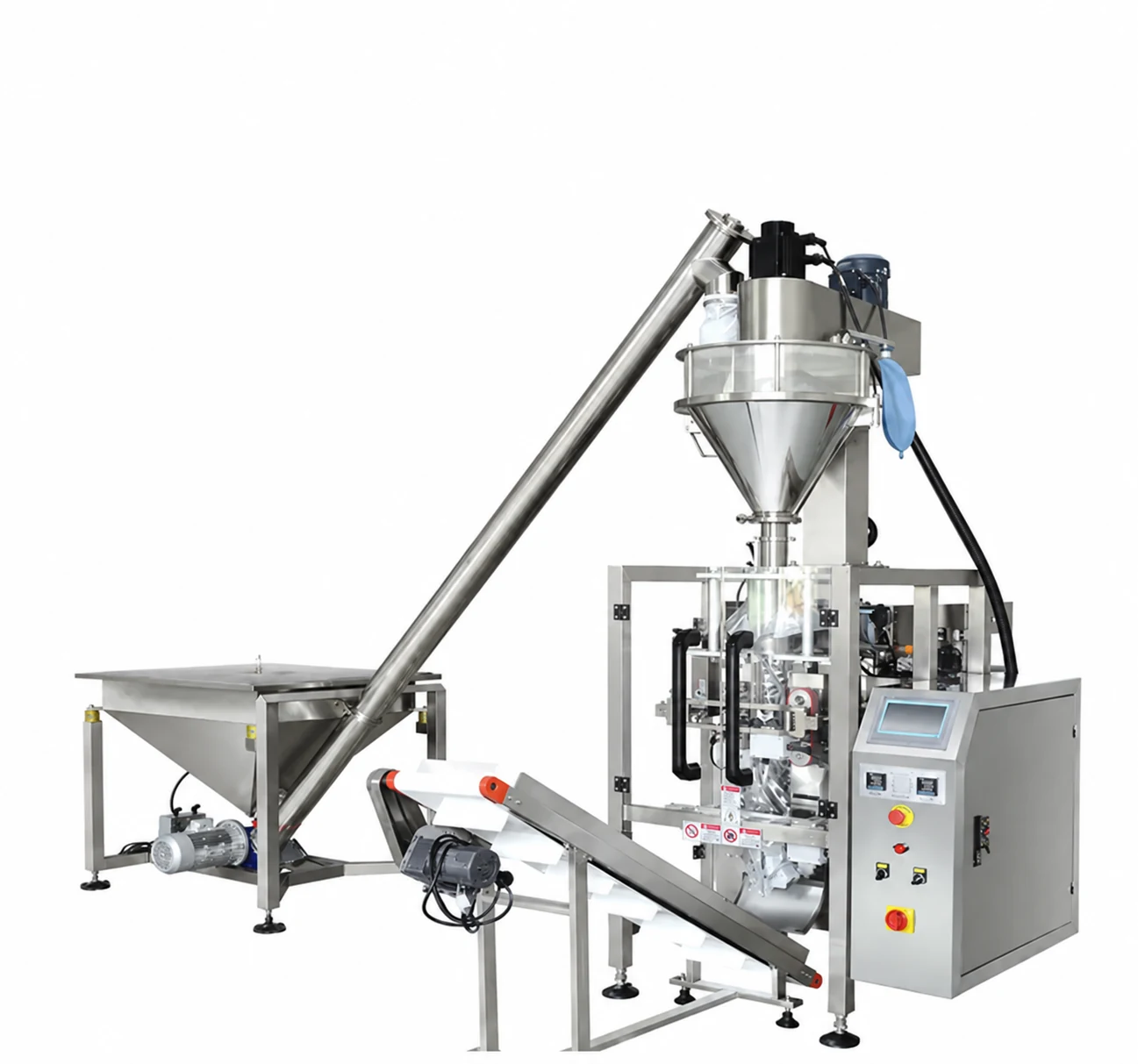
For granular detergent in a regular retail film bag, trial a weigher feeding a vertical bagger. Fine powder can need an auger to control the dose and cutoff. Both form bags continuously from rollstock, with the product kept clear of the seal. Purchased bags are useful when a zipper is specified or short batches do not justify continuous rollstock feeding.
Allow US$15,000–38,000 for the defined linear-weighing, elevator, VFFS and takeoff package for granular detergent, or US$15,000–40,000 for the auger, screw feed, VFFS and takeoff package for a suitable fine powder. Price the actual feed path and extra formats separately.
Start with the product and finished pack
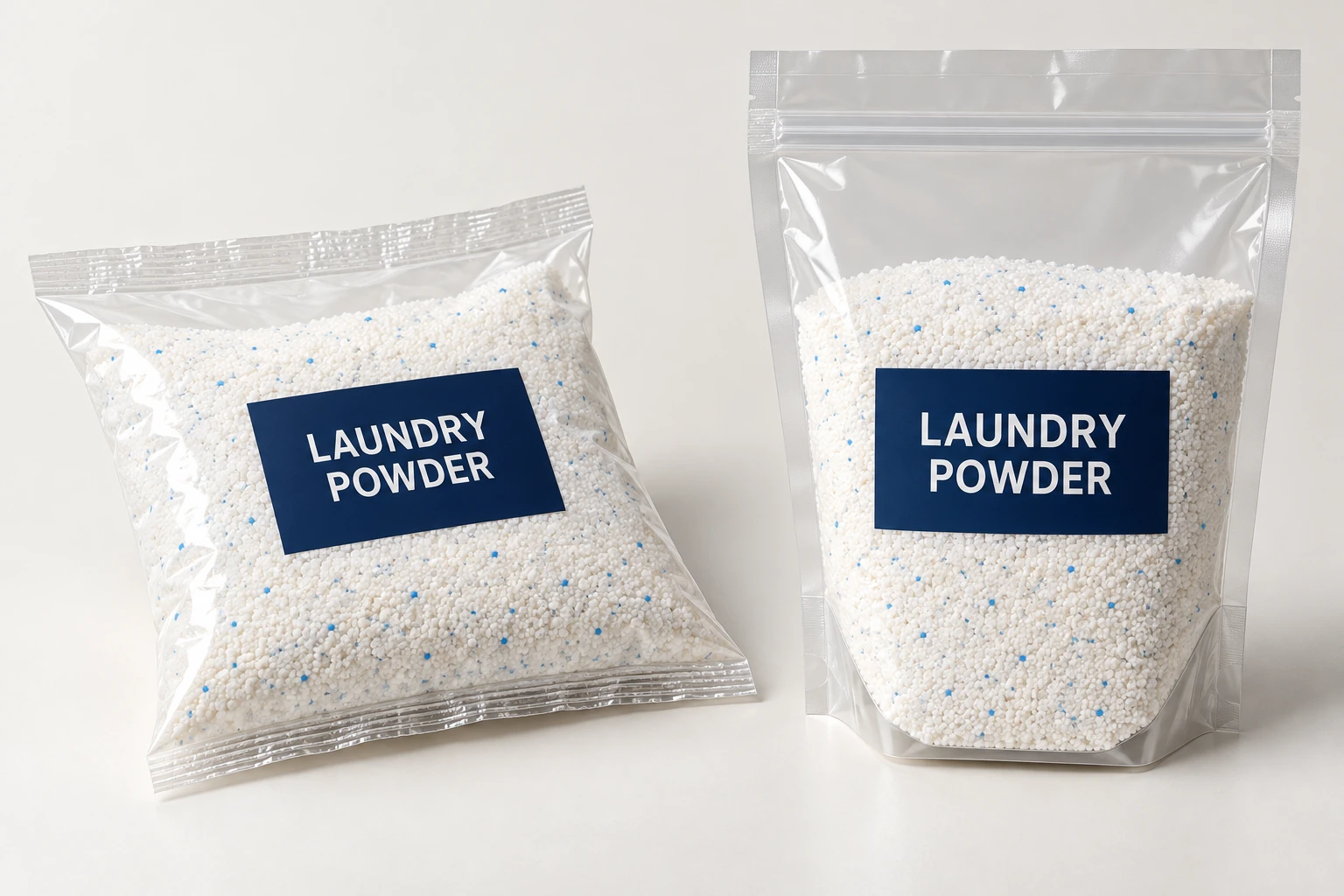
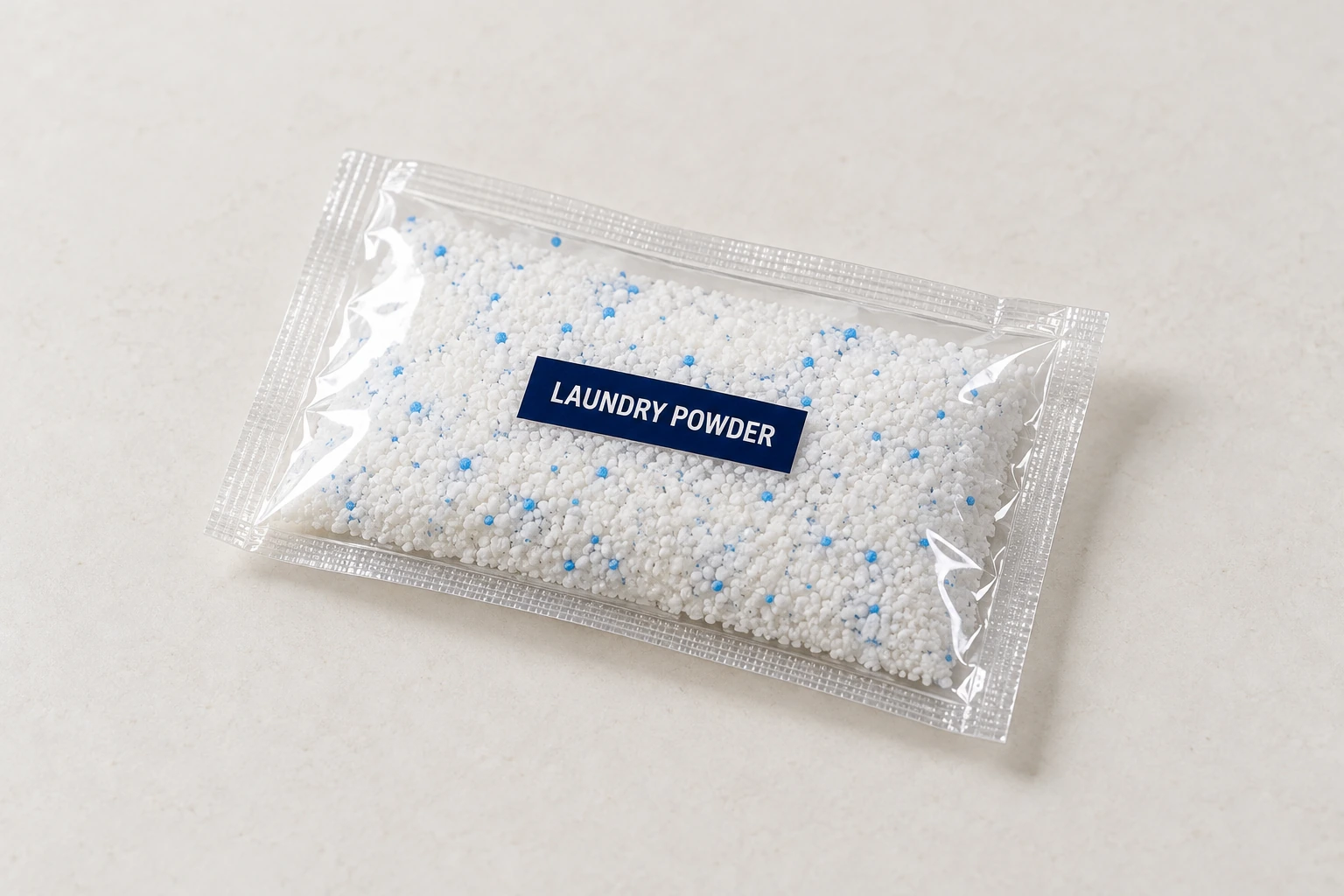
Granular detergent in repeated retail bags
Controlled feed → product-tested weighing → VFFS bag forming, filling and sealing.
Check flow, bulk volume and discharge timing. Consider the actual feed and weighing arrangement before choosing the bagger size.
Fine detergent powder in roll-film bags
Matched powder supply → auger dose → fill, settle and seal.
Test density changes, powder trailing and seal-area cleanliness. Identify any actual weight measurement and feedback.
Small batches in purchased bags
Weigh or dispense → support and fill bag → clear mouth → seal and check.
Compare manual weighing with assisted filling using the complete operator cycle. Include refilling, bag presentation and recipe change.
Resealable retail pouches
Open and support pouch → dose → settle product → top seal.
Check opening width, zipper access and clean headspace. Select the filler for the actual granules or powder.
Choose weighing, cups or an auger by product behaviour
Send representative detergent samples and the product information needed for equipment and contact-material assessment. Include particle-size distribution, loose bulk density, moisture condition, flow and any lumps or tendency to cling. Describe how the formulation changes between batches.
| Dosing method | Candidate application | What to verify |
|---|---|---|
| Linear or multihead weighing | Suitable free-flowing detergent granules | Stable feeding, weighing cycle, hopper discharge and actual mass results |
| Volumetric cups | Suitable consistently flowing particles, including some small sachet jobs | Mass variation when density, filling or settling changes |
| Auger dosing | Suitable fine powders requiring controlled screw delivery | Screw and outlet selection, powder trailing, density effects and weighing feedback if specified |
For cup dosing or a rotation-controlled auger, specify any weighing point and tare handling separately. State whether filled-weight checks trigger rejection, adjust later doses or both. A checkweigher’s control connection determines how its measurements are used.
Check bag volume as well as grams
Two formulations with the same target weight can occupy different volumes. Size the product path, forming set and bag with enough space for settling and a clean seal. Confirm any handle-hole or gusset option on the actual drawing and tooling.
At an assumed loose density of 0.50 kg/L, 1 kg occupies 2 L. At 0.75 kg/L it occupies about 1.33 L. These are calculation examples, not detergent specifications. The bag also needs usable headspace and seal margins.
Specify product-contact materials and cleaning conditions
List metals, plastics, elastomers and seals along the product path. Check them against the formulation, temperature, cleaners and contact conditions. A stainless-steel grade alone does not establish compatibility with every detergent.
Inspect the receiving hopper, feeder, weighing buckets or auger, outlet and gaskets. Confirm access for emptying, removal and inspection. Where wet cleaning is appropriate, include drying and reassembly before the next run. Define checks for residue and recipe carryover using the plant’s procedure.
Define the dust-control interface
Review product safety information and the site’s assessment when specifying powder transfer, extraction, filtration and equipment protection. Include hopper refilling and cleanout as well as filling. Agree the equipment connection, plant services, maintenance access and responsibility for the complete arrangement.
Specify the extraction connection and complete service requirements where applicable. Check the capture arrangement with the intended fill sequence so it does not disturb the portion or draw material across the seal.
Test the film and filled seal together
Specify film structure, sealant and moisture protection for the product and distribution conditions. Trial PE and laminate proposals on the machine to check tracking, seals and bag strength.
| Problem | Inspect | Trial evidence |
|---|---|---|
| Particles or fine powder cross the end seal | Discharge tail, fill timing, settling, bag length and nozzle position | Filled-pack seal integrity during running and restarts |
| Fill mass changes after replenishment | Bulk condition, feed level and actual dosing control | Weights before and after refill, then after a hold |
| Bag is too full to close cleanly | Loose density, portion volume and usable pouch or forming dimensions | Clear seal space after the entire portion settles |
| Resealable pouch has product in the zipper | Pouch opening, funnel insertion, support and transfer | Zipper and primary top-seal condition after filling |
| Filled bag fails in handling | Material, seal, fill distribution and intended handling conditions | Agreed filled-pack tests using the actual product |
Treat small detergent sachets as a separate packing job
Specify the dose, sachet drawing and clear sealing margins. Assess cups or weighing for free-flowing granules, and an auger for fine powder where needed. Ask the supplier to list the metering device, tools and control method.
For multilane production, check each lane’s mass results, sealing and rejects. State accepted sachets per minute across the complete machine and identify how a lane stop affects output. Confirm sachet cutting, collection and any next handling step in the offer.
Washing powder packing machine price
Use a defined formulation and format for early pricing. These USD ranges assume selected new equipment supplied from China. Retail-bag examples use one agreed 250 g–1 kg format. The single-lane sachet example covers one selected job within 20 to 80 g; the four-lane example specifies a 40 g free-flowing granulated formulation and cup metering. Fine powders or different flow behaviour need their matched dosing configuration.
| Equipment scope | Planning budget | Boundary to confirm |
|---|---|---|
| Manual weighing and bag-sealing station | US$1,000 to 4,000 | Operator weighs, fills and handles bags |
| Operator-assisted weighing/filling with basic compatible sealing | US$3,000 to 10,000 | Actual feeder, weighing control, support and remaining manual tasks |
| Selected VFFS platform configuration | US$5,000 to 30,000 | Included filler, accessories and film requirements |
| Linear weighing, elevator, platform, VFFS and takeoff package | US$15,000 to 38,000 | Product-tested granular detergent, one defined retail format |
| Auger, screw feed, VFFS and takeoff package | US$15,000 to 40,000 | Suitable fine powder, selected dosing tools and agreed contact path |
| Selected premade-pouch filling and sealing platform | US$10,000 to 45,000 | Actual dosing, pouch opening and closing components |
| Single-lane small-sachet filling and sealing | US$6,000 to 18,000 | One agreed job around 20 to 80 g, with matched dosing and film |
| Four-lane granulated-detergent sachet example | US$25,000 to 55,000 | One freely flowing formulation, one selected 40 g dose and film format; cup metering to four lanes, filling/sealing/cutting. Auger-fed powder, special dust controls and secondary packing separately assessed. |
The VFFS and premade-platform ranges cover selected equipment. Other figures are planning budgets, subject to an itemized quotation. They are not verified market averages. Corrosion resistance, cleaning, powder controls and output requirements can change the price.
Unless listed, exclude detergent manufacturing, specialized contact construction, containment, extraction, filtration, protection, inspection, extra formats, downstream packing, freight, taxes and overseas installation. Compare prices for India or Pakistan on the same delivery basis, with actual duties, utilities and local service addressed separately.
Compare the complete operator job and accepted output
Demonstrate hopper replenishment, film threading, roll changes, parameter selection, fault recovery and cleanout with the intended operators. Record training, access levels and any manual bag handling.
If 3,600 packs are made and 90 rejected across 90 elapsed minutes, accepted output is 39 packs per minute. At 1 kg per accepted pack, that represents 2,340 kg/hour during that defined run. Include the same stops and checks when comparing equipment. Match powder supply to accepted packs per minute × portion (kg) × 60, then account separately for rejects and overfill.
What to send for a detergent packing trial
Send formulation samples, material-assessment information, target weights and proposed film or pouches. Include batch size, recipe changes, utilities and output. Identify the formulation even where the enquiry uses a brand name.
Request a continuous video and run record covering feed, dose, fill, seal and discharge, including a refill and restart. Retain weights, rejected packs and filled-seal samples. Demonstrate product-path access and the intended cleanout. Confirm that the final component list matches the tested arrangement.
Plan your detergent pack with Comwin
Comwin can coordinate the feeder, dosing system, bagger and required checking interfaces around your product and pack. Free sample testing and factory visits are available. Send your formulation, pack and output target, or explore our bagged packaging equipment.