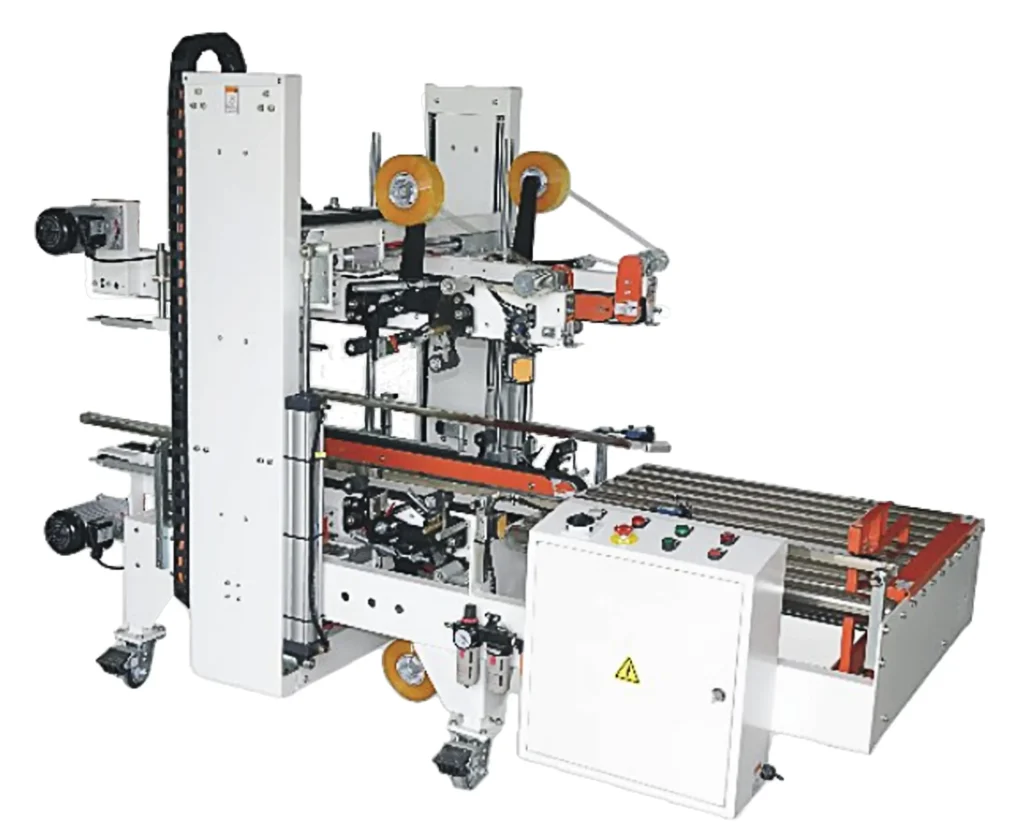
Automatic Carton Sealing Machines

Choose a case sealer by how filled boxes reach it. Check whether the top flaps are already folded and whether box sizes change by batch or from one case to the next.

Comwin reviews the packed box, the closure it needs and how it moves through the line. That gives us a starting point for a taping station or a sealer that also folds the top flaps.

    Comwin case sealer with conveyor, tape rolls and an adjustable frame
    Comwin catalog case sealer. The conveyor presents each box to the tape heads.

    How do filled cases arrive at the sealer?

    Match the incoming flap position and the order of box sizes. If your customer specifies a particular tape or edge pattern, check that closure as well.

    Top flaps at entryBox sizesStarting setupWhat to show us
    One size per batch, flaps already foldedOne size per batchUniform case taperHow the flaps stay down
    One size per batch, top flaps openOne size per batchFlap folder and taperFlap height and clearance above the contents
    Mixed sizes with folded flapsSizes alternateAutomatically adjusting case taperShortest gap between different cases
    Mixed sizes arriving with open flapsSizes alternateSize sensing with compatible flap foldingContinuous video of large and small cases alternating

    One size per batch, flaps already folded

    For a packing bench or conveyor that feeds one size at a time.

    1. Fold flaps at loading
    2. Guide the filled case
    3. Apply tape along seam
    4. Check tape and release

    Start with an adjustable uniform case taper. Set its guides and head position for the batch. With the flaps prepared at loading, the station can take over tape application and cutting while operators continue packing. Specify top-only or top and bottom tape based on what the case already has.

    Test the smallest, lightest and heaviest cases you will feed. Check that the belts grip the box without crushing it and that tape is centered. If staff are still stopping to fold flaps, consider an automatic flap-folding station.

    Three matching boxes filled with retail cartons, shown open, folded and taped
    From open case to folded flaps to taped seam. Taping starts with the flaps held closed. Packaging illustration.

    One size per batch, top flaps open

    For filled cases arriving open from a loader or conveyor during runs of the same size.

    1. Separate incoming cases
    2. Fold short and long flaps
    3. Hold the seam flat
    4. Tape and transfer

    Specify a flap-folding and sealing unit so the loading station can release an open case. This removes a repeated fold from the operator’s work. Keep contents and packing inserts below the flap sweep, and confirm the spacing the folder needs.

    Test the loaded case that leaves the least clearance under the top flaps. If alternating sizes reach the folder in the same run, ask the supplier to prove mixed-size folding separately.

    Incoming

    Four top flaps are open. Contents sit below the fold path.

    Folding

    Short flaps close first. Long flaps meet along the center.

    Sealing

    The head tapes the seam once both long flaps are level.

    Open-flap infeed and folded seam. Process illustration.

    Mixed sizes with folded flaps

    For packing lines or fulfillment runs that feed changing box sizes at the same station.

    1. Space the cases
    2. Read or receive size
    3. Adjust guide and head
    4. Seal and verify

    Assess a random case sealer with size adjustment. It avoids manual resetting between compatible cases. Give the supplier the actual size order and the shortest gap so the trial reflects how often the head and guides need to move.

    Compare the smallest-to-largest and largest-to-smallest transitions with your actual loaded boxes. If formats can be batched without disrupting packing, a uniform taper with planned adjustments may suit the job.

    Two groups of taped corrugated cases, one uniform and one with different heights and widths
    Uniform batches and alternating sizes can leave the same taped seam. The difference is what the station must handle at infeed. Packaging illustration.

    Mixed sizes arriving with open flaps

    For different loaded case sizes arriving back to back with open flaps.

    1. Identify the case
    2. Set guides and folding height
    3. Fold clear of the product
    4. Tape and release

    Try the largest case followed by the smallest, then reverse the order. Allow time for the guides and folding mechanism to adjust between cases.

    If the shortest gap is too small, evaluate metered entry or group compatible sizes upstream.

    Open cases of different heightsRecord the shortest gap at production speed
    Film a full transition with all four top flaps visible. Include the product height inside the case.

    Review a prescribed material or tape pattern

    For a case specification that names water-activated tape, hot melt, or a seam and edge pattern beyond a center strip.

    1. Provide approved closure
    2. Check board and flaps
    3. Specify the applying station
    4. Trial bond and appearance

    Start with the approved case and closure sample. Water-activated tape needs controlled activation, while a hot-melt closure bonds the specified flap surfaces. Confirm equipment scope and consumable compatibility before selecting an applicator or tape head.

    Send the actual board, any coating and a drawing or approved pack. Use the agreed handling conditions to evaluate bond, coverage and how long the case has to remain supported.

    Center-seam tape

    Tape bridges the long flap seam. Specify required end tabs or additional edges.

    Water-activated tape

    Match the approved tape and activation hardware to the board.

    Hot-melt bond

    Provide the flap contact area and approved adhesive details.

    Three closure specifications to resolve before selecting hardware.

    Check the taped case after sealing and handling

    A crooked strip can start at the infeed. A lifted tape end may show up only after the case leaves the conveyor. Bring loaded cases so the trial can separate feed issues from adhesion.

    Three taped case samples showing centered tape, an offset strip and a lifted tape end
    Look at the center seam and both tape ends. Centered tape, offset tape and a lifted tab are shown here. Packaging illustration.
    Box drifts at the tape head
    Check the first contact with the drive belts, then confirm the guides present the seam in line with the head. Use the lightest narrow case to test stable entry.
    Tape ends lift or miss the seam
    Trial the actual tape and board lots. Record where the tape lifts, check it after handling, and inspect the bottom seam when both faces are specified.
    First case after restart is out of position
    Include a normal stop, a tape replacement and a format change in the sample run. Record the first good case and how damaged or unfinished cases are held.

    Decide which closing steps stay with the operator

    For an existing conveyor, share its height, speed and direction. Check stable transfer before asking the closing station to match the upstream rate.

    Production setupOperator workChangeover and handoffWhat to prove
    One size per batch at a packing benchPack, fold and feed each box.Reset guide width and head height between batches. Record adjustment time.Run each batch size, including light boxes and the first case after changeover.
    Automatic folder on an existing conveyorReplenish tape and follow the agreed stop procedure.Set case spacing and fold guides for each format. Check infeed height and ready signals.Feed open flaps at the operating rate and examine closure before and after sealing.
    Mixed sizes at the closing stationMonitor infeed and respond to jams and tape alarms.Agree size limits and available gaps. Verify whether the station uses sensors or upstream data.Alternate cases in the real order and record good output, missed seals and recovery.

    If your line starts with flat blanks, compare the case erector for opening and bottom closure. For loading before tape or labeling at the outfeed, see the case erecting, sealing and labeling line.

    Compare case sealer proposals on the same loaded boxes

    Specify which closures and which conveyor connections the project includes. Use the same filled case samples and acceptable seam criteria for every trial.

    CompareWhat to agree with ComwinWhat to check across offers
    Supply scopeIdentify the drive, head, top-flap folding and conveyor scope. Mark top and bottom as separate requirements.Which closures and interfaces are included?
    OutputUse target good cases per minute and the actual incoming box sequence.Can the vendor show accepted output on the same mix?
    Format adjustmentShare the size range, gross weight and board construction. State how often sizes change.Which guides or head positions require adjustment, and who adjusts them?
    SupportConfirm change and cleaning access, wear parts and tape head service.Which spare items and operating instructions come with the proposed unit?
    DeliveryAgree a sample trial and define the transfer height, flow direction and controls.What must pass during the trial and at line handover?

    Case sealer questions

    Can one sealer tape the top and bottom?

    A compatible top-and-bottom taper has heads at both seams. Check case support and bottom access with the filled case. If the bottom is already closed upstream, specify whether it needs any further tape.

    Do automatic flap folding and random size adjustment come together?

    They are separate functions. Specify whether flaps arrive open and whether sizes alternate without a batch change. Test both functions together if your line needs both.

    Can you review a sealer we already use?

    Send a photo of the nameplate, installed tape heads and both transfers, plus one loaded case and a short clip of the issue. The exact configuration and available mounting space guide the review.

    Send a loaded case and show how it arrives

    Start with a photo of the full case, its dimensions and weight, and your target good cases per minute. If you have a line running, include a short infeed video.

    One size per batch, flaps already folded

    Send first
    A typical filled case and your smallest and largest formats. Tell us which faces need tape and how batches change.
    What Comwin checks
    Drive grip, guide settings, tape head position and whether top-and-bottom tape is needed.
    Inquiry subject to copy
    One size per batch, flaps already folded

    One size per batch, top flaps open

    Send first
    A loaded case with all flaps open, the stack height inside it and a clip with the incoming gap visible.
    What Comwin checks
    Folding clearance, case spacing and coordination with the loading station.
    Inquiry subject to copy
    One size per batch, top flaps open

    Mixed sizes with folded flaps

    Send first
    The actual sequence of sizes, the gross weight for each and the shortest gap at your target rate.
    What Comwin checks
    Size adjustment, stable transfer and the transitions to include in a trial.
    Inquiry subject to copy
    Mixed sizes with folded flaps

    Mixed sizes arriving with open flaps

    Send first
    Send a continuous video with large and small cases alternating, loaded dimensions and weights, shortest gap, target cases per minute and any product above the rim.
    What Comwin checks
    Time for guide adjustment and flap folding, clearance above the product and whether entry needs metering.
    Inquiry subject to copy
    Mixed sizes arriving with open flaps

    A prescribed tape, bond or edge pattern

    Send first
    The closure spec, the actual box material and a sample or drawing of the finished seal.
    What Comwin checks
    Applicator fit, board compatibility and the bond and coverage checks required by the spec.
    Inquiry subject to copy
    A prescribed tape, bond or edge pattern