Automatic Corrugated Case Erectors

An automatic case erector delivers a square, empty corrugated case with the bottom closed and the top open for loading.

A Comwin case erector can feed a hand-packing station or transfer empty cases into an existing line. Start with your blank and the position the case must reach at loading.

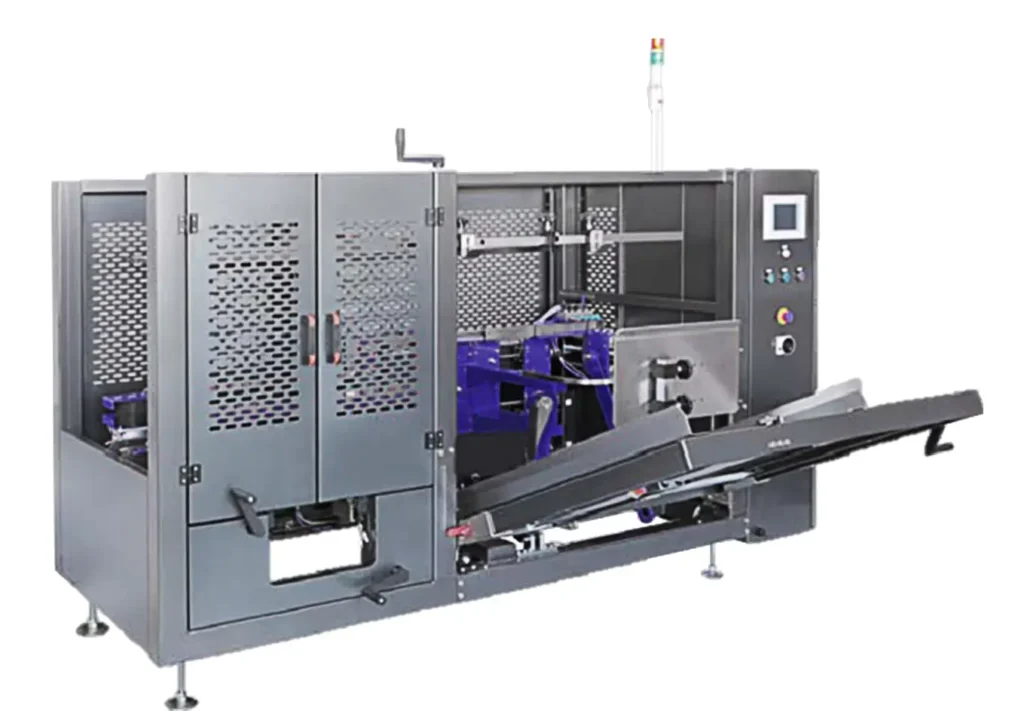
    Comwin automatic case erector with an inclined corrugated blank magazine and enclosed forming station
    Comwin automatic case erector. The inclined magazine presents flat blanks to the guarded forming station.

    Choose the bottom closure, then the loading point

    A regular slotted case (RSC) arrives flat with its side seam joined. First match your blank and bottom closure. Then decide where the open case needs to go.

    Open empty corrugated case at dischargeClosed baseOpen top
    The erector delivers this empty case to the loading point. The top is closed after loading.
    DecisionYour applicationEquipment scopeWhat to check
    1. Form the casePrejoined RSC blanks run in batchesAutomatic forming and tape-bottom sealingScore lines, flap overlap and tape contact
    1. Form the caseAdhesive bottom or a different blank constructionDrawing and sample review before specifying forming and closurePanel feed, fold geometry and bond
    2. Deliver the open caseStaffed benchPresent cases within reachPickup height and room for waiting cases
    2. Deliver the open caseExisting automatic loaderTransfer each case in the required orientationReady signal, spacing and inlet height

    Erect repeated RSC blanks and tape the bottom

    For regular slotted cases supplied flat with the side joint already made, scheduled in batches by size.

    1. Load the blank magazine
    2. Pick one blank and open it
    3. Square and fold the bottom flaps
    4. Tape the bottom and discharge the case

    Set the guides and tape head to the actual case and tape width. Confirm the bottom stays closed across the transfer and the case leaves with its top open for loading.

    Test the smallest and largest case sizes and blanks from more than one regular board lot. A bowed blank or a stiff score can prevent a clean pick or keep the case from staying square. When formats change, agree a first-case check before resuming output.


    Flat corrugated case at left, erected empty case in the center and sealed case at right
    Formation ends at the empty case shown in the center. The closed case at right comes after loading and top sealing. Case-state illustration.

    Review adhesive bottoms and nonstandard blanks before choosing tooling

    For a specified adhesive closure, unusual flap overlap, or a case formed from several panels.

    1. Identify the blank and panel count
    2. Mark the folds and bond locations
    3. Check forming tools and closure
    4. Trial the case under its intended load

    Send the case drawing before choosing an erector. A three-piece Bliss case uses separate end panels and a body blank. Its feed and bond requirements differ from opening a prejoined RSC sleeve. Have Comwin review forming and closure separately for this job.

    Include the actual board and finished case specification. Agree which adhesive or tape is approved and how the closure will be checked at handoff and after packing.

    Two corrugated case bottoms, one with a visible strip of tape and one with no external strip
    A taped bottom has a visible strip across the seam. An adhesive closure can leave the exterior seam clear. Closure illustration.

    Feed a hand-packing bench or an automatic loader

    For a new erector feeding packers at a bench or supplying a case position on an existing conveyor.

    1. Check where the case is filled
    2. Set the presentation height and direction
    3. Match release to available space
    4. Check stop and restart at the handoff

    At a hand-loading bench, keep the open case in a consistent pickup position and let the operator set its pace. At an automatic loader, agree the orientation, buffer capacity and blocked or ready signals before selecting conveyor sections.

    During a short downstream stop, prove that released cases have somewhere to wait and the upstream erector stops when that space fills. If an empty case must receive a liner, specify the liner station and its ready signal separately.

    For stations beyond erection, see the case erecting, sealing and labeling line.

    Mark the discharge height and show where the operator or loader receives the empty case.Erector dischargeStaffed benchAutomatic loaderMeasure at the transfer point
    Mark the discharge height and show where the operator or loader receives the empty case.
    Comwin catalog case-handling line with an erector platform and conveyor sections
    Example of connected case-handling equipment. Mark where your loader takes an empty case before specifying the conveyor handoff.

    Check the empty case where the loader receives it

    Agree what counts as a usable case at outfeed and count only the cases that pass those checks during the run.

    Blank pickup
    Run regular board lots and look for double picks, torn corners or a blank that fails to open. Check the factory joint position as it is presented in the magazine.
    Case squareness
    Compare the two diagonals at the open top from corresponding reference points. Agree the allowed difference with the loader requirements before the trial.
    Bottom closure
    Check flap alignment and exterior tape contact across the bottom seam and ends. Where adhesive is specified, agree the bond check and the time before loading.
    Restart and first case
    Stop the downstream station, observe the erector response, then inspect the first cases after restart and after a size change. Agree how to remove a partially formed case.

    Plan operator work and format changes

    Use the order of real jobs to choose the setup. A machine that handles two dimensions in separate runs may still require adjustments between them.

    Production setupOperator workSetup and controlsWhat to show in the run
    Hand loading at a staffed stationSupply blanks and tape, take each formed case, and load it at the bench.Set safe access, pickup height and the release method.The operator can receive and load the planned output without accumulating empty cases.
    Automatic forming in size batchesReplenish the magazine and tape, then confirm the first case at changeover.Record guide and tape-head settings for each size and the board construction.Time the actual size change and count acceptable cases after restart.
    Conveyor outfeed to an existing loaderReplenish blanks and clear forming faults using the agreed procedure.Confirm travel direction, case orientation, speed, and blocked and ready signals.Demonstrate a planned stop, case accumulation and controlled recovery.

    Compare machines at the same empty-case outfeed

    Use the same case drawings, actual blanks and handoff drawing in each enquiry. Include any closure equipment or connection work expected in the supply.

    CompareWhat to agree with ComwinWhat to match in other offers
    Supply scopeDefine magazine, opening and bottom closure, take-away method and conveyor or guarding interfaces.Check which stations and connections are included.
    Case rangeList the smallest and largest blanks by construction and erected length, width and height.Confirm limits for each case style and which adjustments or tooling are needed.
    ProductionUse accepted empty cases by size and regular operating sequence.Compare good output from the same blank lot and include changeover, replenishment and restart.
    SupportAgree tape and wear items, operator training and support for handoff controls.Ask for consumables specifications, recommended spares and fault recovery coverage.
    DeliveryAgree site dimensions, utilities and the acceptance run.Apply the same pass conditions to closure, squareness and loader presentation.

    Case erector questions

    What happens after the erector closes the bottom?

    The erected empty case leaves with its top open for loading. A downstream case sealer closes the filled case after loading.

    How do I describe my case size?

    Send the erected outside length, width and height with the blank drawing. Mark the factory joint and the edge that enters the magazine first if you already use this blank in production.

    Can one erector handle several box sizes?

    Share the full size list and how the jobs change. Batch changes may be possible with guide and tape-head adjustment. Consecutive mixed sizes need a separate review of blank supply, forming and downstream spacing.

    Do you need samples if I have a drawing?

    A drawing is enough to start the layout. Physical blanks show how the scores fold, how flat the board remains and whether the bottom closes as intended. Use production stock to confirm the final setup.

    Describe your case and where it will be loaded

    Include a blank photo or drawing, erected outside dimensions for your size range, bottom closure and target cases per minute. Add your closure details and one handoff: a staffed bench or an automatic loader.

    Repeated RSC sizes with taped bottoms

    Send first
    Include a blank photo or drawing, erected outside dimensions for your size range, bottom closure and target cases per minute. For taped cases, add tape width and batch sequence. Tell us whether cases go to a bench or a loader.
    What Comwin checks
    Blank pickup, opening and squaring, flap sequence, tape position and adjustments between sizes.
    Inquiry subject to copy
    Repeated RSC sizes with taped bottoms

    Feed a staffed packing bench

    Send first
    Include a blank photo or drawing, erected outside dimensions for your size range, bottom closure and target cases per minute. For a bench, add a sketch with pickup height, available space and the rate the operator can load.
    What Comwin checks
    Empty-case height and direction, pickup access and how to time delivery to the operator.
    Inquiry subject to copy
    Feed a staffed packing bench

    Connect to an existing case packer or conveyor

    Send first
    Include a blank photo or drawing, erected outside dimensions for your size range, bottom closure and target cases per minute. For an automatic loader, add inlet height, case orientation, travel direction and required gap. Include a line video or ready/blocked signals if available.
    What Comwin checks
    Case spacing, accumulation, ready and blocked coordination, and the division of controls and conveyor work.
    Inquiry subject to copy
    Connect to an existing case packer or conveyor

    Adhesive closure or another case construction

    Send first
    Include a blank photo or drawing, erected outside dimensions for your size range, bottom closure and target cases per minute. For adhesive or special blanks, mark the bond areas, panel overlap and intended load. Identify the loading point.
    What Comwin checks
    How to feed and form the blank and what to prove in a closure and handling trial.
    Inquiry subject to copy
    Adhesive closure or another case construction