
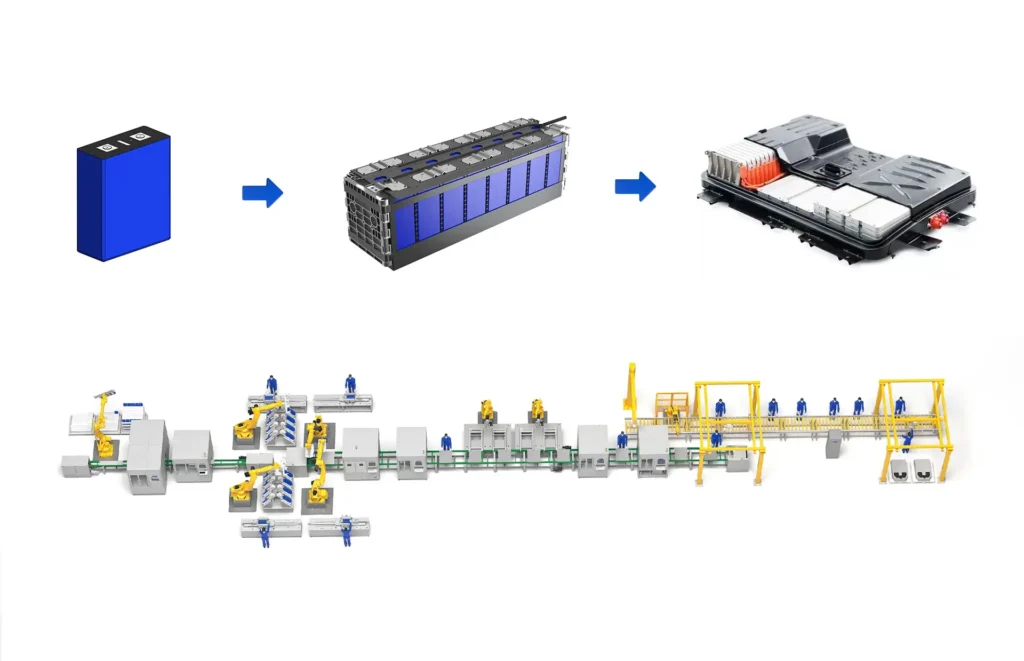
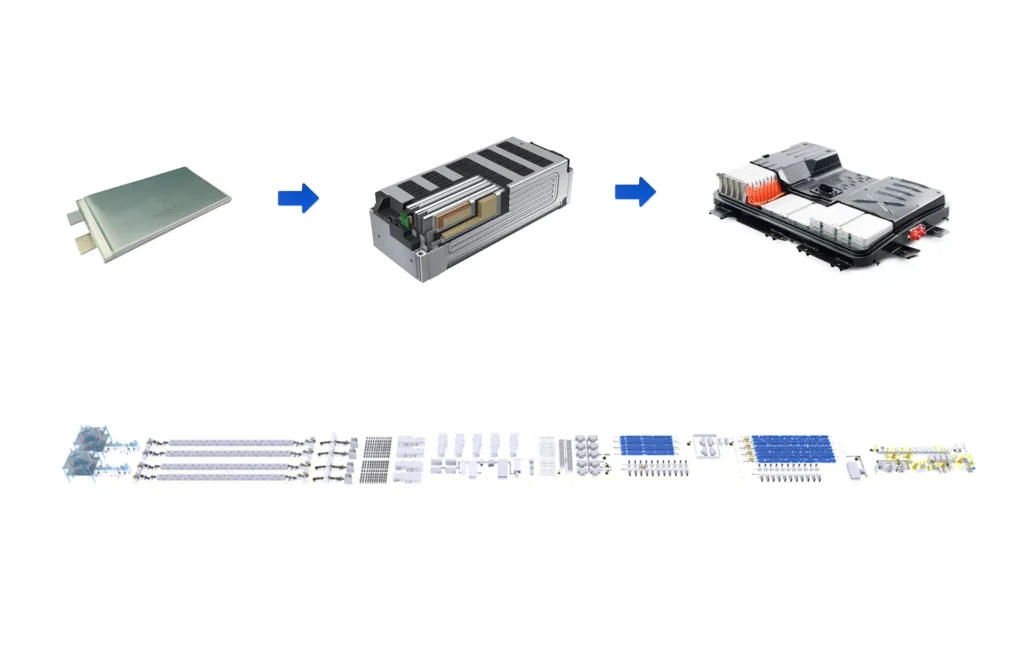
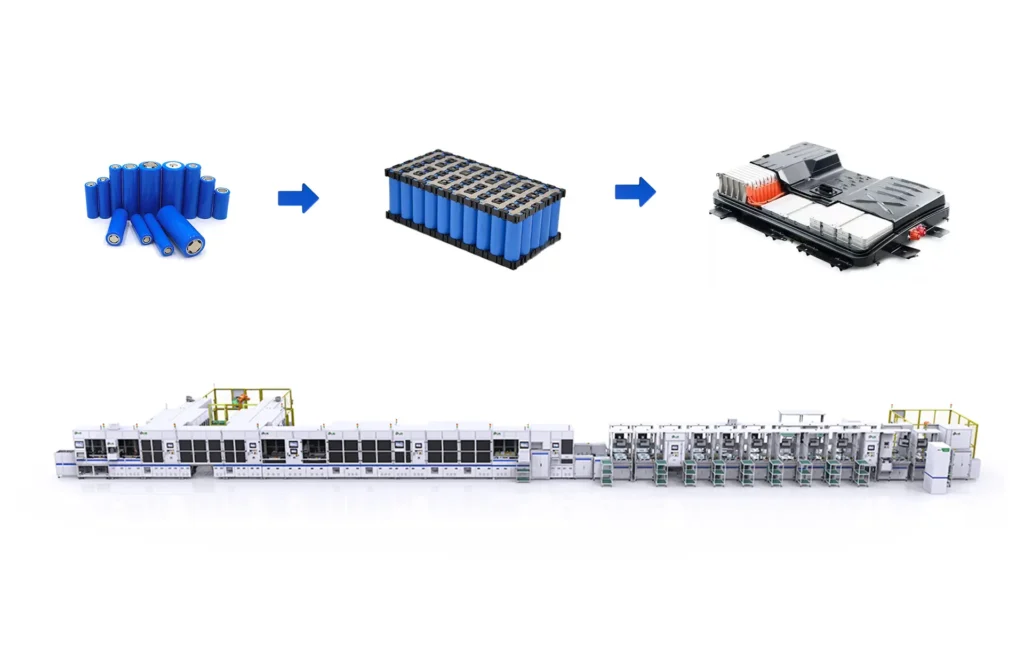
Market Status: Square batteries dominate the market (accounting for approximately 77% of the domestic market share). Cylindrical batteries have seen an increase in market share due to their early adoption in popular models, while pouch batteries are primarily used in high-end vehicles. In terms of application scenarios, square battery packs are suitable for mainstream models that prioritize cost-effectiveness, cylindrical battery packs are ideal for high-performance and long-range needs, and pouch batteries require expansion into specific high-end markets or technological breakthroughs to broaden their application.
Core Processes: Mainly winding or stacking processes, involving electrode preparation, cell encapsulation (aluminum/steel shell), top cover welding, etc. Equipment includes hot press forming machines, cell insertion machines, ultrasonic welding machines, etc.
Advantages: Strong compatibility, adaptable to different sizes and customization needs; simple structure, high energy density (e.g., blade battery).
Core Processes: Fully automatic winding as the core, with supporting tab welding, liquid injection, sealing, and other equipment. A typical example is the 4680 cylindrical battery production line.
Advantages: Mature process (e.g., 18650/21700 series), high automation, excellent yield and consistency; large heat dissipation area, fast single-cell production cycle (e.g., high-speed production lines can reach 300PPM).
Challenges: Complex module design, low space utilization; large cylindrical batteries (e.g., 4680) need to overcome technical bottlenecks such as welding and shell strength.
Core Processes: Based on stacking technology, key equipment includes tab welding machines, aluminum film punching and shell insertion machines, top and side sealing machines, etc., relying on high-precision linear or rotary production line layouts.
Advantages: Highest energy density (5-10% higher than square cells at the cell level), good safety (easy pressure relief in case of thermal runaway); adaptable to future solid-state battery technology routes.
Challenges: Low domestic production of aluminum film, reliance on imports, stacking efficiency lower than winding (many semi-manual processes); weak shell strength, requiring additional module materials, lagging CTP technology application.
| Battery Type | Recommended Scenarios | Cost and Efficiency |
|---|---|---|
| Square Battery | Customization needs for car manufacturers, high energy density models | Medium-high cost, medium production efficiency |
| Cylindrical Battery | Standardized mass production, pursuit of cost and automation | Low cost, highest production efficiency |
| Pouch Battery | High-end passenger vehicles, forward-looking technology layout | High cost, low production efficiency |
Automation Machine One-stop Solution
Huide International Building, Fuyong Street, Bao’an District, Shenzhen
© 2026 All Rights Reserved.
