
Choose the oil package before choosing the machine
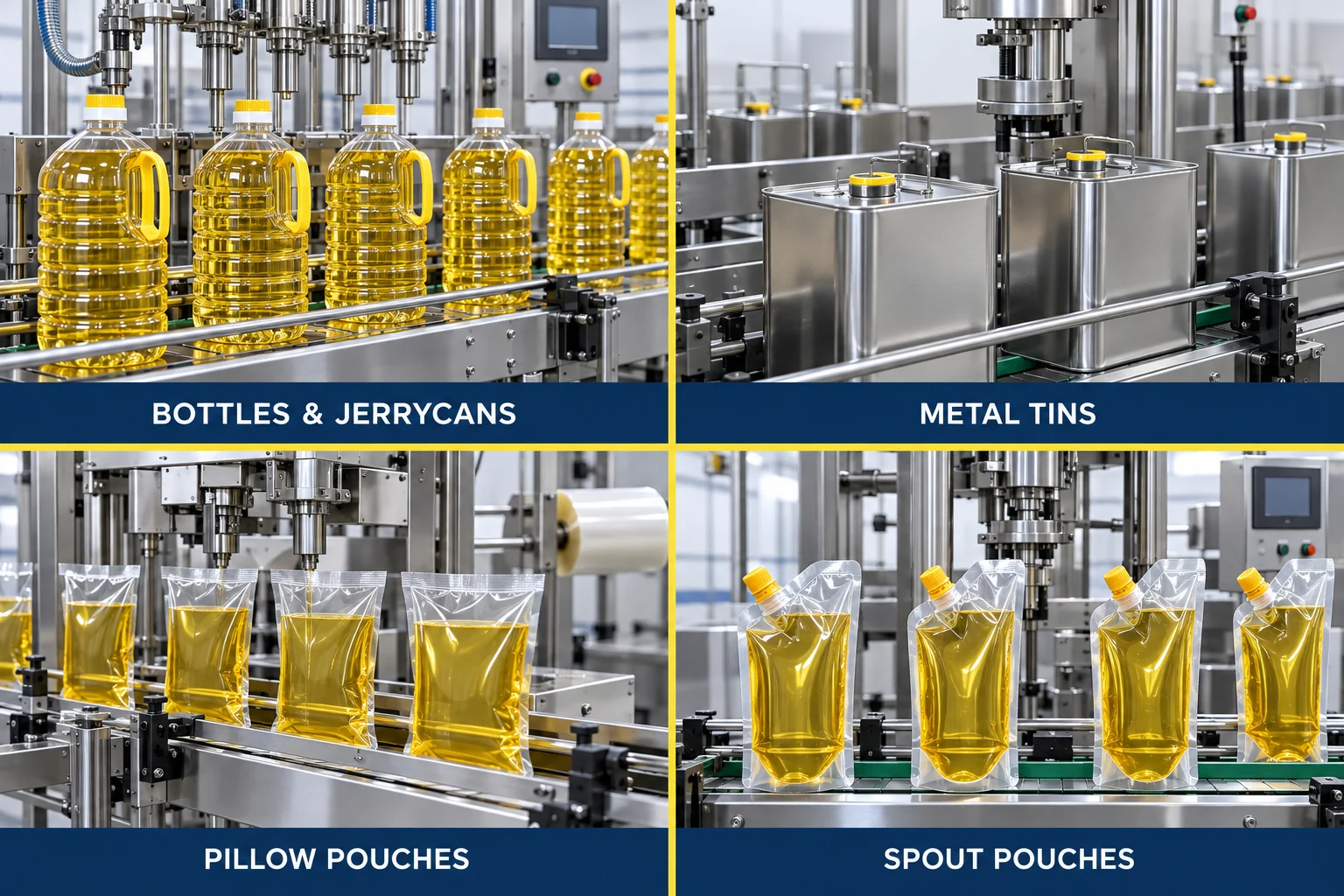
“Oil packing” can describe several different factory tasks. The correct line depends more on the container and closure than on whether the product is sunflower, soybean, canola, blended vegetable or salad oil. Oil temperature and viscosity still affect flow, drip control and cleaning, but a bottle capper cannot replace a pouch heat sealer and a pouch machine cannot close a metal tin.
| Finished package | Primary equipment | Closing method | Best-fit buying case |
|---|---|---|---|
| PET or HDPE bottle | Volumetric, flowmeter, pump or net-weight filler selected after trials | Screw cap; optional induction foil and tamper band | Mainstream retail sizes and frequent SKU changes |
| Handled jerrycan | Large-volume bottle filler with stable container control | Torque-controlled cap or specified plug-and-cap system | Foodservice and bulk household packs |
| Glass bottle | Gentle bottle handling plus controlled liquid filling | ROPP, screw cap, cork or other confirmed closure | Premium oils where package presentation matters |
| Metal tin | Rigid-container filler with tin-compatible conveyor guides | Crimped or pressed closure matched to the tin supplier | Barrier-sensitive or export retail formats |
| Rollstock pillow pouch | Liquid VFFS forming, dosing and heat sealing | Longitudinal and cross heat seals | Economical flexible packs when film and seal tests pass |
| Premade spout pouch | Pouch indexing, filling through the spout and cap application | Spout cap with verified torque and leak performance | Convenient pouring and premium flexible presentation |
If your main format is a rigid container, start with our bottle filling and sealing machine. If you need pouch formats, the bagged packaging machine solution helps separate rollstock and premade-bag routes.
How a cooking oil bottle line should flow
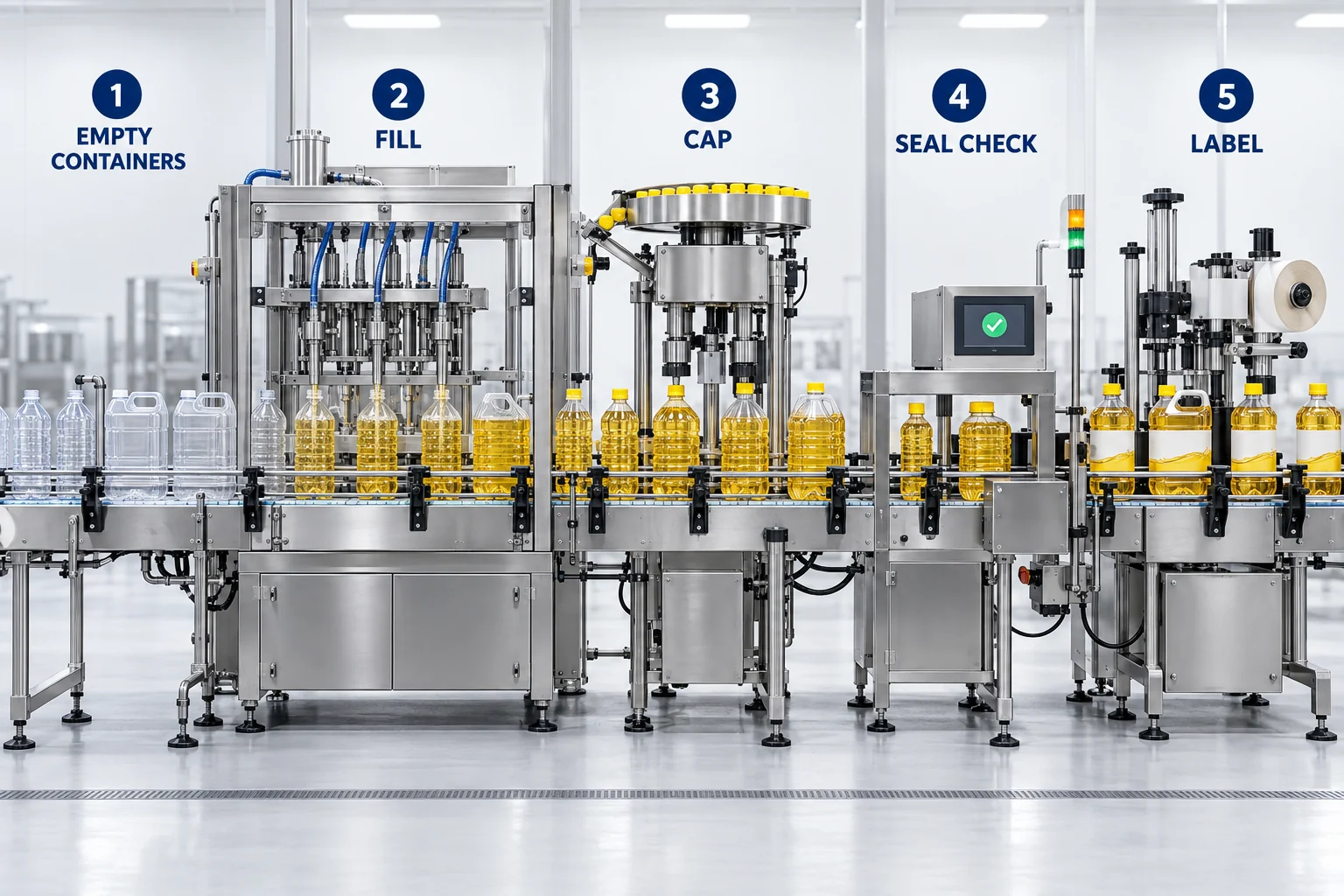
A practical line starts with stable empty-container feeding. The filler then meters oil without dragging product across the bottle neck or conveyor. Cap feeding and tightening follow filling; an induction seal, tamper band or other secondary seal is added only when the bottle and closure specification calls for it. Labeling comes after the outside of the container is clean and the closure is secure.
Select the filling principle separately from the machine motion
Stop-and-fill, tracking and rotary layouts describe how containers move. Volumetric, flowmeter, piston, servo-pump and net-weight systems describe how the dose is measured. Treat these as separate decisions. A net-weight approach is useful when the purchased quantity and legal-metrology controls are weight-based; a flowmeter or servo-pump system may suit other projects. Product trials should confirm foam, aeration, stringing, nozzle shutoff and residual drips.
For a coordinated filler, capper, labeler, inspection station and downstream packing system, review the complete filling-product packaging line rather than pricing every machine in isolation.
What does the oil sealing machine need to control?
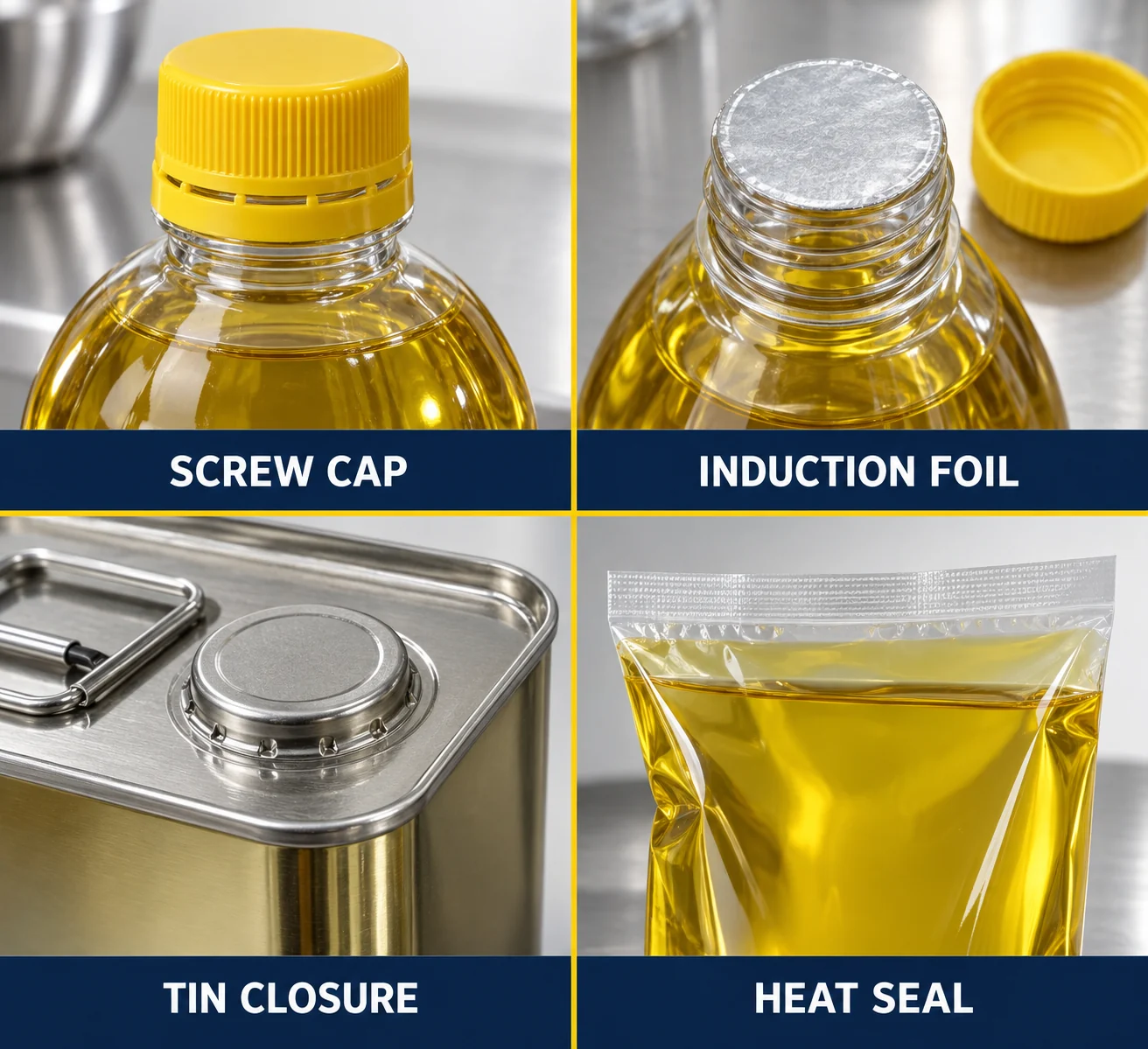
The closure must prevent leakage during distribution and give the buyer the intended opening experience. A screw cap depends on cap geometry, thread match and torque. An induction foil depends on bottle-neck material, liner construction, coil setup and time under the field. A tin closure depends on the matched lid and closing tool. A heat-sealed pouch depends on film structure, seal temperature, dwell, pressure and a clean seal area.
| Method | What the machine controls | What to test | Frequent quotation omission |
|---|---|---|---|
| Screw capping | Cap pickup, alignment, applied torque and container restraint | Torque window, cap presence, leakage and tamper-band condition | Change parts for every neck and cap family |
| Induction foil sealing | Coil position, power and exposure time | Peel result, bond around the full land area and leak resistance | Compatible liner and bottle-neck material |
| Metal tin closing | Tool profile, closing pressure and container support | Closure dimensions, deformation and transport leakage | Matched samples from the intended tin supplier |
| Pouch heat sealing | Temperature, dwell, pressure, tracking and clean seal zone | Burst/leak behavior, channel leaks and oil contamination at the seal | Real production laminate and target fill temperature |
| Spout-pouch capping | Spout location, fill nozzle engagement and cap torque | Spout weld, cap fit, squeeze leakage and drop handling | Preformed pouch tolerance and cap-feed scope |
Bottle and pouch oil packaging are different projects
Rollstock VFFS forms each pillow pouch from film, doses the oil and closes the longitudinal and cross seals. It can offer an economical package, but the laminate, sealing window and product contact at the seal must be tested. A premade spout-pouch system receives an already converted pouch, indexes it under a filler and applies a cap. It normally costs more per empty package but supports a rigid pouring fitment and a different retail position.
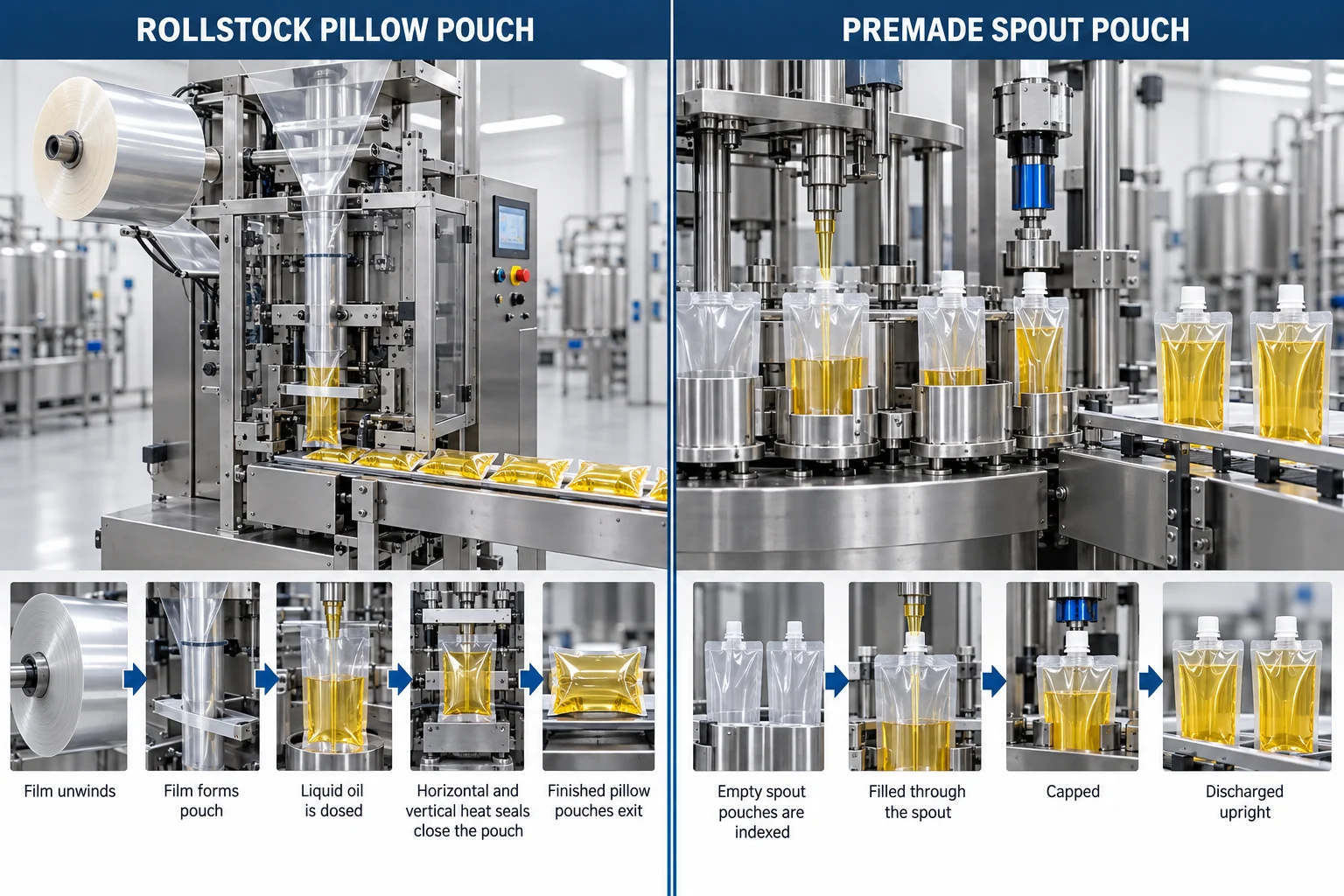
Do not ask a supplier for an “oil pouch machine” without sending the target pouch. Share the film roll or premade pouch, fill volume, oil temperature, required output, leak-test method and coding position. A free sample test can establish whether the seal remains clean and whether the package survives handling.
Oil packing machine price: compare the same scope
The following bands are procurement planning references in USD. They exclude visibly low-price listings and Indian price anchors. They also separate a single machine from a connected line. Freight, duties, site utilities, certification, installation, spare parts and change tooling must be confirmed in the commercial offer.
| Reference | Price basis | Scope represented | How to use it |
|---|---|---|---|
| Comwin bottle filling and closing equipment | US$12,000–50,000 planning band | Liquid bottle filler plus the confirmed capping or closing scope; labeling may be separate | Use for an early machine budget after bottle, cap, fill range and output are defined |
| Comwin liquid VFFS | US$5,000–30,000 planning band | Rollstock forming, liquid dosing and heat sealing; coder and film handling depend on configuration | Use for pillow-pouch planning after laminate and seal tests |
| Comwin premade-pouch equipment | US$10,000–45,000 planning band | Pouch handling with the selected liquid filling and closing system | Use for a premade spout or other approved pouch concept; final scope is quote-based |
| Comwin filling-product packaging line | US$80,000–500,000+ project band | Configured filling, closing, labeling, coding, conveying, inspection and downstream automation | Use only when the quotation covers a coordinated project rather than a single filler |
| U Tech automatic cooking-oil filler/capper / China | US$15,000–28,000 advertised | One listed automatic oil filling and capping set; supplier states a 1–5 L bottle basis | Confirm current validity, real output basis, cap type, labeling, FAT, freight and service |
| PACK’R PULSA-S / Europe | Quote-based | Weight-filling and capping platform; brochure states 500 mL–20 L containers and up to 18 cpm | A mature multi-format benchmark; compare tooling, cleaning, controls and local lifecycle support |
| APACKS automatic line / US | US$330,000 budgetary price | Published 40–50 bottle/min line with turntables, six-head pump filler, cap handling, coding and labeling | Useful for showing how a US integrated line differs from a single-machine quote |
What moves the quotation up or down?
The largest drivers are package range, nozzle count, dosing method, changeover tooling, cap or seal system, contact-part specification, cleaning design, output acceptance conditions and downstream scope. A quoted “filler” may exclude the cap elevator, induction sealer, labeler, printer, inspection, conveyors and line controls. Ask for a station-by-station supply list before comparing totals.
Quality control after filling and sealing
Oil residue can make a good label fail, contaminate a case and hide a closure problem. Build acceptance around the real package: fill quantity, closure presence, torque or seal result, external cleanliness, label position and leakage after handling. A checkweigher can flag large fill deviations, but it does not replace closure inspection or a package-specific leak test.
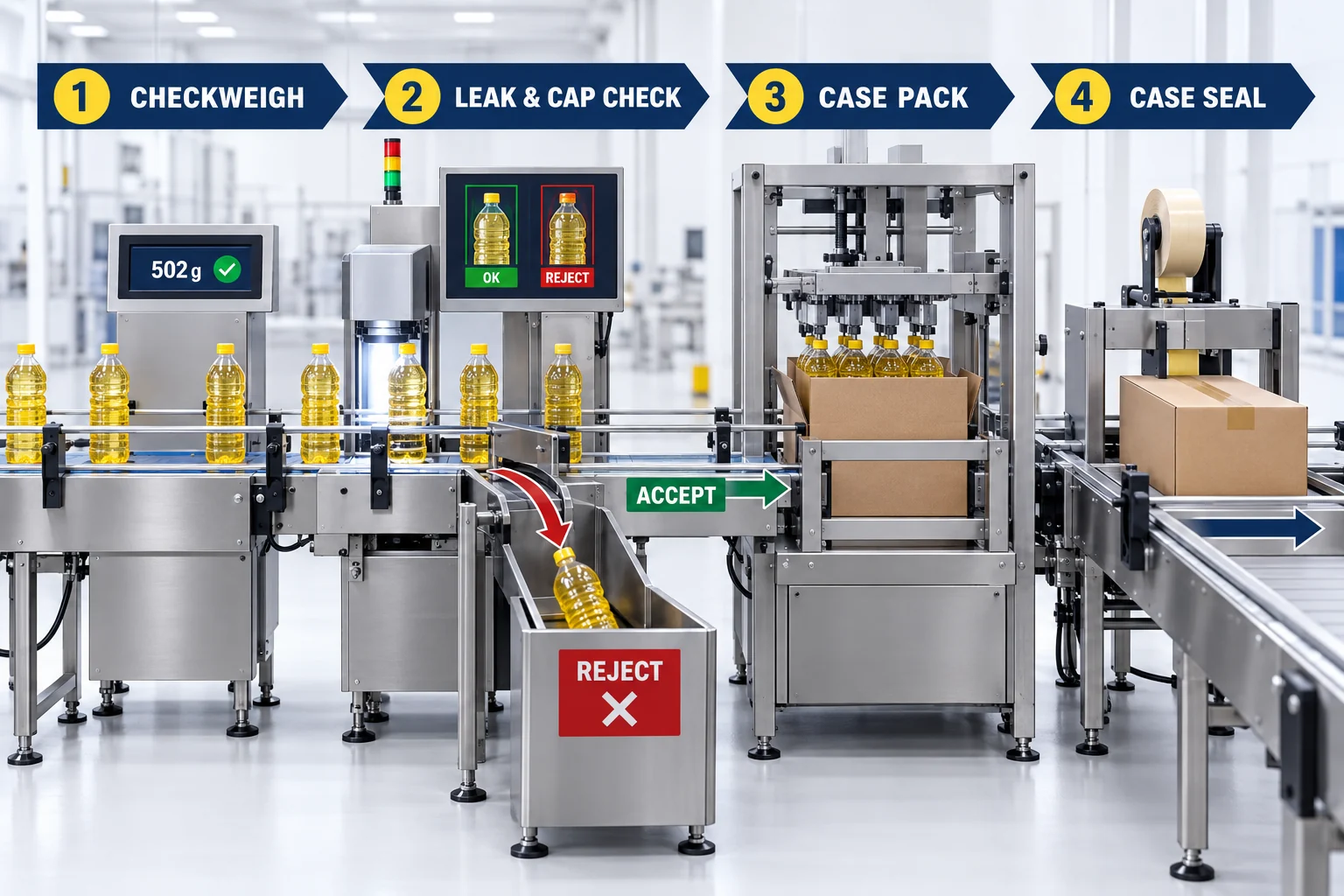
Once primary packages pass inspection, an automatic case packer can group approved bottles or tins into shipping cases. If retail containers need automatic label application, specify the bottle shape, label material and required orientation when selecting an automatic labeling machine.
Information needed for a useful quotation
| Input | Minimum detail | Why it changes the machine |
|---|---|---|
| Oil product | Oil type, working temperature, viscosity range and any particulates | Determines product path, pump or valve choice, nozzle shutoff and cleaning |
| Package samples | Bottle, tin, film roll or premade pouch from the intended supplier | Confirms guides, tooling, fill opening, sealing area and tolerances |
| Fill range | Minimum and maximum volume or net weight for every SKU | Sets dosing range, nozzle size, cycle time and change parts |
| Closure | Cap, liner, ROPP, plug, lid, tin end, heat-seal laminate or pouch spout | Defines the closing machine and inspection method |
| Required output | Accepted packs per hour by package and fill size | Prevents a high nominal speed from hiding slow changeovers or unsuitable fill conditions |
| Line boundary | Filler only or feeding, closing, coding, labeling, inspection, case packing and controls | Makes price comparisons use the same supply scope |
| Factory conditions | Layout, voltage, air, oil supply, cleaning method, destination and standards | Affects utilities, guarding, documentation and commissioning |
Why buyers consider Comwin
We match the packaging route to your oil, container, closure, output and factory limits. You can send representative oil and packages for free sample testing or inspect our factory in person or by live video. Small equipment includes video guidance and remote calls; larger lines can include project commissioning support. Our standard service position is a two-year machine warranty, three years for core components and remote response within 24 hours.
Frequently asked questions
Is an oil sealing machine the same as an oil packing machine?
No. The sealing machine performs the closing step. A complete oil packing machine or line may also include filling, capping or heat sealing, coding, labeling, inspection and case packing. Ask the supplier to mark exactly which stations are included.
Which machine is best for cooking oil bottles?
Start with a filler selected for the oil and fill range, then match the capper or closer to the actual neck and closure. Add induction sealing only when the bottle and liner are compatible. Send filled and empty package samples for leakage, torque, drip and changeover trials.
Can one oil packaging machine handle bottles and pouches?
Usually not as one primary machine. Bottle filling and capping, rollstock pouch FFS and premade spout-pouch filling use different package handling and closing systems. They can share upstream oil preparation or downstream case packing when the interfaces are engineered.
How should I compare oil packing machine prices?
Compare the same fill range, output basis, number of heads, closing method, change parts, guarding, controls, inspection and service scope. Separate a single filler from a complete line, then add freight, duties, commissioning and local compliance costs.
What is different about a salad oil packing machine?
“Salad oil” generally identifies the edible-oil application rather than a unique machine class. The container, closure, oil temperature, viscosity, hygiene plan and required output still determine the filler and sealing method.
What should be tested before ordering?
Run the real oil at the intended temperature with production bottles, caps, tins, film or pouches. Check fill control, nozzle drips, closure integrity, pouch seals, package cleanliness, label adhesion, changeover time and transport leakage before fixing the final configuration.
Get a matched oil packaging proposal
Share your oil, package samples, fill range, closure, target output, line boundary and destination with contact our packaging team. We will recommend the suitable filling, sealing and downstream configuration and return a scope-based quotation.