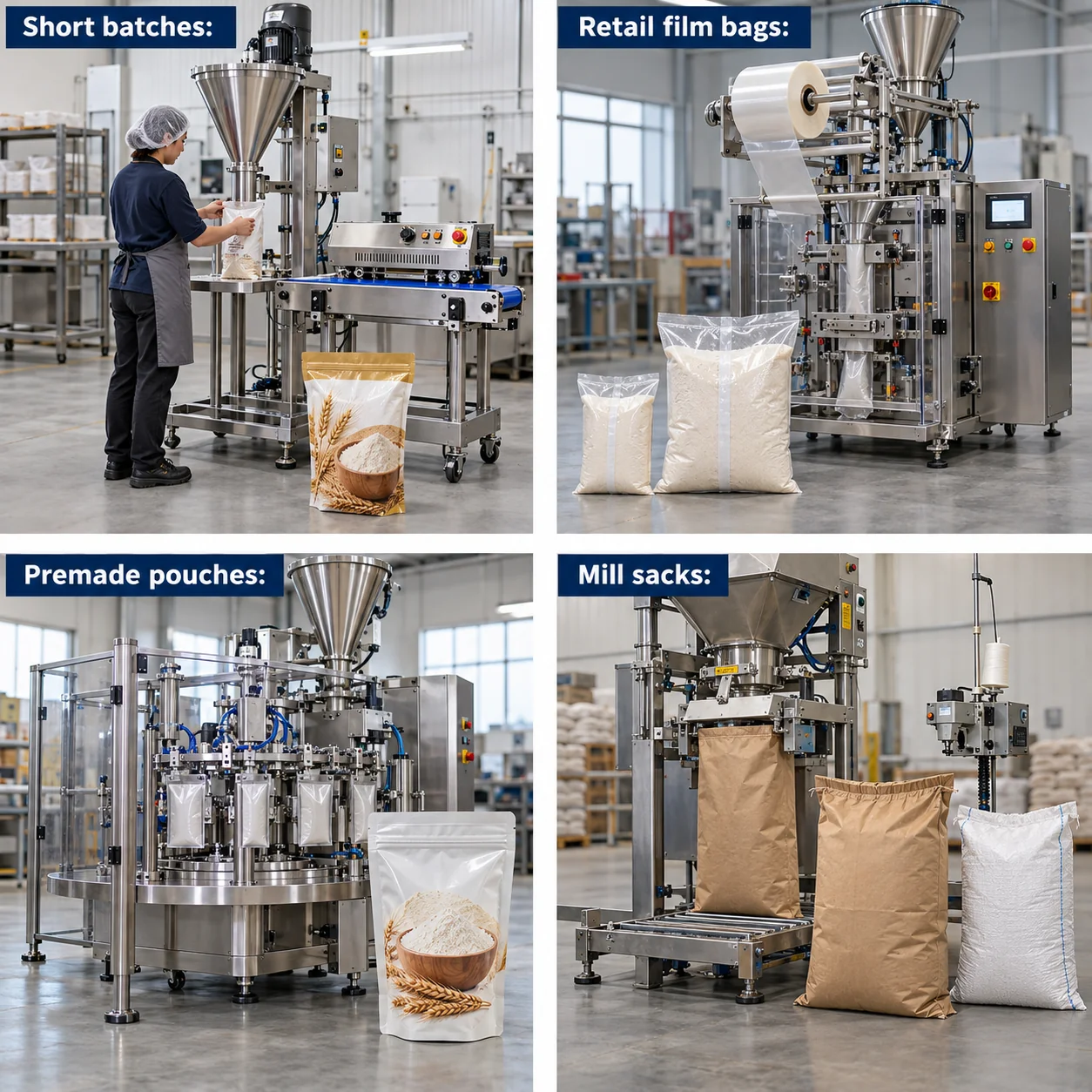
For regular 1 kg flour or atta orders in roll-film bags, start with an auger doser and a vertical form fill seal machine (VFFS). For ready-made stand-up pouches, use pouch handling with powder dosing. For 25 kg or 50 kg mill sacks, use a dedicated weighing, filling and bag-closing station.
An indicative budget for a 1 kg VFFS flour packing combination is USD 15,000 to 40,000. That covers one selected bag format, auger dosing, basic feeding and discharge. Heavy retail bags and industrial sacks have different scopes and budgets below. Comwin matches the dosing, bag handling and controls to your flour, packaging material and required output.
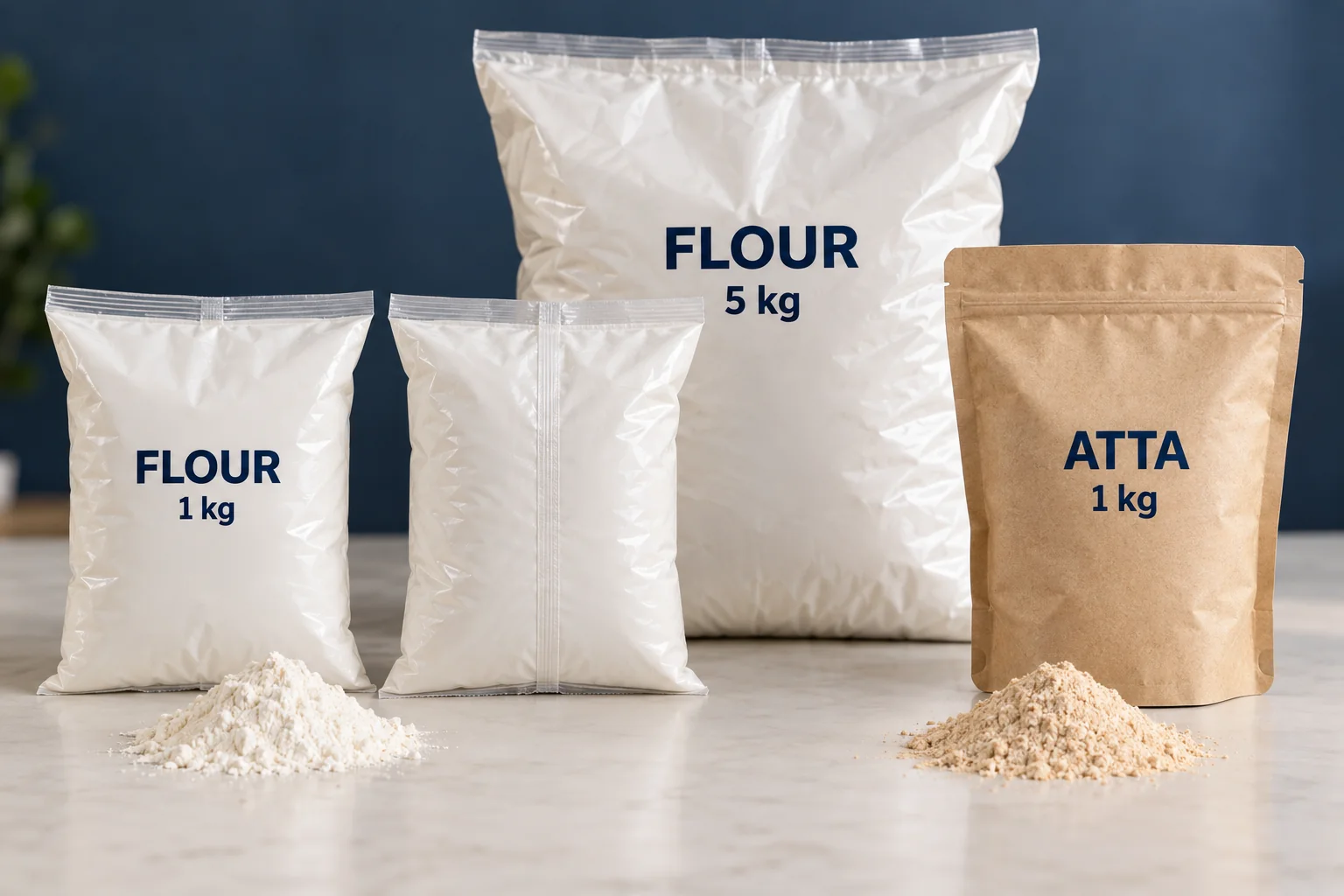
Choose a flour and atta packing route
Wheat flour and wholemeal atta can differ in bulk density, aeration and flow. Send representative flour and actual packaging material before fixing the feeder, auger or bag dimensions. A flour filling machine handles dosing; the bag still needs to be presented, supported and closed.
| Finished pack and production need | Equipment route | Why it fits | When to change the route |
|---|---|---|---|
| Short batches in ready-made retail bags | Operator-fed auger filler and separate heat sealer | Accommodates frequent bag changes while retaining manual bag presentation and transfer | Move to automatic pouch handling when those manual steps limit output |
| Regular 1 kg roll-film bags | Auger doser, VFFS and discharge conveyor | Forms, fills and seals bags continuously; dosing and sealing timing can be coordinated | Use premade-pouch handling when the chosen bag cannot be formed from the specified roll film |
| One selected 5 kg or 10 kg retail bag | Powder dosing with matched heavy-bag forming or open-mouth bag handling | Provides the bag width, filled-volume allowance and support needed for the heavier pack | Move to an industrial sack station when the bag construction and handling require it |
| Heat-sealable stand-up or zipper pouch | Premade-pouch handling, auger dosing and top sealing | Retains the selected pouch appearance and provides a repeatable opening and sealing sequence | Compare VFFS if a roll-film pack meets the sales requirement and sustained volume is the priority |
| 25 kg or 50 kg mill sack | Controlled powder feeding, weighing, bag clamping, closing and conveying | Supports the sack during filling and carries it through the specified closing process | Add automatic bag loading or palletizing when consistent bags and production demand justify those steps |
Roll-film bags for continuous retail production
The auger meters powder into a bag made from film on the VFFS machine. The auger geometry, agitation, hopper level and stopping sequence affect the fill. Test the proposed arrangement with representative flour batches, including those that flow less readily.
A 1 kg atta packing machine also needs enough usable bag volume. As a planning example, powder with an assumed loose bulk density of 0.55 kg per litre occupies about 1.82 litres at 1 kg. Divide the target net mass by the measured loose bulk density to obtain product volume. Then verify usable bag volume with headspace, settling and seal allowance. Measure your flour rather than selecting a bag from this assumed density.
For a 5 kg or 10 kg atta bag, check the forming width, filled height, drop path and support under the bag. Changing the weight setting alone does not establish that a retail model can handle the larger pack.
Premade pouches for an established retail format
A premade-pouch packaging platform can pick, open and hold the chosen bag while a matched powder doser fills it. The selected pouch must open reliably and leave a clean top-seal area after filling. A consumer zipper sits below that factory seal.
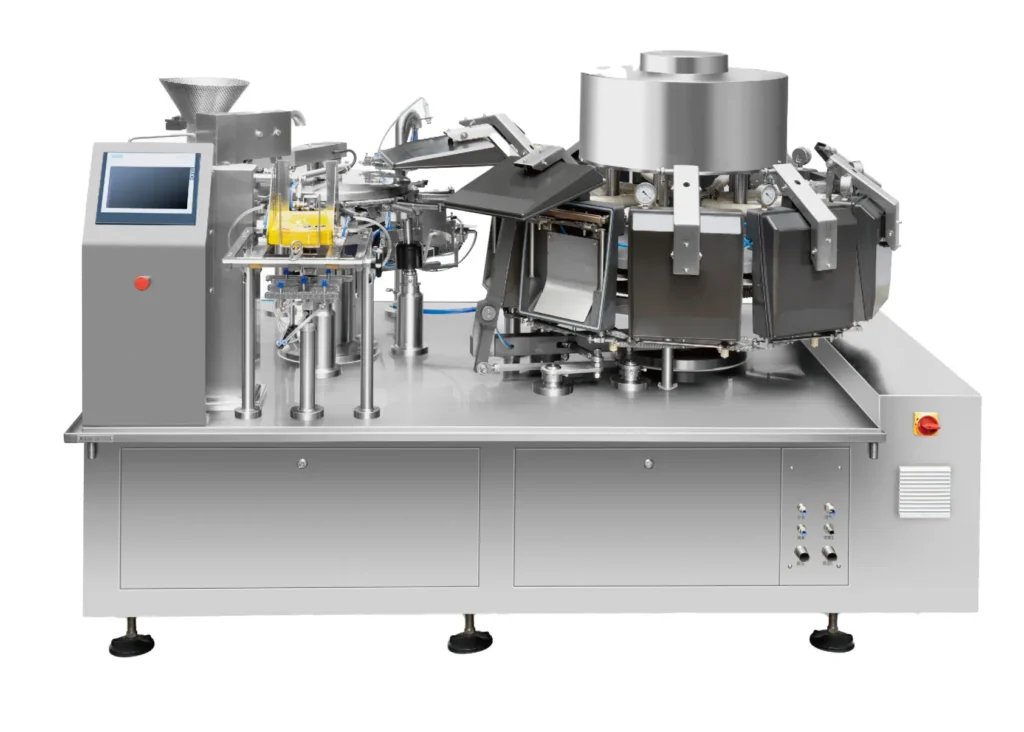
Comwin matches the pouch opening, zipper position and filled-pouch stability to the powder discharge. Compare the finished pouch cost and accepted output with roll film; retain premade handling when the shelf pack requires that structure.
Industrial sacks for mill and wholesale supply
A 50 kg atta packing machine needs a sack filling and handling arrangement. Controlled feeding delivers flour to a net-weigh or gross-weigh system, the clamp holds the bag, and the filled sack moves to its closing station.
Closing depends on the sack. A heat-sealable liner, a paper sack and a woven outer bag may require different operations. If the specification requires both liner sealing and outer-bag sewing, include both steps in the offer. Palletizing belongs to a separate handling scope.
Solve the flour problems that affect saleable bags
| Problem on the packing floor | Likely mechanism | Configuration or operating response | What to check with samples |
|---|---|---|---|
| Weight changes between batches or hopper levels | Bulk density, entrained air and auger filling change the dose per revolution | Match the auger and agitation; maintain suitable hopper conditions and add weight feedback when required | Net-weight distribution at different hopper levels and across representative batches |
| Flour in the top seal or around the filler | Powder falls into the sealing area or continues after the intended cutoff | Coordinate dosing and sealing; manage the drop path, dust extraction interface and bag-mouth cleaning | Filled-bag seal cleanliness and leakage after handling |
| A 5 kg or 10 kg bag sags, slips or swells | Filled volume, trapped air or unsupported load exceeds the chosen bag arrangement | Match bag support, settling or deaeration to the material and pack | Filled height, clamp stability, bag-bottom load and transport condition |
| Residue remains after a product change | Powder stays in the feeder, hopper or dosing parts | Specify accessible contact parts and a practical removal and cleaning procedure | Actual cleaning time and the agreed residue controls |
| Filling runs faster than closing or collection | The closing or transfer step is the bottleneck | Coordinate filling, mouth preparation, closing and conveying | Sustained good bags per hour across the whole agreed scope |
Fine flour can also create a combustible-dust hazard under suitable conditions. OSHA identifies flour among materials that can be explosible in dust form. The plant dust assessment, collection system and protective measures need to address the installation. A suction connection on the filler does not establish that the whole site is adequately protected.
Vacuum-assisted powder dosing can help control powder behaviour in a suitable design. It does not mean that the finished flour bag is vacuum packed. Specify these as separate functions if either is required.
Match the machine to your flour packing scenario
| Product and order pattern | Finished pack | Starting equipment route | Condition that changes the choice |
|---|---|---|---|
| Refined wheat flour, regular retail orders | 1 kg roll-film bag | Auger dosing and VFFS | A fixed premade-pouch requirement moves bag handling to a pouch machine |
| Wholemeal atta, several short orders | 1 kg printed premade bags | Operator-fed auger filler and separate heat sealing | Repeated manual transfer delays justify automatic pouch handling |
| Atta for larger household or food-service packs | One 5 kg or 10 kg heat-sealable bag | Matched heavy-bag dosing, support and forming or bag handling | Sack construction or difficult settling may require an open-mouth arrangement |
| Flour for mill customers and wholesalers | 25 kg or 50 kg paper or lined woven sacks | Weighing, clamping, filling, closing and conveying | Frequent bag loading or pallet handling may justify additional automation |
| Branded flour intended for repeat use | Heat-sealed zipper stand-up pouch | Premade-pouch handling and powder dosing | Film-formed packaging becomes an alternative if the shelf requirement changes |
Example: 1 kg atta with frequent label changes
Assume the product stays similar but several printed bags are used in short runs. Operator-fed filling can keep the changeover simple because the operator presents each bag. The tradeoff is the time spent opening, transferring and sealing it.
Test with the least free-flowing atta batch and the smallest bag opening. Record net weight, powder in the seal and the time required to switch bags and clean the contact parts. If bag presentation dominates the cycle, compare automatic premade-pouch handling using those same bags.
Example: 25 kg mill sacks with a slow closing step
Suppose the filling station supplies sacks faster than the operator can prepare and sew their mouths. A faster doser would increase the queue. Improve the bag support, mouth preparation and closing sequence first, then assess automatic bag loading against the resulting output. Check leakage during transfer and the load presented to the next conveyor.
Flour packing machine prices by configuration
These are indicative planning budgets in USD, prepared in October 2026, for new equipment supplied from China for ordinary non-aseptic food packing. Each row assumes one product and one selected bag size and format. The selected configuration determines the quotation. Freight, taxes, overseas installation, upstream milling and site works are excluded.
| Selected configuration | Indicative budget | Included planning scope | Main items to price separately |
|---|---|---|---|
| Operator-fed powder filling, around 1 kg | USD 6,000 to 18,000 | Auger dosing, basic feeding interface and one matched separate heat-sealing unit | Automatic bag presentation, inspection and plant dust collection |
| 1 kg flour VFFS combination | USD 15,000 to 40,000 | VFFS, auger, basic feeding and discharge for one retail bag | Extra formats, inspection and special dust-protection engineering |
| One 5 kg or 10 kg heavy retail format | USD 25,000 to 60,000 | Matched dosing, bag support, filling and closing for the selected arrangement | A second format, industrial sack handling and palletizing |
| Premade flour-pouch combination | USD 22,000 to 55,000 | Pouch handling, powder dosing and basic feeding for one heat-sealable pouch | Extra zipper mechanisms, additional formats and inspection |
| One 25 kg or 50 kg semi-automatic sack station | USD 12,000 to 35,000 | Weighing and filling, manual bag loading, clamping, basic conveying, one closing method and extraction hood interface | Automatic bag loading, dedicated compaction or deaeration, central dust collection and palletizing |
| One 25 kg or 50 kg automatic sack arrangement | USD 45,000 to 130,000 | Automatic loading of consistent bags, controlled powder filling, basic closing and conveying | Complex sack closure, multiple formats, full site dust engineering and palletizing |
For a 5 kg atta packing machine price or a 10 kg atta packing machine price, send the actual bag construction with the weight. The quoted scope can change substantially between a roll-film pack and a lined open-mouth sack. The heavy-retail budget covers one chosen format, not every change part for both weights.
For a fully automatic flour packing machine price, define the required endpoint: sealed bags, counted cases or completed pallets. Ask for a component list so feeding, filling, closing and optional handling are priced once.
Semi-automatic or automatic flour packing
| Decision | Operator-fed filling | Automatic retail bag packing | Automatic sack loading and closing |
|---|---|---|---|
| Production pattern | Short runs and changing bags | Sustained orders in compatible film or premade pouches | Repeated industrial sacks with consistent dimensions |
| Manual work | Present, transfer and feed filled bags to the sealer | Replenish product or bags and collect packs unless further handling is included | Replenish sacks and supervise; pallet handling depends on the scope |
| Changeover and cleaning | Check access to the auger and hopper plus separate-sealer setup | Include forming parts or pouch settings, dosing parts and cleanout | Include clamps, sack magazine, closing settings and product-contact cleanout |
| Acceptance basis | Good filled and sealed bags per hour with the agreed staffing | Good bags, net-weight distribution, clean seals and actual change time | Stable loading, acceptable net weight, sound closure and reliable transfer |
An automatic atta packing machine can still require manual replenishment and collection. Specify those tasks and the intended operators when comparing output. Measure good bags over a representative run, including routine stops and rejected packs, rather than relying on an unloaded maximum cycle rate.
Add case packing or palletizing when handling becomes the bottleneck
Retail bags can be grouped into transport cases after sealing. Industrial sacks can move to a palletizing station after closing. If these steps consume too much labour or create queues, a bagged-product packaging line can coordinate the relevant interfaces.
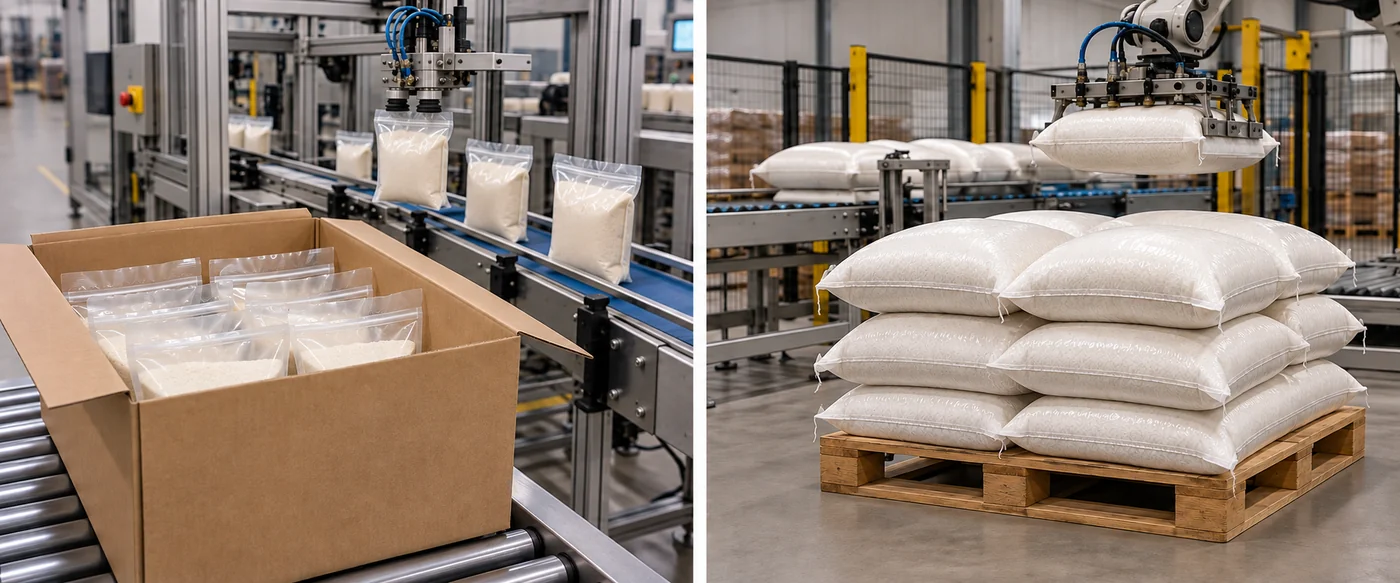
Specify retail bags per case, case dimensions, sack orientation and the required pallet pattern. Case packing and palletizing are optional additions to the filling budgets above; neither is included simply because the bag packing is automatic.
Compare flour packing suppliers on the same scope
| Dimension | Evidence to compare | What to discuss with Comwin |
|---|---|---|
| Budget and scope | A component list tied to the same flour, bag and output | Dosing, bag handling, closing and separately priced options |
| Production | A run with representative flour and the chosen bag material | Required good bags per shift, staffing and the slowest handling step |
| Product and pack fit | Powder behaviour, filled volume, opening width and change parts | Auger, support, dust interfaces and cleaning access matched to the application |
| Support | Named responsibilities for testing, training, spares and troubleshooting | Support arrangements and the parts information required for operation |
| Delivery | Configuration freeze, sample approval and acceptance milestones | A schedule based on the agreed equipment and readiness of materials |
Comwin develops flour packing solutions from a filling station to coordinated bag handling. We offer free sample testing and factory visits. Equipment warranty is two years, with three years for core components; remote response is within 24 hours. Installation, training and spare-parts scope are agreed for the selected equipment.
Flour packing questions
Can one machine handle 1 kg, 5 kg and 10 kg atta bags?
For shared 1 kg, 5 kg and 10 kg production, specify the approved formats and change parts. The selected dosing, bag-forming and load/support range must cover each pack; allow separate handling when the heavy bag changes that task.
Is an auger enough for accurate flour filling?
When density or aeration varies, the same auger setting can give different net weights. Stabilize feeding conditions, match the auger and agitation, and assess weighing feedback against the required weight distribution. Validate the arrangement with representative batches.
Does vacuum-assisted dosing produce vacuum-packed flour?
For a vacuum finished pack, add the actual vacuum-packaging process and material. The powder-control function described above performs the dosing task.
What does a 50 kg flour packing station include?
For an industrial sack, include the feeding and weighing arrangement, bag clamp, support, closing method and conveyor interface. Add automatic sack loading or palletizing only where required. A liner seal followed by outer-bag sewing needs two defined operations.
Can wheat flour and wholemeal atta share the same configuration?
When their flow, density and cleanout requirements are compatible, a shared platform may be suitable with matched dosing parts and recipes. Compare samples before confirming that scope. Other powders, including besan or sattu, need their own product assessment.
Send the information needed for a flour packing proposal
- Product: refined flour or wholemeal atta, particle and flow characteristics, measured loose bulk density, representative batches and cleaning requirements.
- Pack: roll film, premade pouch or industrial sack; dimensions, laminate or liner, zipper position and finished-pack sample.
- Fill: chosen 1 kg, 5 kg, 10 kg, 25 kg or 50 kg target, acceptable net-weight range and settling or headspace requirements.
- Closure: heat sealing, paper-sack closing, liner sealing or sewing; date marking and inspection requirements.
- Production: good bags per shift, operating hours, SKU changes, current manual steps and optional case or pallet handling.
- Site: upstream flour supply, dust-collection interface, power, compressed air, space, access and destination market.
Comwin can return a matched configuration, a component and option list, and proposed sample-test acceptance criteria based on these inputs.
Arrange sample testing with the intended flour and packaging material, or send Comwin your packing requirements for a matched equipment proposal.