
 Best fit: preformed plastic juice cups that require automatic cup feeding, liquid filling and foil heat sealing. Empty cups enter before filling; sealed cups leave after the sealing station.
Does “Juice Glass” Mean a Cup or a Glass Bottle?
Confirm this before discussing price. Search results for the exact phrase are dominated by disposable cup filling and sealing equipment. A real glass bottle follows a different route with bottle rinsing, filling and a screw, ROPP, lug or crown closure.| Package shown to supplier | Correct machine family | Closing method | This page covers it? |
|---|---|---|---|
| Disposable plastic cup or “juice glass” | Preformed-cup filling and sealing machine. | Die-cut foil lid or roll-stock sealing film heat-sealed to the cup rim. | Yes—this is the primary route. |
| Real glass bottle | Bottle rinser/filler plus a screw, ROPP, lug or crown capping system. | A bottle closure applied by a dedicated capper. | No—request a glass-bottle juice filling line. |
| Cup formed from roll stock | Thermoform-fill-seal machine. | Top web sealed to a cup formed inside the machine. | Related but a different, higher-scope machine family. |
| Prefilled cup needing only a lid | Cup sealer without automatic product filling. | Foil or film sealing only. | Partial route; do not compare its price with a filler-sealer. |
Juice Glass Packing Machine Price
The machine price changes with automatic cup feeding, lane or station count, filler type, foil handling, print registration, seal tooling, hygienic construction, controls and downstream scope. The table starts with Comwin’s relevant planning reference, then uses higher-configuration Chinese listings and quote-based European and North American suppliers. It excludes Indian price comparisons and visibly low-cost entry listings.| Reference | Price basis | Scope represented | Buying interpretation |
|---|---|---|---|
| Comwin customized cup filling and sealing project | Quote-based; US$12,000–50,000 is the nearest current Comwin filling/closing machinery planning benchmark | Configured automatic feeding, juice dosing and foil sealing require confirmation from cup, lid, recipe, output and hygiene scope. | Use the band only for initial planning. It is not a published fixed cup-machine price or a promise that every project fits the range. |
| FEIZHAN automatic inline machine / China | US$15,399 advertised | Automatic preformed-cup feeding, servo-piston filling and sealing platform; page is marketed mainly for viscous foods. | A mid-range automation reference. Confirm suitability for free-flowing juice, nozzle choice, lane count and sanitation. |
| Artisan rotary machine / China | US$26,490 advertised for one piece | Automatic rotary cup filling and sealing listing with a customized forming/filling/sealing scope. | Verify actual cup-feed method, juice dosing, foil system, output basis, FAT and included change parts. |
| Youngsun higher-output rotary reference / China | US$55,000 advertised | Rotary liquid cup filler-sealer listing with a stated 5,500 cups/hour basis for a specified cup range. | Useful as a higher-output reference; verify listing age, real supplier quote, accepted output and service scope. |
| NOVAPAC / Germany | Quote-based | European cup filling and closing platform positioned for products including orange juice. | Compare hygienic design, dosing, output, validation, controls and lifecycle service. |
| Winpak / North America | Quote-based | Cup filling machinery guide covering filling and sealing stations for food and beverage applications. | Compare package compatibility, seal system, local support, consumables and total ownership requirements. |
What the Automatic Process Should Include
A complete preformed-cup machine should move the same cup through a logical sequence. Empty cups are separated from a stack, indexed under the filling heads, covered with a compatible foil lid or roll-stock film, heat-sealed and discharged. Coding, inspection and case packing may be integrated or supplied downstream.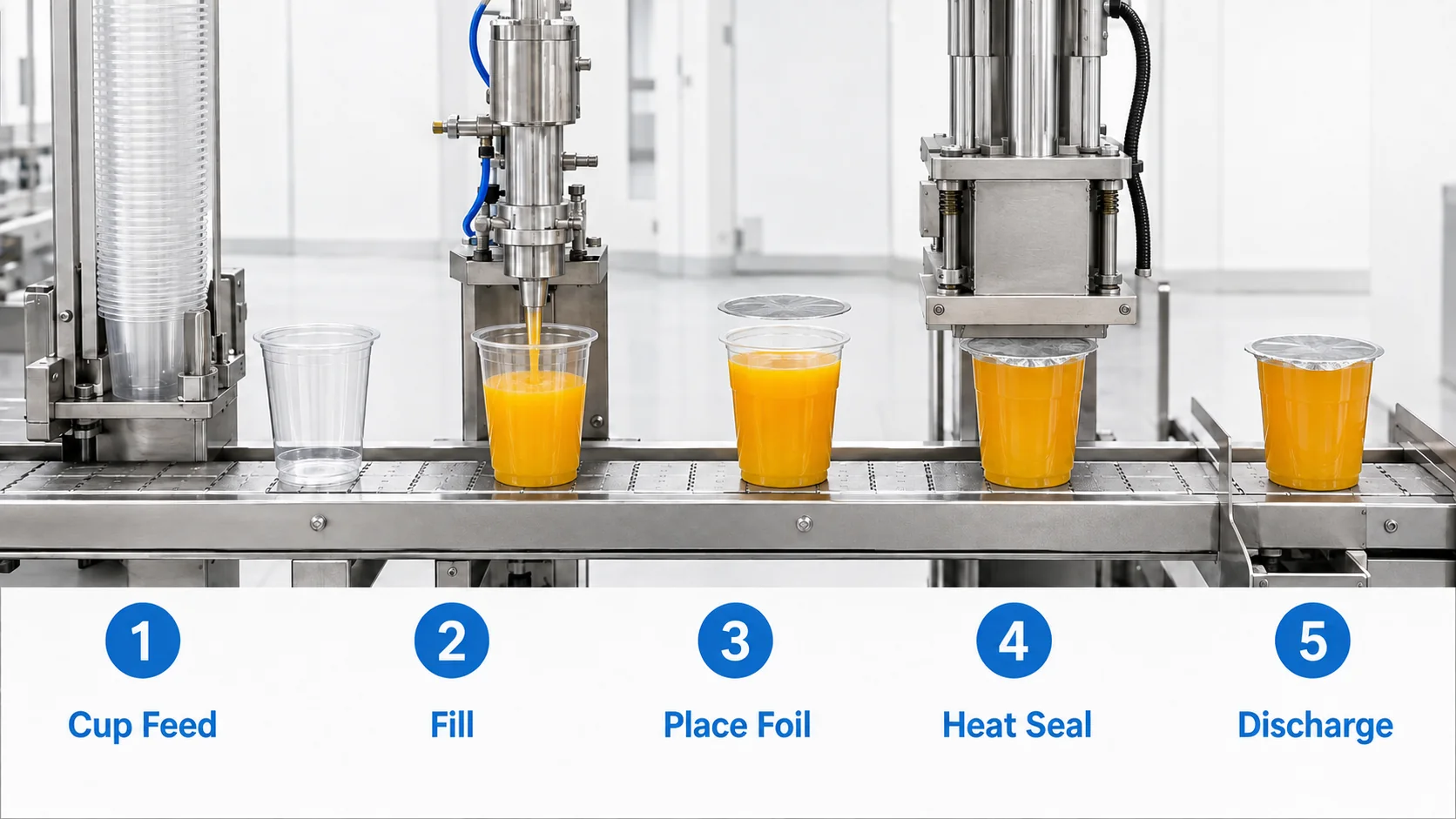 Five-stage cup route: cup feeding, filling, foil placement, heat sealing and discharge. The exact number of machine stations depends on the lid system, coding and inspection scope.
Semi-Automatic, Inline or Rotary?
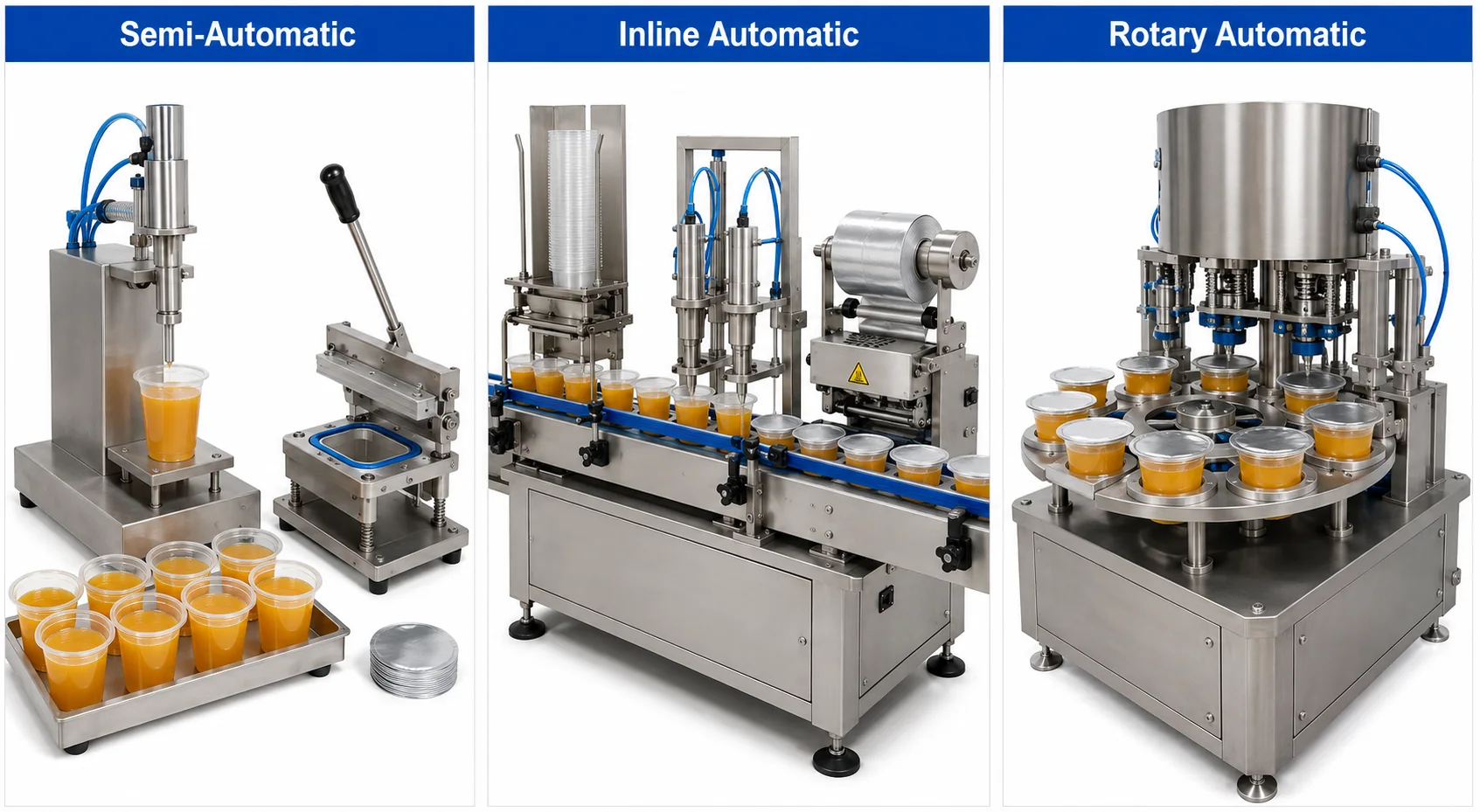 Automation choices: semi-automatic cells reduce initial scope, inline systems provide configurable stations, and rotary machines offer a compact indexed layout.
| Configuration | Typical included functions | Best fit | Cost drivers |
|---|---|---|---|
| Semi-automatic cells | Operator places cups, triggers filling and moves cups to a separate or combined sealer. | Product trials and very short runs where labor is available. | Filler type, seal fixture, controls and number of stations. |
| Inline automatic | Automatic cup denesting, indexing, filling, lid or film placement, sealing and discharge. | Growing producers needing a clear straight-line layout and configurable stations. | Number of lanes, index speed, dosing heads, foil feed, coding and guards. |
| Rotary automatic | Cup holders index around a rotary platform through feeding, filling and sealing. | Compact automatic production with stable cup formats. | Number of stations, tooling sets, filling system and output acceptance. |
| Thermoform-fill-seal | Forms cups from bottom web, fills, seals with top web and cuts packs. | High-volume projects prepared to manage roll-stock package forming. | Forming area, mold, web handling, utilities, sanitation and downstream automation. |
The Cup and Foil Determine Seal Quality
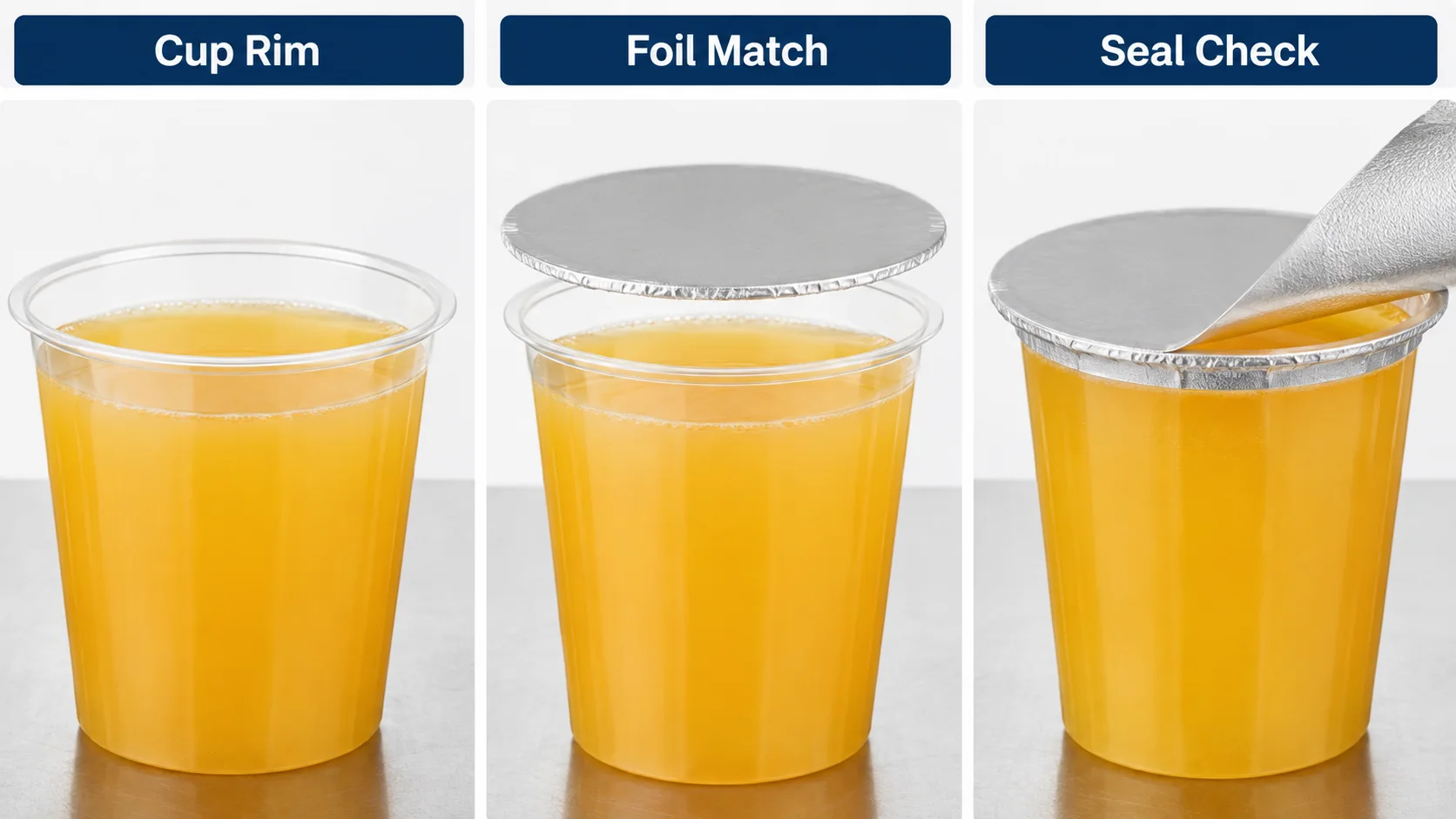
The sealing layer must bond to the specific cup material. Rim contamination from foam, splash, pulp or an overfilled cup can create channels and leaks. Cup distortion, uneven rims and poorly aligned lids can produce the same problem even when temperature and pressure appear correct.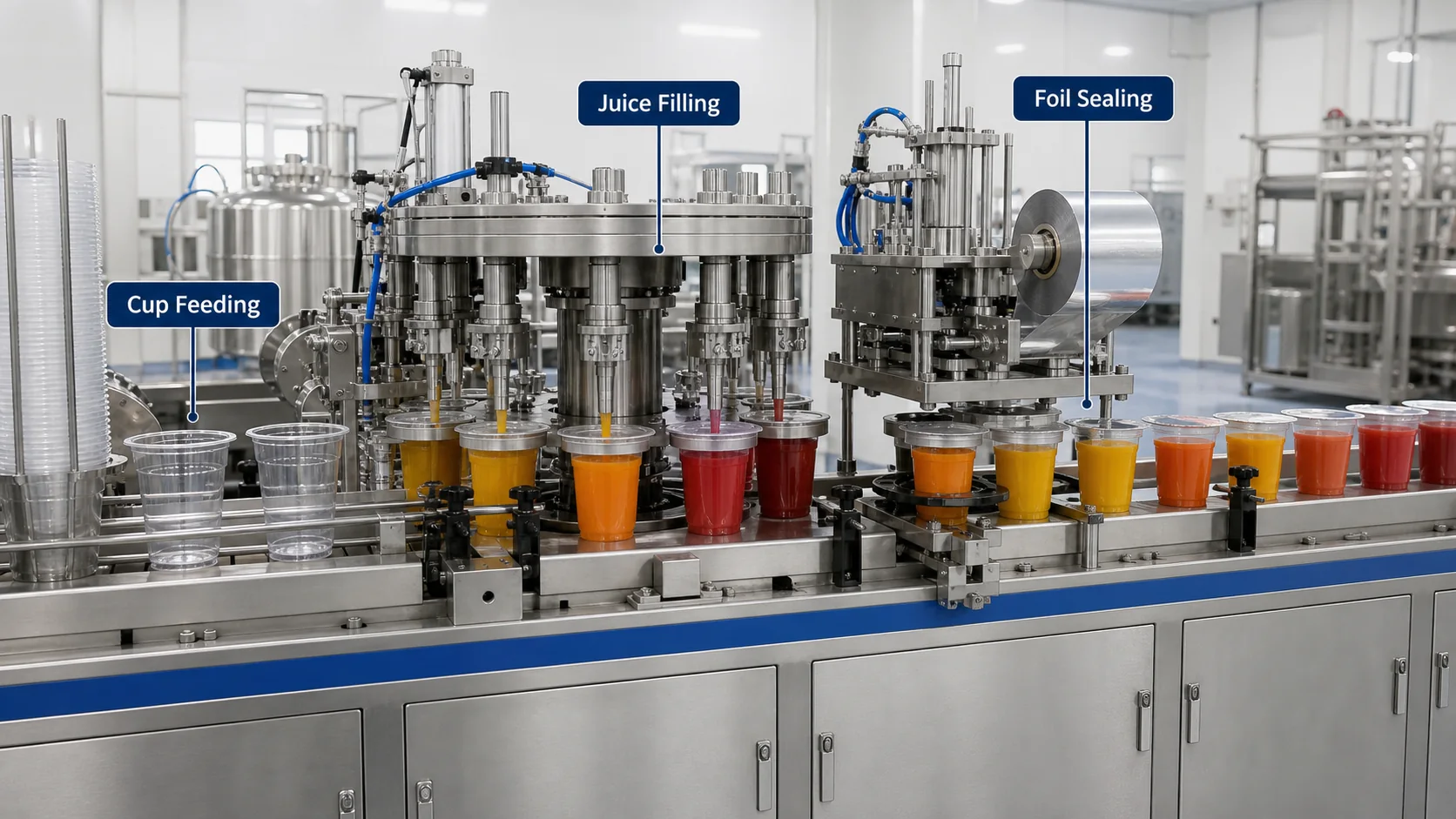 Package validation: inspect the cup rim, match the foil sealant to the cup material and verify a continuous finished seal under the agreed peel or leak test.
| Check | What to define | Why it matters |
|---|---|---|
| Cup material and rim | PP, PET or other structure; rim diameter, profile, flatness and dimensional tolerance. | Determines tooling, compatible sealant layer and pressure distribution. |
| Lid or film | Die-cut lid or roll stock, printed registration, peel requirement and barrier specification. | Determines feed system, sensor, sealing window and product protection. |
| Seal window | Validated temperature, pressure and dwell-time range for the actual cup/lid pair. | A narrow operating window increases leak risk during normal material variation. |
| Product at the rim | Foam, splash, pulp, fibers and fill headspace under real operating conditions. | Residue can prevent a continuous heat seal even when the machine completes a cycle. |
| Finished-pack test | Visual seal ring, peel behavior, leakage test, code quality and transport simulation. | Converts machine cycling speed into accepted saleable cups. |
Juice Recipe and Filling System
Free-flowing filtered juice may use gravity, timed-flow or flow-meter dosing according to accuracy and sanitation needs. Viscous nectar can require a pump or piston system. Pulp and fibers need a sufficiently large product path and a shutoff that does not trap solids or drip onto the sealing rim. Foaming products may require bottom-up filling, controlled nozzle speed or additional headspace. The filling machine does not create shelf life by itself. Define whether the product will be chilled or distributed at ambient temperature and have the complete product, treatment, package and hygiene process validated by qualified food-safety personnel.Coding, Inspection and Final Packing
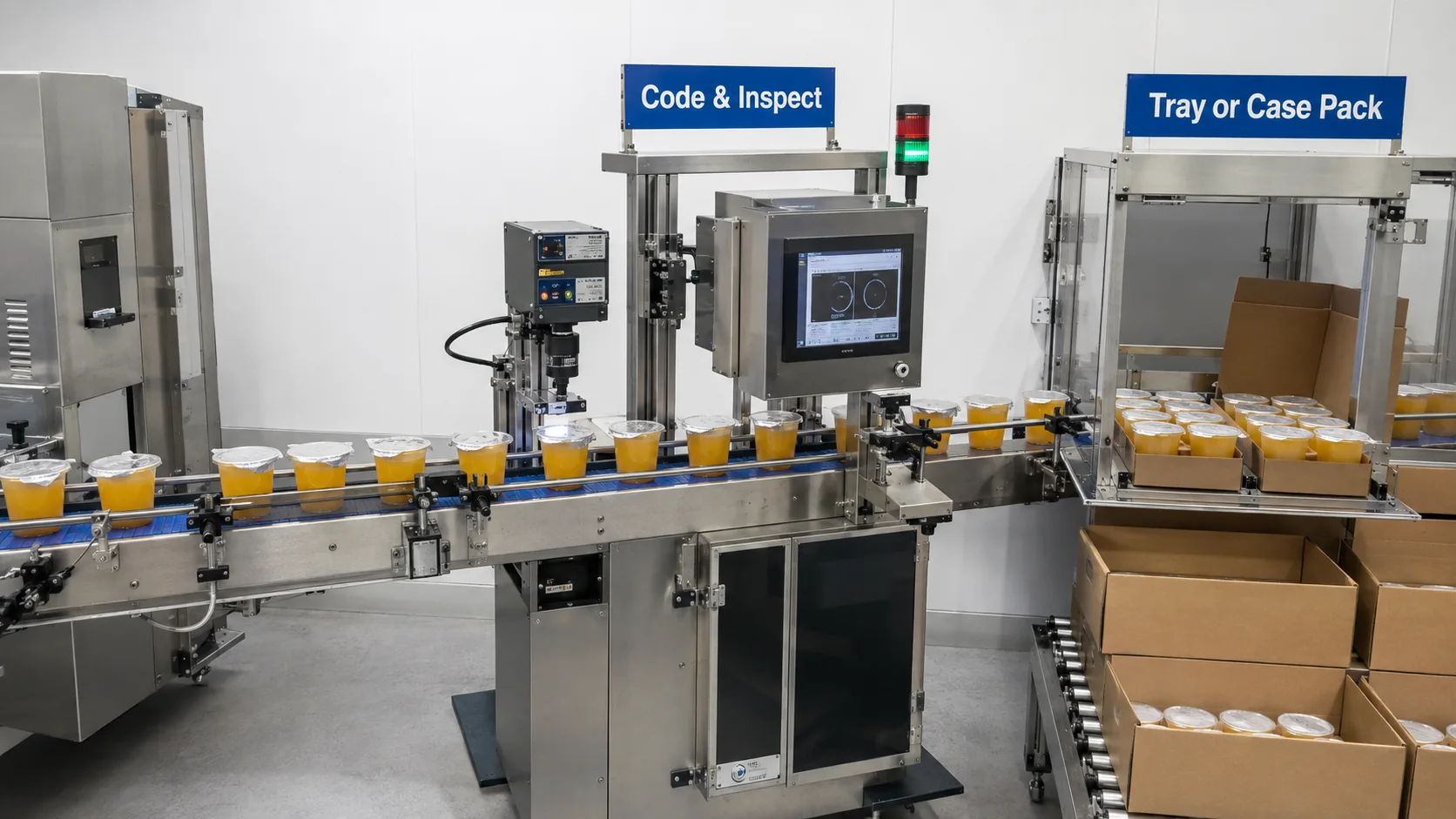 After sealing: closed cups can move through date coding and inspection before tray or case packing. Downstream capacity must match accepted cup output.
Information Needed for a Comwin Quotation
| Input | Provide | Effect on quotation |
|---|---|---|
| Juice | Recipe category, viscosity, pulp/particle size, foaming behavior, fill temperature and cleaning needs. | Sets product path, dosing system, nozzle motion and hygienic design. |
| Cup and lid | Samples plus drawings, material, rim size, volume, lid/film specification and artwork registration. | Sets cup denester, holders, sealing tooling, sensors and change parts. |
| Accepted output | Required saleable cups per hour for each size and recipe. | Sets lane or station count and the capacities of every downstream module. |
| Shelf-life process | Chilled or ambient distribution and the validated product/package preservation method. | Sets hygiene, treatment interfaces and possible controlled-environment requirements. |
| Factory and final pack | Utilities, floor plan, code, tray or case pattern, documentation and installation support. | Sets layout, electrical/pneumatic specification and project boundary. |
Supplier Positioning: Comwin, Europe, North America and China
Comwin is positioned for overseas buyers who want Chinese project economics and a machine configured from the actual cup, lid and juice, with the option to coordinate downstream inspection and packing. Use the same written requirement sheet for every supplier.| Supplier / region | Positioning | Relevant strength | Suitable buyer |
|---|---|---|---|
| Comwin Group / China | Customized export project from a cup filler-sealer to coordinated inspection and final packing. | Solution matching, free sample testing, real-factory visits, two-year machine warranty, three-year core-component warranty and remote response within 24 hours. | Buyers seeking Chinese project economics and one contact for primary and downstream packaging. |
| NOVAPAC / Germany | European cup filling and closing equipment specialist. | Industrial dosing, filling and closing platforms with application engineering. | Plants prioritizing an established European platform and regional lifecycle support. |
| Winpak / North America | North American packaging and cup-filling machinery provider. | Cup filling/sealing equipment combined with packaging-material expertise. | North American buyers comparing machinery, consumables and local service. |
| Chinese export equipment market | Wide selection from compact rotary units to higher-output inline and thermoform systems. | Flexible scope and public price visibility on some configurations. | Buyers prepared to define tooling, hygiene, FAT, spares, documents and commissioning in the contract. |
Factory Acceptance Test
Run the agreed juice, cup and lid for a defined period. Record accepted sealed cups per hour, dose consistency, foam and dripping, cup-feed faults, lid alignment, continuous seal quality, code readability and rejects. Demonstrate cleaning, recipe changeover, format change and restart. If inspection or case packing is included, test those modules at the same accepted line rate.Common Buying Mistakes
- Sending only cup volume: the rim geometry, material and physical samples determine tooling and sealing.
- Comparing with a countertop sealer: it omits automatic filling, cup feeding and production-line controls.
- Ignoring juice on the rim: splash or pulp can turn a visually closed lid into a leaking package.
- Using cycles per hour as saleable output: define accepted sealed cups after rejects and normal stops.
- Assuming the headline price is installed cost: normalize tooling, tests, freight, commissioning, spares and downstream modules.