
A sauce packing machine should match the sauce you make and the pack your customer buys. For small batches in bottles or jars, start with a piston filler and a separate capper. For takeaway condiment sachets, choose a liquid/paste form-fill-seal machine. For retail stand-up pouches, choose a premade pouch filler and sealer. Comwin can match the dosing system, packaging machine and level of automation to your product, so you invest in the steps that actually need improvement.
Ketchup that strings across a seal, mayonnaise that fills too slowly and chili sauce that blocks a nozzle need different solutions. Below, you can compare our recommended routes, see how the configurations address these problems, and find a practical starting point for a small sauce business or an expanding condiment line.
Equipment Selection Guide: Three Sauce Packaging Solutions
Choose A for bottles and jars, B for single-serve sachets, or C for retail pouches. Then size the filler around your sauce—not around a water-filling demonstration.
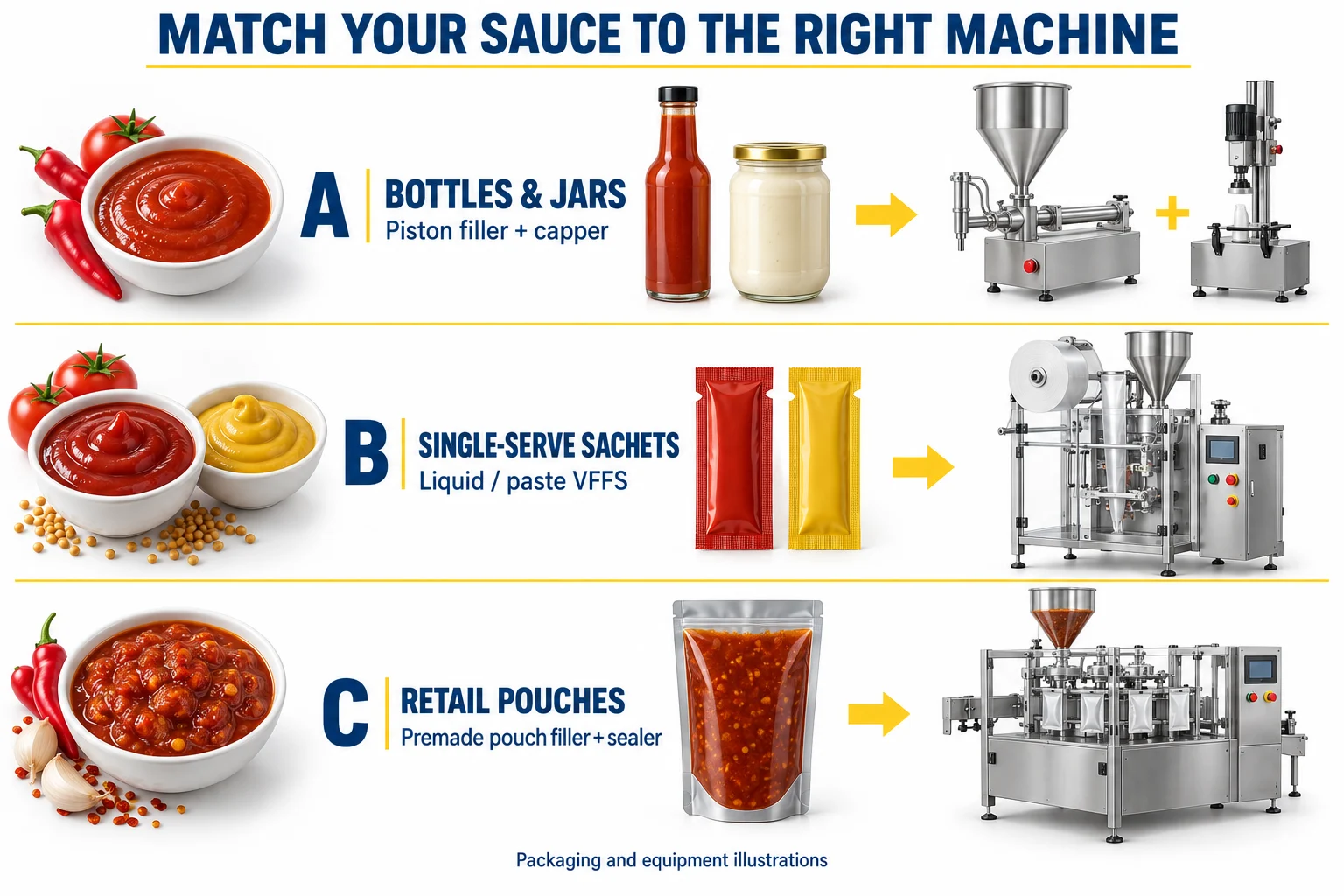
Solution A: Piston Filling and Capping for Bottles and Jars
Best for: small-batch hot sauce, BBQ sauce, mayonnaise and mustard sold in capped bottles or wide-mouth jars.
A piston filler draws a measured volume into a cylinder and dispenses it through a nozzle. For a new product range, we recommend starting with a semi-automatic filler: the operator positions the container, triggers the dose and transfers it to a separate capping station. You automate the repetitive filling task while keeping bottle handling flexible.
When orders become regular and manual handling limits output, move to an automatic multi-head filler with container conveying and a matched capper. For thick sauces, select the product path, shut-off nozzle and filling cycle together. A wider nozzle may improve flow, but it must still fit your bottle opening. Wide-mouth jars can be a better starting package for sauces with larger pieces.
Why choose this route: keep the bottle or jar your customers already recognize, with a clear upgrade path from operator-loaded filling to automated handling. Explore our filling and sealing equipment.
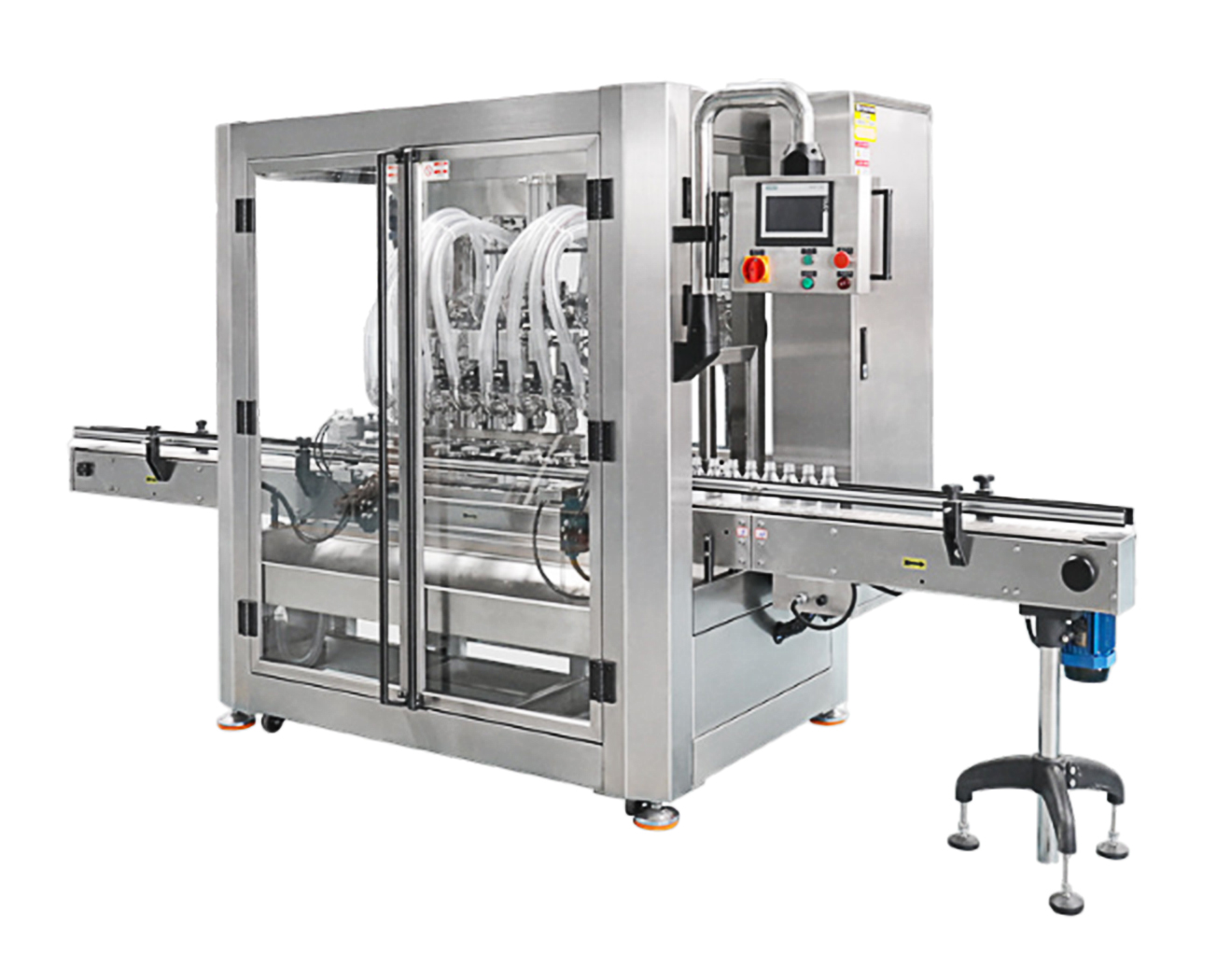
Solution B: Liquid/Paste VFFS for Single-Serve Sauce Sachets
Best for: ketchup, smooth mustard, mayonnaise and soy sauce portions supplied to takeaway restaurants, meal kits and catering distributors.
A vertical form-fill-seal machine forms the pack from roll film, meters the sauce, heat-seals the pack and cuts it from the web. For smooth, thicker condiments, pair the bagger with a suitable piston or pump dosing system and controlled nozzle shut-off. Thin soy sauce needs a dosing and valve arrangement that prevents uncontrolled flow between fills.
Why choose this route: it removes the need to handle each empty sachet and combines forming, filling and sealing. Roll film is often economical for repeat orders, but compare the actual film specification, pack size and waste with your alternatives. Specify the finished seam style first: a back-seal sachet, four-side-seal packet and narrow stick pack are not automatically interchangeable on the same machine.
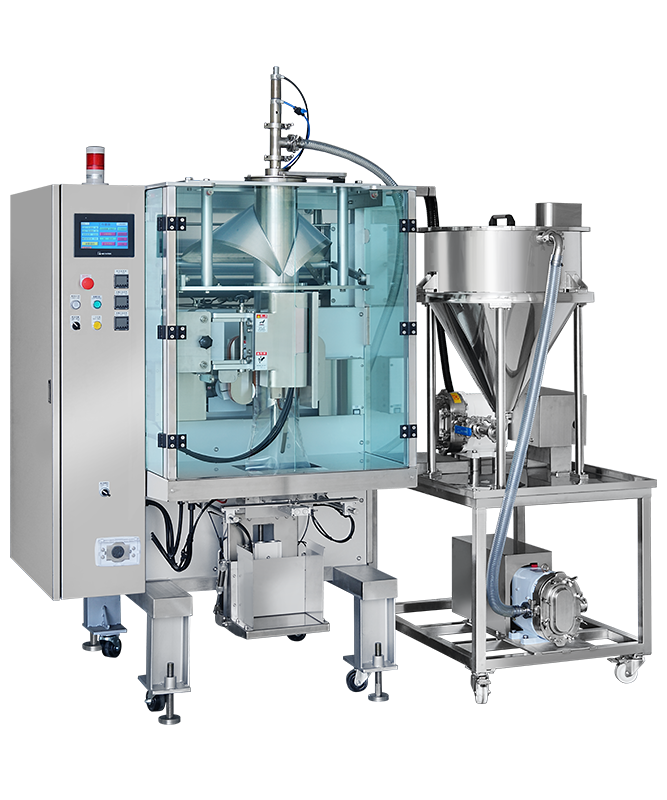
See our bagged packaging solutions for the roll-film packaging route.
Solution C: Premade Pouch Filling and Sealing for Retail Sauces
Best for: cooking sauces, chili paste and family-size condiments in printed stand-up pouches.
The machine opens a finished empty pouch, holds it for dosing, then seals the mouth. We recommend this route when shelf presentation and the pouch shape matter more than making the package from roll film. For sauces with pieces, match the pump, valves and nozzle passage to the largest inclusion, and support the pouch during filling to keep the mouth stable.
Why choose this route: use a retail-ready pouch while automating the handling and sealing steps that become awkward when done by hand. Select a compact pouch machine for a constrained layout or a rotary system for more continuous production. A top-filled pouch is the route shown here; filling through a spout and applying a cap requires a different handling and closing arrangement.
For the broader liquid, powder, granule and mixed-product decision, return to the condiment packaging machine guide.
Sauce Packaging Pain Points—and the Configurations We Recommend
A faster bagger will not solve an unsuitable nozzle or a dirty seal area. Start with the problem you see on the line, then specify the part of the solution that removes its cause.
| Your production problem | Recommended solution | How the configuration helps | Best application |
|---|---|---|---|
| Sauce drips onto bottle shoulders or pouch seals. | A, B or C: positive shut-off nozzle; evaluate suck-back where suitable. | Stop the product stream before the container moves or the jaws close. Set nozzle withdrawal and dose timing together; inspect the closure area during the trial. | Ketchup, BBQ sauce and smooth pastes. |
| Thick sauce fills slowly or leaves inconsistent portions. | A, B or C: product-matched piston or positive-displacement pump; controlled hopper feed. | Provide a consistent supply to the dosing chamber. Size the inlet and outlet for the sauce at its actual filling temperature, then check net weight across the run. | Mayonnaise, mustard and thick cooking sauces. |
| Chili or vegetable pieces block the filler or lose their texture. | A or C: wide product passages and a particle-compatible valve/pump; gentle mixing only if needed. | Match the narrowest passage to the inclusions. Compare filled samples with the original sauce for intact pieces and distribution, not just total weight. | Chili sauce, salsa and sauces with soft inclusions. |
| Filled sachets leak or have sauce trapped in the seam. | B: synchronized dose cut-off and jaw timing; C: stable pouch opening and fill positioning. | Keep the sealing zone clear, then set heat, pressure and dwell for the actual laminate. Inspect seams and test finished packs after filling. | Takeaway sachets and retail sauce pouches. |
| Hand filling ties up staff, but demand does not justify a full line. | A: semi-automatic filler plus separate capper. | Automate dosing first. Retain manual container loading and changeovers; measure complete packed output before adding conveyors or extra heads. | New sauce brands and seasonal small batches. |
| Cleaning between flavors consumes the production window. | A, B or C: accessible product path, removable contact parts and planned changeover sequence. | Choose access around the hopper, pump and nozzle—not just a compact machine footprint. Demonstrate draining, disassembly and cleaning on the proposed configuration. | Multiple recipes, sticky sauces and allergen changeovers. |
For product-specific selection, compare the ketchup packing machine guide and the chutney packing machine guide.
Applicable Scenarios: Which Setup Fits Your Sauce Business?
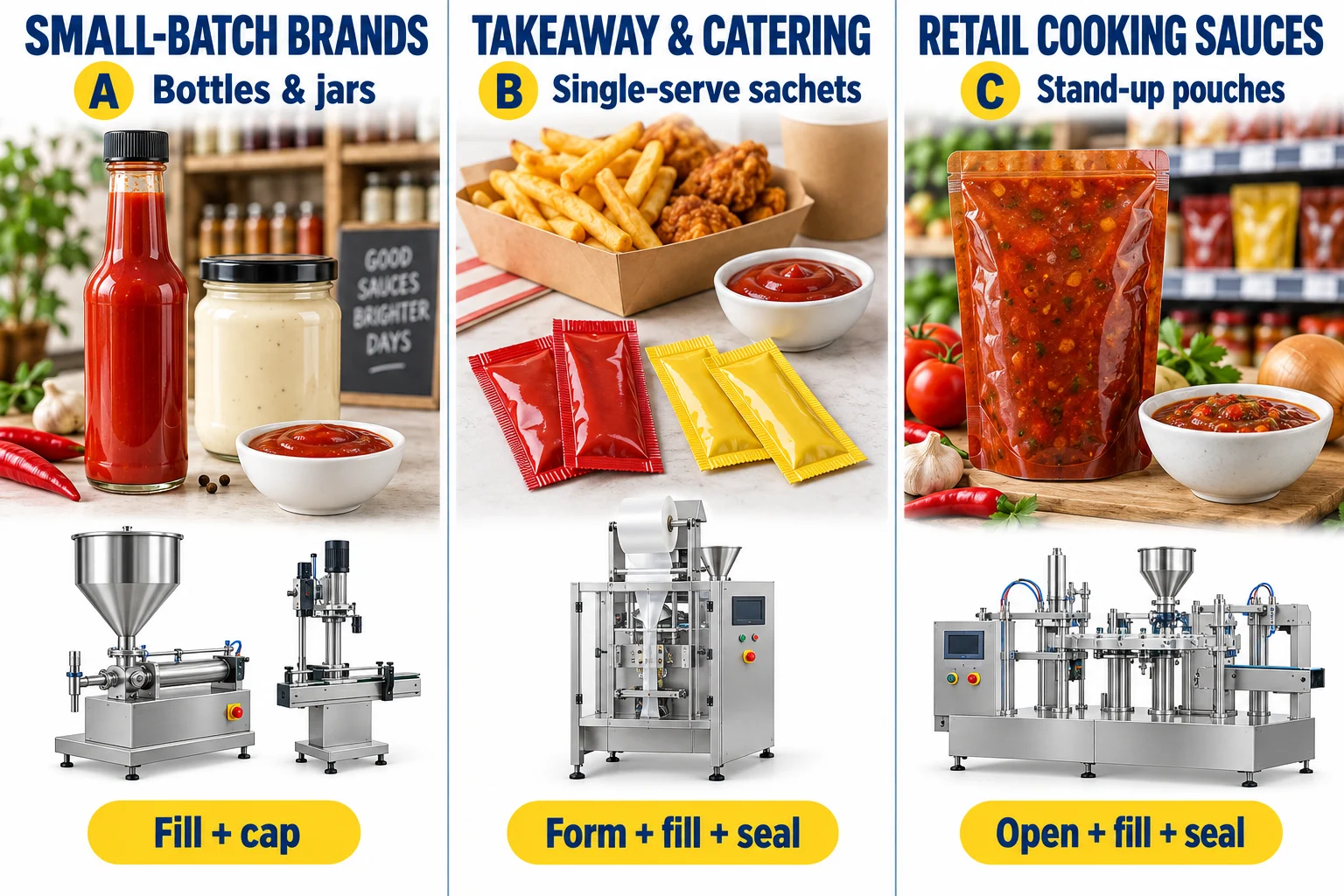
- A new hot sauce brand selling several recipes: choose Solution A with operator-loaded bottles and a separate capper. Put your first investment into repeatable dosing and convenient cleaning instead of automating every transfer.
- A restaurant supplier delivering ketchup and mustard portions: choose Solution B with roll-film sachets and synchronized dosing. Run both recipes during evaluation; similar pack sizes do not mean identical filling behavior.
- A retail brand launching chunky chili cooking sauce: choose Solution C with top-filled stand-up pouches and a particle-compatible dosing path. Use the largest pieces in the sample batch, and inspect both texture and seal cleanliness.
- An established mayonnaise or dressing producer adding bottle capacity: expand Solution A to automatic filling and capping. Match the capper, labeling and operator replenishment to the filler so a faster dose does not simply move the bottleneck.
Which Small Sauce Packaging Machine Should You Start With?
For short runs in bottles or jars, our starting recommendation is a semi-automatic piston filler with a separate closing station. For repeat sachet orders, a compact automatic VFFS machine is the more relevant choice because it makes and seals the pack as well as filling it. For purchased retail pouches, compare manual pouch loading with a compact automatic premade-pouch system.
Small does not mean operator-free. A benchtop filler normally still needs someone to present containers, replenish sauce and close the packs. A compact automatic machine reduces pack handling, but still needs space for film or pouch loading, cleaning, utilities and finished-pack collection.
| If this describes your business | Start here | What remains manual / what triggers an upgrade |
|---|---|---|
| Short batches, several bottle or jar sizes, changing recipes. | Semi-auto piston filler + separate capper (A). | Loading, transfer and often cap placement. Upgrade when these tasks consistently limit finished output. |
| Repeat orders for the same takeaway portion. | Compact liquid/paste VFFS (B). | Film replacement, sauce replenishment and collection. Add capacity after proving clean seals and stable dosing with the production film. |
| Retail stand-up pouches with regular orders. | Compact premade pouch filler/sealer (C). | Replenishment and changeovers; handling depends on the selected model. Compare operator time and cleaning access against a rotary system. |
Size the Machine Around Finished Packs, Not an Empty-Cycle Speed
For example, suppose you need 2,400 saleable bottles per day and have 4 hours of actual packing time after cleaning and changeovers. Your required average is 2,400 ÷ 240 = 10 finished bottles per minute. This is an illustrative planning calculation, not a Comwin machine rating. The trial must include filling, capping, operator handling and rejects; select operating margin based on the observed interruptions.
For a small team, this calculation often makes the purchase decision clearer than comparing the number of filling heads. A machine that doses quickly but leaves a queue at manual capping has not delivered the required finished output.
Configure the Filler for Your Actual Recipe
A condiment packaging machine for liquid or paste products should be selected with three recipe conditions in view:
- Flow at filling temperature: provide the temperature and a sample, not just the name “chili sauce.” Evaluate a jacketed hopper only when the process needs temperature control; heating is not a universal fix for slow filling.
- Particles and separation: include the largest pieces and their typical concentration. Assess gentle agitation where settling changes the composition of each dose; mixing must not damage the product texture.
- Cleaning and contact compatibility: specify oil, acid, salt and allergens, together with cleaning chemicals. Select seals and contact materials for that combination, and demonstrate how retained product is removed.
Dry seasoning powders require a different dosing system and are outside the liquid/paste routes described here. Likewise, the packaging machine does not by itself establish shelf life: your preservation process, packaging barrier and storage conditions must be validated separately.
What We Check in a Sauce Sample Trial
Our free sample testing helps turn a proposed configuration into a practical selection. Send the sauce together with the actual bottle and cap, premade pouch, or production film. The most useful trial shows:
- Dose consistency: record net weights over a run, including restart and replenishment—not just one successful fill.
- Texture and presentation: inspect intact pieces, visible separation, drips and product around the closure.
- Pack integrity: check sealed areas or applied caps against agreed packaging acceptance criteria, including the planned handling conditions.
- Changeover effort: demonstrate draining and access to the product path, then record the steps needed for the next recipe or pack size.
Agree on the fill range, acceptable weight variation, good-pack output and closure checks before acceptance. A water-only demonstration is not a substitute for running your thick or particulate sauce.
Working with Comwin
We match single machines and customized lines to your sauce, packaging and production plan. Free sample testing and real factory visits support selection. Small machines include video tutorials and remote-call support. Our service commitment is a two-year machine warranty, three years for core components and remote response within 24 hours. Your proposal will identify the supplied modules and project-specific requirements.
Frequently Asked Questions
Can one sauce packing machine handle ketchup, mayonnaise and soy sauce?
One platform may handle them with suitable dosing parts and settings, but do not assume an unchanged setup. Thin soy sauce needs controlled shut-off; mayonnaise needs a product path that fills without starving or excessive resistance. Test the thinnest and thickest recipes before selecting the shared configuration.
Should I choose sachets or premade pouches?
Choose roll-film sachets for repeat single-portion orders. Choose premade stand-up pouches when retail appearance and larger pack presentation are priorities. Compare actual packaging quotations and changeover needs; a lower film cost alone does not decide the best system for short runs.
Can a small filler handle chunky chili sauce?
Yes, if its pump or piston valve, nozzle and product passages are designed for those pieces. “Suitable for paste” is not enough. Send a representative sample with the largest inclusions for testing, and assess whether a wide-mouth jar or top-filled pouch gives the product a more suitable passage than a narrow bottle neck.
Does a sauce filler also seal the package?
A standalone filler only doses the product. Bottle capping, pouch heat-sealing and sachet forming/sealing are different operations. Our proposal separates these modules so you can see what is automated and what your operator will still do.
Get a Sauce Packaging Solution Matched to Your Product
Send us your sauce sample or product video, filling temperature, largest particle size, target fill weight, packaging sample, daily output and available workspace. Tell us where the current process slows down or creates waste.
We will recommend the packaging route, dosing configuration and automation level, with a module-by-module supply scope and a sample-testing plan. You can compare a practical small-machine starting point with the upgrade needed for your next production stage.