
A condiment packaging machine is not one universal machine. The correct system depends first on whether your condiment is a liquid, paste, fine powder, free-flowing granule or mixed recipe. It then depends on the finished pack: bottle, jar, roll-film sachet, stick pack or premade pouch.
For sauces and liquid seasonings, choose a pump or piston filling route. For chili powder, curry powder and other fine seasonings, use an auger dosing system. For salt, sugar crystals, MSG and similar granules, use a volumetric cup or weighing system. Mixed herb-and-spice recipes may need separate dosing stations so each component reaches the pack in the intended proportion. Comwin matches the dosing method, packaging machine and automation level to your product and production plan.
Equipment Selection Guide: Four Condiment Packaging Routes
Choose Route A for liquids and pastes, B for fine powders, C for free-flowing granules, or D for multi-component seasoning blends. Do not choose the bagger before identifying how the product must be measured and transferred.
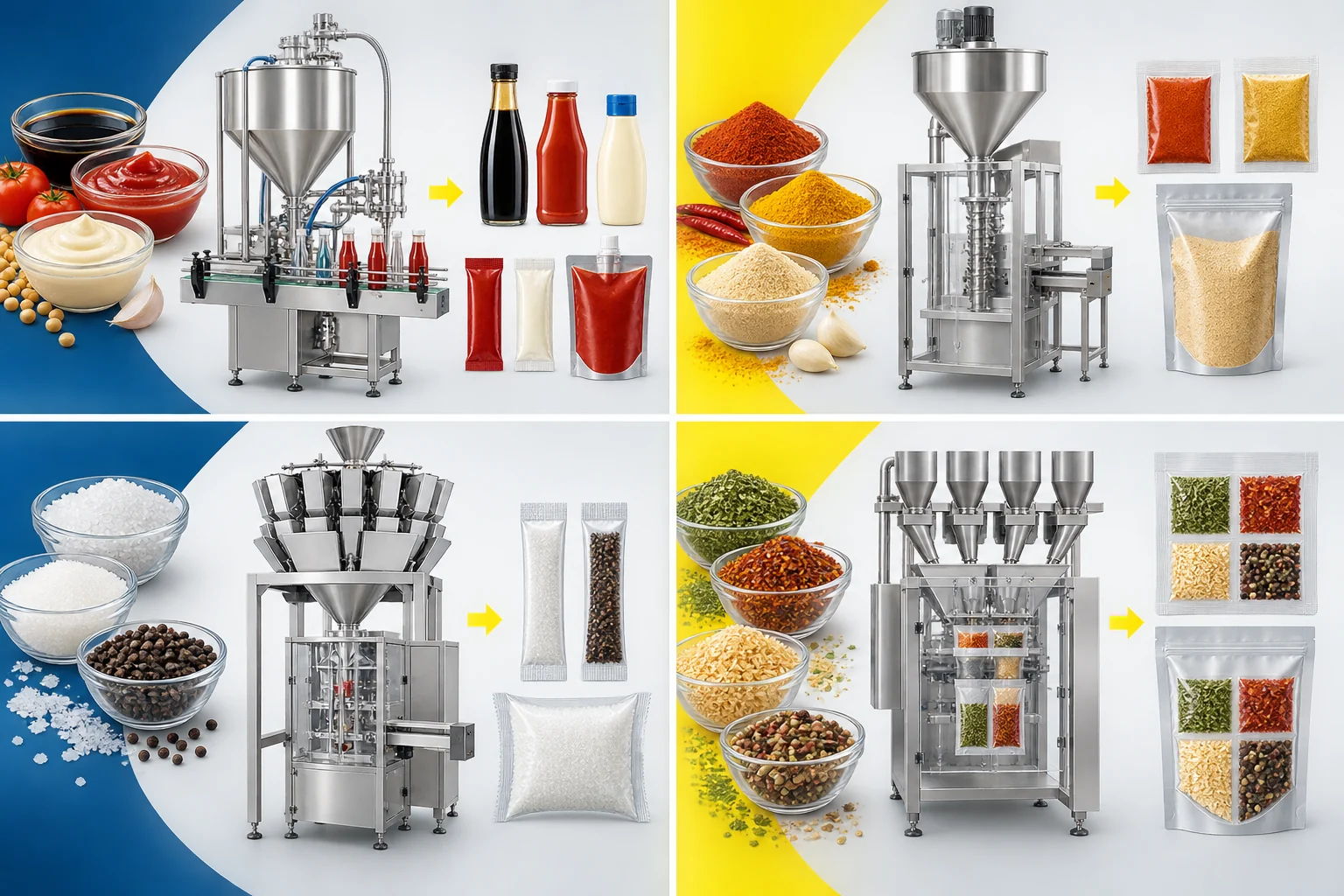
Route A: Pump or Piston Filling for Liquid and Paste Condiments
Best for: soy sauce, vinegar, fish sauce, ketchup, mayonnaise, mustard, salad dressing, chili sauce and smooth cooking pastes.
Thin, free-flowing liquids need controlled valves and clean shut-off. Thick emulsions and pastes normally need a piston or product-matched positive-displacement pump. Products containing chili, garlic or vegetable pieces require passages and valves sized around the largest inclusion—not merely the average viscosity.
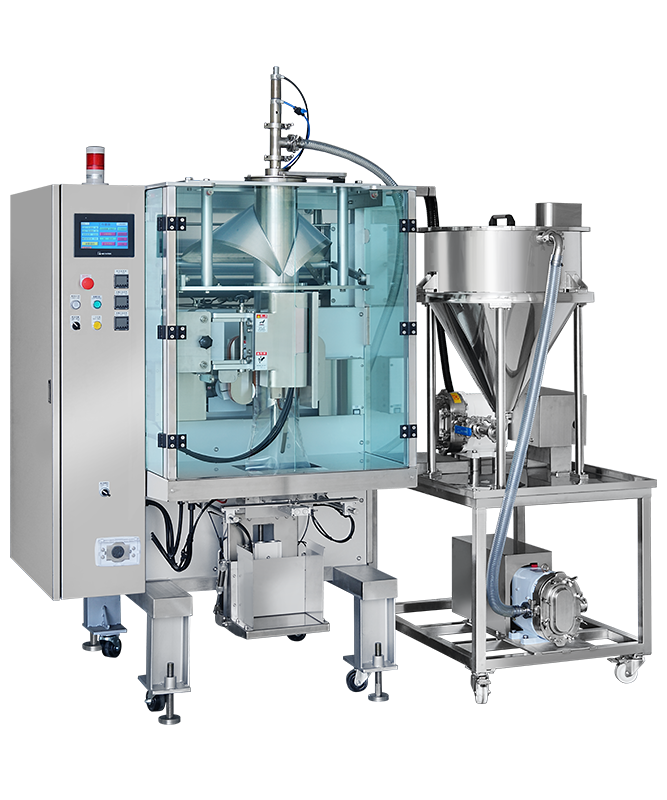
Choose a bottle or jar filler when the closure and retail format are already established. Choose liquid/paste VFFS when the machine should form single-serve sachets from roll film. Choose a premade-pouch filler and sealer when the pouch shape, print quality or shelf presentation is the priority. These routes use different container handling and sealing systems.
Why choose Route A: it matches the filler to flow behavior and keeps the seal or closure area clean. See our filling and sealing equipment for bottle and container projects.
Route B: Auger Dosing for Fine Seasoning Powders
Best for: chili powder, curry powder, garlic powder, pepper powder, bouillon powder and fine blended seasonings.
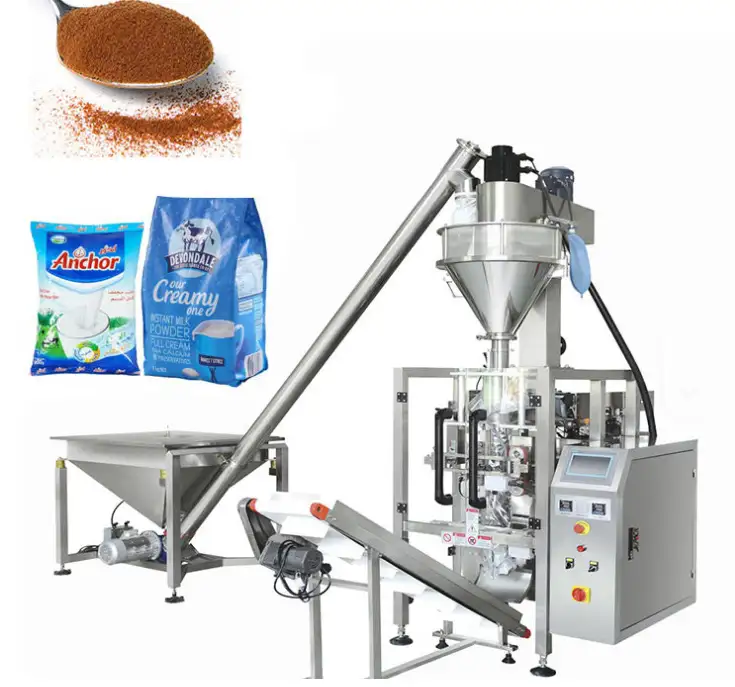
An auger rotates a controlled number of turns to dispense powder into the pack. It is the usual starting route when the product does not flow consistently through a cup filler. The auger, hopper agitation, feeding method and bagger must be selected together. A powder that aerates, compacts or sticks to surfaces can change its bulk density during a run.
Dust extraction or local dust control may be needed around the dosing and sealing area. The goal is not only dose repeatability: powder must stay out of the seal zone. For frequent recipe changes, check access to the hopper, screw and product-contact parts before choosing a compact layout.
Why choose Route B: the auger actively meters fine powder and can be integrated with VFFS sachets, premade pouches or a separate container-filling station. It is a different dosing system from the pump used for sauces.
Route C: Cup or Weighing Systems for Granular Condiments
Best for: salt crystals, sugar, MSG granules, peppercorns, sesame and other reasonably free-flowing particles.
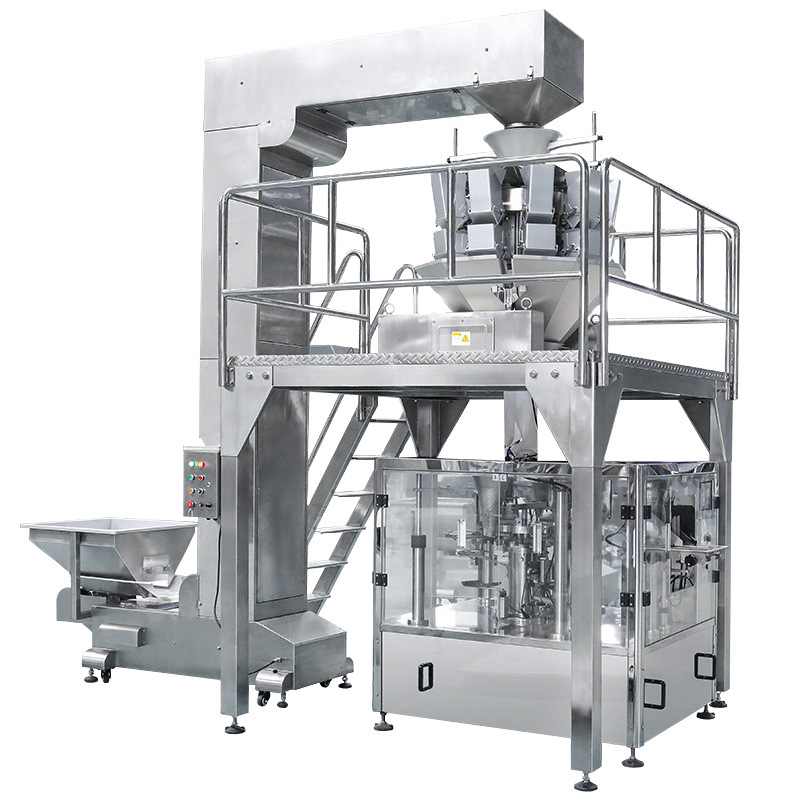
A volumetric cup system measures by volume and is practical when particle shape and bulk density remain stable. A linear or multihead weigher measures by weight and is the better comparison when particle sizes vary, the product value justifies closer weight control, or different target weights are required. The product still needs a suitable elevator or feeder and a bagger synchronized with the dose.
Fine salt and coarse sea salt should not be treated as identical. Hygroscopic products may bridge in the hopper or pick up moisture; fragile ingredients can break during feeding. Provide the actual production material and planned storage conditions for trials.
Why choose Route C: cups and weighers handle discrete particles without forcing them through a paste pump or powder auger. Choose between them by product consistency, target weight, changeover needs and acceptance criteria.
Route D: Separate Dosing Stations for Mixed Seasoning Kits
Best for: soup bases, noodle seasoning kits, dry rubs and herb-spice blends in which components differ greatly in size, flow or required dose.
A single hopper can allow large and small particles to separate before filling. When recipe uniformity cannot be maintained by gentle mixing, use independent dosing stations for the powder and coarse components, then discharge them into one pouch or into separate sachets assembled as a kit. A premade pouch line can also combine separately prepared components when pack presentation or zipper features matter.
Why choose Route D: it controls components according to their own behavior. This route costs more and needs more cleaning coordination than one filler, so it should be justified by the recipe and acceptance test—not added automatically.
For liquid and paste condiments, continue to the sauce packing machine selection guide. It compares bottle and jar filling, rollstock sachets and premade pouches in more detail.
Condiment Packaging Problems—and the Comwin Route to Evaluate
The machine recommendation should explain the cause of the problem and how the proposed configuration will be tested. “Suitable for condiments” is not a complete specification.
| Production problem | Recommended Comwin route/configuration | How it addresses the cause | Products and acceptance check |
|---|---|---|---|
| Sauce drips onto a bottle shoulder or sachet seal. | Route A: product-matched pump or piston filler with positive shut-off; evaluate suck-back where appropriate. | Stop the product stream before the container moves or sealing jaws close. Coordinate nozzle movement, dose timing and pack handling. | Ketchup, mustard, dressings and soy sauce. Inspect closures and seals during a representative run. |
| Fine seasoning powder contaminates the seal or workplace. | Route B: enclosed auger feed, controlled discharge and project-specific dust management. | Shorten uncontrolled powder fall and keep the sealing zone clear. Select extraction only after understanding product dust behavior. | Chili, curry, garlic and bouillon powders. Check seal cleanliness, dust escape and net weight. |
| Salt or granules bridge in the hopper and interrupt dosing. | Route C: suitable hopper geometry, agitation or vibration, and a cup or weighing system chosen from sample trials. | Maintain consistent product presentation to the measuring device instead of compensating only with bagger speed. | Salt, MSG and coarse seasonings. Observe refill, restart and low-level behavior. |
| A herb-spice blend separates before it reaches the pack. | Route D: separate dosing for components with materially different particle size or density. | Meter each component independently, or prove that the proposed preblend remains uniform through feeding and filling. | Soup mixes, dry rubs and meal kits. Sample packs across the run and compare component distribution. |
| Frequent recipe changes consume the production window. | Routes A–D: accessible product-contact parts, removable dosing components and a documented changeover sequence. | Cleaning access and part identification reduce avoidable disassembly and reassembly time; allergen controls remain site-specific. | Multi-flavor factories. Demonstrate draining, cleaning, inspection and restart. |
| The filler is fast but finished-pack output remains low. | Match feeder, dosing system, bagger, coding, inspection and case handling as one line. | Measure good finished packs rather than an empty-cycle speed. Find the real constraint before adding heads or lanes. | Any high-volume project. Record output, stops and rejects under agreed conditions. |
Applicable Scenarios: Which Condiment Packaging Setup Fits?
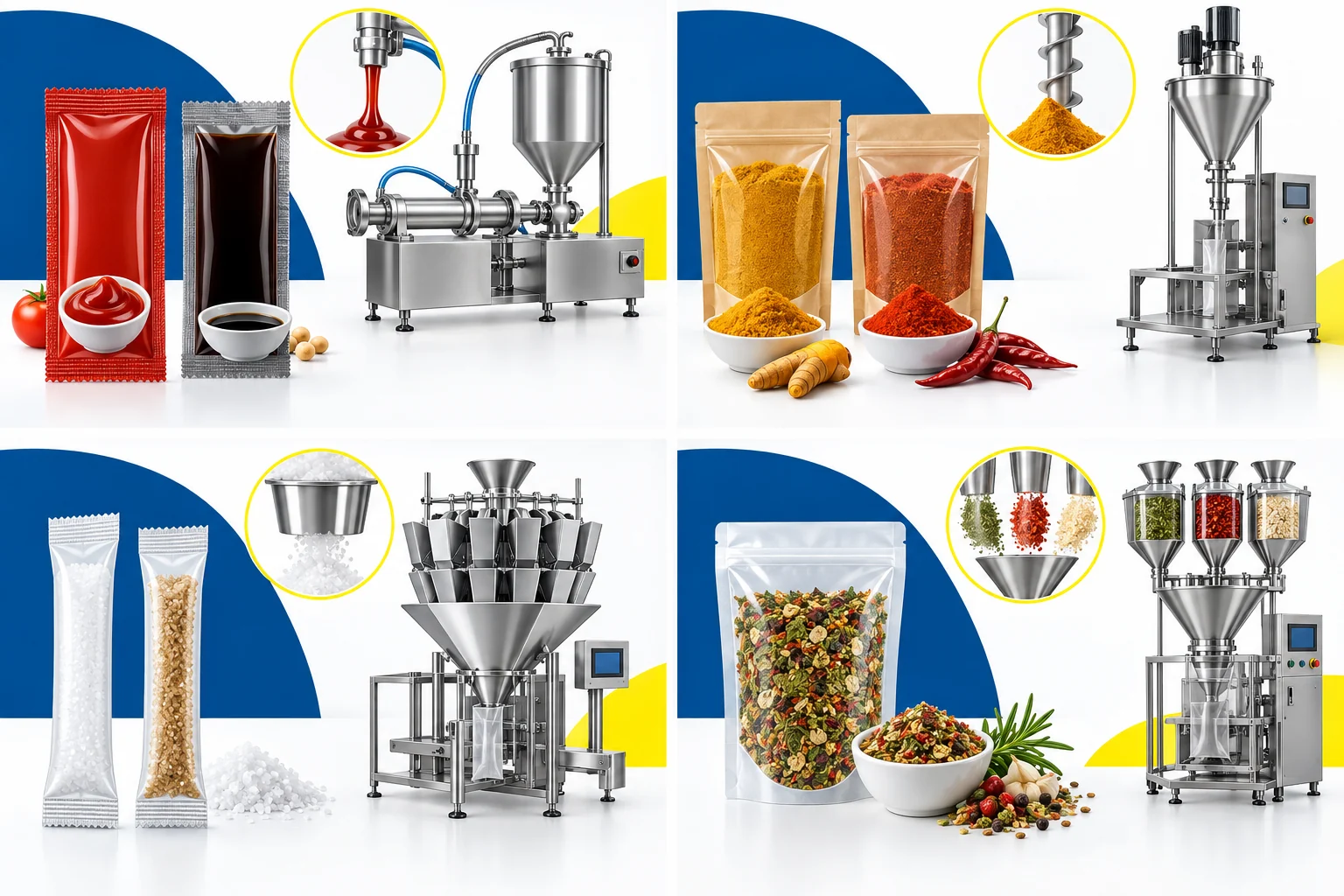
- A foodservice supplier producing ketchup, mayonnaise and soy-sauce portions: start with Route A and a liquid/paste sachet machine. Test the thinnest and thickest recipes because they may require different pump parts and settings.
- A spice brand selling curry and chili powder in retail pouches: choose Route B with auger dosing and either VFFS roll film or a premade-pouch machine. Prioritize dust control, seal cleanliness and fast access for recipe changes.
- A hotel or meal-kit supplier packing salt and sugar sticks: choose Route C with a cup or other validated granular doser. Compare single-lane flexibility with multi-lane capacity only after fixing the dose, stick dimensions and film.
- A soup or noodle producer combining powder, dried vegetables and coarse spices: evaluate Route D. Separate dosing is appropriate when a shared hopper cannot maintain the intended component distribution.
- A co-packer handling all four product states: do not expect one universal product-contact system. Standardize controls and downstream handling where practical, but use dedicated or exchangeable dosing modules with validated cleaning boundaries.
Choose the Package After the Product Route
| Finished package | Best fit | Machine route | Decision to confirm |
|---|---|---|---|
| Roll-film sachet or stick pack | Single portions and repeat orders | VFFS or multilane sachet machine with pump, auger or granule doser | Seal style, film structure, dose, lane count, tear notch and coding |
| Premade stand-up pouch | Retail presentation, zipper options and larger portions | Premade-pouch opener/filler/sealer with the product-specific dosing system | Pouch dimensions, opening quality, support during filling and seal contamination risk |
| Bottle or jar | Pourable sauces, table condiments and reusable retail packs | Container filler plus the correct capper, sealer and labeler | Container opening, cap/liner, fill temperature, drip control and closure inspection |
| Multi-sachet kit | Meal kits and recipes with separately protected components | Two or more filling routes plus collating or secondary packaging | Component count, sequence, missing-component detection and final kit presentation |
See our bagged packaging solutions when comparing roll-film and premade-pouch routes. Package choice also depends on barrier, preservation process and distribution conditions; the packaging machine alone does not establish shelf life.
How to Specify a Complete Condiment Packaging Line
Begin with the saleable pack and work upstream. A complete line may include product preparation, transfer, dosing, primary packaging, coding, inspection, collection and case packing. Not every project needs every module.
- Define the product: supply recipe family, viscosity or flow behavior, particle-size range, bulk-density variation, oil/acid/salt exposure, allergens and filling temperature.
- Define the finished pack: give physical samples or drawings for film, pouch, bottle, jar, cap and label. State the target fill range and expected changeovers.
- Define saleable output: state good packs per minute or per shift after normal replenishment, cleaning and changeovers—not only a desired machine cycle.
- Define utilities and layout: confirm voltage, frequency, phase, compressed air, available height, cleaning access and connections to upstream or downstream equipment.
- Define acceptance: agree how dose consistency, seal or closure quality, recipe distribution, cleaning and good-pack output will be checked.
For example, a requirement for 12,000 acceptable sachets in a six-hour packing window equals 12,000 ÷ 360 = 33.3 good sachets per minute. This is a planning calculation, not a Comwin machine rating. Add operating margin only after estimating replenishment, film changes, cleaning and expected stops.
What We Check During Condiment Sample Testing
Our free sample testing is used to match the dosing system and packaging route before the final configuration is confirmed. Send production-representative material—not only a substitute with a convenient flow.
- Liquid and paste: dose behavior at the actual filling temperature, nozzle shut-off, particles, stringing and contamination around the closure or seal.
- Powder: feeding consistency, compaction or aeration, dust escape, seal cleanliness and weight variation through refill and restart.
- Granules: bridging, breakage, particle segregation, cup or weighing performance and low-level hopper behavior.
- Mixed recipes: component distribution across multiple packs, gentle handling, missing-component controls and cleaning between recipes.
The trial should use the proposed film, pouch or container wherever possible. Agree on sample count, acceptable variation, pack integrity and good-output criteria before the test. A short demonstration of one successful pack is not a factory acceptance test.
Working with Comwin
We provide the most suitable packaging solution for your product, pack format and production requirements. Comwin can match a single machine or a customized line, support free sample testing and arrange real factory visits. Small machines include video tutorials and remote-call support. Our service commitment is a two-year machine warranty, three years for core components and remote response within 24 hours. The proposal will identify the supplied modules and project-specific acceptance conditions.
Frequently Asked Questions
Can one condiment packaging machine pack sauces, powders and granules?
The same bagging platform may sometimes accept different dosing modules, but the product-contact and metering systems are different. Sauces need pumps or pistons, powders commonly need augers, and granules use cups or weighing systems. Changeover feasibility, cleaning and the required pack range must be confirmed before treating one platform as multi-product.
What is the difference between a condiment filling machine and a condiment packing machine?
A filling machine meters product into an existing container or pouch. A packing machine may also form the package, seal it, cut it and add coding. Always ask which operations are included; a standalone filler does not automatically cap a bottle or seal a pouch.
Should seasoning powder use an auger or a cup filler?
Use an auger when the powder needs active, controlled dispensing and does not flow reliably by gravity. A cup filler may suit free-flowing granules or stable coarse products. Sample testing should confirm bulk-density effects, dust and the required dose range.
When is a multihead weigher useful for condiments?
It is useful for discrete particles when weight-based combination offers a better fit than volumetric cups, especially across variable particle sizes or higher-value products. It is not the default choice for fine powders or sauces.
Can the line handle both retail pouches and foodservice sachets?
Usually these formats require different pouch handling or forming equipment. A project can share upstream preparation or some dosing concepts, but a premade retail pouch and a roll-film single-serve sachet should be evaluated as separate packaging routes.
What information is needed for a quotation?
Send the condiment type and sample, particle or viscosity details, target fill range, package sample and dimensions, desired good-pack output, available utilities, layout limits and destination country. For multi-product use, list every recipe and pack combination rather than only the easiest one.
Get a Condiment Packaging Solution Matched to Your Product
Send us your condiment sample, product specification, target weight or volume, finished-pack sample, required output and factory layout. We will compare the suitable dosing route, primary packaging machine and automation level, then define what should be verified during sample testing.