Dry tissue and paper-product packaging
Tissue Paper Packing Machine Price: Soft Stacks and Rolls
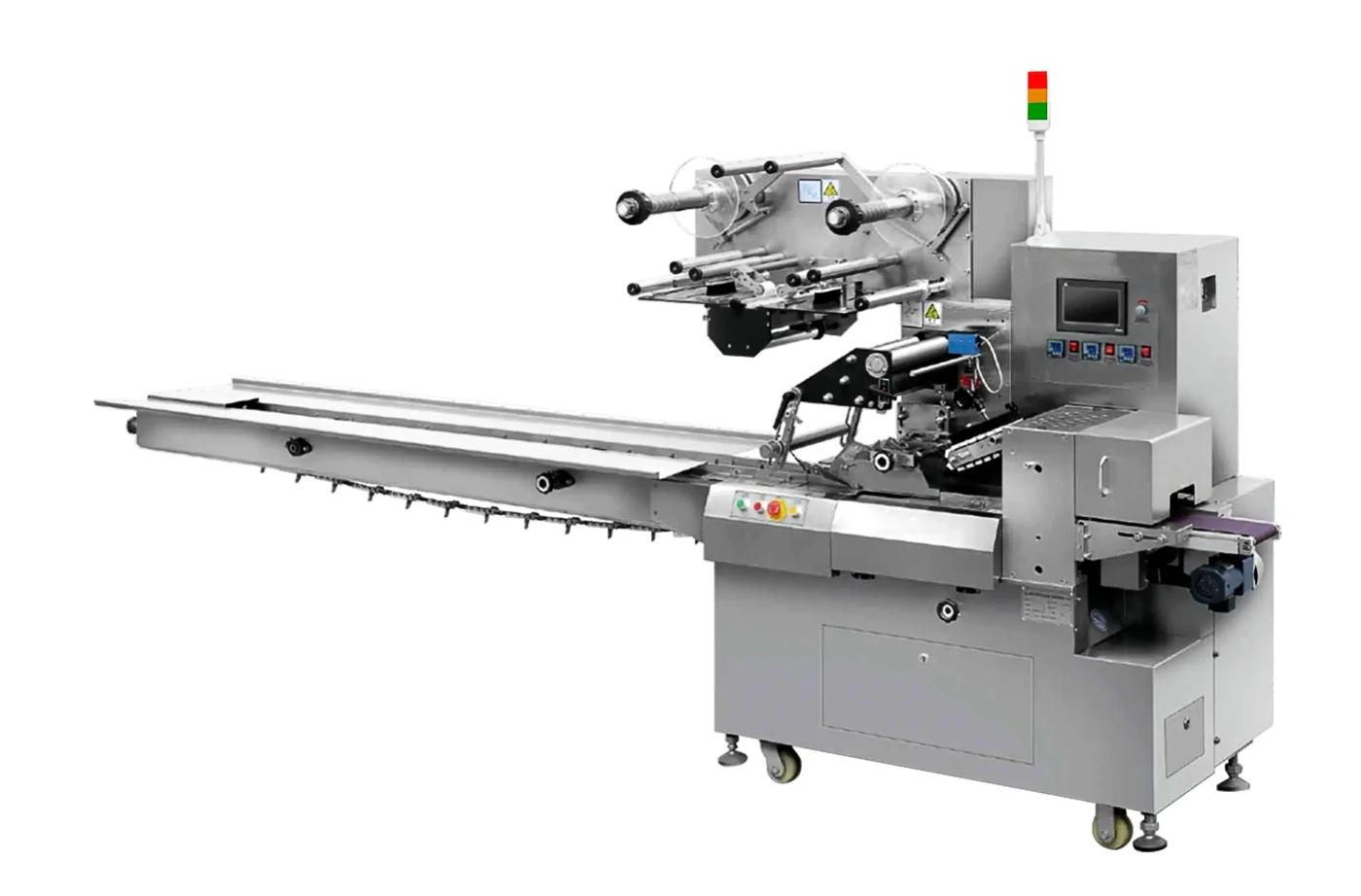
For stable folded tissue stacks that accept a film pack, use horizontal wrapping with side and bottom support. It keeps the edges together through the former and away from the seal. A single roll needs guides that prevent it rotating or drifting at transfer. Specify a dispenser carton or shipping case according to the finished pack.
An automatic stack wrapper with the defined feed and film-closing tools is US$18,000–55,000. A single-roll wrapper with its matched infeed is US$10,000–35,000. Retail cartoning, arranging multiple wrapped packs and shipping cases are separate scopes.
Match the primary pack to the product
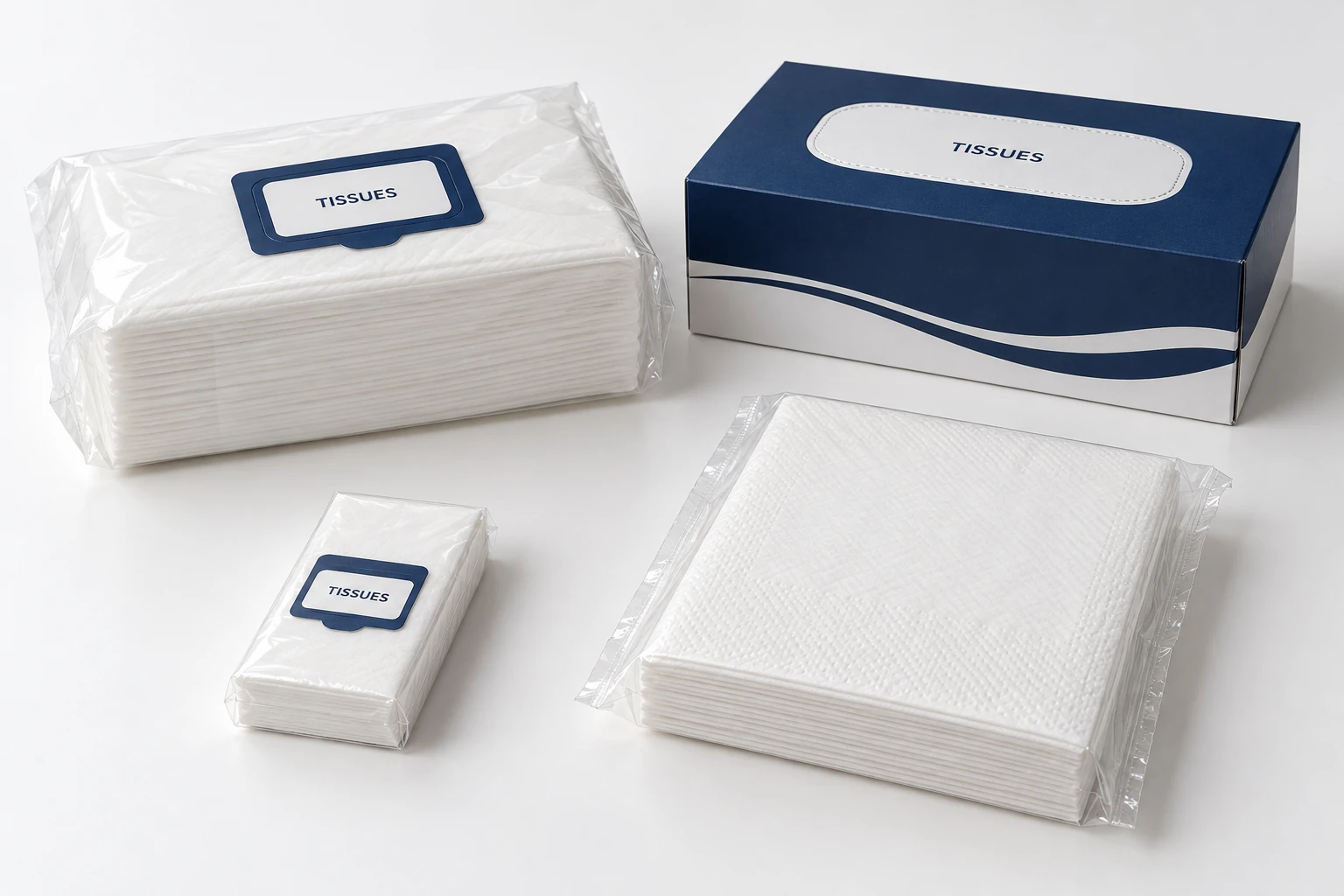
Soft facial-tissue packs
Present counted interfolded stack → control and centre → wrap and seal → check opening and dispensing.
Assess stack height, compression, film tension and the selected dispensing opening or label. Keep loose sheets clear of the seal.
Folded napkin stacks
Present specified folded stack → support and shape → film wrap or bag → close and inspect.
Check sheet count, folded dimensions and exposed edges. The actual folding pattern and stack determine the feed and wrapper tools.
Pocket and handkerchief tissues
Receive prepared small stack → position → wrap → apply the specified opening or closure.
Standard, mini and wallet formats need their actual dimensions and fold arrangement assessed. Confirm whether upstream folding is included or customer-supplied.
Boxed facial tissues
Form dispenser carton → load oriented interfolded stack → close and inspect.
Match the insert or stack support and dispensing opening to tissue withdrawal. A shipping-case packer does not perform this retail-box task.
Control the stack through feeding, compression and sealing
Specify sheet size, fold, stack dimensions, count and inlet condition. Distinguish sheets from plies, and include normal variation in height and compressibility. These determine the feed path alongside pack length.
Check supports, side guides, transfer gaps and any top restraint or compression. Hold the stack without tearing edges, spreading sheets or overcompressing the pack. Agree finished shape and dispensing checks using samples.
Choose the opening and film with the finished product
Identify whether the customer opens a perforation, removes a label or tears a sealed edge. Confirm the location relative to the tissue fold and withdrawal direction. A resealable label, where used, needs its own positioning and application checks.
Trial film, print registration, folds and seals. Specify any vent or air-release opening and its purpose; a vented bag is not airtight.
| Observed issue | Inspect | Finished-pack check |
|---|---|---|
| Stack spreads or sheets catch | Inlet condition, transfer gaps, side support and timing | Stack position, count and exposed edges after packing |
| Pack is distorted or too tight | Compression, film allowance and release of trapped air | Pack shape and tissue withdrawal after the agreed handling period |
| Tissue enters the seal | Positioning, loose edges, film forming and closure timing | Clean seal area and agreed seal integrity |
| Opening is misplaced | Stack orientation, registration and opening-tool or label position | Usable access and dispensing from the finished pack |
| Bundles have the wrong pattern | Unit counting, orientation, grouping and transfer | Correct units, rows and layers in the outer package |
Distinguish single-roll wrapping from roll multipacks
Provide roll diameter, width, core details, winding condition and the required orientation. Check the largest and least stable roll, exposed paper edges and any tendency to unwind during transfer. Kitchen towels and toilet rolls can need different dimensions and handling even when they use a similar packaging process.
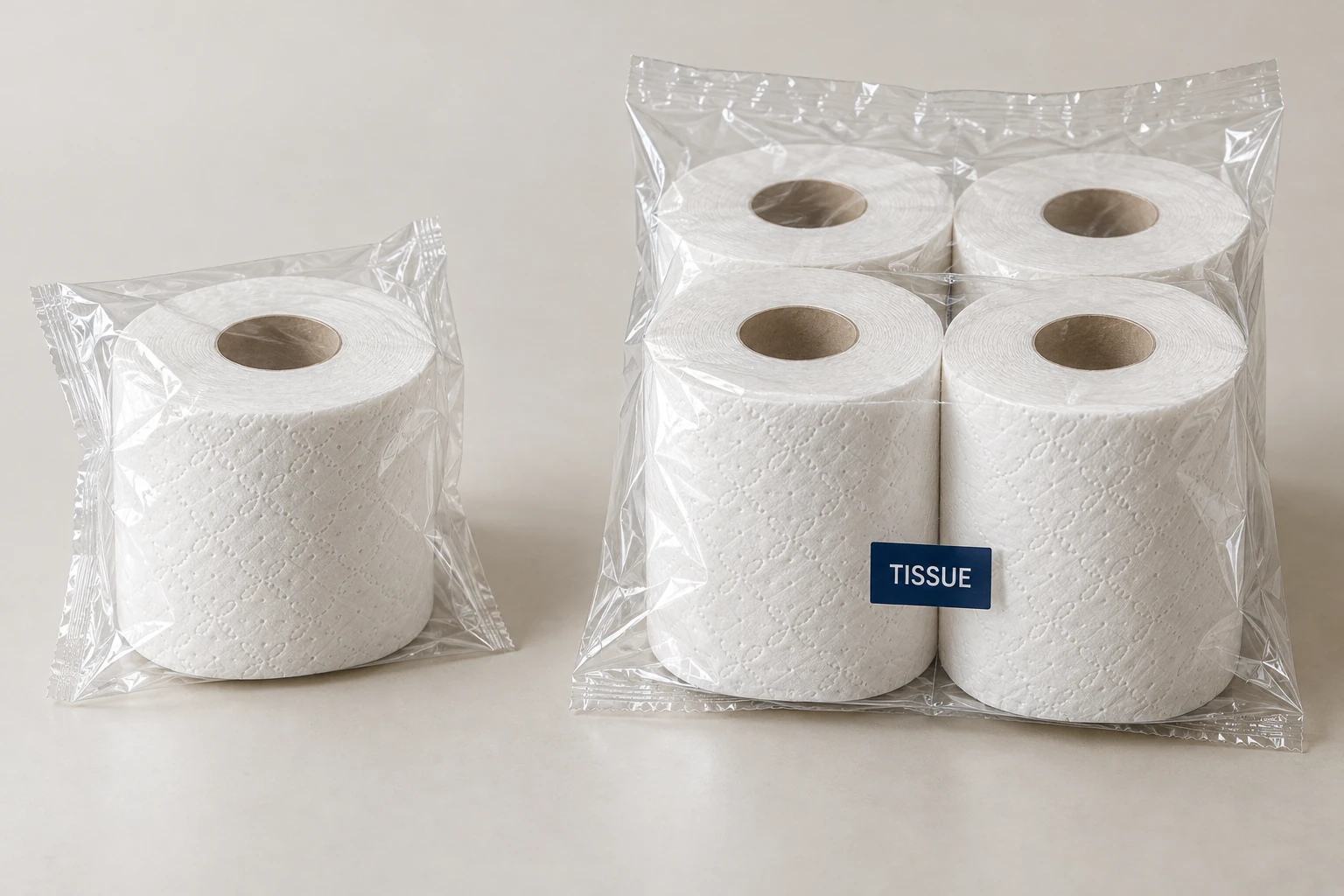
A single-roll wrapper handles one prepared roll. A bundle system forms the specified rows or layers and closes a shared outer package. Specify film or purchased bags, any handle arrangement and the accepted pattern. The grouping equipment must preserve roll shape while producing a stable bundle.
Add bundles and shipping cases where the finished pack requires them
For facial-tissue bundles, define the incoming primary pack, units per bundle, orientation and rows or layers. Check how wrapped packs are counted, arranged, compressed where appropriate and inserted into an outer bag or film package. Assess pocket-tissue and napkin family packs as separate jobs with their own grouping drawings.
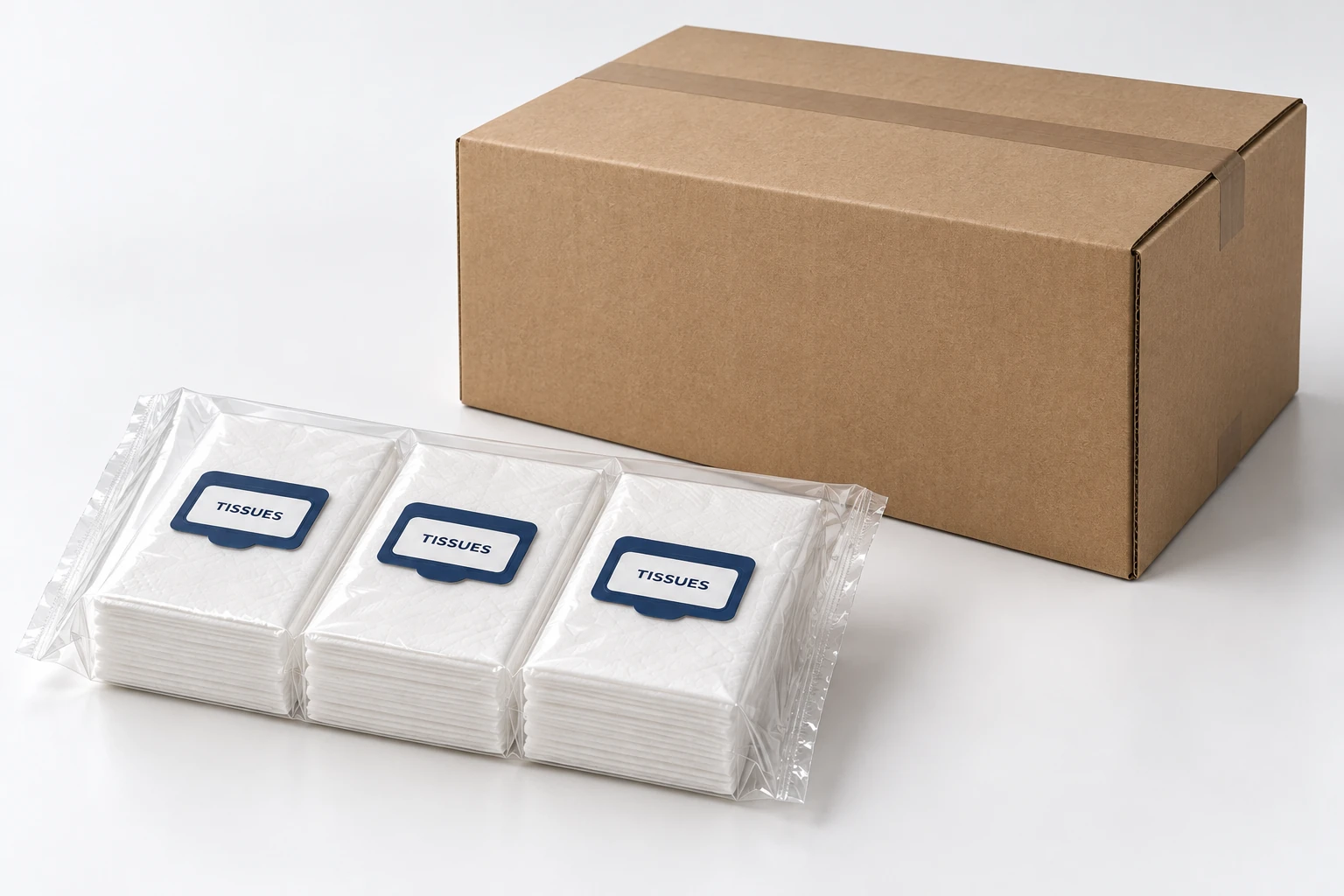
Case packing starts with the selected retail packs or bundles. Define the case pattern, loading direction, pack restraint and case closing. Check how a soft pack is supported or gripped without damaging film, labels or tissue. Measure accepted cases at the required pattern and record the retail units in each case.
Use the same output unit and time boundary
State individual packs per minute, bundles per minute and cases per minute separately. Record units per bundle and bundles per case. Also distinguish sheets per minute from finished packs; sheet count changes that conversion.
Assume an individual wrapper can supply 80 packs/minute and a bundler can make 12 six-pack bundles/minute. The bundler corresponds to 72 individual packs/minute, limiting this route before further losses. Four bundles per case would require 3 cases/minute.
At 72 individual packs/minute for an assumed 420 productive minutes, theoretical output is 30,240 packs. This is arithmetic, not a machine or daily-output guarantee. Use the actual run time, replenishment, changes and rejected product when establishing production capacity.
For semi-automatic work, measure every operator task
Time stack or roll presentation, bag opening, loading, sealing, checks and collection. An example complete cycle of 24 seconds gives 150 packs/hour before breaks and changeovers. Sealing time alone does not describe that job.
Identify how the operator receives counted product and how incorrect stacks or damaged rolls are handled. Demonstrate the job with the intended staffing. Automatic equipment still needs product, bags or film replenishment and controlled recovery after a stop.
Tissue paper packing machine price
These USD ranges support early planning for selected new equipment supplied from China, one prepared dry product and one agreed format. Set the pack dimensions, count, film, output and feeding arrangement before comparing offers.
| Equipment scope | Planning budget | Boundary to confirm |
|---|---|---|
| Operator-presented bag filling and sealing station | US$1,500 to 6,000 | Manual product handling, selected bag support and closure |
| Selected automatic soft-facial or folded-napkin stack wrapper | US$18,000 to 55,000 | Stack feed, shaping, opening and film-closing tools |
| Selected single-roll wrapper | US$10,000 to 35,000 | One agreed roll and packaging format, with matched infeed |
| Selected automatic bundle arranging and bagging | US$18,000 to 60,000 | Actual incoming unit, count, rows/layers and outer package |
| Selected retail cartoning configuration | US$25,000 to 80,000 | Product loading, dispensing-carton features and closure scope |
| Selected shipping-case packing configuration | US$25,000 to 80,000 | Soft-pack or bundle handling, case pattern and included closing equipment |
The cartoner and case-packer ranges cover different operations. Other figures are planning budgets subject to a quotation, rather than verified market averages. Pocket-pack folding and closure, extra tools, difficult formats or higher speeds need a separate proposal.
For a dedicated tissue wrapper, quote the opening, shaping, feed and closure as the selected, product-tested configuration. Unless listed, exclude papermaking, rewinding, interfolding, embossing, log cutting, extra patterns, inspection, plant services, downstream equipment, freight, taxes and overseas installation.
Send tissue stacks or rolls and the required finished pack
Send representative stacks or rolls and the finished pack, with dimensions, fold and sheet count or roll specification. Supply actual film or bags, opening requirements, bundle and case patterns where applicable. State inlet conditions, target output, batch sizes, utilities and the upstream/downstream handoff.
Keep packs from steady running, replenishment and restarts. Check count, appearance, seals, opening and tissue withdrawal. Demonstrate a size change and record time, tools, settings and rejects. Request a continuous video from infeed through wrapping or bagging to completed packs.
Plan your tissue pack with Comwin
Comwin can coordinate product feeding, primary packaging and the required bundle or case interfaces. Free sample testing and factory visits are available. Send your tissue, finished pack and output target, or explore our flow-wrapping equipment.
Common questions
Does a packing machine also cut and fold the tissue?
Confirm the actual inlet. A packer may receive prepared stacks or rolls from separate conversion equipment. Folding, cutting and rewinding require their own scope, controls and capacity assessment.
Can dry cotton tissues use the same setup?
Identify the actual material, fold, stack and finished package first. Dry nonwoven or cotton-like tissue needs its own feed, opening and closure assessment; the name does not establish identical behaviour to pulp tissue.