
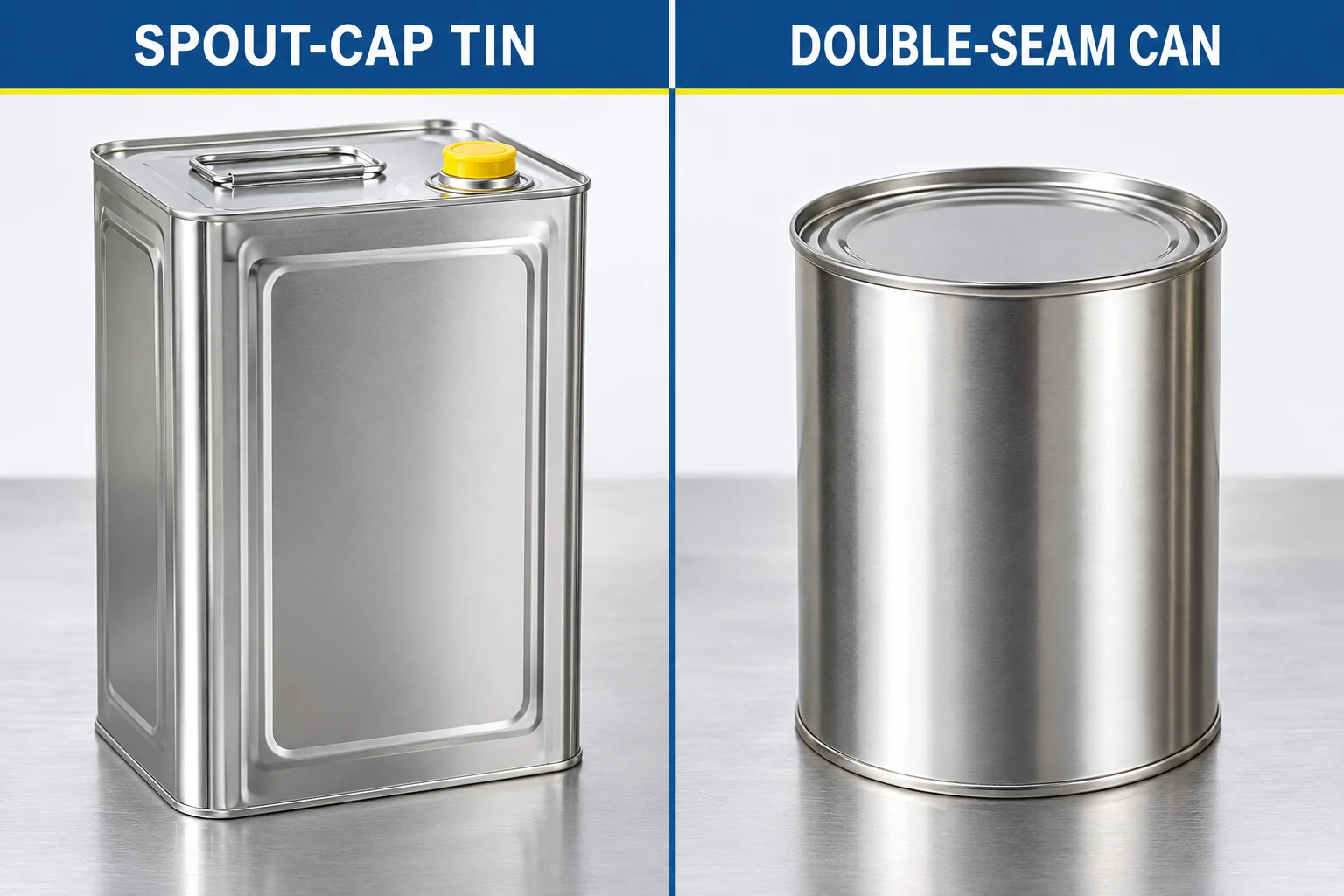
Start with the tin and closure, not the machine name
“Tin packing” is used loosely in supplier listings. It can mean filling oil into a rigid metal container, pressing a small closure into a top opening, seaming a complete can end, or supplying the entire line. The purchase becomes much clearer when the container drawing and closure drawing come before the machine specification.
The published cooking oil packaging guide compares bottles, tins and pouches.
| Finished container | Required closing action | Tooling evidence | Best-fit buying question |
|---|---|---|---|
| Rectangular or square spout-cap tin | Place and press or crimp the matched pour-spout cap | Tin top, opening, cap profile, support fixture and retained-height sample | Can one head close every intended tin without panel distortion or leakage? |
| Round can with full metal end | Form a controlled double seam around the complete rim | Body flange, end curl, chuck, first- and second-operation rolls, seam teardown record | Does the seamer hold the specified seam dimensions at accepted output? |
| Filling and closing cell | Meter oil, control drips, place the approved closure and close it | Oil temperature, fill target, headspace, container handling and closure samples | Which stations and change parts are included in the quoted boundary? |
| Complete line | Add infeed, coding, inspection, discharge and optional case packing | Layout, utilities, reject logic, accumulation and line acceptance target | Is the promised output good closed tins per hour or only nominal machine cycles? |
Spout-cap pressing and double seaming are different processes
Spout-cap oil tins
Large rectangular cooking-oil tins often have a small pouring opening in the top panel. The closer must locate the tin, support the panel and apply the specified motion to the matching cap or fitment. Cap diameter alone is not enough. The tool profile, insertion depth, top-panel stiffness and opening geometry affect retention and leakage.
A low-cost hand or bench cap press may suit small batches, but it is not automatically an oil tin packing line. Automatic production can add tin indexing, cap orientation or manual cap placement with interlocks, powered pressing, closed-tin detection and rejection. State the operator’s remaining tasks in the quotation.
Full-end double-seam cans
A double seam mechanically interlocks the can body flange with the end curl through staged roll operations. The buying specification should identify the can body and end, then define how seam quality will be checked. A cap press intended for a small spout cannot replace this seamer.
The industrial seamer references from CFT show why the tooling, can diameter, height, seaming stations and changeover scope belong in the purchase decision. Its published capacities describe specific high-speed machines, not a Comwin guarantee for this project.
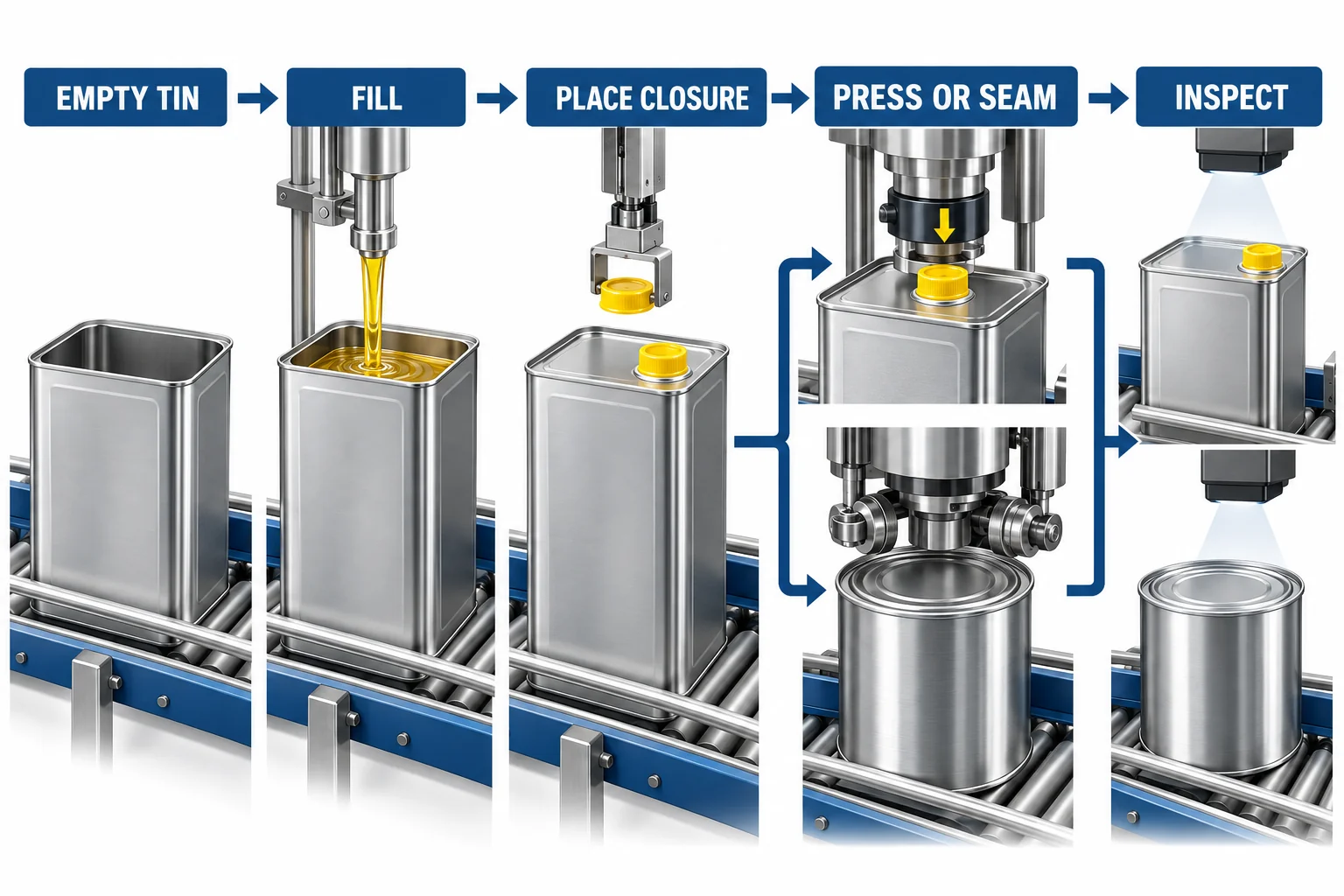
Build the line around clean filling and controlled closure
Edible oil can remain on the nozzle or container top after dosing. That residue can interfere with a cap seat, contaminate a seam area or reach the outside of the tin. The line therefore needs a stable filling method, positive product shutoff, enough settling time and a protected closure surface.
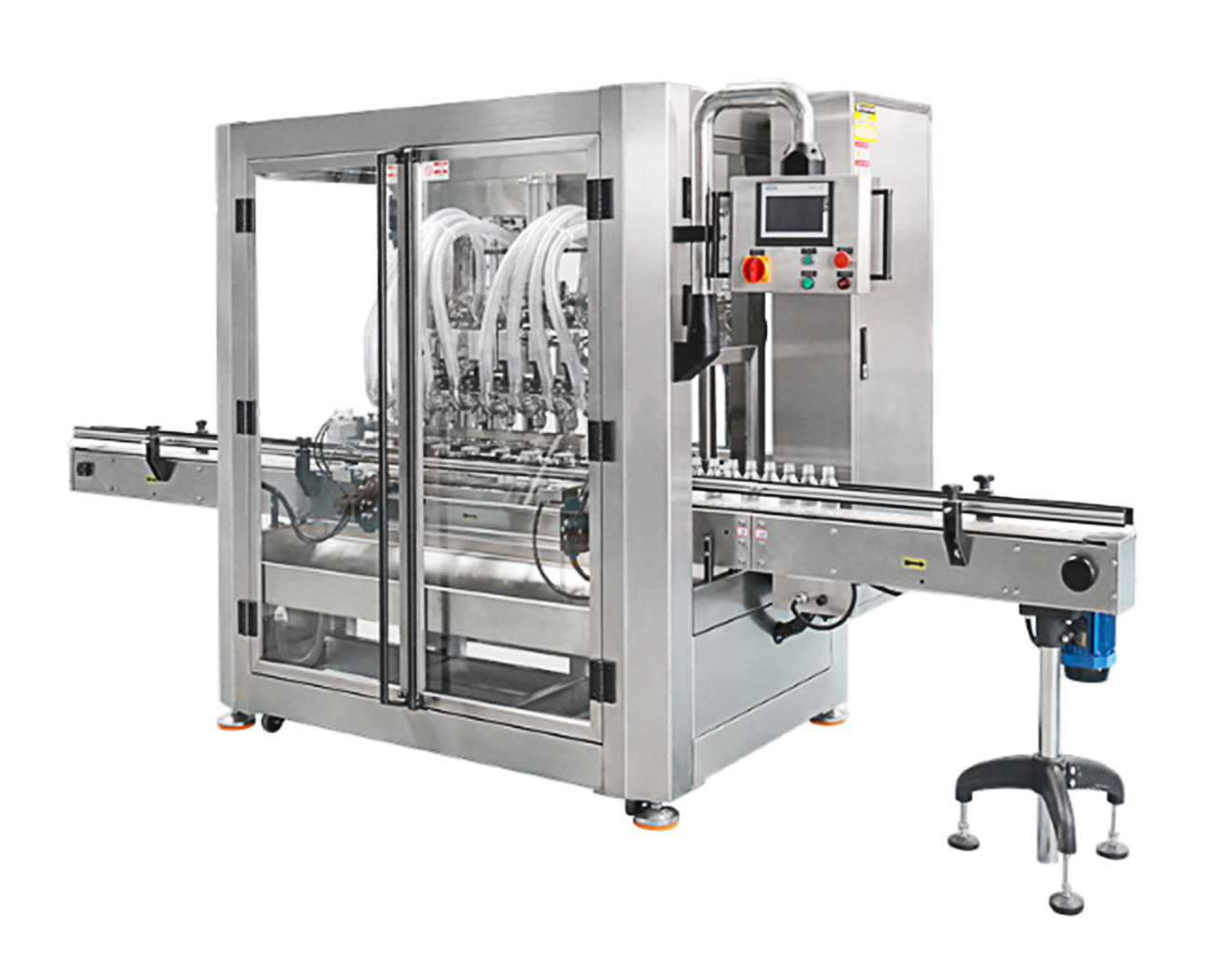
Our filling and sealing machine options is the closest standard equipment family for early planning. A tin project still requires container-specific guides, nozzles, supports and a verified closure head. For a wider automated boundary, review the complete filling-product packaging line rather than assuming every downstream station is included.
| Station | Control to specify | Evidence at acceptance |
|---|---|---|
| Tin infeed | Orientation, guide contact, dent prevention and container-present logic | Stable transport of minimum and maximum approved tins |
| Oil filling | Filling principle, target quantity, oil temperature and positive nozzle shutoff | Recorded fill results with no unacceptable trailing drip |
| Closure placement | Manual or automatic supply, orientation and missing-closure detection | No unclosed tin continues as an accepted product |
| Press-cap closing | Support fixture, tool profile, force or travel and closed height | Retention, deformation and leakage meet the agreed method |
| Double seaming | Chuck, roll profiles, first and second operations and lubrication control | External inspection plus agreed teardown measurements |
| Discharge inspection | Closure presence, leakage, coding and reject handling | Rejects are separated and recorded under production conditions |
Oil tin packing machine price: compare the same boundary
The following figures separate a cap-only station from filling-and-closing equipment and a complete line. Comwin bands come from the company USD planning workbook dated September 4, 2026. They are experience-based sales references, not market averages, factory cost or binding quotations. Freight, tax, special tooling, certification, installation and commissioning remain outside the range unless the offer lists them.
| Reference scope | Price basis | What the figure does and does not mean |
|---|---|---|
| Standalone oil tin cap sealing machine or can seamer | Quote-based | No direct Comwin workbook row. Quote after confirming tin, cap or end, closing method, automation and accepted output. |
| Nearest Comwin filling-and-capping equipment family | US$12,000–50,000 planning range | Useful for early filling/closing budgeting, but not a fixed tin-machine offer and not proof that tin tooling is included. |
| Comwin complete filling-product packaging line | US$80,000–500,000+ project range | For coordinated filling, conveying, inspection and downstream automation. It is not the starting price for a simple cap press. |
| China can-capping equipment listing | US$15,600–16,500 listed | A public supplier snapshot for 1–5 L can equipment. Application and specification details are mixed, so closure style, food suitability and supply scope need independent confirmation. |
| High-speed European industrial seamers | Quote-based | Ferrum and CFT publish machine ranges and features rather than a directly comparable project price. Their capacity class should not be compared with a bench cap press. |
What changes the final price?
The main drivers are the number of tin formats, fill range, target good output, filling principle, number of nozzles, cap or end feeding, closing-head design, change parts, guarding, oil-contact materials, coding, inspection, reject handling, conveyor length, case packing, electrical standard, documentation and site service. Ask each supplier to mark included, optional and excluded items.
Calculate the capacity you actually need
Convert sales or production demand into accepted closed tins, then allow for planned line availability. For example, a requirement of 1,200 good tins per hour at 80% planned availability needs a nominal rate of 1,200 ÷ 60 ÷ 0.80 = 25 tins per minute. This is a planning calculation, not an equipment guarantee. Repeat it for every tin size because filling time, handling and closure motion may change.
| Input | Example | Why it matters |
|---|---|---|
| Required accepted output | 1,200 good tins/hour | Use saleable closed tins, not filler strokes |
| Planned availability | 80% | Allows for normal stops, changeover and minor adjustments |
| Required nominal rate | 25 tins/minute | Starting point for filler, closer and conveyor sizing |
| Tin range | Confirm each size and closure | The slowest approved format can set the line limit |
| Acceptance duration | Define sustained run and sample frequency | A short demonstration does not prove stable line output |
Tin-specific factory acceptance checklist
This checklist is the article’s main purchasing tool. The final limits should come from your packaging specification, tin supplier and agreed tests. Generic web specifications cannot establish your acceptable seam dimensions, cap retention or leakage threshold.
| Check | Run with | Record before approval |
|---|---|---|
| Approved samples | Production tins, caps or ends from intended suppliers | Drawings, lot identification and all machine change parts |
| Oil condition | Minimum and maximum normal filling temperature | Flow behavior, fill setting, drips and cleaning method |
| Fill quantity | Agreed sample plan during a sustained run | Target, tolerance, instrument and reject result |
| Spout-cap closure | Minimum and maximum approved top panels and caps | Closed height or travel, retention, panel deformation and leak result |
| Double seam | Approved can bodies and ends | Visual checks, countersink and the agreed teardown dimensions |
| Changeover | Every quoted tin and closure family | Parts, settings, time and first accepted tin |
| Line output | All stations in the quoted automatic boundary | Good tins/hour, stops, rejects and operator interventions |
| Transport test | Closed tins after normal downstream handling | Leakage, dents, closure movement and case condition |
If closed tins must be packed automatically, define tin orientation, count, case strength and reject location before adding an automatic case packer. A leak should be detected before oil contaminates the case or downstream equipment.
Information to send for a reliable quotation
| Input | Required detail | Quotation impact |
|---|---|---|
| Oil | Type, density, temperature range and required cleaning | Filling principle, valves, nozzles and product-contact scope |
| Tin | Drawings, empty samples, dimensions, top-panel construction and supplier | Guides, support fixture, filling position and change parts |
| Closure | Spout cap or full end, drawing, samples and application method | Selects a cap press or a double-seam can seamer |
| Fill range | Minimum and maximum net weight or volume | Number of nozzles, dosing range and cycle time |
| Accepted output | Good closed tins/hour for every format | Sizes the slowest linked station and accumulation |
| Acceptance method | Fill, leak, deformation, retention or seam checks | Defines testing, inspection and reject equipment |
| Project boundary | Infeed, filling, closure feeding, coding, inspection, case packing and service | Separates the machine price from the complete-line price |
Why buyers consider Comwin
We match filling, tin handling and closure equipment to your samples, output and budget. Send representative oil, tins and closures for free sample testing, or inspect the factory by video or in person. Standard service includes a two-year machine warranty, three years for core components and remote response within 24 hours.
Frequently asked questions
Is an oil tin cap sealing machine the same as a can seamer?
No. A small spout-cap closer presses or crimps a localized closure into the tin top. A can seamer forms a double seam around a full metal end. Confirm the closure drawing before choosing the machine.
Does the oil tin packing machine price include filling?
Only when the quotation lists a filler. A cap-only sealer may exclude oil supply, dosing, conveyors, cap feeding, coding and inspection. Compare a station-by-station scope instead of comparing totals alone.
Can one machine run 1 L, 5 L and 15 L oil tins?
Possibly, if the filling range, guides, support fixtures and closure family are compatible. Send every tin and closure sample. The supplier should demonstrate the quoted formats and list all change parts.
How should we test an oil tin seal?
Use the method agreed with the tin and closure suppliers. For spout caps, check seating, retention, deformation and leakage. For double seams, combine external inspection with the specified teardown measurements and a transport-condition leak test.
Request an oil tin packing machine price
Send your oil data, empty tins, caps or ends, fill range, accepted output, test method and destination to contact our packaging team. We will separate the filling, cap pressing or seaming, inspection and downstream scope in the proposal.