
Choose the Peanut Butter Package First
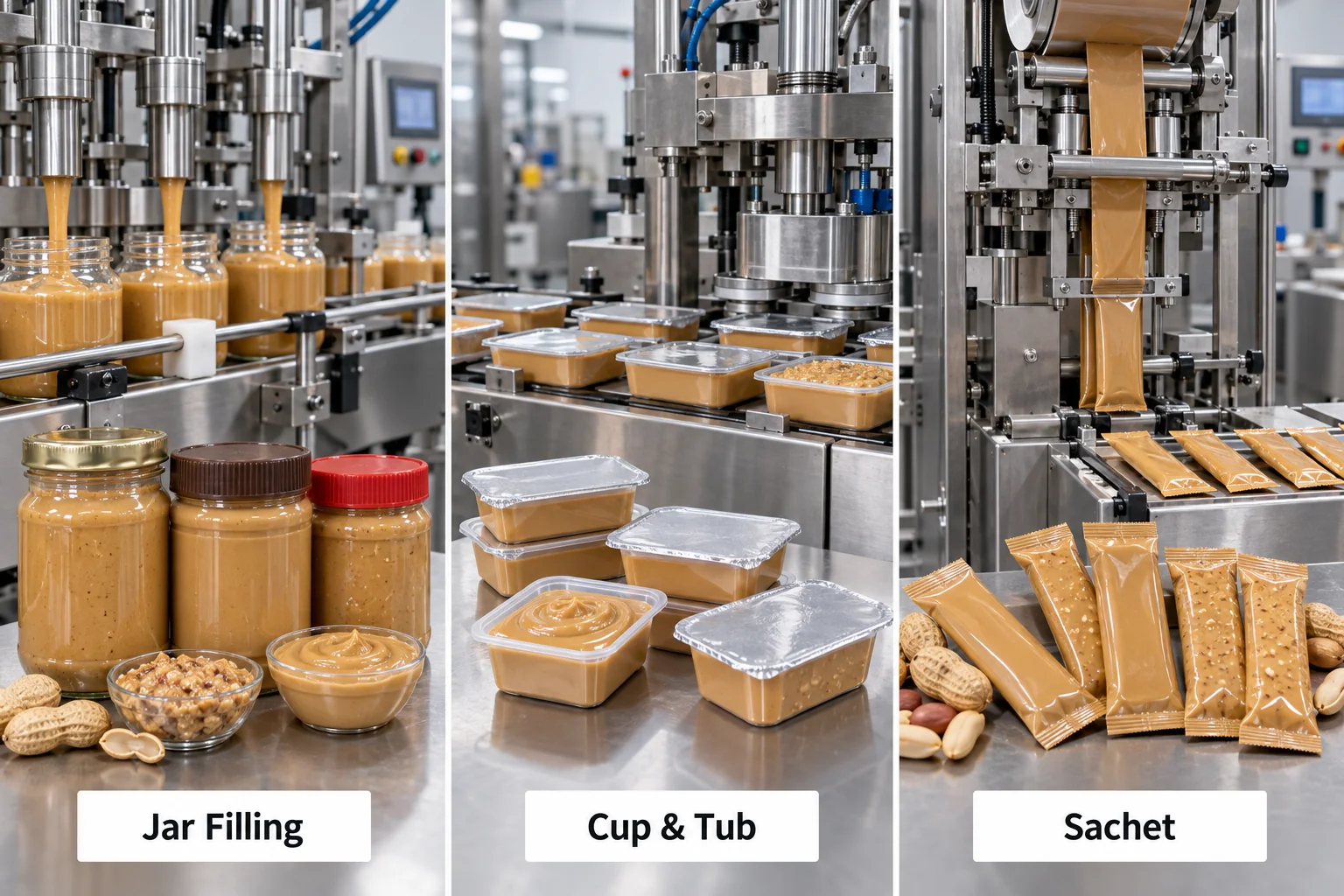
Jars dominate the industrial search intent because they combine strong shelf presence, reclosure and compatibility with thick-product filling. Cups and tubs suit portions, foodservice or dip formats. Flexible sachets reduce pack weight and can serve single portions, but they need a viscous-product dosing path and carefully controlled seals. These packages can share upstream peanut-butter preparation; they do not use the same primary packaging machine.
| Finished pack | Machine route | Best fit | Critical input |
|---|---|---|---|
| Glass or PET jar | Jar infeed, viscous filler, capper, optional induction sealer and labeler. | Mainstream retail smooth, crunchy or natural peanut butter. | Jar/neck, cap/liner, dose, temperature and accepted output. |
| Preformed cup or tub | Container denesting, piston deposit, foil placement/sealing and optional overcap. | Single portions, snack trays and foodservice packs. | Cup flange, lid sealant, dose profile and seal cleanliness. |
| Sachet or stick pack | Single/multilane roll-film forming, paste dosing, sealing and cutting. | Samples, single servings and institutional portions. | Film, width/length, dose, seal window and product cut-off. |
| Premade pouch | Pouch pick/open, viscous filling, zipper/fitment management and sealing. | Larger flexible packs or premium formats. | Pouch structure, opening, zipper/spout, fill temperature and headspace. |
Peanut Butter Recipe Drives the Filling System
Peanut butter behaves as a high-viscosity paste rather than a free-flowing liquid. Its resistance changes with temperature, solids, roast, grind, stabilizer and oil content. Natural formulations may separate during holding, while crunchy products add particles that must pass through every pump, valve and nozzle without bridging or excessive damage.
Define an operating window from production samples. A warm sample that fills easily does not prove performance at the coldest normal condition. If heating is allowed, specify the permitted product and hopper temperature; heat should support consistent flow without changing flavor, texture or shelf-life validation.
| Recipe condition | Likely challenge | Configuration direction | Test |
|---|---|---|---|
| Smooth stabilized | High viscosity and nozzle stringing. | Servo piston or positive-displacement filler with shutoff/suck-back nozzle. | Dose accuracy, clean cut-off, pressure and temperature range. |
| Crunchy | Nut pieces can bridge small ports or be crushed. | Wide product passages, suitable valve and gentle piston/pump action. | Largest piece, concentration, integrity and blockage. |
| Natural/oil separating | Density and consistency can drift during holding. | Gentle validated agitation or recirculation without aeration. | Oil distribution, fill repeatability and stop/restart. |
| Flavored/inclusion recipe | Cocoa, honey or other ingredients change viscosity and cleaning. | Recipe-specific settings and compatible seals/contact parts. | Hardest recipe, allergen changeover and residual product. |
Automatic Peanut Butter Jar Filling Line
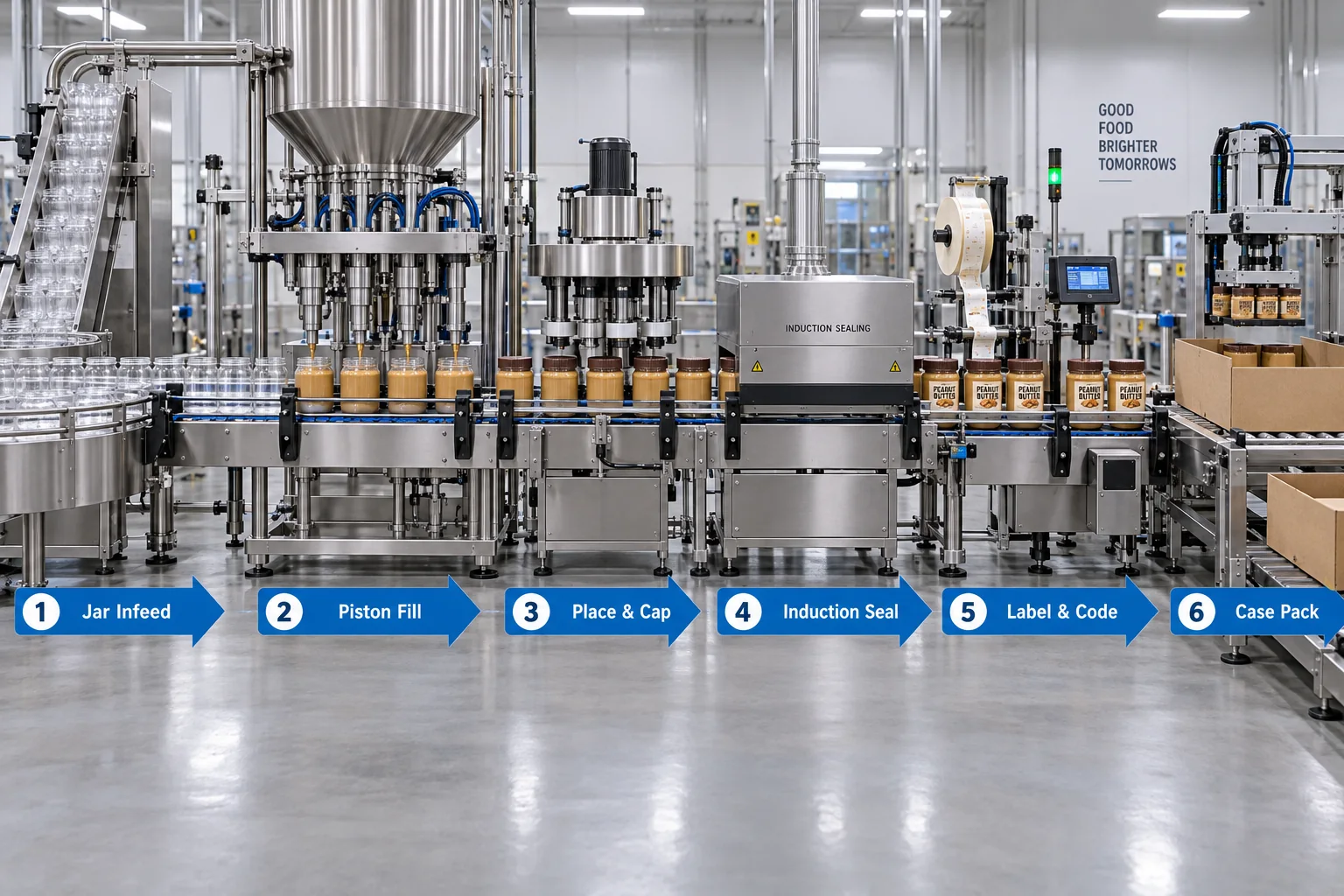
Empty jars enter upright and stable. The filler meters peanut butter while keeping the rim and threads clean. Caps are presented in the correct orientation and tightened to the approved application torque. If the cap contains a compatible induction liner, the closed jar then passes through the induction field; the cap is required to hold the liner against the land during sealing. Labels and codes are applied after closure, and closed jars continue to inspection and case packing.
A foil membrane applied by a separate conduction sealer follows a different process. Confirm whether the project uses cap-integrated induction liners, pressure-sensitive liners, pre-cut foil, or no inner seal. These options should not be treated as interchangeable.
| Stage | Control | Acceptance point |
|---|---|---|
| Jar infeed | Unscrambler/table, guides, neck/diameter change parts and cleaning. | Stable clean jars reach the filler without scuffing or jams. |
| Filling | Hopper level, product temperature, piston stroke, nozzle height and shutoff. | Correct dose with clean rim/threads and acceptable surface. |
| Capping | Cap orientation, presence, engagement and torque. | No cross-threading, cap damage or loose closure. |
| Induction seal | Compatible liner, cap pressure, power, line speed and cooling time. | Continuous bonded foil under a correctly applied cap. |
| Label/code/case | Label registration, readable traceability and case pattern. | Saleable jars correctly identified and protected for distribution. |
Smooth, Crunchy and Natural Filling
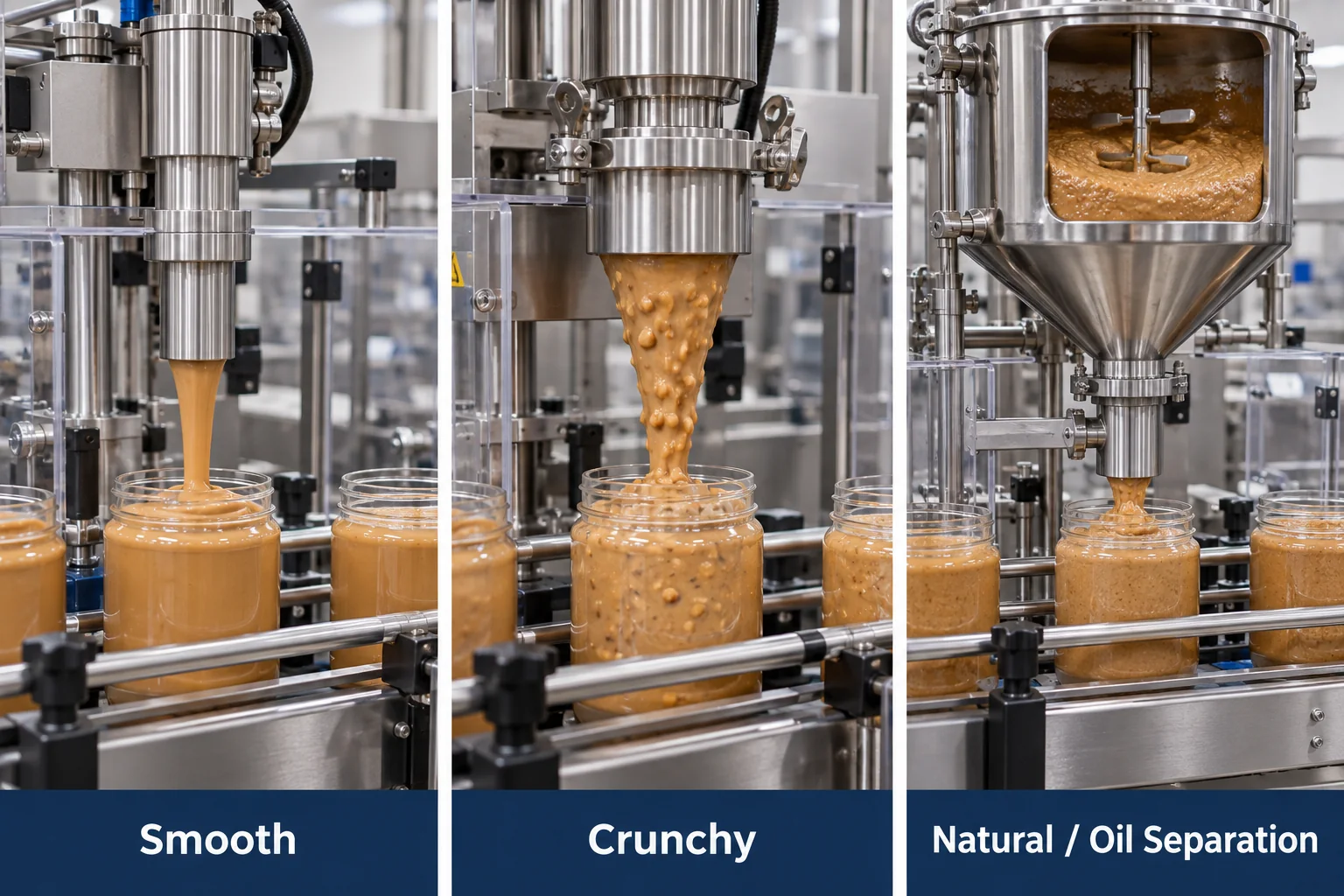
A servo piston filler provides controlled displacement and recipe adjustment for many jar projects. Rotary volumetric systems may suit high output when the product and container are stable. A lobe, progressive-cavity or other positive-displacement pump can support product transfer or filling after testing. The decisive factor is the complete passage from hopper outlet through valves to nozzle.
For crunchy peanut butter, compare the smallest port with the largest real nut piece, not an average particle size. For natural peanut butter, agitation must distribute oil and solids without adding air. Nozzles may dive or follow a fill profile to reduce voids and tailing, but their motion must remain clear of the jar.
| System | Suitable case | Advantages | Validate |
|---|---|---|---|
| Servo piston filler | Smooth or crunchy paste within a defined particle range. | Positive dose, adjustable profile and effective shutoff options. | Cylinder/valve size, particle passage, pressure, tailing and cleaning. |
| Rotary volumetric filler | Stable high-volume jar format and prepared product supply. | Continuous container handling and high head-count potential. | Change parts, feed stability, accuracy conditions and maintenance. |
| Positive-displacement pump system | Continuous thick-product transfer or project-specific filling. | Controlled movement of viscous product at suitable speed. | Shear, slip, backpressure, particles and dose control. |
| Manual/semi-auto depositor | Small batches, trials or many recipe changes. | Lower automation and simple operator control. | Operator consistency, jar handling, separate closure capacity and hygiene. |
Jars, Caps and Induction Liners
| Component | Provide | Why it matters |
|---|---|---|
| Jar | Material, brimful volume, neck finish, diameter, height and weight. | Guides, filling height, dose/headspace and conveyor stability. |
| Cap | Thread/closure drawing, diameter, height, liner and application torque. | Feeder, chute, chuck/spindle, torque and tamper evidence. |
| Induction liner | Foil/sealant structure matched to jar land and cap. | Sealing power, dwell, cooling and peel/bond result. |
| Label | Pressure-sensitive or sleeve material, roll direction and artwork. | Applicator type, registration, sensors and code position. |
| Case | Count, orientation, dividers, tape/glue and pallet pattern. | Accumulation, pick/place or drop packer and line output. |
Cup, Tub and Sachet Packaging
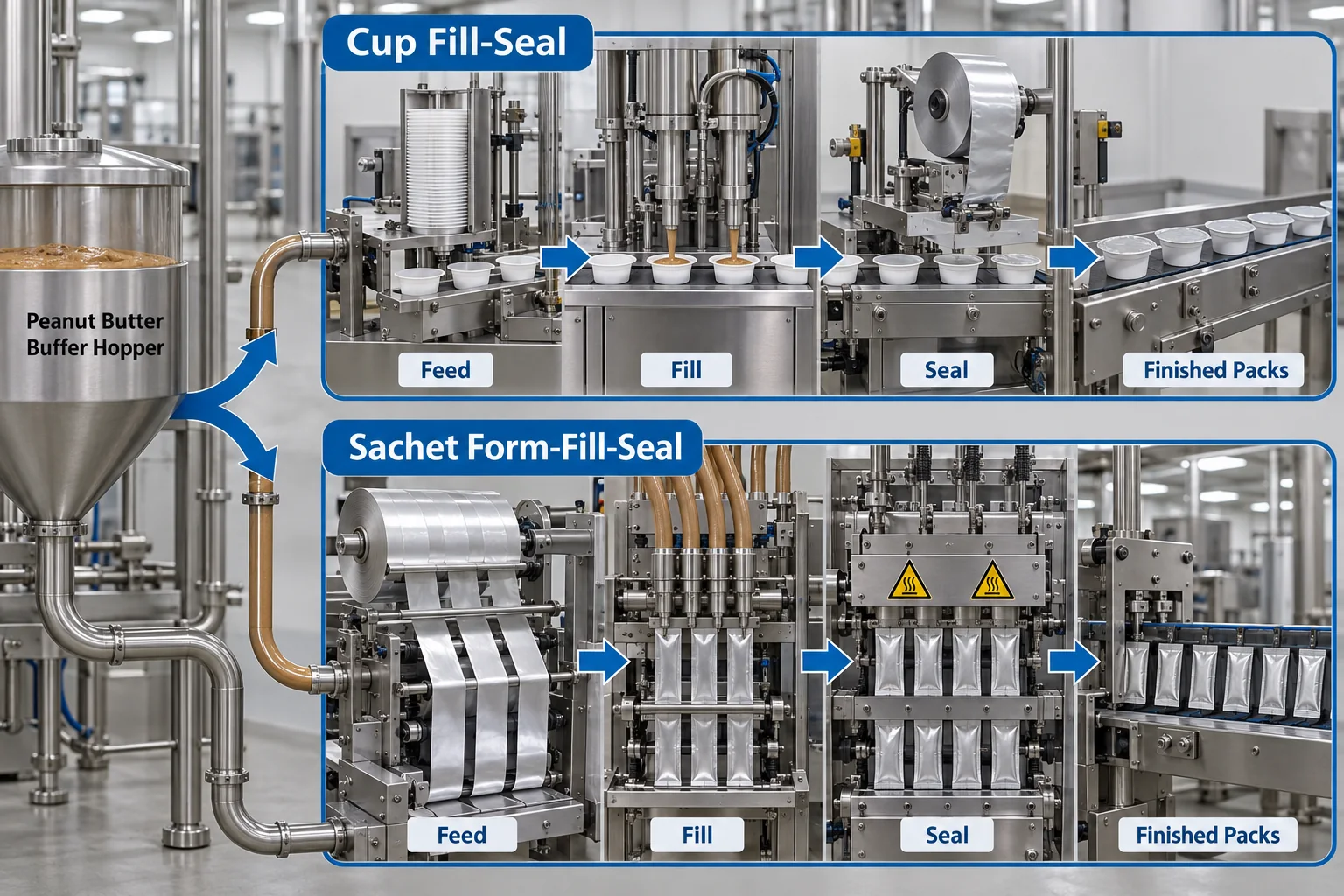
A preformed-cup line denests containers, deposits the portion, places foil and heat seals the flange before discharge. A sachet machine unwinds roll film, forms individual lanes or a tube, meters peanut butter, seals around a clean product area and cuts the packs. Multilane sachets increase total output but multiply filler circuits and seal positions that must remain balanced.
Film and peanut butter must be tested together. Oils can migrate into an incompatible seal layer, and paste trapped at the edge can create channels. Confirm easy-open behavior, seal strength and leakage after storage and distribution, not only immediately after production.
| Route | Best fit | Machine decisions | Trade-off |
|---|---|---|---|
| Preformed cup/tub | Rigid portion, peelable lid and possible overcap. | Denesting, piston deposit, foil feed, heat seal and container tooling. | Higher container volume and tooling; strong presentation and handling. |
| Single-lane sachet | Launch volumes or larger flexible portions. | Film forming, paste dose, registration, sealing and cut. | Moderate output with simpler balancing and changeover. |
| Multilane sachet/stick | High-volume single servings. | Lane count, manifold balance, web guidance and per-lane seal control. | Higher output and complexity; every lane needs validation. |
| Premade pouch | Zipper, spout or premium flexible format. | Pouch opening, product nozzle, headspace, seal cleaning and closing. | Higher material/handling cost with flexible market presentation. |
Peanut Butter Packaging Machine Price
The following Comwin bands are planning references rather than binding offers. Price depends on the product operating window, particle size, number of filling heads or lanes, container handling, hygiene, inspection and final packing. Indian prices and visibly low-price marketplace products are excluded.
| Comwin reference | Planning price | Scope interpretation |
|---|---|---|
| Jar filling and capping machine | US$12,000–50,000. | Reference for bottle/jar handling, filling and capping; paste-specific piston system, hopper and cap/liner determine final offer. |
| Liquid/paste VFFS sachet machine | US$5,000–30,000. | Roll-film forming, viscous dosing, sealing and cutting; multilane systems require separate scope. |
| Premade pouch machine | US$10,000–45,000. | Pouch handling, filling and sealing; zipper, spout, gas and cleaning options affect price. |
| Cup or tub fill-seal project | Quote-based; nearest filling reference US$12,000–50,000. | Not a fixed cup-line price; container tooling, foil placement, sealing stations and hygiene must be quoted. |
| Coordinated filling-product line | US$80,000–500,000+. | May include product feed, filler/packer, closure, induction sealing, labeling, inspection, case packing and conveyors. |
Require separate prices for the base machine, product hopper/feed pump, change parts, cap and liner handling, induction sealer, labeler, coder, inspection, conveyors, case packer, spares, FAT, freight, installation and taxes. A single-head filler and a complete jar line are not comparable quotations.
Hygiene, Allergens and Cleaning
| Area | Define | Design response |
|---|---|---|
| Product supply | Batch tank/hopper, temperature, level control, agitation and pressure. | Jacket, sensors, pump/auger and interlocks. |
| Contact path | Material, finish, dead spaces, valves, hose/pipe and drainability. | Quick-release or CIP-capable components and inspection access. |
| Cleaning method | CIP, COP or manual disassembly, chemistry, temperature and verification. | Seal materials, return path, removable parts and planned downtime. |
| Allergen control | Peanut-only line or changeover to other nut/seed spreads. | Segregation, cleaning validation, scheduling and product release. |
| Environment | Open-container exposure, dust, condensation and personnel flow. | Guarding/enclosure, jar protection and sanitation procedure. |
Quality Checks from Dose to Case
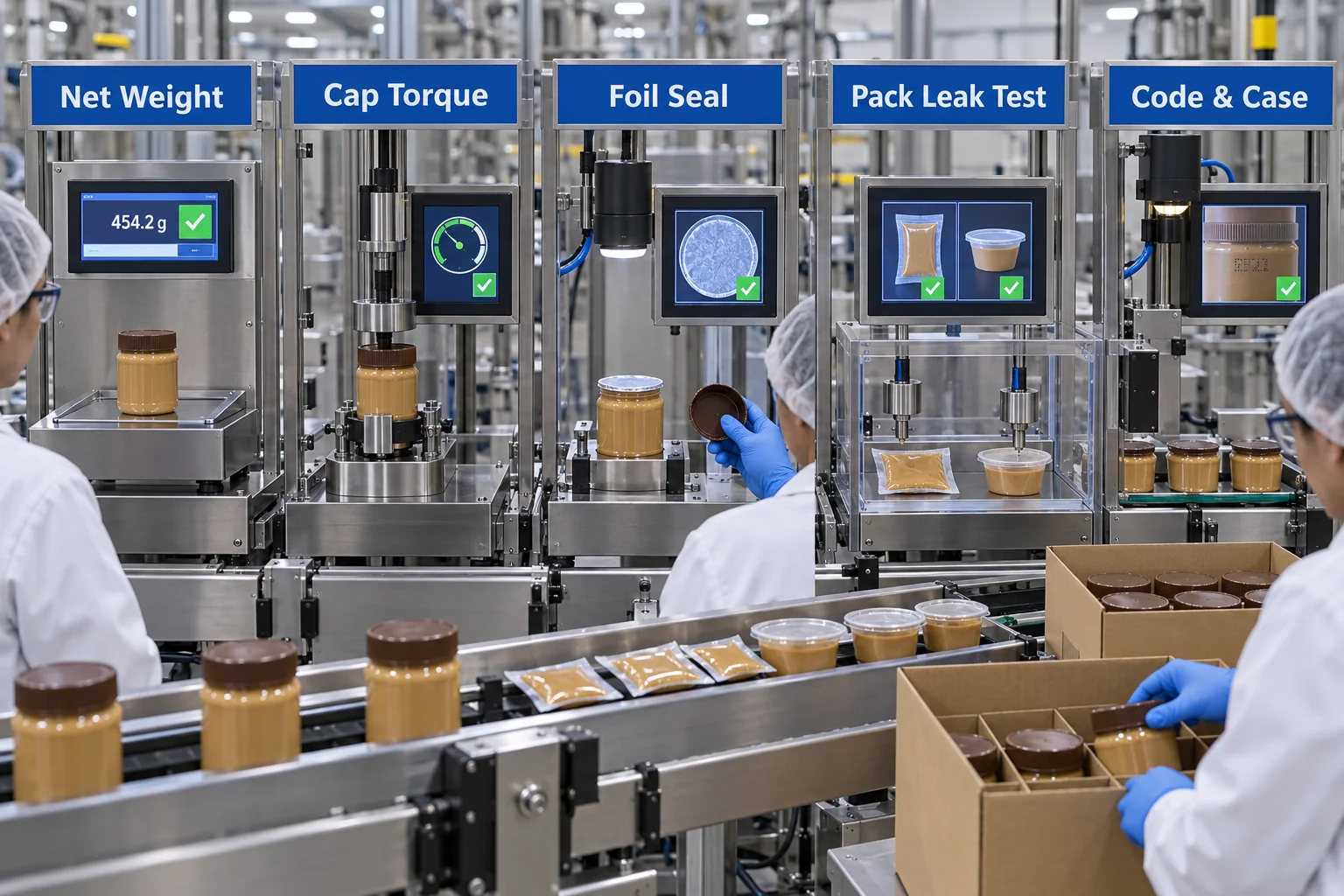
Measure net content across start-up, steady operation and normal restarts. Inspect jar rims before closure, verify cap torque and test the induction membrane after cooling. For cups and sachets, check seal appearance and leakage after realistic storage. Code verification and case checks complete traceability; they do not replace closure testing.
| Check | Method | Pass condition |
|---|---|---|
| Net weight | Calibrated samples or checkweigher across every format. | Within agreed tolerance without systematic drift/giveaway. |
| Fill cleanliness | Inspect rim, threads, flange and external container. | No product that interferes with closure or retail appearance. |
| Cap/foil | Torque measurement plus induction-seal bond/leak test after cooling. | Correct cap application and continuous compatible liner seal. |
| Flexible/cup seal | Visual seal plus validated leak, burst or peel method. | No channel, trapped paste or recurring failure. |
| Code/case | Vision/operator code check and final pack count/orientation. | Readable traceability and protected shipment configuration. |
Quotation and FAT Inputs
| Input | Provide | Quotation effect |
|---|---|---|
| Product | Smooth/crunchy/natural recipes, temperature, viscosity/density and largest nut piece. | Defines hopper, agitation, pump, piston, valve, nozzle and cleaning. |
| Containers | Jar/cap/liner, cup/lid, film or pouch samples and drawings. | Defines handling, change parts, sealing and sensors. |
| Formats | Net weights, dimensions, headspace, number of SKUs and changeover goal. | Defines dosing range, recipes and tooling. |
| Output | Accepted packs/hour by format and planned shifts. | Defines heads/lanes, indexing and downstream capacity. |
| Factory | Utilities, layout, product inlet, hygiene boundary and local standards. | Defines controls, interfaces, documentation and commissioning. |
| Final packing | Label/code, inspection, case count, orientation and pallet pattern. | Defines conveyors, accumulation and end-of-line modules. |
Send production-representative peanut butter and package components for free sample testing. FAT should run the coldest, thickest and most particle-loaded approved recipes through start-up, steady production, stop/restart and changeover with written reject criteria.
Supplier Positioning
| Supplier / region | Positioning | Evaluation focus |
|---|---|---|
| Comwin Group / China | Customized viscous filling, capping, sealing, labeling and end-of-line project matching. | Sample testing, package fit, itemized scope and coordination from machine to complete line. |
| Chinese export market | Wide selection from semi-auto piston fillers to multihead jar and portion lines. | Contact materials, product passage, controls, real-recipe FAT, documentation, spares and commissioning. |
| Pacific Packaging Machinery / North America | Rotary volumetric filling platforms engineered for peanut butter and other viscous foods. | Product feed, volumetric accuracy conditions, speed, cleaning and regional lifecycle support. |
| Serac / Europe and North America | Cup/tub filling, capping and overlidding platforms for viscous food products including nut spreads. | Container/lid range, hygiene level, dosing method and service structure. |
Frequently Asked Questions
Which filling machine is best for peanut butter?
A servo piston or validated positive-displacement system is the usual starting point. Smooth, crunchy and natural recipes can require different valves, passages and hopper control, so test the most difficult production recipe.
Can one machine fill smooth and crunchy peanut butter?
Yes when the piston, valve and nozzle pass the largest nut piece and both recipes fit the pressure and cleaning range. Confirm particle integrity, blockage and dose accuracy with samples.
How much does a peanut butter filling machine cost?
Comwin’s jar filling-and-capping reference is US$12,000–50,000. Paste VFFS is US$5,000–30,000, while a coordinated line with closure, labeling, inspection and case packing is generally US$80,000–500,000+.
Should induction sealing happen before or after capping?
For a cap-integrated foil liner, the cap is placed and tightened first; the closed jar then passes through the induction sealer. Other foil-sealing systems follow different sequences, so identify the closure construction.
How can I reduce peanut butter dripping or stringing?
Use an appropriate shutoff or suck-back nozzle, control product temperature, tune the fill profile and keep the nozzle position close to the product surface where safe. Confirm the result at commercial speed.
Request a Peanut Butter Packaging Proposal
Send your recipes, temperature and particle range, package samples, fill weights, accepted output and final case pattern through our contact page. Comwin provides the most suitable packaging solution for your product, pack format and production requirements. Service includes a two-year machine warranty, three-year core-component warranty and remote response within 24 hours.