
Choose the Equipment Route
| Buyer condition | Recommended configuration | Best-fit product or pack | Confirm with a sample |
|---|---|---|---|
| Non-carbonated liquid in film | Liquid pouch or ice-pop form-fill-seal | Single-use regional beverage packs | Recipe, film seal and accepted pouches per hour |
| Carbonated drink in bottle | Pressure-compatible filling and closing line | PET/glass retail soda | CO₂ retention, cap integrity and line output |
| Carbonated drink in can | Pressure-compatible can filling and seaming | Canned carbonated beverage | Seam inspection and package stability |
For the equipment family behind this selection, review our vertical packing machine solutions.
Why These Configurations Solve Production Problems
| Production pain | Likely cause | Configuration response | Applicable product |
|---|---|---|---|
| Machine called ‘Pepsi’ does not match product | Market label hides carbonation and pack differences | Specify beverage and finished pack first | All brand-term inquiries |
| Liquid pouch leaks | Splash contaminates film seal | Test dosing cutoff and seal window | Non-carbonated sachets |
| Carbonated package goes flat | Closure or pressure handling is mismatched | Choose compatible filler/closure route | Bottle or can projects |
Applications and Finished-Pack Examples
| Buyer scenario | Finished pack | Starting route | Decision check |
|---|---|---|---|
| Flavored still-drink sachet | Roll-film pillow pouch | Liquid FFS; see specialist pouch guide | Seal and fill trial |
| Freeze-after-filling ice candy | Long film tube | Specialist Chuski route | Cold-chain seal integrity |
| Cola-style carbonated beverage | PET/glass bottle or can | Pressure-compatible line | CO₂ and closure tests |
For the adjacent equipment route, use the Pepsi pouch and Chuski machine selection.
To compare the wider beverage packaging routes, return to the drink packaging machine and beverage line guide.
Buyers searching for a Pepsi filling machine or automatic Pepsi machine are usually comparing compact liquid-pack equipment, output, film compatibility and price. The practical purchasing task is to define what liquid you will pack and what the finished pack must survive. At Comwin Group, we provide the most suitable packaging solution for your product, pack format and production requirements.
Brand clarification: Pepsi and PepsiCo are trademarks of their respective owner. Comwin Group is not affiliated with, authorized by or supplying equipment on behalf of PepsiCo. This page explains the machinery-market use of the search term and helps independent beverage producers specify suitable equipment. PepsiCo’s own packaging overview covers a much broader portfolio of primary and secondary packaging.
Which Pepsi Packing Machine Do You Need?
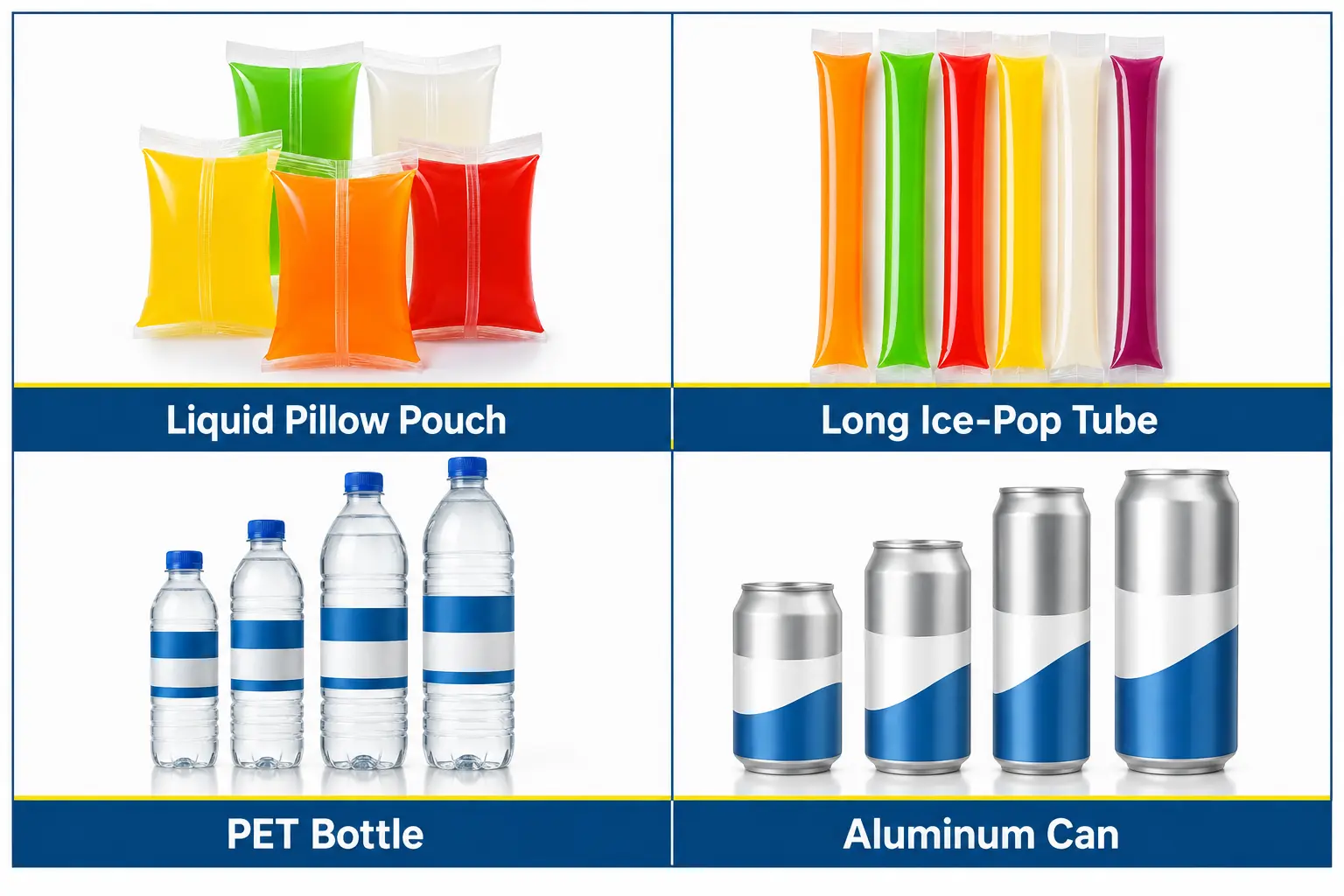
There is no single machine for every drink and package. Suppliers may use names such as Pepsi filling machine, automatic Pepsi machine or automatic Pepsi packing machine, but the correct equipment is determined by the finished package:
- Liquid pillow pouch or long ice-pop tube: choose a liquid form-fill-seal machine for a suitable non-carbonated, free-flowing drink.
- PET bottle: choose a bottle rinsing, filling and capping line. Carbonated drinks require pressure-controlled filling.
- Aluminum can: choose a can rinsing, filling and seaming line designed for the drink and carbonation level.
To receive the correct recommendation, send Comwin four details: your drink, package type, fill volume and required accepted output per hour. A product sample and empty package or film allow us to test the filling and sealing route before the machine is finalized.
Choose the Finished Pack First
The strongest specification starts with the finished package. A low-cost pillow pouch and a long frozen ice-pop tube can use related forming and sealing principles, but they require different film widths, cut lengths and handling tests. A carbonated PET bottle or can requires another filling route.
| Finished pack | Typical equipment route | Best-fit use | Main checks |
|---|---|---|---|
| Small pillow pouch | Liquid vertical form-fill-seal with a gravity or timed-valve dosing system. | Free-flowing, non-carbonated beverage or ice-pop liquid in low-cost single-use packs. | Fill range, film width, seal layer, leakage after handling and coding position. |
| Long ice-pop tube | Narrow liquid form-fill-seal setup with length control and reliable end seals. | Frozen-treat or flavored-liquid products sold in long sealed tubes. | Tube width, cut length, headspace, seal strength and freezing-distribution test. |
| PET bottle or can | Pressure-managed beverage filling, closing and downstream packaging line. | Carbonated soft drinks or branded retail beverages requiring bottles or cans. | CO₂ level, filling pressure and temperature, container/closure, hygiene and line speed. |
How the Pouch Route Fits the Project
For a non-carbonated drink, the film is formed into a pouch or tube, filled, sealed and cut. The specialist article covers film dimensions, dosing options, seal checks and Chuski tube trials in detail; use this broader page to decide whether the project is a pouch, bottle or can route.
Can It Pack a Carbonated Cola?
A simple free-flow liquid pouch machine should not be assumed suitable for a carbonated cola. Carbon dioxide release can create foam, unstable fill levels and seal contamination. A technical evaluation must cover carbonation level, product temperature, pressure control, pack strength and the intended shelf-life process.
Carbonated bottle filling needs pressure management and controlled depressurization to limit CO₂ loss and foaming. This changes the equipment route from a basic liquid pouch filler. Specify bottle or can projects against the product’s carbonation, temperature and closure requirements.
Automatic, Semi-Automatic or Manual?
| Option | What it does | When it fits | Limit to understand |
|---|---|---|---|
| Automatic form-fill-seal | Forms the pack from rollstock, doses liquid, seals and cuts in a repeated cycle. | Regular commercial production with a validated product and film. | Automatic motion does not guarantee acceptable seals or fill accuracy without trials and settings. |
| Semi-automatic filling and sealing | An operator presents or moves packs between filling and sealing steps. | Pilot batches, frequent changes or low output where labor is available. | Operator method affects output and consistency. |
| Manual hand sealing | Closes preformed packs after separate manual filling. | Very small tests and temporary work. | It is not equivalent to an automatic Pepsi filling machine and gives limited process control. |
For a repeatable commercial product, an automatic machine is normally the starting point because forming, filling and sealing remain mechanically coordinated. Manual equipment can support trials, but the finished pack must still pass the same leakage, weight or volume, appearance and handling checks.
Specifications That Decide the Machine
Product and filling behavior
State whether the liquid is non-carbonated or carbonated, its viscosity, temperature, sugar content, pulp or particles, foaming tendency and cleaning needs. A filler suitable for clear flavored water may not be suitable for a pulpy juice or a carbonated drink.
Pack dimensions and film
Provide target fill volume, finished width and length, film structure, thickness, roll width, print repeat and seal-layer information. For registered printed film, include the eye-mark layout and acceptable print-to-cut tolerance. Do not approve a film based only on “LDPE” as a generic name; test the actual roll.
Accepted output
Define output as accepted packs per hour at the target fill volume and film size. Representative official platforms reviewed for this guide state up to 80 cycles per minute for a multi-lane sachet machine and up to 100 bags per minute for a liquid VFFS machine. These figures use different machine architectures and conditions, so use them to frame questions rather than as a universal promised speed.
Utilities and line scope
Confirm power supply, air requirements, product feed height, tank and pump arrangement, floor space, drainage, coding, discharge handling and spare parts. Specify whether the quotation should include only the machine or also product preparation, chilling, conveyors and secondary packaging.
Pepsi Packing Price and Quotation Scope
| Project scope | USD planning reference | Quotation boundary |
|---|---|---|
| Non-carbonated liquid VFFS machine/set | US$5,000–30,000 | For suitable roll-film sachets or tube formats |
| Bottle filling and capping | US$12,000–50,000 | Reference family only; carbonated suitability needs configuration review |
| Coordinated beverage line | US$80,000–500,000+ | Define product, filling, closing and downstream scope |
Comwin planning references dated 2026-09-04. These are starting budget ranges for the named equipment family or line, not a tested output or a project quote. Submit the actual product, finished pack, accepted output and site scope for an itemized proposal.
How to Compare Packaging Equipment Suppliers
| Selection factor | Comwin project approach | What to compare in every offer |
|---|---|---|
| Budget and project scope | One specified machine or a coordinated system with an itemized boundary | Ask every supplier to quote the same process, package, upstream/downstream and installation scope |
| Production scale | Configure for accepted packs per hour across the actual SKU mix | Check a timed test, rejects, stoppages and changeover loss instead of brochure cycles |
| Customization | Match product contact, film/container, closure and control interfaces | Use real product and packaging samples to identify required changes |
| Support | Define documentation, spares, training and remote/site response in the proposal | Compare the written support scope and local operating capability |
| Delivery and acceptance | Define FAT evidence, shipment, commissioning and handover | Compare milestones and pass criteria on the same contract boundary |
Comwin matches and customizes single machines through complete packaging lines around your product and finished pack. Request the same acceptance criteria from every bidder so the commercial comparison reflects the equipment you will actually receive.
What Changes the Final Price?
- Filling method, number of filling heads and required fill-volume range.
- Film width, pouch length, printed-film registration and sealing method.
- Stainless-steel product-contact parts, guarding, controls and washdown requirements.
- Batch coding, counting, discharge conveyor and inspection options.
- Electrical standard, spare-parts package, documentation and commissioning scope.
- Whether upstream beverage preparation or downstream packing is included.
Ask every supplier to quote against the same requirement sheet. A headline machine price without film, output conditions and included equipment is not a useful comparison.
Sample Testing and Acceptance
Send representative product and the intended film for a free sample test. The test should confirm whether the liquid flows cleanly through the selected dosing system, whether the seals remain dry, and whether the pouch survives filling, cutting, handling and any freezing step.
Before order approval, agree on the fill-volume check, leakage method, accepted output window, code readability, changeover procedure and the exact product-contact materials. Record the test conditions so the factory acceptance test uses the same product, pack and settings.
Common Buying Mistakes
- Using a brand word as the whole specification: “Pepsi” does not identify carbonation, recipe, fill volume or package.
- Assuming every liquid uses gravity filling: viscosity, particles and foaming may require another dosing method.
- Comparing pouches per hour without pack size: film width, length and sealing time change output.
- Choosing film after the machine: the forming set and seal window must match the actual material.
- Comparing unlike prices: a local base machine and an export-ready configured system may include very different equipment and services.
Frequently Asked Questions
What is a Pepsi packing machine?
In many Indian equipment listings, it means a compact liquid form-fill-seal machine for small beverage pouches or long ice-pop packs. Confirm the product and package because the name is informal and does not define a PepsiCo production line.
Can the same machine pack juice, water and lassi?
Possibly, when the products have compatible flow, temperature, hygiene and filling requirements. Send representative samples for testing. The results determine whether one filler can be shared, which cleaning and change parts are needed, or whether a separate configuration is safer.
Can a standard machine pack carbonated Pepsi?
Do not assume so. A basic gravity-fed pouch machine is normally evaluated for non-carbonated free-flowing liquids. Carbonated beverages require pressure, foam, temperature and package-strength controls; bottles and cans typically use dedicated pressure-managed filling systems.
How much does an automatic Pepsi machine cost?
Comwin’s higher-spec planning reference for a configured liquid VFFS project is US$15,000–30,000. Current Chinese public competitor references in this guide run from about US$30,000 for flat-sachet HFFS equipment to about US$80,000 for a multi-lane liquid sachet configuration, while US and European industrial systems are generally quote-based. Ask Comwin for an itemized quotation using the same product, pack and acceptance requirements before comparing totals.
What film should I use?
Use a food-contact film structure with a seal layer and thickness validated for the product, machine and distribution conditions. Provide an actual roll or specification for testing; “LDPE film” alone is not enough to confirm seal strength, printing or shelf-life performance.
Does the machine also make the beverage?
No. The normal machine forms, fills and seals the package. Mixing, water treatment, syrup preparation, chilling, carbonation and storage are separate upstream processes unless they are explicitly included in the project scope.
Plan Your Liquid Packing Project with Comwin Group
We match the machine to your product, pack format, target output and budget. We offer free sample testing and can arrange visits to real factories to see machines operating. Our service includes a 2-year machine warranty, 3-year core-component warranty and remote response within 24 hours. Small equipment receives video tutorials and remote video-call support.
Send your liquid details, sample film, pack dimensions and target output through our contact page. We will recommend a suitable configuration and prepare an itemized quotation.