
The Prismatic Battery Pack Assembly Line is a key setup for making rectangular, hard-shell battery packs. It supports various cell chemistries, such as lithium iron phosphate, ternary lithium, and sodium-ion, and can handle multiple specifications. This guide explains how the line works, its equipment stack, automation level, BMS integration, safety and quality standards, cost and ROI, and how to choose the right partner for global production.
Definition & Importance
What is a Prismatic Battery Pack?
A prismatic battery pack uses rectangular hard-shell cells. It is common in electric vehicles and energy storage systems due to its high energy density, compact shape, and effective heat management. For details on the line that builds these packs, see the Prismatic Battery Pack Assembly Line.

What is a Prismatic Battery Pack Assembly Line?
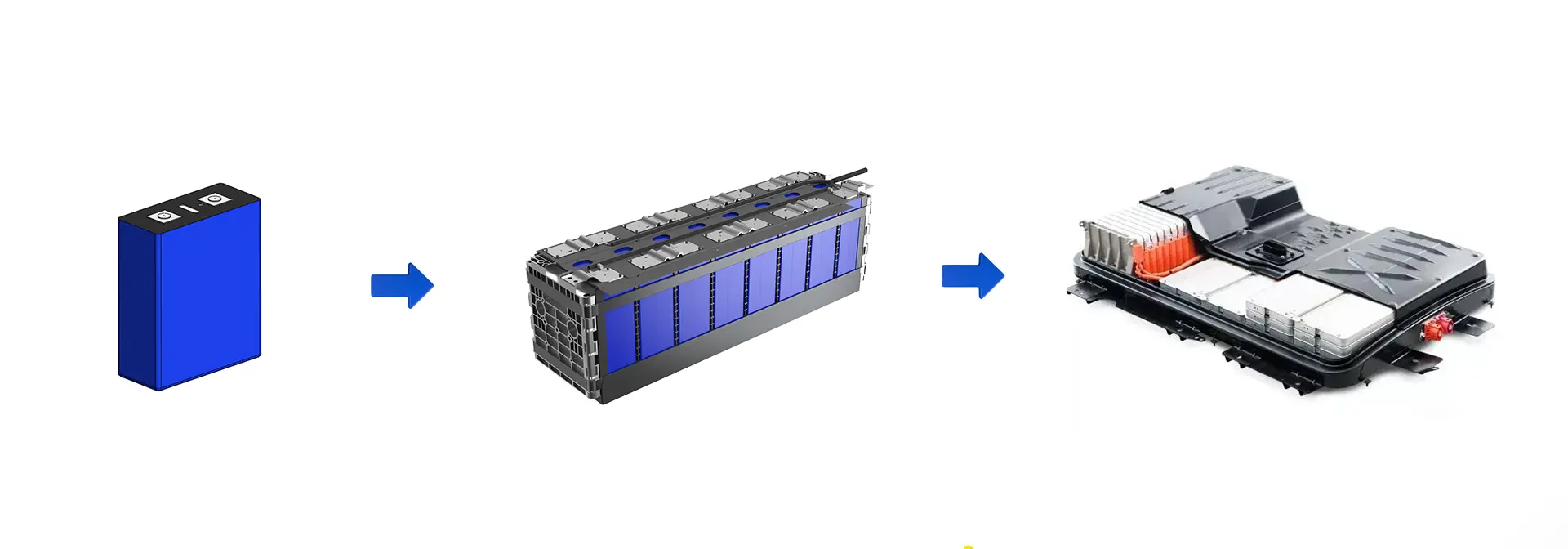
This production line assembles single cells, module parts, interconnects, insulation, enclosures, and the BMS into a complete pack. It covers cell sorting, stacking, laser or other welding, module assembly, sealing, enclosure assembly, BMS interfaces, and end-of-line testing to ensure high production efficiency and global delivery readiness. The line is suitable for different specifications and is designed for energy storage and power battery packs.
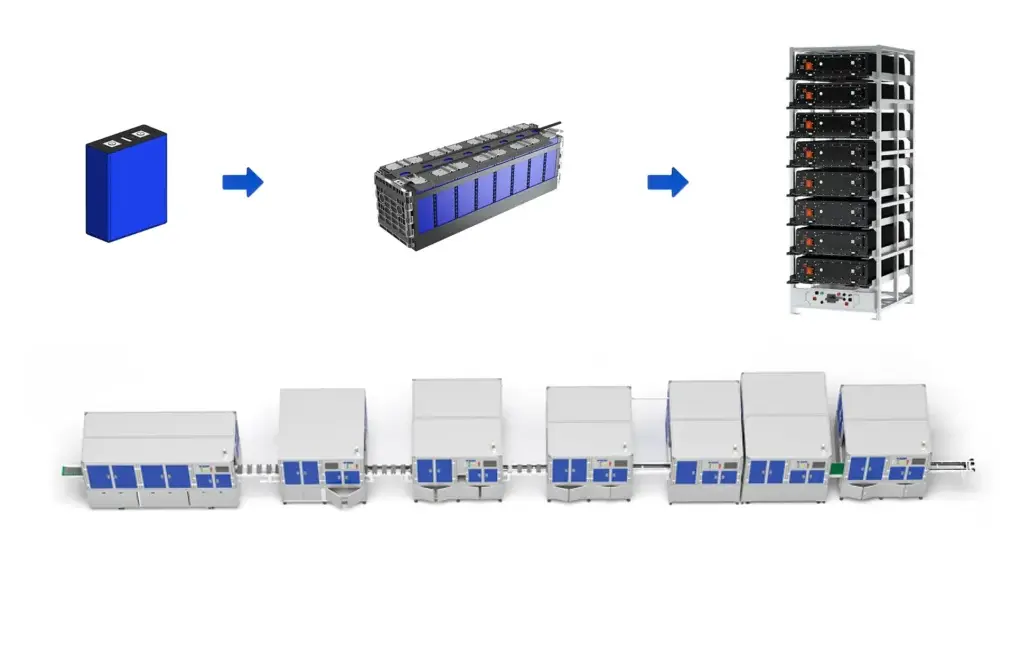
Key Process Flow
Cell Feeding
OCV Testing
Open-circuit voltage tests screen the cell state before assembly to protect overall pack performance.
Cell Adhesive Application
Adhesives or bonding materials are applied as needed to stabilize stacking and subsequent connections.
Cell Stacking & Manual Strapping
Cells are stacked per design and lightly strapped to form stable sub-assemblies for welding and integration.
Addressing Cleaning
Any residues are cleaned to improve welding and sealing quality later in the line.
Busbar Welding
Interconnects and busbars are welded to ensure strong electrical connections and good heat management compatibility.
Module EOL Testing
End-of-module tests verify electrical performance and module-to-module connections before moving forward.
Module Off-Line
Modules are prepared off-line for subsequent assembly stages.
Box On-Line
Box or enclosure components and modules are assembled online to improve packaging consistency.
Liquid Cooling Plate Adhesive Application
Adhesive is applied to liquid cooling plates to optimize heat transfer and durability.
PACK EOL Testing
End-of-packing tests confirm the overall pack performance and safety before final checks.
PACK EOL Testing
Another end-of-line verification step ensures robust end-to-end checks and reliability.
Complete Package Airtightness Testing
Helium or equivalent leak tests validate sealing integrity to prevent moisture or gas ingress.
PACK Off-Line
The completed pack is taken offline for final verification, labeling, and ready-for-shipment preparation.
Line Advantage & Automation
Automation & Vision
Machine vision replaces manual visual checks. An automatic feeding system for auxiliary materials reduces handling steps and boosts automation levels.
One-Touch First-Article
Each device features a one-touch first-piece function, helping improve overall OEE (Overall Equipment Effectiveness).
Modular Design
Modular design enables quick model changes and strong production-line compatibility for different specs and models.
Customization
Lines can be tailored to customer cell processes, including non-standard customization for unique needs.
High Automation & Digitalization
Modern lines use intelligent robots and machine vision for full automation—from cell loading to module testing—improving consistency and output.
Welding & Assembly Technology
Laser welding is a core technology for side seams and busbar welding, delivering stable, safe packs.
Quality Control & Testing
End-of-line tests ensure each module passes rigorous checks, including helium leak detection for sealing and electrical performance tests for consistency.
Intelligent Management
MES integration gives real-time production data and traceability. Some lines use digital twins to speed model changes and boost efficiency.
Environmental & Compatibility
Lines meet environmental standards. Servo fixtures and quick-change trays improve compatibility across specs and models.
BMS Integration & Electrical Interfaces
Standard Interfaces
Common interfaces include CAN, CAN FD, SMBus, and I2C to ensure stable communication across cells, modules, and the pack.
Testing & Validation
Online BMS tests verify protection logic and data communication. Full-chain validation happens before shipment.
Safety, Standards & Compliance
Global standards often referenced include UN38.3, IEC 62133, ISO 9001, ISO 14001, and IATF 16949. The line includes safety features against static electricity, short circuits, fire risk, gas leaks, and temperature monitoring with emergency response plans.
Quality Control & Testing
Online & Offline Testing
Visual inspection, pose verification, nondestructive weld checks, thermal imaging, X-ray/ultrasound, and leak tests are used to ensure quality at multiple points.
Traceability
Batch numbers, module data, process parameters, and equipment status are recorded for full traceability across the supply chain.
Cost, ROI & Sourcing
Cost Drivers
Automation level, line capacity, cell cost, BMS/control system investment, labor costs, and maintenance all influence cost.
ROI & Payback
ROI often occurs in 1–3 years, depending on scale, customization, and market demand.
Global Sourcing & Service
Choose suppliers with global service networks, modular solutions, and strong after-sales support to ensure cross-regional delivery and maintenance.
Global Suppliers & Collaboration
Leading global examples include Shenzhen Comwin Intelligent Equipment Group. They focus on prismatic cell modules and complete PACK solutions, with over a decade in新能源 and a team of more than 200 R&D specialists providing automation from cell processing to finished PACK products. Learn more about the Prismatic Battery Pack Assembly Line on the product page above.
Case Highlights
Global automaker and energy-storage customers have achieved notable throughput and global delivery with modular, scalable lines. Key lessons include setting clear throughput targets, building a traceable QA system, and aligning with BMS providers on standard interfaces to ensure consistent global delivery.
FAQ
What is the typical throughput of a prismatic battery pack assembly line?
Throughput depends on cell size, module design, automation level, and line configuration. A typical target is guided by the line’s 12–30 modules per minute capability, but exact figures come from your specific design.
What standards should I consider for safety and quality?
Consider UN38.3, IEC 62133, ISO 9001, ISO 14001, and IATF 16949. Also align with vehicle or storage system safety requirements and your internal QA processes.
How do you integrate BMS on the line?
Use standardized interfaces and staged testing. Validate communications and protection logic during module assembly and again at the final pack level before shipment.
How to choose a supplier for a prismatic pack line?
Look for technical maturity, turnkey capabilities, global service, delivery timelines, proven cases, and responsive tech support.
What is the typical payback period?
Typically 1–3 years, depending on capacity, automation, labor savings, and market demand.
Conclusion & Call to Action
The Prismatic Battery Pack Assembly Line is a strategic investment for global production. A well-designed process flow, a robust equipment stack, reliable BMS integration, and strict quality controls are essential for consistent, worldwide delivery.
To explore a custom evaluation, equipment list, and ROI analysis for your needs, contact us or request a quote. You can also download our white paper and case studies to understand how to implement a prismatic line across regions.