Quick answer
Free-flowing granulated sugar can be portioned into stick packs or wider sachets with suitable volumetric dosing. Select the finished pack first, then match lane count to the required good-pack output and downstream handling. Powdered or moisture-affected sugar may need a different dosing and feed configuration.
Indicative budgets are USD 5,000–30,000 for single-lane sachets, USD 20,000–60,000 for 2–4-lane sticks and USD 25,000–70,000 for 2–4-column flat sachets.

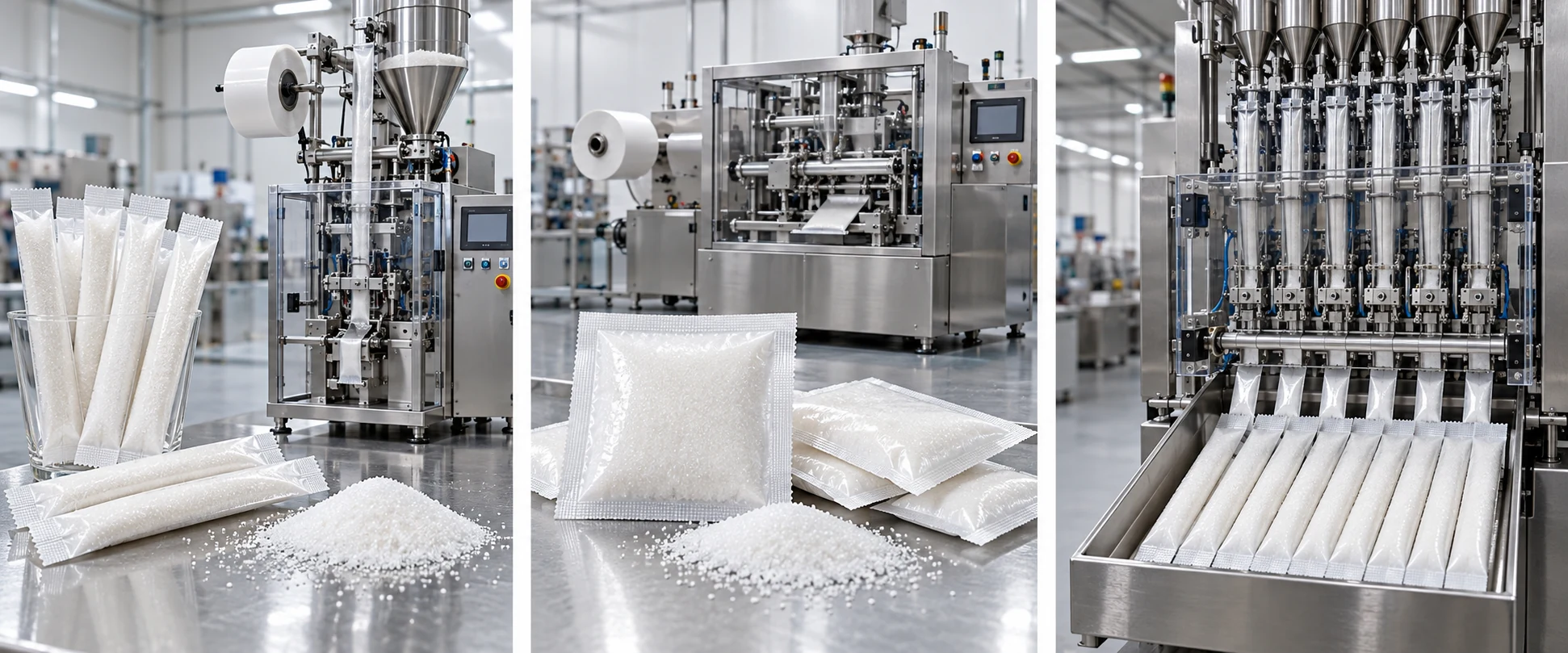
Granulated sugar sticks and wider sachets need the correct dosing and sealing format. Comwin matches the finished pack, lane arrangement and collection to your sugar and required accepted output.
Choose the finished pack and equipment
| Route | Best starting condition | Packaging operations |
|---|---|---|
| Single-lane sugar sachets | Lower accepted output or a defined simple pack format | Granular dosing → specified film forming → filling/sealing/cutting |
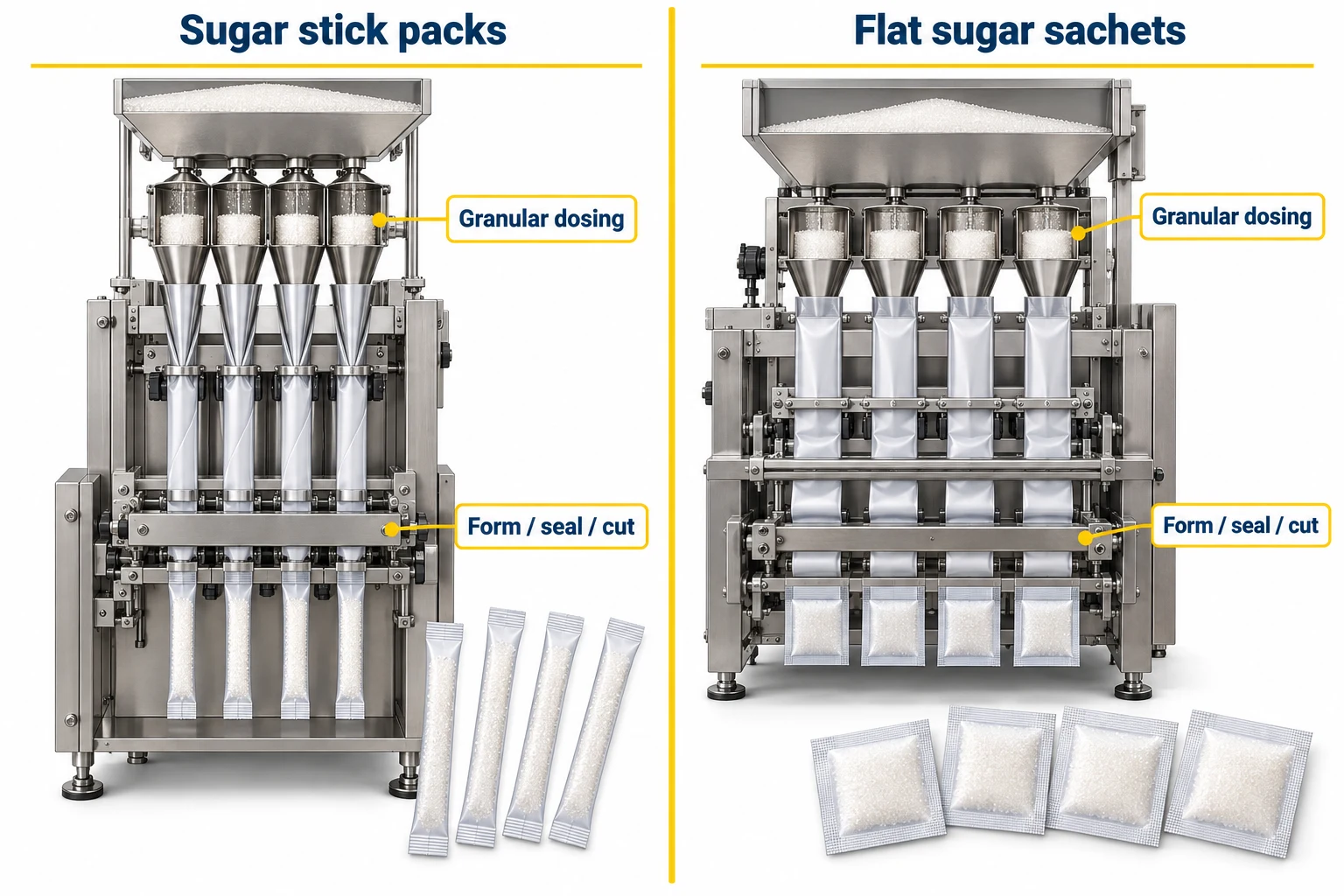
| Multi-lane sugar stick packs | Repeated production of narrow portion packs | Product distribution → per-lane granular dosing → stick forming/sealing/cutting |
| Multi-lane flat sugar sachets | Wider flat portion packs with a specified seal perimeter | Suitable granular dosing → corresponding flat-sachet forming/sealing/cutting |
Single-lane sugar sachets
For free-flowing sugar, suitable volumetric dosing can be evaluated against the actual crystal size and fill. Define whether the required pack is a pillow bag or a three/four-side-sealed sachet; the word sachet does not make every frame compatible.
The vertical packaging platform guide explains film-forming equipment; the feed and dosing must suit this product.
Multi-lane sugar stick packs
Lane count should follow required accepted output and collection capacity. Compare dose consistency across every lane, film width, splitting and end-seal control. Adding lanes will not cure unstable feed or poorly synchronized dosing.
Multi-lane flat sugar sachets
A flat three/four-side-sealed sachet and a narrow stick use different forming and sealing layouts. Bag width changes can affect lane count, tooling and film. Confirm the sample pack and format changes before assuming a stick machine will also make the wider sachet.
Packaging problems and the configuration to check
| Problem | Likely mechanism to investigate | Configuration and confirmation check |
|---|---|---|
| Different lanes have different fills | Product distribution or the dosing adjustments are uneven. | Weigh samples lane by lane at different feed conditions; evaluate the actual sugar particle range. |
| Sugar contaminates the seals | Dosing timing, crystal scatter or dust reaches the seal band. | Synchronize dosing and sealing, provide clearance and suitable dust control where needed; check handled packs. |
| Sugar bridges in the hopper | Moisture or clumps disrupt free flow. | Define incoming sugar and storage/room conditions, then evaluate the feed arrangement; do not assume agitation fixes all moisture problems. |
| Packed sticks accumulate at discharge | Collection cannot keep pace with the filling frame. | Include the actual collection and counting labor in the accepted-output calculation before adding lanes. |
Match the product and use case
| Product or order | Finished pack | Trial or decision |
|---|---|---|
| Coffee service sugar | Narrow granulated-sugar sticks | Set the portion, crystal range and lane-by-lane fill checks. |
| Hotel branded sugar | Wider flat sachets | Verify seal perimeter, printed-film registration and pack dimensions. |
| Central portion supplier | Repeated multi-lane production | Match collection and counts to the intended good-stick output. |
Calculate lanes from usable output
Theoretical packs per hour = lanes × cycles per minute × 60. Planned accepted output also depends on actual operating availability, rejected packs and collection. Fill those factors from your production conditions or agreed trials rather than using a fixed efficiency percentage. A sugar stick packing machine price should therefore identify the lanes, bag width, granular dosing and collection scope. Powdered sugar may need different feed and dosing; it is not assumed to use the granulated-sugar configuration.
Early multi-lane budgets here cover a single format and the stated lane range. Coding, automatic inspection, counting/collection upgrades and secondary packaging are included only when specified.
Sugar Stick Machine Price: Indicative Equipment Budget
Use these USD ranges for preliminary equipment planning as of October 2026. They describe alternative configurations, not a package of all the listed machines. They are not a formal quotation or a verified market average.
| Equipment scope | Planning range | Assumptions and boundaries |
|---|---|---|
| Single-lane sugar sachets | USD 5,000–30,000 | One small sachet format, compatible granule dosing, film forming and sealing. |
| Multi-lane sugar sticks, 2–4 lanes | USD 20,000–60,000 | New China-export equipment, one granulated-sugar stick format and dosing/sealing arrangement. |
| Multi-lane flat sugar sachets, 2–4 columns | USD 25,000–70,000 | New China-export equipment, one flat sachet format and dosing/sealing arrangement. |
Assume a new China-export supply, one agreed packaging format and the ordinary product conditions stated above. Confirm the delivery term and included commissioning in the written quote. Freight, taxes, overseas installation, factory utilities, upstream food or water processing, cold-chain equipment, extra formats/tooling, inspection, labeling and downstream packing are excluded unless expressly included. Heating, cleaning or special-hygiene functions require a defined scope. A broader range does not mean every configuration includes its upper-end features.
Compare offers at the same fill size, product condition, package material, good-pack output and acceptance criteria. Ask for the included functions, change parts, consumables and interfaces alongside the price. Do not add alternative route budgets together.
Compare the work the equipment actually automates
| Dimension | Assisted or batch operation | Repeated automatic operation |
|---|---|---|
| Production mode | Single-lane portions and shorter orders | Repeated multi-lane stick or flat-sachet runs |
| People and replenishment | Replenish sugar/film and handle collected sachets. | Refill sugar/film; inspect every lane and manage output collection. |
| Format and product changes | Keep the actual setup work visible: Film width, lane tooling, printed registration and dose settings. | Agree change parts, setup access and a repeatable cleaning/restart sequence. |
| Acceptance | Use the same product and packaging quality criteria. | Record lane-by-lane fill, seal rejects, stops and good sachets per shift. |
Set the required good packs per shift before choosing a quoted speed. Deduct planned cleaning, format changes and replenishment from production time, and include rejected packs. A short demonstration at nominal speed does not establish sustained accepted output.
What to compare in a supplier proposal
| Dimension | Evidence to request | Useful comparison |
|---|---|---|
| Budget and supply scope | An itemized offer for single-lane sugar sachets or your selected alternative. | Same package, product conditions, included operations, delivery term and exclusions. |
| Production output | A run using the actual granulated sugar portions and packaging, with accepted packs recorded. | Good packs over usable run time; record rejects, replenishment and stops. |
| Product and format adaptation | The agreed product path, packaging tooling, change parts and cleaning access. | Resolve the hardest sample condition in the product trial, not just the easiest demonstration. |
| Support and maintainability | Training, manuals, wear/spare parts, fault information and the support contact. | Define response arrangements and practical local maintenance access. |
| Delivery and acceptance | A written build scope, layout/interfaces, trial protocol and delivery responsibilities. | Record who supplies product/materials and what is needed before shipment and installation. |
Use sample testing with your actual product and packaging to resolve dosing, handling and seal questions before fixing the equipment scope.
Frequently asked questions
What is the difference between sugar sticks and sachets?
A stick is a narrow portion pack; a sachet may be a wider flat three/four-side-sealed pack or another defined format. Supply dimensions and a sample so the forming and seal structure can be matched.
How many lanes does a sugar stick machine need?
Calculate theoretical output from lanes and cycles, then allow for your actual available running time, rejects and collection. If feed or collection is unstable, solve that before adding lanes.
What affects sugar stick packing machine price?
Lane count, portion, width, granular dosing, film control and collection affect price. Extra formats, inspection and downstream operations are included only when specified.
Can granulated sugar and powdered sugar use one dosing system?
The feed and metering requirements can differ. Confirm crystal size, free flow, moisture and dust first. Powdered sugar is not assumed to use the granulated-sugar measuring configuration.
Send the samples that determine the configuration
Sugar crystal size, flow and moisture/clumping conditions; stick or flat-sachet samples; portion and seal width; desired good packs per shift; lanes/formats, printed film, collection, cleaning, utilities and layout.
Include the required product-contact and cleaning specification, acceptable fill variation, seal or cap checks and any existing equipment interfaces. Send photographs, dimensions or samples of the complete package, not only a nominal pack volume.
Comwin uses these inputs to recommend the packaging route, dosing and handling arrangement, required interfaces and an itemized equipment offer. Where testing is needed, the trial plan should identify the product/materials, checks and acceptance criteria before the configuration is finalized.
Comwin offers free sample testing and factory visits. The confirmed warranty is two years for the complete machine and three years for core components, subject to the agreed terms. Remote support targets a response within 24 hours; resolution time depends on the fault and required action.