A gummy packaging machine needs to move soft, sometimes sticky pieces into a consistent retail pack without damaging their shape or trapping product in the seal. The right choice starts with your gummy’s surface condition, the pack format and whether you sell by weight or by piece count.
For weight-based retail bags, compare vertical form fill seal equipment with a premade pouch system. For individually presented portions, assess controlled feeding into a horizontal flow wrapper. Bottled gummies require a solid-product counting or weighing system matched to the container opening and downstream closure equipment.
Comwin Group is a packaging solution integrator. We select and customize equipment around your gummies, finished pack and production target, from a standalone packer to a complete line. The machines shown on our website are examples from a wider equipment offering; your required speed, pack dimensions and automation level guide the proposal.
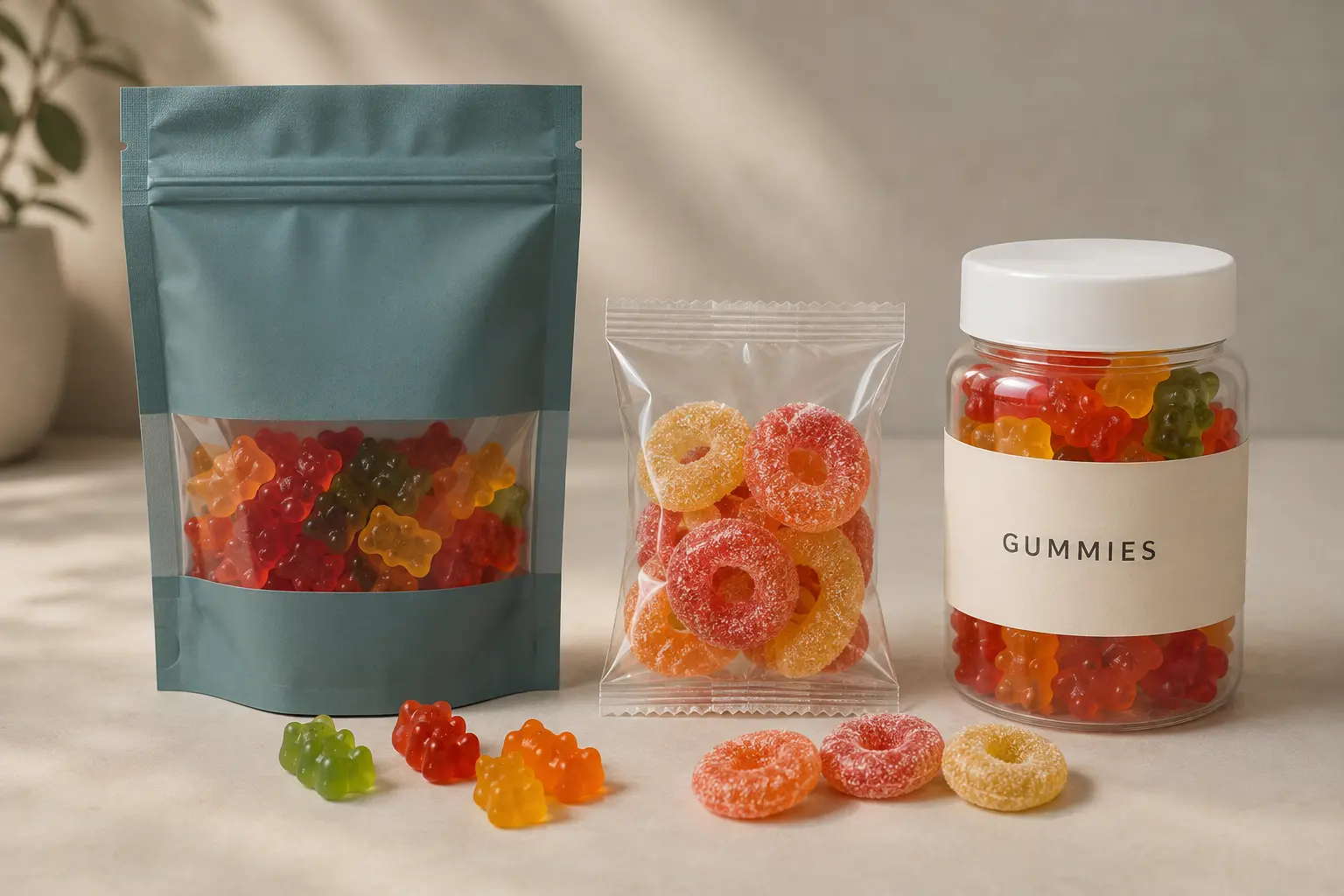
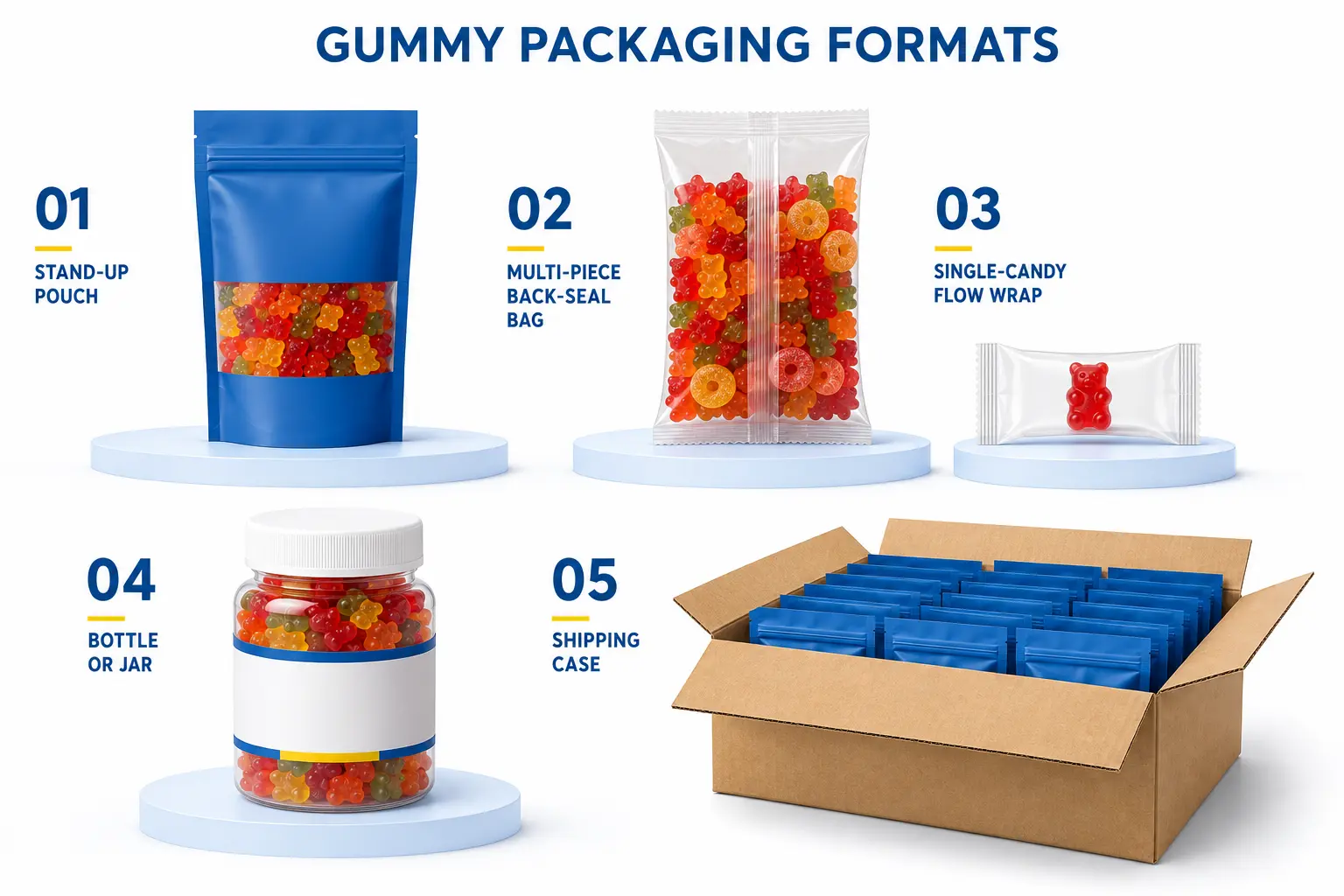 Illustrative pouch, bag and jar formats for gummies. AI-generated packaging examples.
1. Which Gummy Packaging Machine Fits Your Product?
Start with representative samples of every important SKU. Sugar-coated rings can shed particles during handling; oiled bears may behave differently after sitting in a hopper; long worms can bridge a narrow transfer opening. A mixed assortment adds variation in piece size and weight. These differences affect the feeder and filling path as much as the bagger.
Choose the packaging route first, then specify the capacity and pack dimensions you need. We can match mainstream equipment configurations and develop customized solutions for different production requirements. Final machine selection brings together product handling, dosing, sealing and downstream capacity.
| Equipment route | Gummy products and pack formats | Capacity and configuration | Features and best-fit scenario |
|---|---|---|---|
| Vertical form fill seal packaging with a suitable weigher | Weight-based bags of separable gummy bears, rings or mixed pieces; roll-film pillow bags | Specify bags/min at the required fill weight. Match the weigher, bag-forming system and sealing cycle; parallel lines can be assessed for greater output. | Forms bags from rollstock and combines dosing with sealing. A useful route for regular retail bag runs and efficient use of printed roll film. |
| Premade pouch packaging system | Stand-up pouches, zipper pouches and compatible three-side-seal bags | Select the pouch-handling format, filling stations and dosing system around your target bags/min and bag drawing. | Uses ready-made bags with retail features. Suits brands prioritizing shelf presentation, reclosure and multiple pouch designs. |
| Horizontal flow wrapping machine | Separated individual pieces or pre-portioned units | Specify portions/min, portion dimensions and spacing. Match automatic feeding and transfer to the selected wrapper. | Useful for single portions and individually wrapped pieces. A portioning stage prepares loose gummies for wrapping when required. |
| Customized bottle or jar packaging line | Gummies sold by declared piece count or weight in rigid containers | Specify bottles/min plus pieces/bottle or net weight. Size dosing, transfer, capping and labeling as one line. | Integrates a gummy-capable counter or weigher with container handling and closure. Particularly relevant to counted retail packs. |
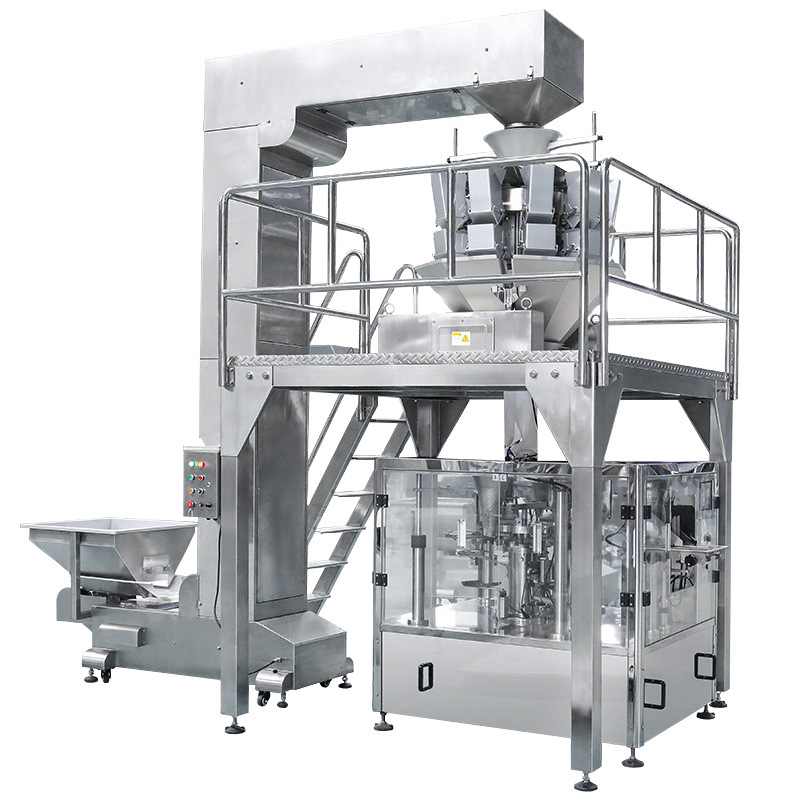
Weighing and counting answer different questions
For a 100 g retail pouch, the key measurement is net product weight. A suitable combination weigher can be evaluated against your weight tolerance, product flow and reject policy. For a bottle labeled with a specific number of gummies, the key measurement is the number of pieces delivered.
Dividing total weight by an assumed average piece weight does not establish an exact count when pieces vary. Where count matters, specify the counting method, separation process and independent verification. A final checkweigher is useful, but it should not be assumed to identify every missing or extra piece in a variable-weight product.
2. Solve the Handling Problems Before Increasing Speed
A faster sealing cycle cannot compensate for gummies hanging up in the feeder. During a trial, record where interruptions occur and whether they change as the hopper level, product residence time or surface condition changes. That information gives the engineering team a useful basis for feeder design and controls.
| Production challenge | Approach to evaluate | Practical benefit | What to verify in sample testing |
|---|---|---|---|
| Pieces stick together or bridge an outlet | Controlled feeding, suitable contact surfaces and a product-specific transfer opening | More consistent delivery to the dosing system | Clumps at startup and after a pause; high and low hopper levels; manual interventions |
| Sugar coating collects in the seal area | Controlled discharge timing, sufficient headspace and accessible cleaning points | Cleaner sealing surfaces and fewer contaminated closures | Seal contamination over an extended run, including the smallest pouch |
| Soft shapes are distorted or coating is damaged | Reduced drop heights and appropriately tuned conveying | Better appearance in the finished pack | Broken pieces, surface damage and loose coating before and after handling |
| Packs vary in weight or count | Match dosing and verification to the declared quantity | A measurable acceptance standard for finished packs | Distribution across a consecutive sample, rejects and start-stop behavior |
| Frequent SKU changes interrupt production | Repeatable settings, accessible product-contact parts and an agreed changeover sequence | More predictable restarts and cleaning | Changeover time, retained product and first accepted packs after restart |
 Illustrative separation between the product, zipper and top sealing area. AI-generated example, not a tested seal sample.
A resealable zipper serves the consumer after opening. For a factory-sealed pouch, the initial closure also needs the intended heat seal above the zipper. Specify enough headspace for product settling and a clean sealing zone. Use your film supplier’s recommended sealing conditions as a starting point, then establish the operating window on the selected machine.
3. Practical Gummy Packaging Applications
The five examples below show how product characteristics connect to packaging formats and equipment routes. Pack weights are examples; bag dimensions, container sizes and output can be specified for your market.
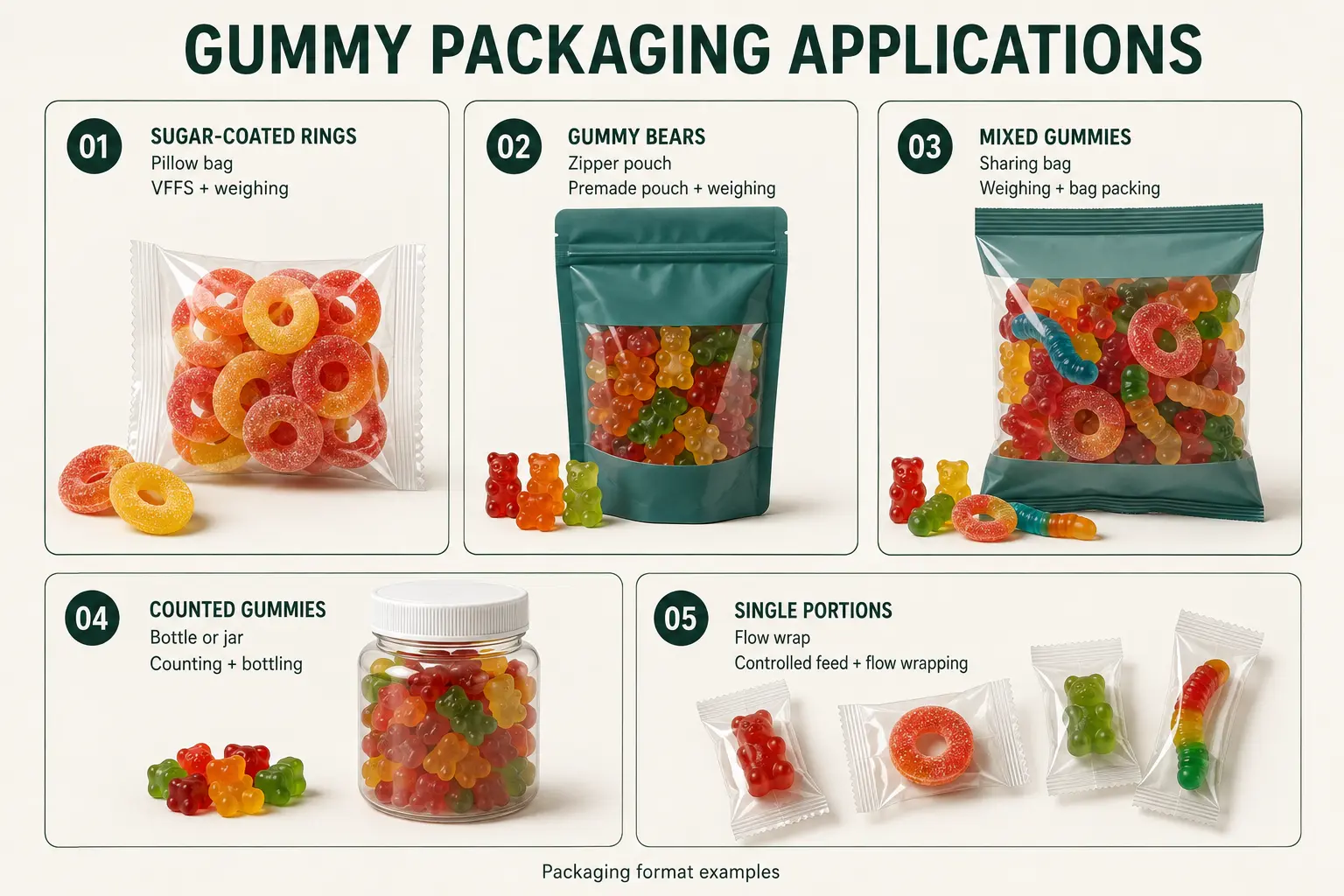
Sugar-coated rings in a 100 g retail bag
A VFFS route can be assessed when the rings separate reliably and pass through the selected dosing path. The trial should check coating loss, seal cleanliness and whether bag volume remains adequate after the product settles. Net weight and finished-pack presentation should both be acceptance criteria.
Oiled gummy bears in a 250 g zipper pouch
A premade pouch system offers a useful route for a resealable retail pack. Evaluate product release from contact surfaces, pouch opening and discharge timing. Testing immediately after a hopper refill is not enough: include product that has spent a representative time in the feed system.
Mixed shapes in a sharing bag
Mixed bears, rings and worms may flow and occupy space differently. If the package promises a particular mix, define how that mix will be supplied or measured. Achieving the correct total bag weight alone does not prove the required proportion of each shape or flavor.
Counted gummies in a bottle or jar
For a specified piece count, match product separation, counting and transfer to the container neck. Our customization service brings the solid-product dosing module together with bottle handling, capping and labeling in a complete packaging line.
Single portions in flow wrap
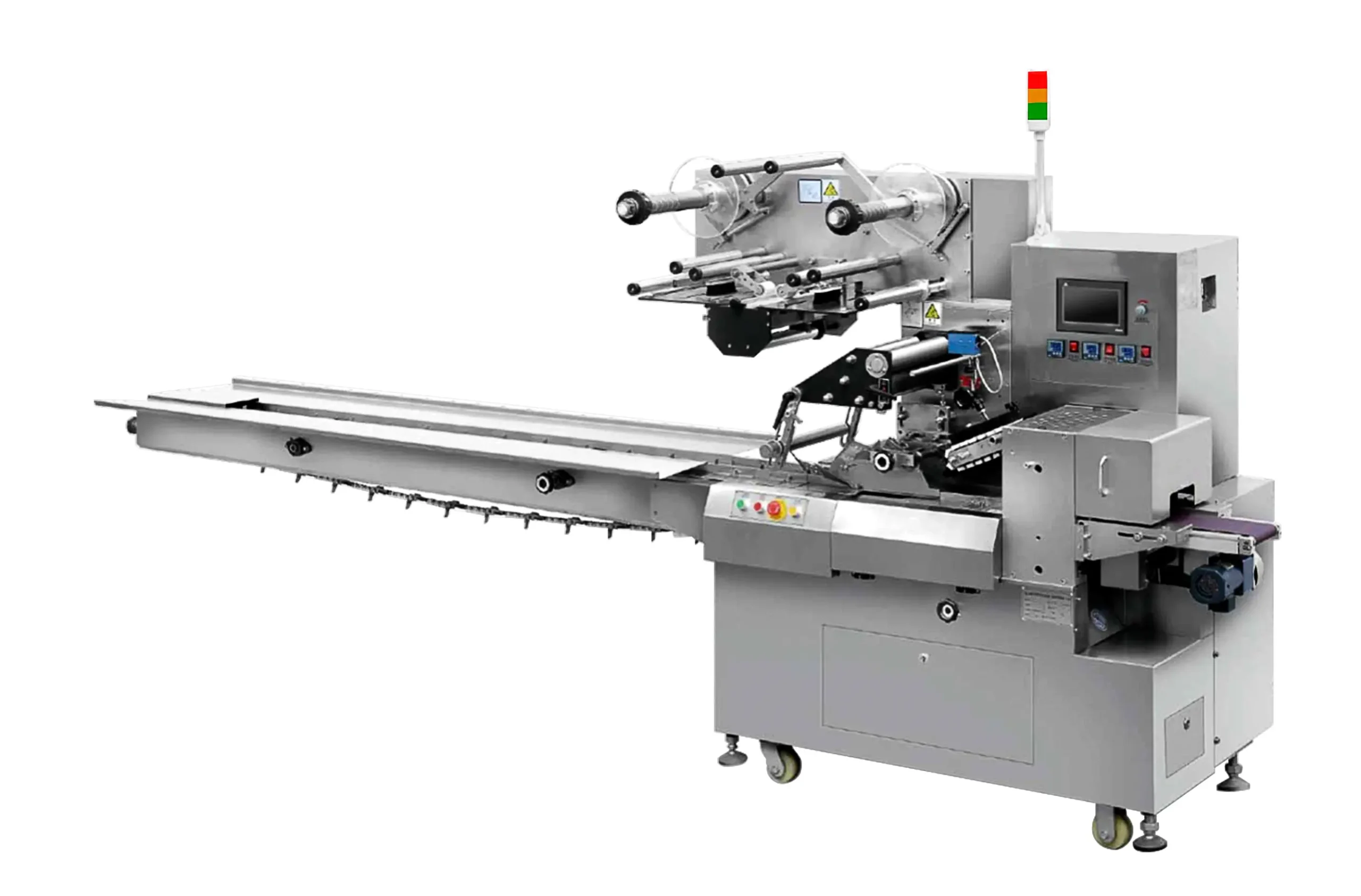
A flow wrapper is a candidate when each portion can arrive at a repeatable position with a clear cutting gap. Test the largest portion, the stickiest surface condition and restart behavior. This is a feeding and product-presentation project as well as a wrapping-machine choice.
4. Technical Specifications and Customization
Build the specification around the complete product path. We select a suitable machine platform, feeding system and downstream equipment to match your requirements. Our nonstandard equipment customization covers product handling, packaging features and line integration, including requirements beyond the sample models displayed online.
| Specification area | What to define for a gummy application |
|---|---|
| Product and dosing | Shape, size distribution, coating, surface condition, target net weight or piece count, acceptable variation and verification method. |
| Bag style and dimensions | Roll-film pillow bags, premade stand-up pouches, zipper pouches and other suitable formats. We match forming parts or pouch-handling tooling to your bag drawing, usable fill volume and sealing area. |
| Capacity and format changes | Define required accepted bags/min or bottles/min, pack weight or count, and the smallest/largest SKU. We select the machine size, dosing capacity, tooling and line arrangement around that brief. |
| Packaging materials | Evaluate suitable heat-sealable laminates or compatible PE/PP structures. Confirm moisture and oxygen barrier needs, sealant layer, stiffness, printing and storage conditions with the packaging supplier. |
| Machine and contact materials | Select frame construction, stainless steel grade, contact surfaces and removable parts for the product, cleaning method and factory environment. The quotation identifies the materials supplied. |
| Product-contact surfaces and cleaning | Evaluate finish, release behavior, removable parts, access and cleaning method using your product and cleaning agents. Stainless construction alone does not establish washdown suitability. |
| Gas flushing | Consider a nitrogen option only where the product and stability assessment justify it. Specify gas supply and a measurable headspace target if required; gas flushing alone does not establish shelf life. |
| Retail features | Assess zipper handling, tear notches and a hanging-hole punch positioned outside the sealed product chamber. Confirm compatibility with the actual pouch drawing. |
| Coding, labeling and inspection | Specify date/batch coding, label position, barcode checks, checkweighing and suitable foreign-material detection. Match detection to product and pack material. |
| Utilities and controls | Confirm voltage, frequency, compressed-air demand, footprint, access clearances, operator interface and upstream/downstream signals for the quoted configuration. |
For bottles, add container dimensions, neck opening, cap type and liner-sealing requirements. A gummy-capable counting or weighing module forms the front end of the line, followed by the appropriate closure and inspection equipment.
Packaging material selection also needs a realistic distribution scenario. A pack that seals successfully at the machine still needs evaluation for handling, storage and transport. Agree the relevant checks with your packaging and quality teams before making shelf-life claims.
5. Connect the Packer to a Complete Gummy Packaging Line
A typical bag route starts with conditioned, ready-to-pack gummies, followed by controlled feeding, weighing or counting, bag forming or pouch opening, filling, sealing and coding. Inspection and rejection can then feed into bag collation, case packing, case sealing and optional pallet handling.
Our bagged product packaging production line provides the basis for discussing these connections. Select one suitable primary packaging route and specify the downstream modules around it. Product accumulation, reject access and safe cleaning access should be included in the layout.
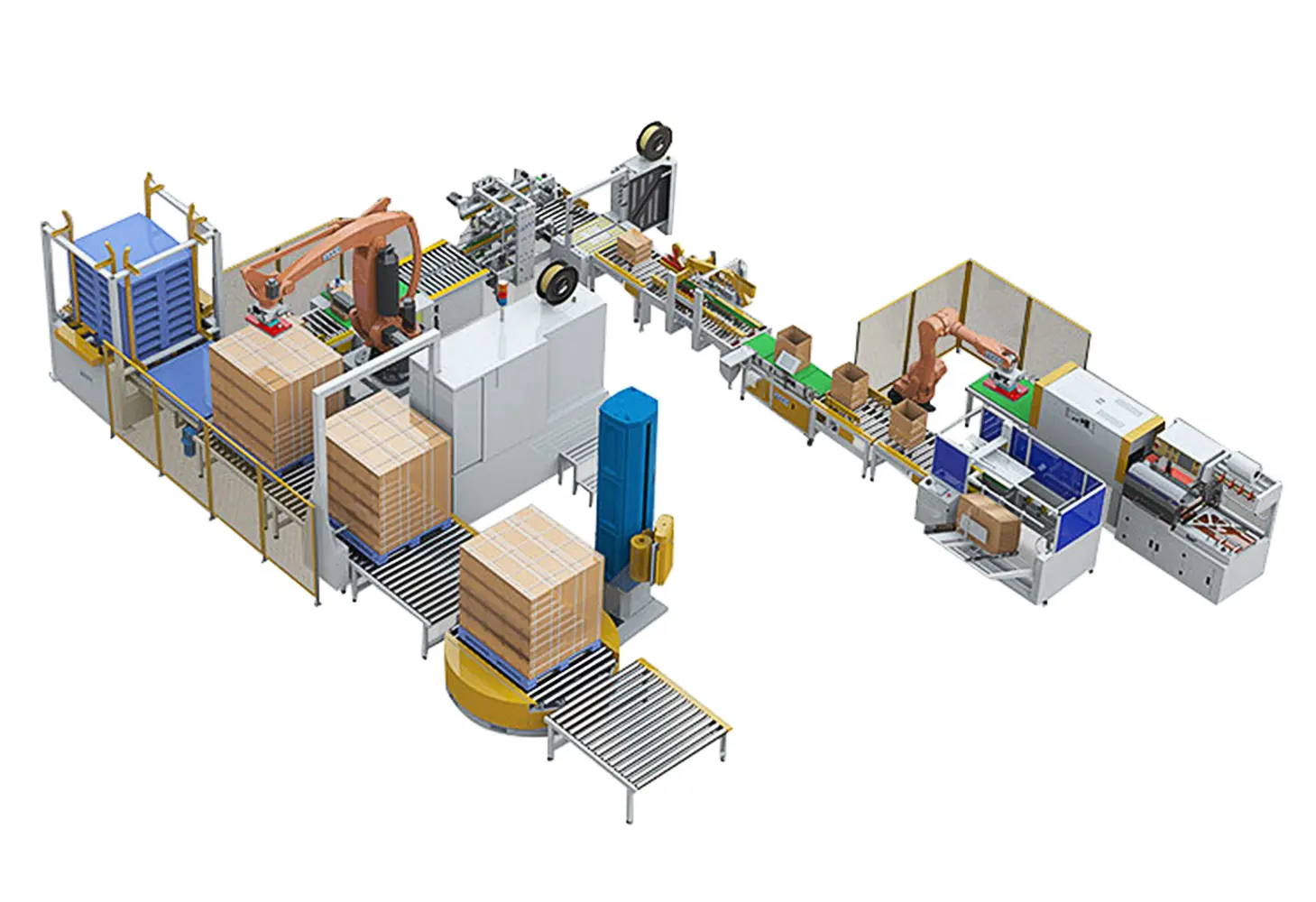
An automatic case packer groups and loads the finished products into shipping cases. An automatic carton sealing machine closes the case with the specified sealing arrangement. Bag dimensions, pack flexibility, orientation and case pattern determine how these stations should be matched.
A simple capacity calculation
Suppose a project targets 30 accepted bags/min, with 100 g per bag and 12 bags per case. The required accepted product flow is 3 kg/min, or 180 kg/hour. The downstream demand is 2.5 cases/min, or 150 cases/hour.
This is a planning example: replace 30 bags/min with your required output. Stoppages, rejects, cleaning and replenishment affect actual shift production, so we match downstream capacity and buffering to the real discharge pattern.
For bottle projects, specify pieces/min as well as bottles/min. A target of 30 bottles/min containing 60 pieces requires 1,800 accepted pieces/min through the counting and transfer stages. This calculation helps size the counter, transfer system and bottle-handling equipment together.
6. Why Work with Comwin Group?
We combine packaging experience, equipment selection and custom integration to help you achieve the right balance of cost, output and pack quality. Start with free sample testing, or visit a real factory with our team to see equipment in operation.
7. Installation, Training and After-Sales Support
Small equipment is supported with video tutorials and remote video calls; integrated-line commissioning and training are arranged for the project. We provide a two-year whole-machine warranty, a three-year core-component warranty, and remote response within 24 hours.
Frequently Asked Questions
Can one gummy packing machine handle coated and uncoated products?
One system may suit both, but we recommend sending samples of your coated and uncoated gummies for free sample testing before selecting the equipment. We assess feeding, sticking, dosing and sealing with your intended packaging, then recommend whether a shared configuration with changeover adjustments or a different handling arrangement is the better solution.
Should I choose VFFS or premade pouches?
Choose VFFS when lower packaging cost is the priority: forming bags from rollstock typically costs less per bag than buying comparable premade pouches. Choose a premade pouch system for high-value gummies where premium presentation, stand-up formats and resealable features support your positioning. Share your target pack size, monthly volume and preferred appearance; we can recommend a configuration that balances packaging cost and shelf appeal.
Can weight filling guarantee an exact gummy count?
No. If you sell gummies by weight, choose a weighing system. If you promise a fixed number of pieces, choose a gummy-compatible counting system and verify its performance with your product. We can match the feeding, counting and inspection arrangement to your pack specification, particularly when pieces vary in size or stick together.
How do I establish a realistic packaging speed?
Start with the number of finished packs you need per shift, the available production time and the quantity in each pack. Allow for changeovers and cleaning, then size the feeding, filling, sealing and downstream equipment together. Use a product trial to check sustained output and acceptable packs before confirming the configuration.
What should I send for a quotation and sample test?
For an initial quotation, send product photos, your target pack weight or count, preferred packaging style and required output. Add bag or container dimensions, factory location and available floor space where known. For machine testing, provide representative gummy and packaging samples. If the pack format is still undecided, tell us your budget and sales channel so we can compare suitable options.
Ready to specify your gummy packaging equipment? Contact Comwin Group to arrange free sample testing and discuss a configuration matched to your gummies, packaging format and production goals.