For a repeat 1 kg rollstock bag, match a weigher to free-flowing granules or an auger to a compatible powder, then size the vertical bagger from the actual filled volume. At 5 kg, check the drop, filled bag height and load support before choosing rollstock or an operator-presented bag.
Indicative prices are US$5,000–30,000 for a selected VFFS platform before complete feeding and dosing, US$12,000–40,000 for the defined powder dosing and bagging configuration and US$6,000–20,000 for hand-applied weighing and powered closing for a supported bag.
Compare the actual packing operations
| Product behaviour | Starting dose route | Bag-handling requirement | Check during a format change |
|---|---|---|---|
| Free-flowing granules | Appropriate weighing and controlled feed | Support the full bag and keep grains out of the seam | Fine feed, cutoff, bag volume and discharge |
| Powder with variable flow | Product-matched auger and supply | Control dust, discharge and mouth presentation | Tooling, bulk density and settled fill distribution |
| Same product in a smaller 50/100 g pack | A dosing range assessed for the smaller portion | Use a matching bag opening and seal clearance | Minimum useful dose and repeatability, not display resolution |

Match weighing, discharge and support to the product
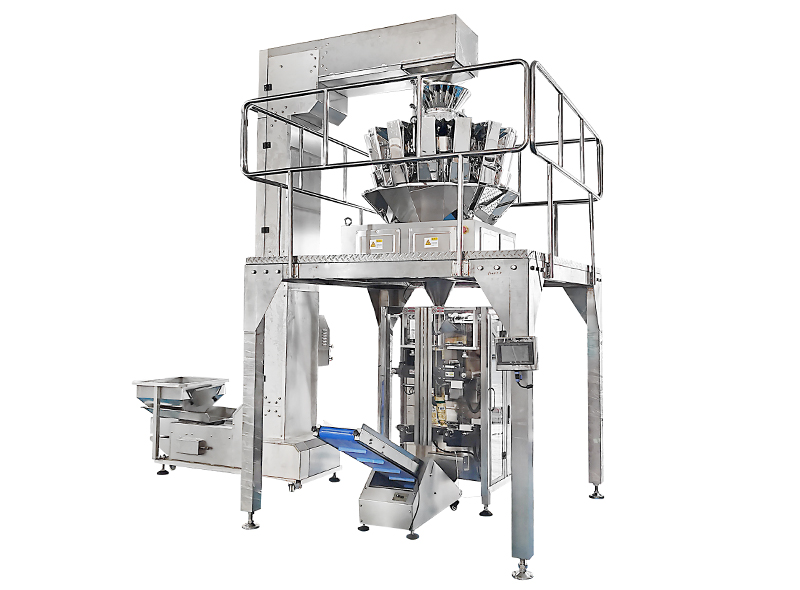
Weighing and supported bag filling for granules
A feeder brings product to a selected weighing unit. The dose discharges into a bag whose opening and bottom support suit the portion. In a hand-applied arrangement, the operator places the bag and transfers it to closing. In a VFFS arrangement, dosing and bag formation are coordinated.
For rice or granules, trial fine feed near the target weight, settling, discharge clearance and the spread of filled weights. A broad outlet for larger doses may not fit a narrow smaller bag. Trial both ends of the required portion range with their bags.

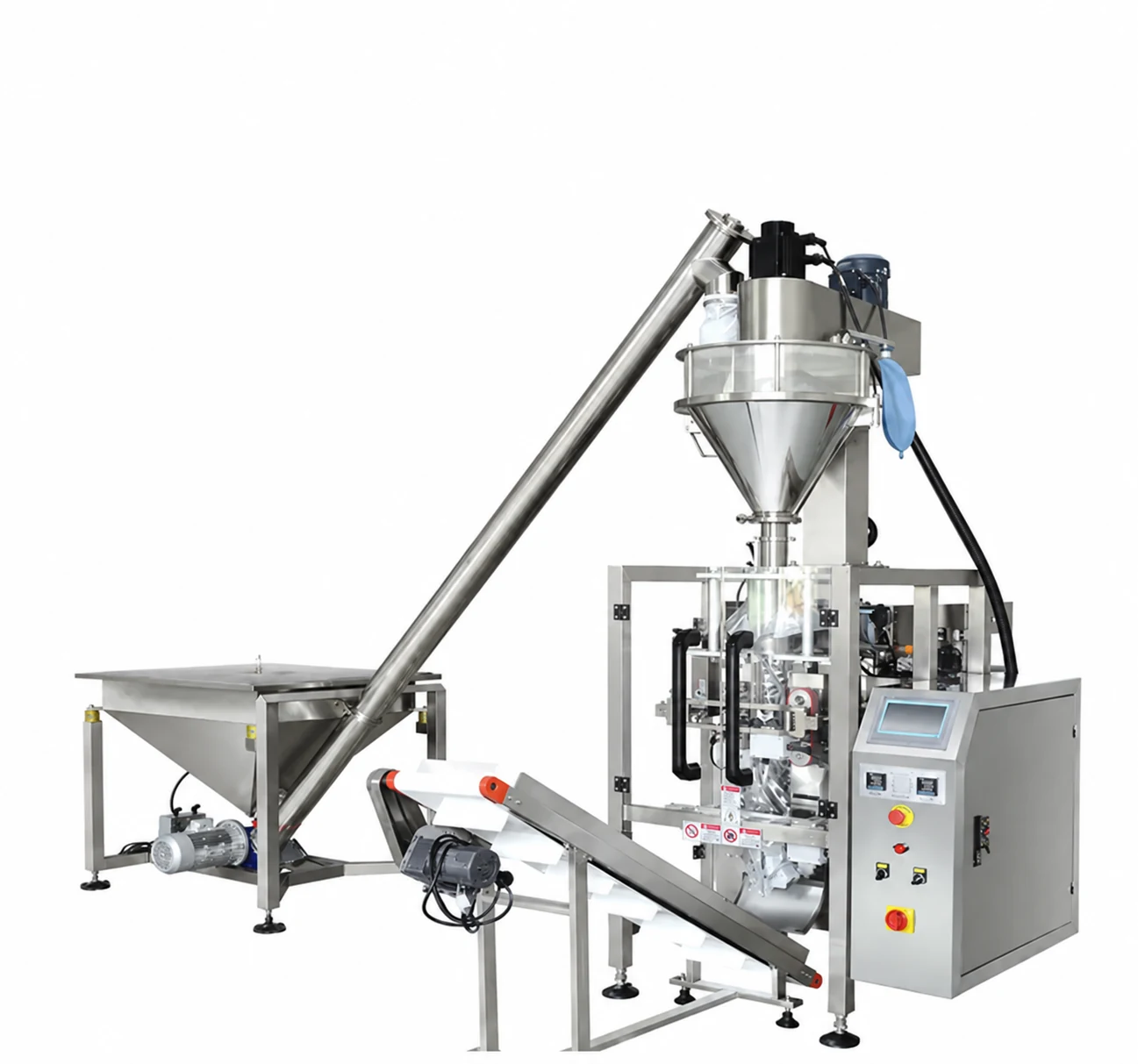
Auger dosing and clean mouth handling for powders
An auger meters powder using tooling suited to its flow. Aeration, compaction and bulk-density changes can affect filled mass. Include replenishment and changing hopper levels in the trial.
Arrange the nozzle, filling path and bag mouth so powder enters cleanly. Support a larger bag through transfer and closing. Assess dust extraction, contact materials and any product hazard separately from the kilogram setting.
Oversized fills, variable doses and unsupported bags
| Problem | Matched equipment or check | Response and verification | Applicable task |
|---|---|---|---|
| The specified mass will not fit the selected bag | Package-volume and settling assessment | Check bulk density, useful filled volume and sealing clearance with the real product. | Light powders or changing product density |
| A smaller portion varies after a tool change | Matched weighing/auger range and controlled supply | Assess actual dose samples and cutoff across the intended range. | 50/100 g and larger formats |
| A full 5 kg bag pulls on the mouth | Adequate bottom support and transfer | Keep the bag load supported before, during and after closing. | Larger filled pouches |
| Powder reaches the sealing land | Product-specific cutoff and controlled mouth presentation | Trial normal pauses, replenishment and filled-pack integrity. | Fine powders |
Rice, flour and larger bags of the same product
| Situation | Pack or equipment condition | Route or check | Key input |
|---|---|---|---|
| Free-flowing rice in one 1 kg bag | Sealed granule pouch | Weighing plus supported filling/closing or matched VFFS | Density, bag opening and full cycle Check fine feed and discharge on the smallest required portion. |
| Flour in a defined retail pouch | Sealed powder pouch | Auger dosing with controlled bag mouth | Flow, aeration, dust and seal clearance Reassess tooling when product density or portion changes. |
| The same product moves to a broader 5 kg bag | Larger supported pouch | Reassessed dosing and bag handling | Bag volume, load, outlet and transfer A larger weight setting alone does not extend machine capability. |
Account for the remaining operator work
| Production arrangement | Operator work | Changeover or supply issue | Acceptance focus |
|---|---|---|---|
| Hand-applied weighing/filling | Operator presents and transfers bags | Flexible formats; handling remains | Accepted dose and complete closed pack |
| Automatic dosing with selected bagging | Operator replenishes product and material | Dosing tools and bag formers follow the range | Filled-pack output and ordinary supply variation |
| Connected product feed and packing | Included transfers coordinate supply | More interfaces and cleaning/change work | Whole agreed operation through replenishment and stops |
Product density, bag structure and smaller portions
Provide the product’s bulk density and normal variation, particle size, moisture, flow and packing condition. A liquid’s mass-to-volume conversion also needs its actual density; 1 kg should not automatically be treated as 1 litre. Provide the full bag drawing and material construction alongside the target mass.
A 50 g or 100 g variant may need different tooling or a different dosing range from the 1 kg format. Assess very small 1 to 10 g sachets separately; changing the weight setting does not establish small-dose performance.
Check bag volume and dose distribution separately
As a simplified volume calculation, 1 kg at an assumed bulk density of 0.5 kg per litre occupies 2 litres before allowing for the required package shape and sealing clearance. At that same assumed density, 5 kg occupies 10 litres. Use measured product behaviour and filled samples for final bag dimensions.
Evaluate the distribution of actual filled masses under the agreed supply conditions. A scale display increment is not a guarantee of portion accuracy. For a hypothetical average excess fill of 5 g over 10,000 packs, excess product is 50 kg. This arithmetic explains why dose control matters; it does not prescribe a fill allowance or a legal quantity requirement.
Equipment prices and the scope behind each range
October 2026 planning references for new equipment supplied from China, covering one ordinary product and one format unless listed otherwise. Confirm the configuration in a project quotation. Unlisted product preparation, extra formats, freight, taxes, overseas installation and site work are excluded. Special contact, cleaning, hazardous or aseptic requirements need separate assessment.
| Equipment scope | Planning budget (USD) | Range applies to | Define separately |
|---|---|---|---|
| Hand-applied weighing and powered bag closing | USD 6,000 to 20,000 | One ordinary granule product and supported 1 to 5 kg bag family | Automatic bag application, product lift and special construction |
| Selected VFFS platform | USD 5,000 to 30,000 | Defined bagger and roll-film format that fit the assessed pack | Complete dosing/feed and any larger-format platform change |
| Selected powder-dosing/bagging configuration | USD 12,000 to 40,000 | One ordinary powder and defined dosing/bag sequence | Unlisted extraction plant, product lift, extra tools and hazard-related construction |
Convert tonnes per shift into bag cycles
An illustrative requirement of 1 tonne in 200 available minutes means 1,000 acceptable 1 kg packs, or 5 packs per minute. At 5 kg it means 200 packs, or 1 pack per minute. The product throughput remains 5 kg per minute while bag-handling frequency changes. These are workload calculations, not machine ratings.
Trial the minimum and maximum dose, normal product replenishment, bag changes and complete closing. Count accepted filled packs and retain the dose and seal records for each format.
Compare proposals for the same product and pack
| Dimension | Evidence to compare |
|---|---|
| Equipment price and scope | Product, formats, listed operations, inclusions and exclusions. |
| Usable output | Compare real dose samples, supported full bags and complete usable output at the required formats. |
| Product and format fit | Actual product, bulk density and flow information; Minimum/normal/maximum dose and permitted variation. |
| Training and support | Operator, maintenance, spares and commissioning responsibilities. |
| Delivery | Format confirmation, layout and acceptance requirements. |
Questions before selecting equipment
Will a 1 kg machine also pack 5 kg?
Its dosing range, bag dimensions, support and discharge must cover the larger pack. Confirm those items and trial both formats.
Can one auger handle all powders?
Tooling and feed conditions depend on the powder. Flow, aeration and density variation should be assessed using the actual product.
Can Comwin supply a project for delivery to India?
Include the delivery destination and required documentation in the enquiry. Equipment, freight, import charges and installation responsibilities belong in the project quotation; this guide does not represent a local dealer stock offer.
Can a 1 kg bagger also run 50 g or 100 g?
Assess the useful dosing range, tooling and bag dimensions for each format. The target weights alone cannot establish that one setup will handle all of them.
Send filled bags and the required weight range
- Actual product, bulk density and flow information
- Minimum/normal/maximum dose and permitted variation
- Filled bag samples, dimensions and material layers
- Required tonnes and acceptable packs per shift
- Product supply, dust/cleaning and closing requirements
- Format changes, utilities, layout and delivery destination
- Destination, regional purchasing requirements and required documentation
Comwin will assess the product and bag range, specify dosing and bag support, and explain configuration, included work and trial requirements.