Blister Card Sealing Machine Price: Tooling, Feed and Forming
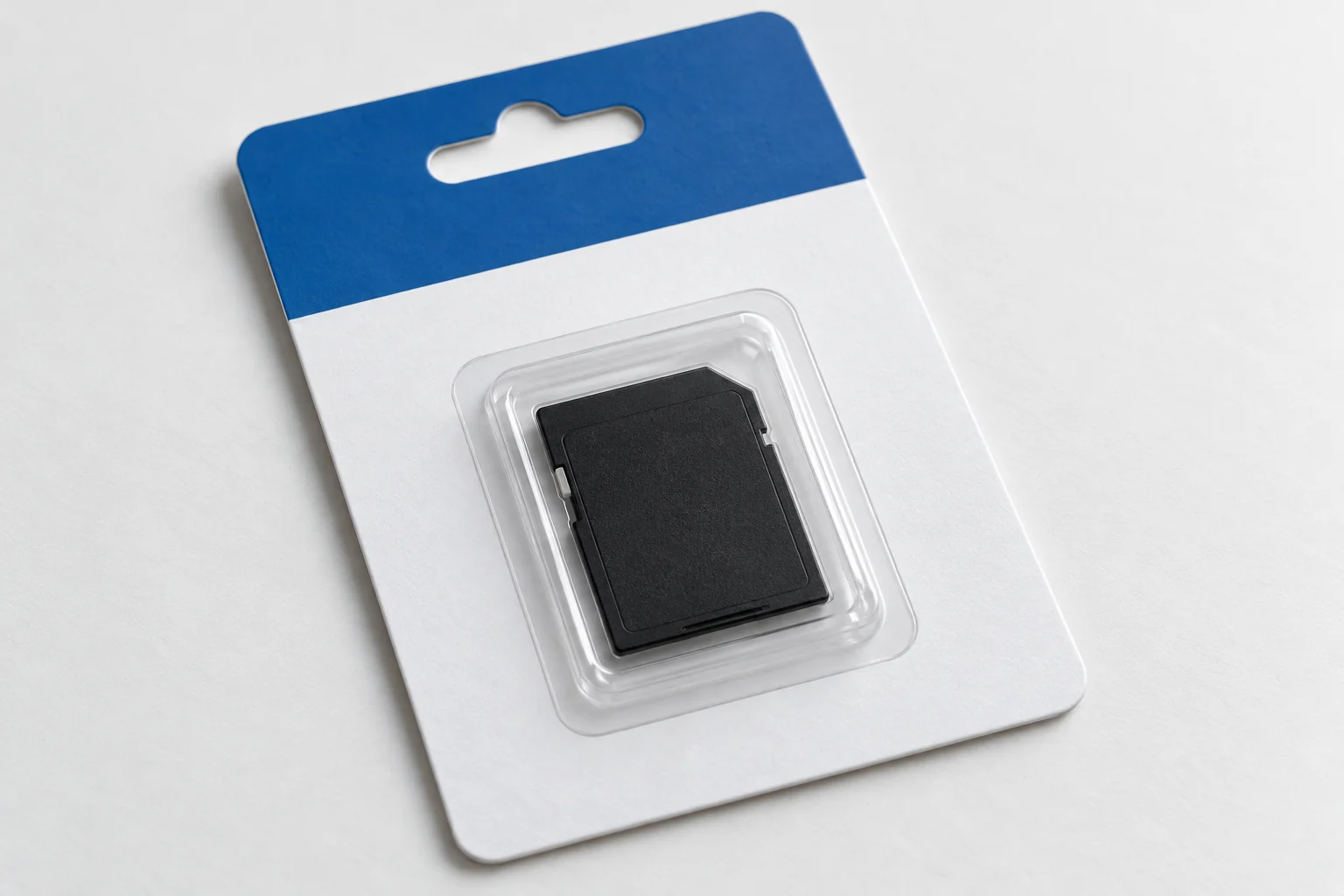
A blister card packaging machine seals a formed plastic pocket to a compatible backing card around a retail item. The pocket holds the product; its flat flange provides the sealing area. Tooling must support that area while leaving space for the pocket and product.Early allowances range from US$4,000–15,000 for an assisted sealer using supplied pockets to US$40,000–120,000 for a section that also forms the pockets. Product loading is a separate scope decision: automatic package handling does not necessarily include an automatic product feeder.Finished memory-card-style retail blister (packaging illustration).
Bought pockets or forming on the line?
A supplied pocket avoids forming on the sealing station, but it still needs a matched nest and a reliable loading step. Handling a larger formed sheet can keep pockets registered through sealing and add a trimming task. For repeat formats, compare the handling saved by forming inline with the added mold, cutting and setup work.
Packaging supply
Equipment route
When to assess it first
Finished pockets and cut backing cards
Supported loading and card sealing, with manual or specified automatic handling
When you already have an approved packaging supplier or run varied short orders
Formed master sheets and cards
Loading, sealing and the required trimming/cutting arrangement
When several pack positions are handled together; the sheet and tools must match
Compatible forming material and backing cards
Integrated pocket forming, product loading, card sealing and cutting
When repeated production justifies bringing pocket manufacture into the line scope
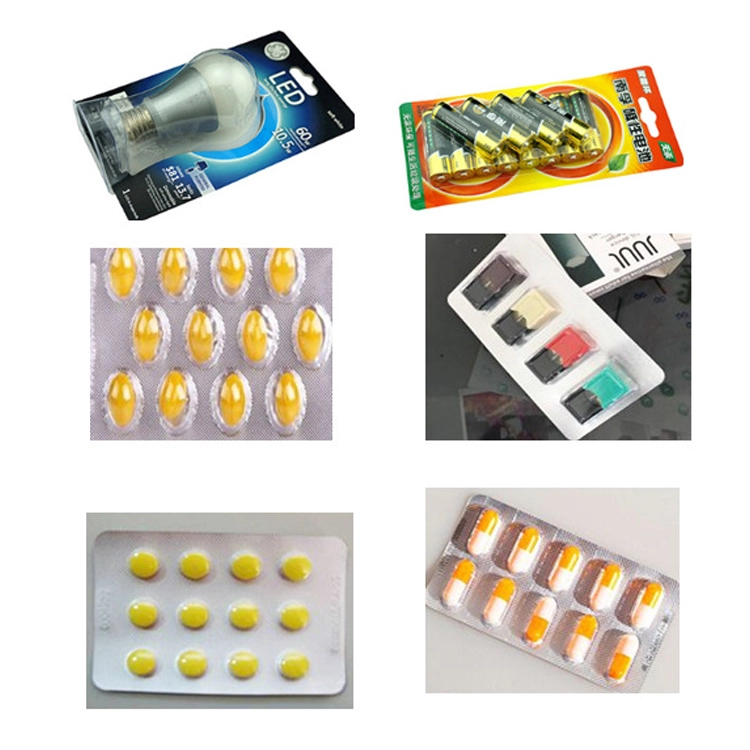
The guide concerns retail carded packs. Pharmaceutical foil-lidded blisters, slide-in cards and trapped-card constructions can use different materials or closing operations. Show the actual package construction when requesting a blister card packing machine.
Choose where loading and sealing happen
Example layout
Loading positions and work
Sealing and removal
Single assisted station
Operator places pocket, product and card in the matching fixture.
Sealing cycle follows; operator removes the pack before reloading.
Shuttle with separate load and seal positions
Operator loads the accessible fixture; the shuttle moves it to the guarded sealing position.
An arrangement with separate fixtures may allow loading while another fixture seals, subject to its safety and control design. Finished packs return to removal.
Rotary or circulating fixtures
Example sequence: pocket placement → product loading → card placement, at designated positions.
Fixtures move to sealing and pack removal. Product placement can remain manual even when pocket/card handling is automatic.
These are layout examples, not standard station counts for every model. Additional fixtures can provide work positions or allow operations to overlap. Output still depends on the slowest required action, loading access and the complete cycle.
Approve the pocket, card and seal as one package
The raised cavity holds the product; the flat flange meets the backing card (package-component illustration).
Part of the pack
Tooling requirement
Raised cavity and product
Provide a matching recess and clearance so sealing force does not crush the pocket onto the item.
Flat flange and card beneath it
Provide aligned support and sealing contact around the intended bonded area.
Printed card outside the seal
Locate the card without unwanted marks, bending or heat damage.
In a typical supported-tool arrangement, the cavity sits in a recess while the flange lies on a surrounding support surface. The matching sealing contact acts across the flange/card area. Tool orientation and heating arrangement depend on the selected machine.The card coating and pocket material must work with the selected sealing process. Set temperature, pressure and time for that combination. More heat cannot reliably compensate for a mismatched coating or a flange left unsupported.After sealing, inspect retention, printed-card appearance and the intended opening method. A neat perimeter alone does not establish a sound pack, and excessive opening force can damage the item during use.
Match the layout to the order pattern
Several small products in short runs
For an ordinary metal key ring, the cavity must hold the ring and any projecting tab in their intended positions. A loose ring can move while a card is placed over it. Pocket location, loading access and the matching nest matter more here than the product’s small size. Check how the ring rests and moves during loading.Supplied pockets with an assisted sealer are a useful starting point when operators can place the items reliably and orders change frequently. Compare the work to replace the pocket nest and sealing tools, replenish new cards and release the first acceptable pack. A complex feeder may offer little benefit if it spends much of the shift being changed for another item.
One repeating retail pack
An automatic blister card packing machine can take over defined pocket and card handling as the order becomes repetitive. Establish product loading separately. Operators may still load products, or a dedicated product feed may be required. Forming on the line becomes a further decision involving material supply, forming tools and trimming, even when the product itself stays unchanged.
Define every operation in the repeating pack
Supply or form the pocket → load the product → place the card → seal → trim if required → discharge the pack
A memory card in a retail blister
For a memory card blister packing machine, the cavity should locate the small item without placing sealing pressure on it. Contact surfaces, handling and exposure during sealing need to suit the product. Where electrostatic protection or identity tracking is required, specify those functions separately and obtain the relevant evidence; ordinary clear packaging does not establish either.
Use defects to find the part of the process to change
Defect
First areas to examine
Edges lift after sealing
Material compatibility, flange support, surface condition and sealing settings
Card curls or print is damaged
Card construction, heat exposure and tool contact
Pocket or product is crushed
Cavity clearance and where the tool applies force
A card or product is missing
Separation, loading and the agreed checks before pack release
Buying pockets or making them during packing
Work to compare
Buy preformed pockets
Form from material on the line
Tools and changes
Matching pocket nest and seal tooling; source the new pocket design.
Forming, sealing and cutting tools plus their setup for each design.
Material supply
Store and replenish shaped pockets and cards; check separation of nested pockets.
Store forming material and cards; replenish rolls/sheets and control the forming conditions.
Waste and upkeep
Manage damaged supplied pockets and normal sealing waste.
Also manage trim, forming setup waste, heaters and forming/cutting maintenance.
Order pattern
Useful to compare for many designs or short runs with a reliable package supplier.
Useful to compare for repeat volume that can keep the added forming work productive.
Compare total work over the order schedule, including package supply and changeovers. No payback period follows from machine price alone.
Blister-card budgets with loading work identified
These October 2026 indicative allowances cover new China-supplied equipment for one ordinary face-seal retail pack, with one preformed pocket/card design or equivalent first forming-tool set. The product is manually placed in the reference scopes. Specialist medical, sterile and electronic-product qualification is excluded; the required output is specified separately.
Planning allowance
Included reference configuration
Work remaining outside that scope
US$4,000 to 15,000
Assisted pocket/card sealer
A matching nest and seal tool with controls for the approved supplied pocket and card
Operators load components and remove packs. Pocket manufacture and card printing/cutting are upstream.
US$20,000 to 60,000
Automated preformed-pack handling and sealing
Defined pocket/card feeding and transport, matching tools, sealing and discharge
For this planning scope, product placement remains operator-assisted. Automatic product loading requires an explicitly priced feeder.
US$40,000 to 120,000
Integrated forming and card-sealing section
Compatible material feed, forming, a product-loading position, card handling, sealing, cutting and discharge with the stated first-format tools
The base planning scope allows manual product placement. A dedicated loading system, extra tool sets and complex inspection are additional.
For an entirely automatic process, include the product feeder in the proposal and budget. Its selection depends on the item and incoming supply. Secondary packaging, freight, taxes and overseas installation are additional unless listed.
Calculate from the complete cycle
If a fixture has two pack positions and completes its entire cycle every six seconds, its theoretical output is 20 packs per minute: two multiplied by ten complete cycles. If six seconds describes only sealing dwell, that calculation cannot be used until loading, movement and release are accounted for.On equipment with overlapping stations, use the actual rate at which completed packs leave the system. Record good packs, rejects and downtime over the agreed run to establish accepted output. These example numbers explain the calculation; they are not a machine rating.
Review the pocket, card and loading together
Send Comwin the product, pocket and backing card, the order pattern and required packs per shift. If pocket supply is undecided, we can compare buying pockets with forming them on the line. The proposal should identify product loading, tool changes and how finished packs will be checked for retention, appearance and opening.Comwin offers free sample testing, a two-year machine warranty and a three-year warranty for core components. Remote support responds within 24 hours; installation and training are specified in the proposal.