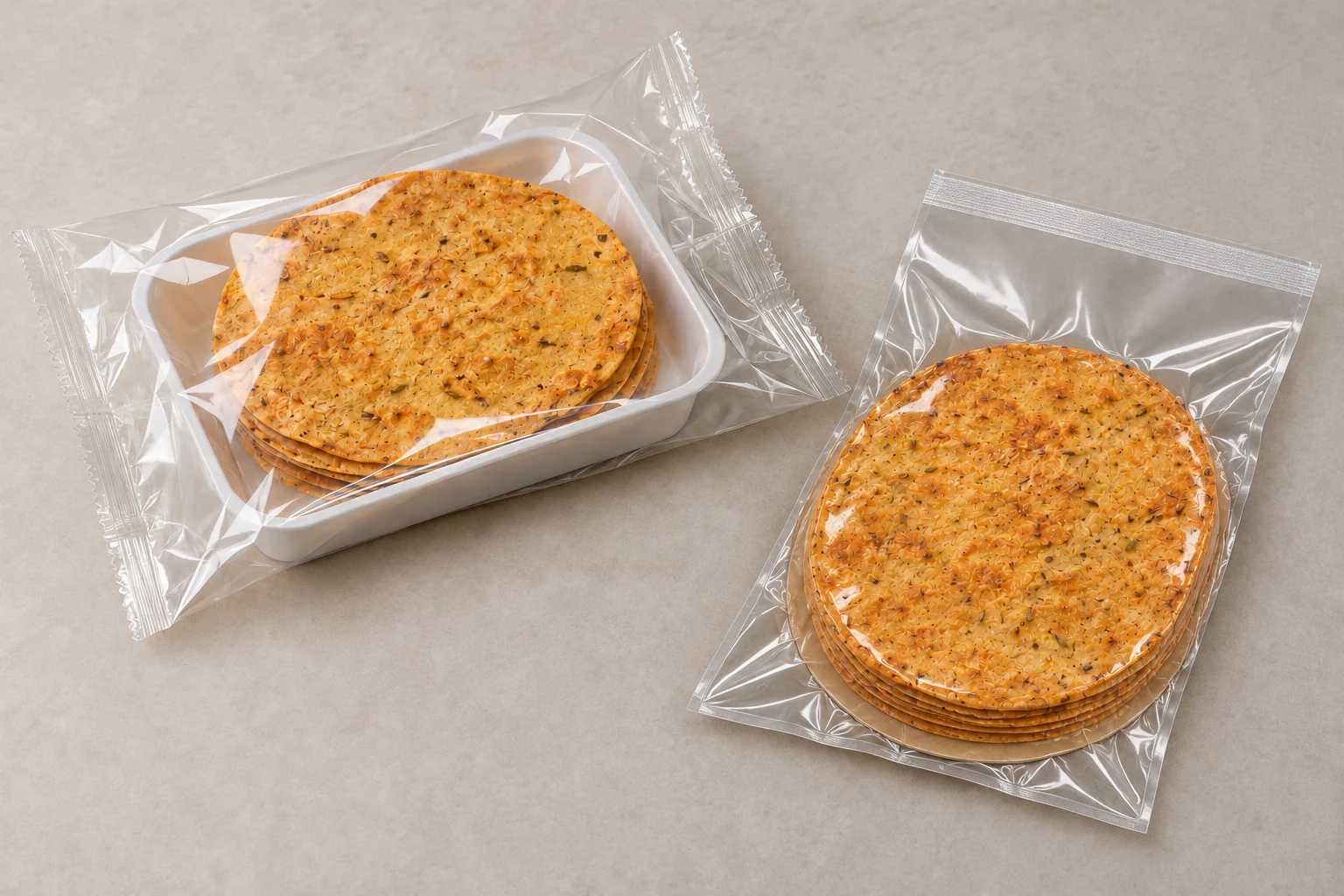
For whole, brittle khakhra discs, start by evaluating horizontal flow wrapping with enough support to keep the stack intact. If your packaging specification calls for vacuum, trial the discs, support and pouch together before choosing a vacuum packing machine. A tighter-looking pack can still contain broken khakhra.
Comwin matches the wrapping or sealing arrangement to the disc size, pack count, product condition and distribution requirements. Cooking, roasting and cooling the khakhra are separate production operations.
A manually loaded flow wrapper for one supported stack and compatible rollstock is US$5,000–25,000 for planning. An operator-loaded chamber vacuum sealer is US$3,000–15,000, sized to the pouch and seal length. Automatic stacking and dedicated tray feeding are separate.
Choose the pack around the whole disc
| Requirement | Starting route | Condition that changes the choice |
|---|---|---|
| A repeated retail stack, with whole discs as the priority | Supported horizontal flow wrap, with a tray or other suitable support where needed. | Product movement, film pressure or the transfer causes breakage; change the support or feeding arrangement before increasing speed. |
| A specified vacuum pouch | Operator-loaded chamber sealing, using a compatible pouch and support established in the trial. | Discs crack during evacuation, pressure recovery or later handling. Review the pack and vacuum process rather than accepting a visually tight bag. |
| An atmosphere-control requirement | Assess compatible gas-flush equipment with the film and finished pack. | The required atmosphere or seal integrity cannot be maintained under the intended storage conditions. |
Gas flushing can be assessed as part of a compatible wrapping or chamber process. Define the intended preservation requirement and validate the atmosphere, film and seal with the actual food and distribution conditions.
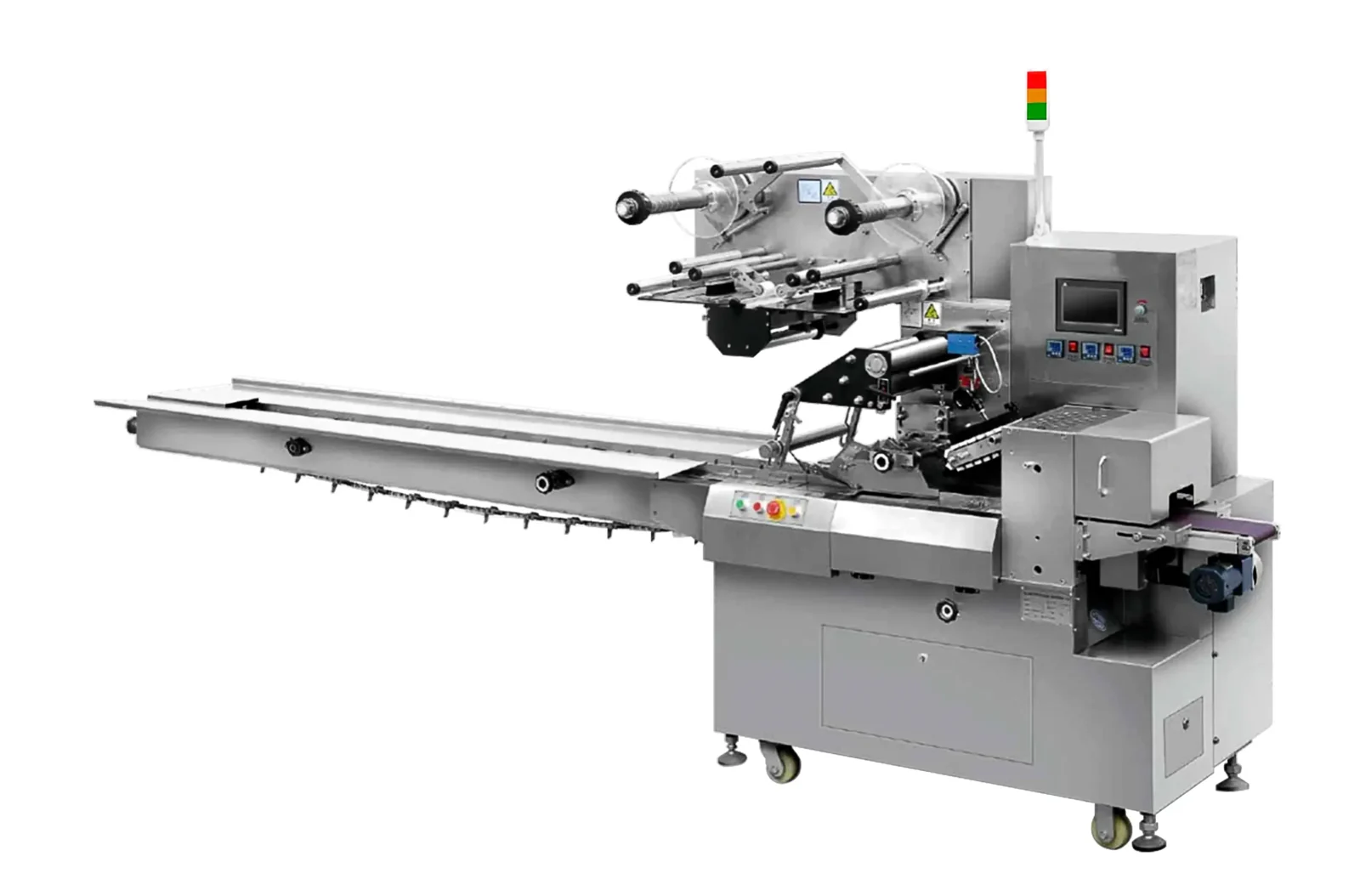
Flow wrapping with a supported stack
A horizontal flow wrapper forms and seals film around each prepared stack or supported tray. This is useful when a stable pack can move through the infeed with limited disturbance. Specify the tray’s external dimensions and the space needed beyond the disc edge for sealing.
A tray may protect the edge during transfer, but its shape and strength still need testing. Check the bottom disc when the stack moves between surfaces. Where direct contact with the discs causes damage, evaluate moving the support rather than pushing the exposed stack.
Vacuum packing needs its own breakage trial
A chamber vacuum sealer removes air and seals a loaded pouch. Specify the usable chamber space, sealing opening and pack arrangement. The tray, pouch neck and seal must all fit without folding the closure area.
Choose the chamber layout around the loaded support and a flat, unobstructed pouch neck. Where evacuation damages the discs, reassess the support, vacuum process and pack format together. Settings and any gas return are established on the selected equipment.
Protect crispness as well as appearance
Khakhra can arrive at packing with different oil levels, seasoning and residual heat. Establish a consistent packing condition before comparing machines. Oil or crumbs in a seal and moisture picked up during handling can undermine an otherwise neat pack.
Select the film for its sealing behaviour and the barrier required by the product and distribution plan. Keep the sealing zone clear, record the trial film specification and inspect retained packs after the agreed storage period. Validate usable storage life with retained samples under the intended distribution conditions.
Three production situations
Several disc sizes in small batches
Prepare and count stacks beside the packer, with enough surface support to prevent edge damage. Compare the operator’s loading method and the actual change of guides, film or pouch size. This can be a practical starting point when packing demand does not justify automatic stacking.
One repeated retail pack throughout the shift
Use the stable format to evaluate controlled tray transfer into the wrapper. Automating this handoff can be useful if manual placement repeatedly shifts the discs. Confirm how trays are replenished and how an incomplete or damaged stack is removed before it reaches the seal.
A buyer specifically requests vacuum packaging
Confirm the specified pouch dimensions and whether a support tray is allowed. Include pouch loading and positioning in the work cycle; a change from flow wrap to a chamber process can also change operator handling and output.
Count acceptable packs over the complete cycle
For a chamber sealer, record loading, chamber operation, unloading and inspection. A quoted chamber cycle alone does not establish packs per hour. For a flow wrapper, include stack preparation, support placement, film changes and rejected packs in the run.
Agree whether the acceptance criterion counts packs with every disc whole or allows a defined level of breakage. Keep the same criterion when comparing manual and automated feeding. The useful output is saleable packs delivered to the next operation.
Budgets for two defined packing stations
| Equipment scope | Indicative USD reference | Assumptions and exclusions |
|---|---|---|
| Compatible manually loaded horizontal flow wrapper | US$5,000 to US$25,000 | One defined supported pack and suitable rollstock. Automatic stacking, dedicated tray feeders and special atmosphere equipment are separate. |
| Operator-loaded chamber vacuum sealer | US$3,000 to US$15,000 | A chamber and sealing arrangement sized for the agreed pouch. Support development, special gas options and automatic loading are separate. |
These equipment planning references cover two different packing stations. Freight, taxes, overseas installation, cooking equipment and production consumables are excluded. The trial determines which configuration can handle your pack without unacceptable damage.
What the sample run should prove
Run the most fragile normal batch and the largest intended pack. Record discs damaged before loading, during packing and after opening the finished package. Inspect the bottom layer and edges, then check seals for contamination and the required integrity.
Repeat the trial with the chosen production film and support. For vacuum packs, assess damage after pressure recovery and handling. The proposal should identify the demonstrated format, included tools, operator tasks, acceptance criteria and any untested variants.
Send a disc and a completed-pack target
For an initial recommendation, provide the disc diameter and thickness, pieces per pack, stack height, product photos and required packs per hour. Tell us whether a tray is acceptable and whether vacuum is required by a specification or is simply being considered.
Comwin can then recommend the packing route and a sample-run scope. Pack dimensions, film, utilities and acceptance details can be confirmed around that proposal.
Comwin offers free sample testing, a two-year machine warranty and a three-year warranty for core components. Remote support responds within 24 hours. Training, installation and spare-part responsibilities are agreed in the proposal.