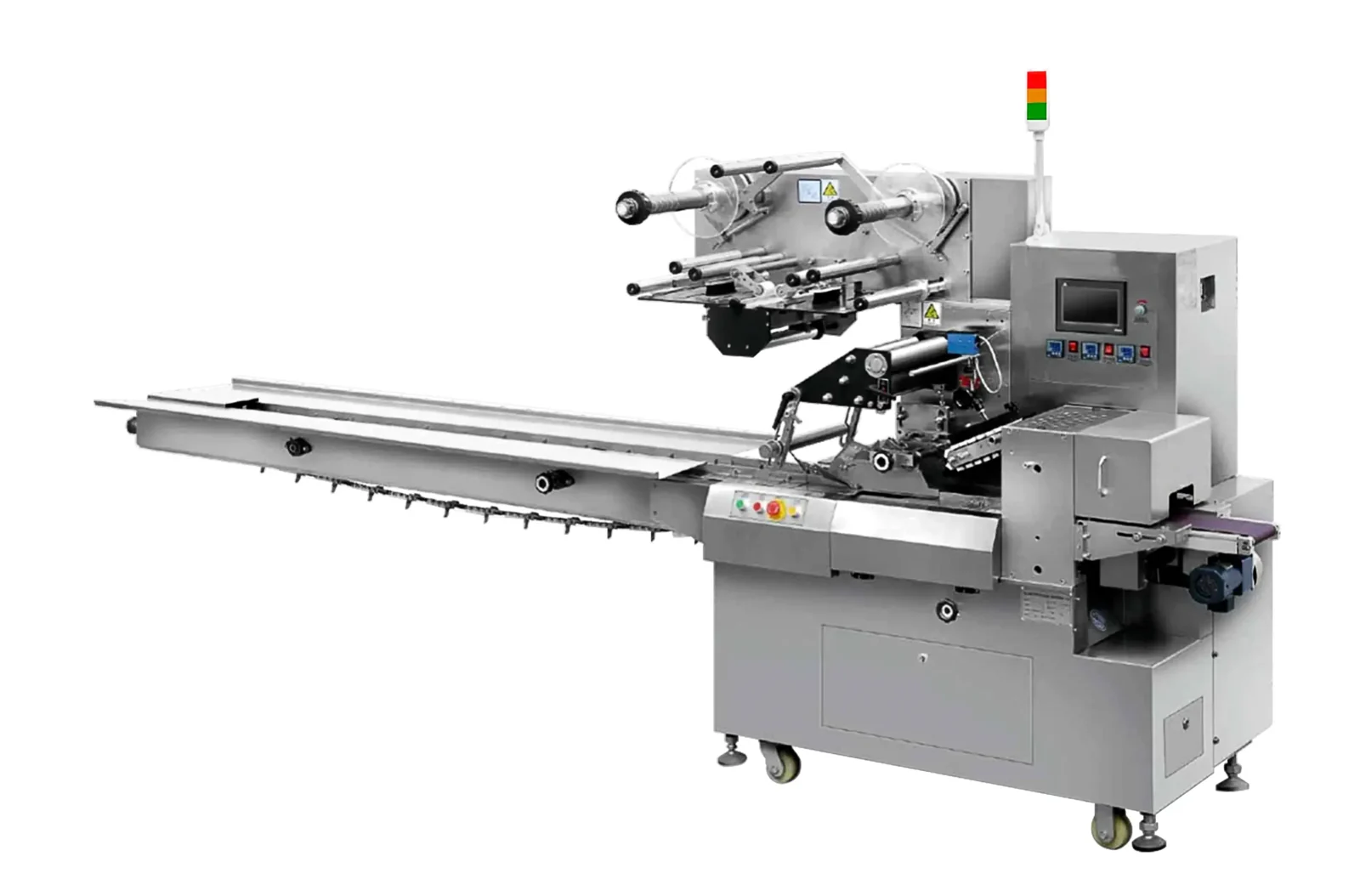
For oranges sold one at a time, use a horizontal flow wrapper with a supported infeed. Each orange travels into its own pillow pack without a tray. Check that the fruit stays in position and clears the end seals. For a display group, wrap the loaded tray. Choose clipped netting for a specified mesh pack and case loading for loose fruit going into transport cartons.

Compare finished orange packs
| Finished pack | Equipment route | What changes the choice |
|---|---|---|
| One orange in a trayless pillow pack | Separate and space individual fruits on a supported infeed, then wrap each on a horizontal flow wrapper. | Run the smallest and largest normal grades. Check roll control, rind marks and clearance at both end seals. |
| Oranges in a flow-wrapped tray | Load the fruit into the tray, then support and feed the filled tray through a horizontal flow wrapper. | Choose the tray for the intended display and fruit arrangement. Account for tray supply and loading. |
| Fixed-count retail net | Grade the fruit to the agreed size range, count it into tubular mesh and clip both ends. | If the pack also carries a weight declaration, verify pack weights across the grade range. Count alone cannot confirm the minimum weight. |
| Weighed retail net | Weigh the portion, load it into the net and clip the closure. | If the last orange pushes the pack well over target weight, try a narrower size grade or a different portion combination. |
| Loose oranges in shipping cases | Load the fruit into the specified case or layer inserts. | Check shoulder contact, clearance below the case above and movement during handling. This is a separate whole-fruit loading task. |
Wrap one orange at a time without a tray
For one fruit per pack, the horizontal pillow packaging machine forms rollstock around the orange, closes the longitudinal seam and seals both ends. Trayless wrapping saves the tray and loading step. The infeed now has to control the round fruit through the transfer so it cannot roll into an end seal.
Start with one grade. Manually present fruit at a repeatable pitch for a short format trial. For continuous feed from a grader, specify singulation and spacing so each wrapper cycle receives one orange. Check the smallest fruit for drifting and the largest for former and jaw clearance. Inspect rind marks after transfer and inspect both seals after a stop and restart. Confirm the film and any ventilation needs with the produce team. If the pack specification requires close-fitting shrink film, evaluate the film and heat step separately.
Wrap the whole retail tray

A horizontal flow wrapper encloses the complete tray in film. The end seals sit beyond the tray; the film is not sealed to a flange around its rim. Use the largest normal oranges and check the loaded tray height, width and fruit positions through the film path. A well-fitting tray can retain the chosen arrangement, but it still needs a smooth transfer into the wrapper.
Compare the work at the infeed. Staff can place fruit into trays and present them at the required spacing. If repeated grades and trays justify automated loading, specify tray supply, fruit placement and missed-tray handling. Include tray and film use in the comparison with netting, without assuming either finish is always cheaper.
Leave enough mesh for the closure
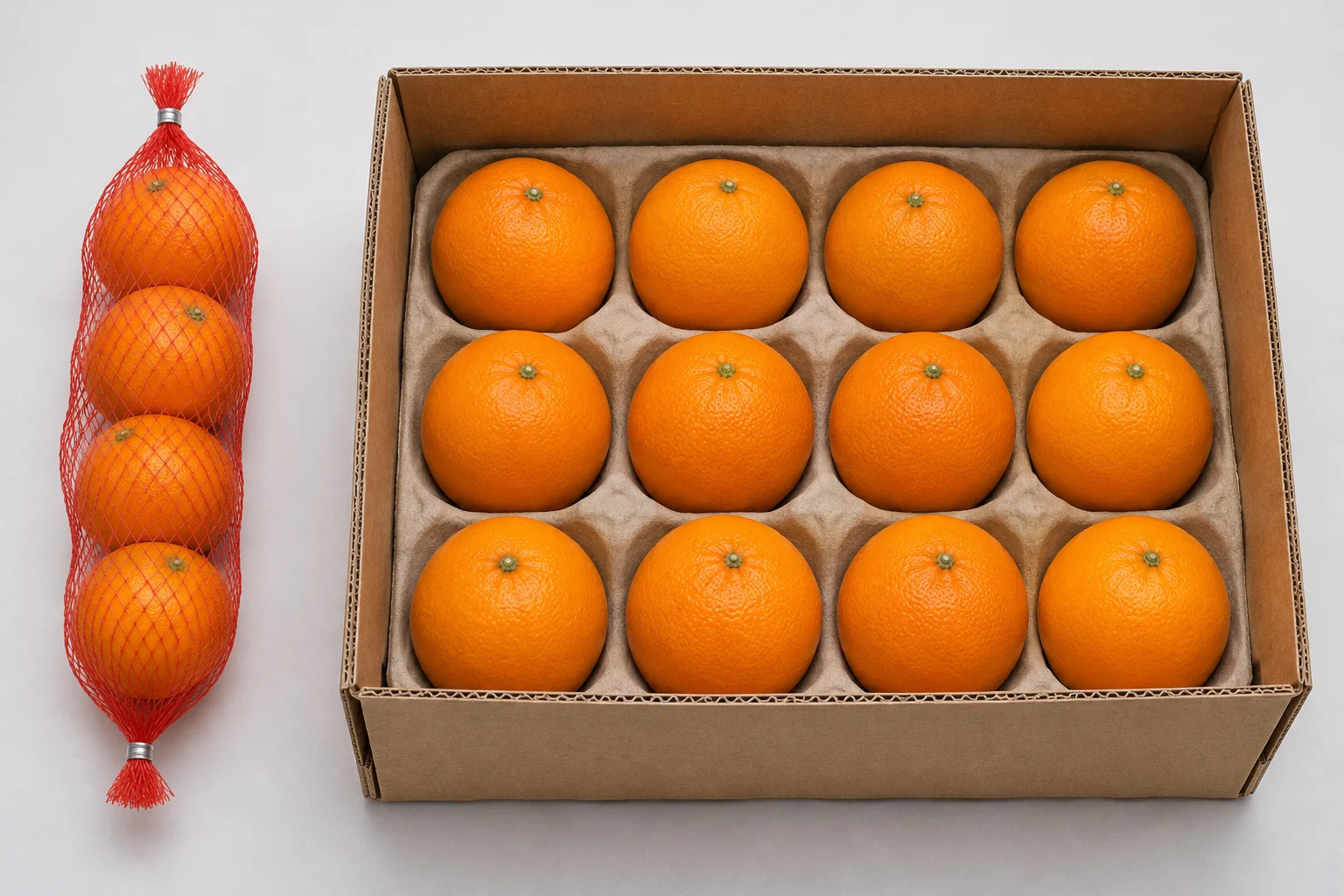
Send the largest and smallest fruit likely to run in the same grade. The largest determines clearance through the filling tube. The smallest helps establish net opening size and retention. On a trial, watch the last orange land and settle before the mesh gathers. A fruit pressing against the gathered section can stretch the net and leave too little material for the clip. Inspect the closed ends under the actual carrying load.
For small or mixed runs, an operator can place the portion while a clipper handles the closure. A repetitive format may justify automatic counting or weighing and timed discharge. Use the trial to check whether most operator time goes to portioning, keeping the net supplied or resolving a downstream queue.
Whole-fruit cases start at the grader outlet
Check each grader outlet separately. One popular grade may keep a lane busy while other case positions remain empty. The loader needs a defined incoming orientation, a supported way to place the fruit and a response to a missed pocket. Confirm the largest normal orange fits the insert without taking the load from the case above it. Compare rind marks before packing and after the agreed handling period.
This case pattern is for loose oranges. Case packing of finished retail nets or trays is a separately scoped downstream task.
Turn a pack-rate target into fruit demand
For example, a requirement of 30 accepted six-orange nets per minute means 180 usable oranges per minute while running at that rate. Allow for refills, start-up rejects and grade changes when setting shift output. Compare completed packs at the required count or weight with the fruit supply at the station.
Send the fruit grade and the finished pack you need
Share the fruit size and weight range, a finished-pack photo, the count or net weight and your output target. Include the grader outlet and case dimensions if you plan to keep them. Comwin can recommend where to weigh or count the fruit, how to support it and what to check during a trial.Discuss your orange packing project. For single-fruit wrap, include the minimum and maximum diameter, whether fruit arrives spaced or in bulk, and the target number of accepted packs per minute.