
Introduction: Why Understand These Two Concepts?
In the realms of electric vehicles, energy storage stations, and consumer electronics, the terms “battery pack” and “battery module” are often used interchangeably; however, their roles are as distinct as “bricks” versus “a house” — fundamentally different! Confusing the two can lead to miscommunication in technical discussions, maintenance misjudgments, and even safety risks. This article will deconstruct the complete chain of construction from batteries (Cell) → modules (Module) → battery packs (Pack), using straightforward language and practical cases to help you clarify the differences. By the end of this read, you will gain insights into the underlying logic of battery system design, the accurate application of terminology, and foresight into future technological trends.
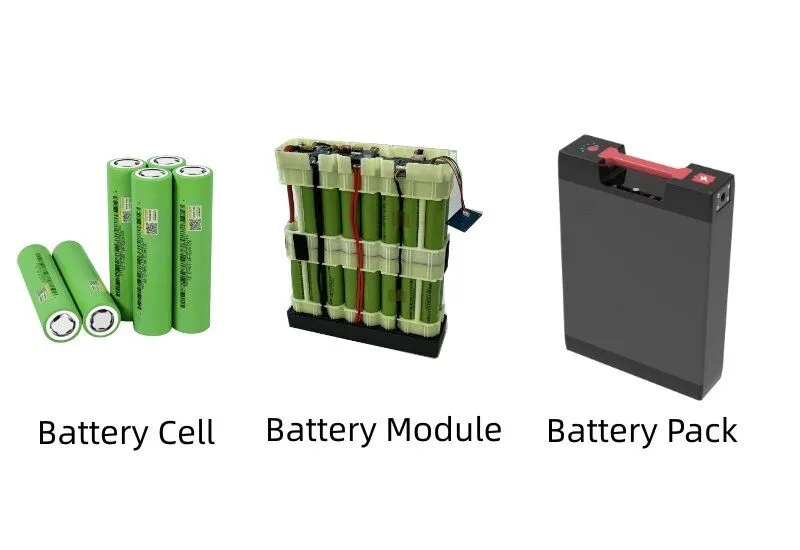
Foundation: Everything Starts from Battery Cells
Battery Systems’ Smallest Unit: What is a Battery Cell?
Battery cells are the atomic units of battery systems, essentially independent devices that convert chemical energy into electrical energy through chemical reactions (such as lithium-ion migration). Their core characteristics include:
- Indivisibility: As the smallest electrochemical unit, they consist of positive and negative electrodes, electrolyte, separator, and casing, and cannot be split further.
- Limited Capacity: A single cell voltage ranges from 3V to 4.2V (like a ternary lithium cell at 3.7V), with capacity usually under 5Ah, far from meeting device requirements.
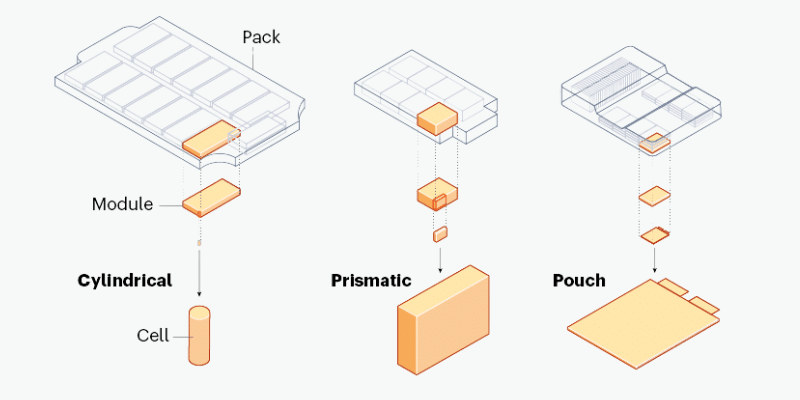
- Three Configurations:
- Cylindrical: Such as Tesla’s 4680 cells, high structural strength but lower space utilization;
- Prismatic: For instance, BYD’s blade battery, easy to stack but challenging heat dissipation;
- Pouch: Such as LG Chem products, lightweight but requires extra protection.

Analogy: If the battery system is a Lego castle, the cell is a fundamental Lego brick — limited in standalone function but capable of creating infinite possibilities when combined.
Intermediate Layer: The Core Value of Modular Construction
Structured Power: What is a Battery Module?
A module is a physical unit that integrates multiple battery cells through series/parallel connections and is encapsulated as standardized middleware. Its design goal is to increase voltage/capacity and simplify subsequent assembly.
Key Components and Functions
| Component | Function Description |
|---|---|
| Cells (6-24) | Configured in series (voltage boosting) or parallel (expansion), such as a 13-string ternary module reaching 48V. |
| Busbars | Copper/aluminum metal strips connecting cell tabs, ensuring stable current transmission. |
| Structural Frame | Metal/plastic brackets secure cells, providing mechanical protection against vibrations and impacts. |
| Basic Sensors | Temperature probes or voltage collection lines enable preliminary status monitoring. |
Core Advantages
- Efficient Production: Standardization of modules can improve battery pack assembly efficiency by 30% (e.g., laser welding lines handling 8 cells per minute).
- Maintenance-Friendly: In the event of a malfunction, modules can be individually replaced at a cost far lower than that of replacing the entire pack.
- Safety Isolation: Risk of thermal runaway is confined within a single module, preventing chain reactions.
Analogy: The module is a pre-assembled “Lego wall” — complete in independent function but needs to be combined to construct a complete building.
Top Layer: How Does a Battery Pack Achieve “Plug-and-Play”?
System-Level Integration: What is a Battery Pack?
The battery pack integrates multiple modules with a smart management system, forming a product that can directly provide power. Its core breakthrough lies in the addition of a “brain” (BMS) and “circulatory systems” (thermal management).
Five Key Components (Nature of Difference from Modules)
- Battery Modules: Typically 4-20 modules form a pack body (e.g., Tesla Model Y contains 4 large modules).
- Battery Management System (BMS):
- Real-time monitoring of voltage, temperature, current, estimating SOC (State Of Charge) and SOH (State Of Health);
- Actively balancing differences between cells to prevent overcharging/over-discharging.
- Thermal Management System:
- Air cooling (fan): Low cost but poor heat dissipation, used in lower-end models;
- Water cooling (cooling plate): Like the Kirin battery side cooling design, keeping temperature differences within 2°C;
- Phase change materials: Absorb heat to maintain stable temperature.
- High Voltage Electrical System: Relays and fuses ensure circuits are cut off during short circuits, safeguarding user safety.
- Protective Shell: Aluminum alloy/steel housing meets IP67 waterproof and dustproof, resistant to compression and impact.
Core Function Enhancements
- Full Lifecycle Management: BMS can predict battery life and optimize charging/discharging strategies.
- Safety Backup: In thermal runaway situations, liquid cooling systems + insulation materials block the spread (e.g., the Lantu “Amber Battery” uses organic silicone filling).
- Environmental Adaptability: Heating at -20°C or cooling at 50°C ensures stable performance.
Analogy: The battery pack is a “Lego castle” with water and electricity systems — independently operational, smartly controlled, and safely reliable.
Core Differences: A Table to Clarify
| Feature | Battery Module | Battery Pack |
|---|---|---|
| Hierarchy Positioning | Intermediate Layer (Cell → Module) | Top Layer System (Module → Pack) |
| Core Components | Cells + Busbars + Structural Frame | Modules + BMS + Thermal Management + High Voltage Circuit + Shell |
| Intelligence Level | Low: Only basic sensors | High: BMS implements AI decisions (e.g., cloud fault diagnosis) |
| Functional Objective | Increase voltage/capacity, physical protection | Provide a safe, stable, and durable complete power solution |
| Independence | Semi-finished, not directly usable | Plug-and-play (e.g., vehicle battery pack directly connected to the motor) |
| Safety Design | Basic mechanical protection | Triple protection: electrical isolation + thermal runaway suppression + physical reinforcement |
| Maintenance Cost | Can be replaced individually (cost around 5%-20% of the entire pack price) | Typically, only the faulty module is replaced, avoiding total pack scrap |
Note: The module is a “subcomponent” of the pack, but battery pack performance depends on module synergy efficiency.
Why Utilize the “Cell-Module-Pack” Hierarchy?
Four Insights of Layered Design
- Modular Scalability: Adjusting the number of modules flexibly adapts to different needs: the same module can be used in compact models (installing 6 groups) or SUVs (installing 12 groups), reducing R&D costs.
- Production Efficiency: Standardizing module production lines (such as laser welding) can achieve battery pack capacities of 8 PPM (8 cells processed per minute), which is 3 times faster than direct cell integration.
- Depth Safety Defense: Module isolation restrains thermal runaway: for example, in energy storage stations, single cell failures are confined to a module, preventing the entire box from catching fire.
- Economic Repairability: Replacing a faulty module costs less than 10% of the entire pack, while CTP technology (no module) requires comprehensive return for repairs.
Exceptions: Mobile phone batteries are a “simplified battery pack” — cell + PCM protection board, requiring no module due to size constraints.
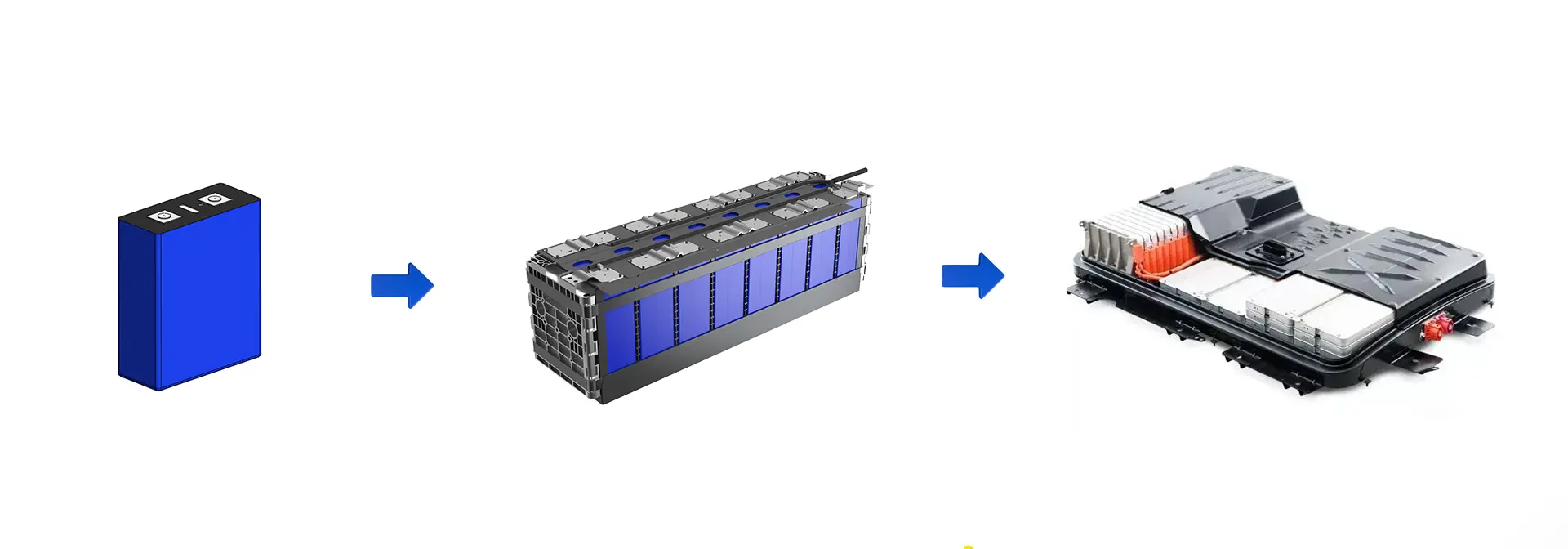
Real-World Applications: From Electric Vehicles to Energy Storage
Practices in Real Scenarios
- Electric Vehicles (like Tesla/BYD):
- Modules: The Model 3’s 4 pieces of 2170 cylindrical modules connected in parallel;
- Battery Pack: Integrates BMS + cooling pipes + aluminum housing, directly embedded in the chassis.
- Energy Storage Systems (such as container stations):
- Modules: 12 soft pack modules form a 95.7kWh unit (Cadillac Lyriq scheme);
- Battery Pack: Parallel multiple groups + air cooling system for a total capacity of 1MWh.
- Technological Frontiers (CTP/CTC):
- BYD blade battery (CTP) eliminates modules, directly integrating cells into packs, achieving a volume utilization rate of 60%;
- Tesla 4680 + CTC technology adheres cells to the vehicle body, enhancing strength but increasing maintenance difficulty.
Conclusion and Future Trends
The essential difference between battery packs and modules lies in the system integration level: modules are “functional components,” while battery packs are “intelligent systems.” The layered design (Cell → Module → Pack) balances performance, safety, and cost, remaining the current mainstream.
Future Evolution Directions:
- CTP/CTC Technology: Eliminating modules enhances energy density (Kirin battery reaches 255Wh/kg), but challenges repair convenience;
- Smart BMS Upgrades: AI algorithms predict battery lifespan and manage faults through cloud-based systems.
Mastering this hierarchical logic positions you ahead of 90% of battery technology discussion participants!
Call to Action
- Your Query Hub: Have questions about thermal management or CTP technology? → Leave a comment below, and experts will respond within 24 hours!
- Custom Solution Needs: Looking for automotive-grade modules or energy storage battery packs? → Contact our engineering team for free design advice.
This article is based on IEEE standards and industry white papers, with data updated to 2025. References include authoritative resources such as Zhihu and 35 other papers.