
A coffee packing machine must match both the coffee and the finished package. Whole beans usually need gentle weighing, ground or instant coffee needs a powder-oriented dosing system, liquid coffee needs filling and closing equipment, and every flexible pack needs a seal process proven with the actual material. A coffee bag sealer may be enough for a small roaster that already weighs and fills bags manually; growing production may justify an integrated VFFS, premade-pouch, vacuum, sachet or complete end-of-line system.
The fastest route to a reliable specification is to send representative coffee, empty bags or roll film, target weights and the required accepted output for free sample testing. We then match feeding, dosing, gas or vacuum options, sealing and downstream equipment without treating any one website model as the limit of the available solution.
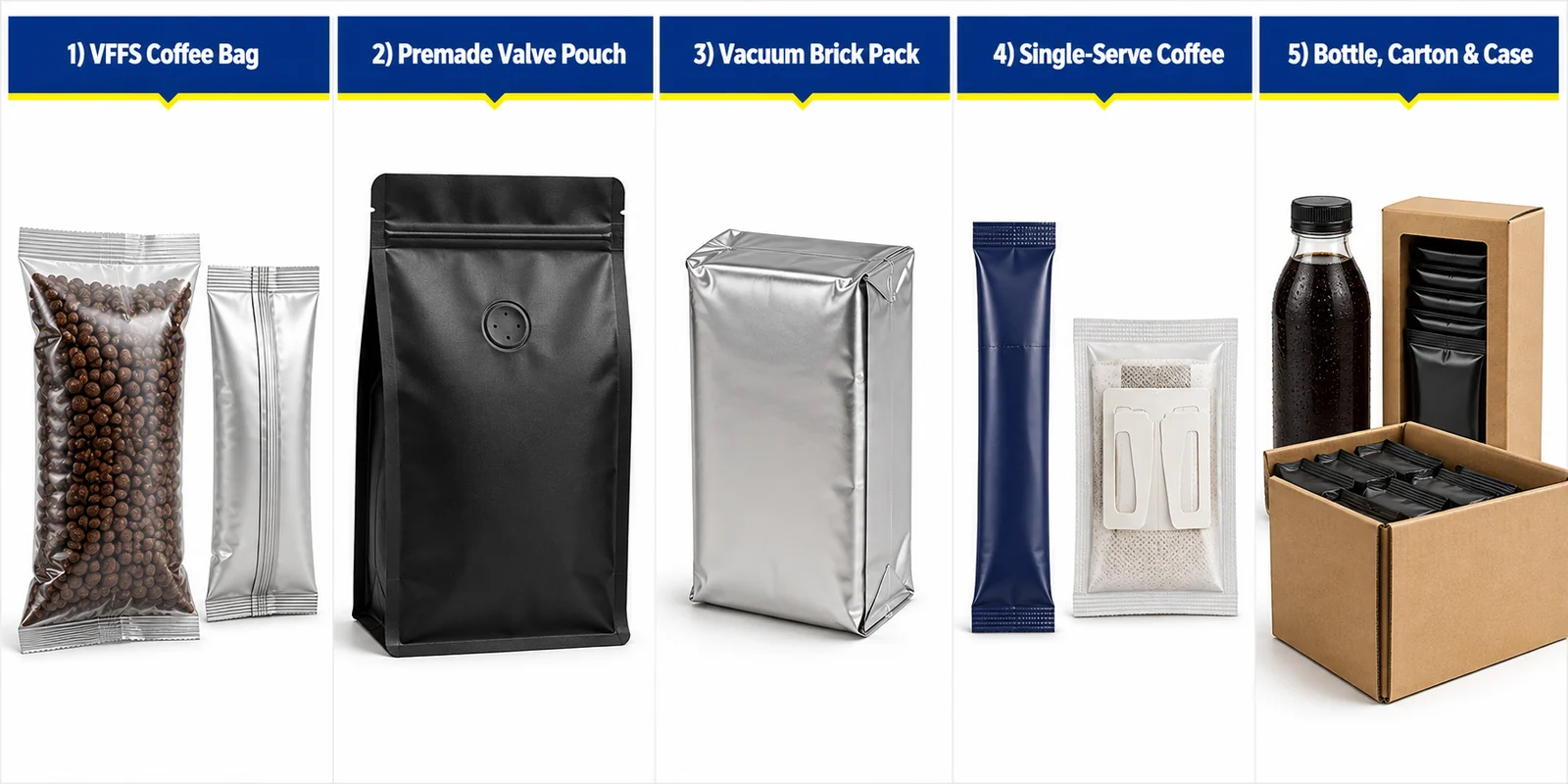 Finished coffee packages: roll-film bean bag, premade valve pouch, vacuum brick, stick and drip portions, bottle, retail carton and shipping case.
 1. Which Coffee Packing Machine Fits Your Product?
Start with coffee form, then select the finished pack. Roasted beans, ground coffee, instant powder, drip portions and cold brew do not follow the same dosing or sealing path. The table separates the routes before speed or price is compared.
| Equipment route | Coffee and finished package | Capacity basis | Best-fit situation |
|---|---|---|---|
| VFFS coffee bag machine | Whole beans with a suitable weigher, or ground/instant coffee with a validated powder filler; roll-film pillow, gusseted, block-bottom or compatible back-seal bags | Specify accepted bags/min at the chosen weight; one published compact coffee VFFS example lists up to 28 packs/min under its conditions | Repeated standard formats, lower roll-film packaging cost and growing retail or food-service volume |
| Premade pouch packing machine | Beans or ground coffee in finished stand-up, zipper, flat-bottom, side-gusset or valve pouches | Supplier-specific premade-pouch examples reach up to 60 pouches/min; actual output depends on pouch opening, dose and sealing | Premium printed packs, high-value coffee and brands prioritizing shelf presentation |
| Coffee bag sealer | Manually or separately filled laminated coffee bags, including compatible valve pouches | Compare seal length and conveyor speed or seals/min; do not convert m/min into bags/min without bag pitch | Small roasters, pilot SKUs and plants that need sealing automation before automatic filling |
| Vacuum coffee packing system | Ground coffee in a validated barrier bag, including a tight brick-style pack when forming is included | Compare cycles/min and evacuation/forming time; product degassing can limit practical output | Dense ground-coffee formats that specifically require vacuum and controlled final shape |
| Stick, sachet or drip-coffee line | Instant coffee sticks, small powder sachets, or formed drip-filter portions with a sealed barrier outer envelope | Use sticks/min, sachets/min or wrapped portions/min and confirm dose plus inner/outer-pack synchronization | Hotels, offices, sampling, e-commerce assortments and single-serve products |
| Bottle filling and closing line | Cold brew, coffee concentrate or other validated liquid coffee in bottles | Specify accepted bottles/min at the fill volume, closure and foaming behavior | Ready-to-drink or concentrate projects with a defined beverage process and hygiene plan |
| Cartoning and case packing | Finished pouches, sachets, drip packs or bottles grouped into retail cartons and shipping cases | Use cartons/min and cases/min based on count pattern and primary-pack output | Distribution-ready automation and reduced manual collation after primary packaging |
Published speeds above are supplier-specific examples, not Comwin ratings. The final target should be accepted output after rejects, refilling, changeovers and downstream constraints. A line that briefly reaches a headline speed but contaminates seals or stops at the cartoner is not meeting the production requirement.
2. VFFS, Premade Pouch or Coffee Bag Sealer?
These three choices solve different business problems. VFFS forms each bag from roll film, premade-pouch equipment handles a finished bag, and a coffee sealing machine closes a bag that has already been filled.
| Decision factor | VFFS roll-film bag | Premade pouch | Sealing-only equipment |
|---|---|---|---|
| Packaging cost | Roll film generally gives a lower packaging cost per comparable bag | Finished pouches cost more but can support premium structures and presentation | Uses the buyer’s existing bags; total cost includes manual or separate filling labor |
| Package appearance | Pillow, gusseted, block-bottom and other formats depend on the selected former and film | Strong option for high-end stand-up, zipper, flat-bottom and pre-applied valve pouches | Preserves the existing bag design; seal appearance depends on material, fill level and setup |
| Automation scope | Forms, doses, fills and seals in one sequence | Picks, opens, fills and top-seals premade bags | Seals only; weighing, filling, valve application and coding may remain separate |
| Changeovers | Film, forming set and filler settings may change | Pouch magazine, grippers, opening and seal settings may change | Seal temperature, pressure, dwell or conveyor guides change with the bag |
| Best choice | Stable volumes and recurring roll-film formats | High-value coffee where finished pouch presentation matters | Low or moderate output when current filling remains useful |
Choose VFFS when recurring volume and roll-film economics matter. Choose premade pouches when premium appearance, zipper formats or pre-applied valve bags justify the higher packaging cost. Choose a standalone sealer when filling is already controlled and the immediate problem is a slow, weak or inconsistent top seal.
3. Coffee Form Changes the Dosing and Sealing System
Whole coffee beans
Roasted beans are free-flowing compared with powder but can chip or break at high drops and aggressive transfers. A linear or multihead weighing system can be selected around weight, speed and gentle handling. Freshly roasted beans release carbon dioxide, so the packaging study may include a one-way valve, gas flushing, headspace management and a barrier material. A valve can be pre-applied to a premade pouch or applied to compatible roll film by a separate module.
Ground coffee and coffee powder
Ground coffee creates dust and can carry oils into the seal area. An auger or another validated powder filler controls the dose while the nozzle, discharge timing, headspace and dust extraction help keep the seal path clean. Instant coffee powder may also absorb moisture and cake, so storage, hopper design and cleaning need attention. A coffee powder packing machine should be tested with the finest and least-free-flowing batch expected, not only an easy sample.
Single-serve coffee
Instant coffee sticks and flat sachets use small-dose powder filling. A drip-coffee product adds an inner filter-bag process and usually a separate barrier outer wrap; the flow wrapper does not automatically manufacture the filled inner filter bag. Counted finished portions can continue to a retail cartoner and shipping case.
Liquid coffee
Cold brew and coffee concentrate require a liquid filler, suitable bottle handling and a compatible cap or seal. Fill temperature, foam, drips, cleaning and the beverage’s validated processing plan affect the equipment. The filling machine alone does not establish shelf stability.
4. Coffee Packaging Applications
The application map connects each coffee form to its dosing method, machine route and finished sample. Whole beans can use VFFS or premium premade valve pouches; ground coffee can use VFFS, premade pouches or a validated vacuum brick route; instant and drip formats need dedicated small-dose or inner/outer-pack processes; liquids move through filling and closing. Finished packs can then be inspected, cartoned, case packed and case sealed.
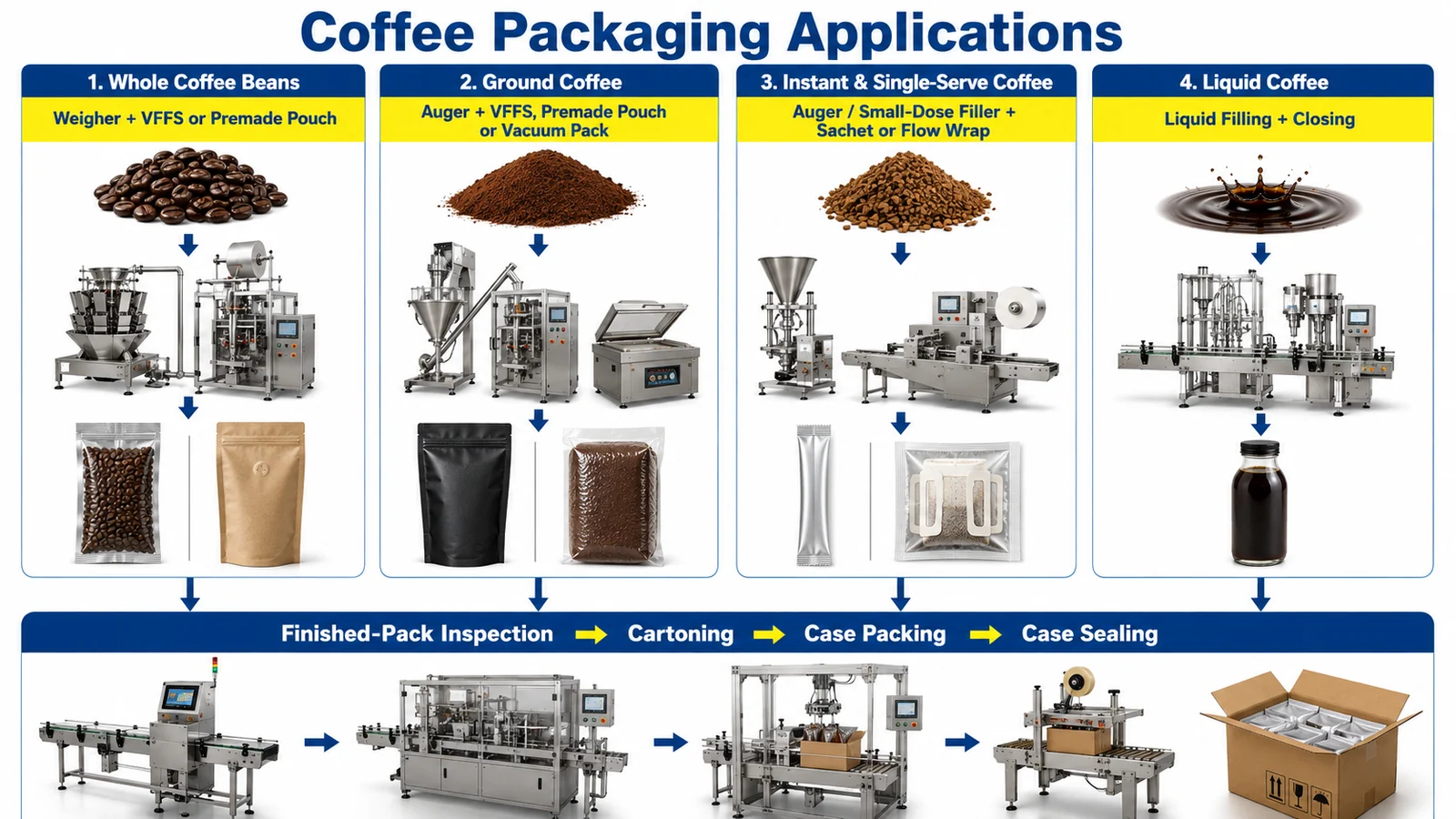 Coffee form, dosing method, equipment route and finished pack shown together. Primary packs can continue through inspection, cartoning and case packing. AI-generated application diagram.
| Product example | Recommended package and machine | Problem solved | Sample-test focus |
|---|---|---|---|
| 250 g or 500 g roasted beans | Weigher plus VFFS roll-film bag, or premade flat-bottom/stand-up valve pouch | Moves from manual weighing to repeatable filling and sealing while supporting retail presentation | Bean breakage, weight variation, valve position, headspace and top-seal integrity |
| 250 g to 1 kg ground coffee | Powder filler plus VFFS or premade pouch; vacuum pack only when specifically required | Controls dust and dose while protecting the sealing zone | Powder trails, oily residue, seal contamination, pack density and accepted output |
| Bulk or food-service coffee | Larger compatible bag with matched weighing or powder dosing and sealing | Reduces repeated manual handling for wholesale formats | Filled-bag support, seal length, drop height, lifting and downstream case needs |
| Instant coffee stick or sachet | Small-dose auger or validated filler with stick/sachet equipment | Produces controlled single portions in a compact primary pack | Small-dose repeatability, film tracking, tear feature and seal cleanliness |
| Drip coffee portion | Inner drip-filter process plus barrier outer envelope or flow wrap | Separates brewing function from the protective outer package | Filter fill, hanger placement, inner-to-outer transfer, envelope seal and count |
| Cold brew or concentrate | Liquid filling, closing, labeling and case packing | Automates controlled filling and bottle handling | Foam, drip control, fill volume, closure torque/seal and cleaning access |
| Finished coffee packs | Cartoner, case packer and case sealer matched to primary output | Prevents finished packs accumulating before shipment | Count pattern, orientation, case strength, barcode/label data and line balance |
5. How to Select a Coffee Bag Sealer
A sealer cannot compensate for the wrong material, coffee trapped in the seal or insufficient headspace. Send filled and empty bag samples so we can test the complete cross-section, including zipper, gussets and laminate layers.
| Sealing requirement | Practical equipment direction | What to verify |
|---|---|---|
| Occasional small batches | Impulse or controlled-jaw sealing for a compatible heat-sealable bag | Seal width, dwell, cooling, operator consistency and production rate |
| Continuous filled-bag flow | Horizontal or vertical continuous band sealer, selected around filled-bag support | Conveyor orientation, bag weight, seal position, speed and coding integration |
| Premium zipper or valve pouch | Seal above the zipper with enough clean headspace; use premade valves or a validated valve module | Zipper opening, valve location, top-seal flatness and leak testing |
| Nitrogen-flushed bag | Gas delivery coordinated with filling and final sealing | Gas supply, purge arrangement, residual-oxygen acceptance and gas consumption |
| Vacuum ground-coffee pack | Chamber or integrated vacuum/forming equipment designed for the pack | Evacuation time, final shape, material, seal integrity and coffee degassing behavior |
| Printed coding at the seal station | Compatible thermal-transfer, inkjet or embossing option | Code adhesion, readability, location and batch-data workflow |
Valve, nitrogen and vacuum are different functions. A one-way valve provides a path for gas released by roasted coffee; gas flushing displaces air before closing; vacuum removes air and may form a dense pack. The right combination depends on roast age, coffee form, barrier target, distribution period and desired pack appearance. Validate the full package rather than assuming one feature guarantees freshness.
6. Technical Specification and Customization Checklist
Our website shows representative equipment, not the complete range of configurations we can match. The agreed machine specification should translate the buyer’s product and packaging goal into measurable conditions.
| Specification group | Information and options to confirm |
|---|---|
| Coffee | Whole bean, roast level, ground size, instant powder or liquid; bulk density range, dust, oils, moisture sensitivity and normal production variation |
| Dose and filler | Target and tolerance; weigher for suitable beans, auger or validated powder filler, small-dose system, or liquid filling principle |
| Bag or container | Pillow, side-gusset, block-bottom, stand-up, zipper or valve pouch; sachet, stick, vacuum brick, bottle, carton and shipping case |
| Materials | Rollstock or premade laminate, sealant layer, barrier target, mono-material candidate, filter material, bottle and closure; provide samples or specifications |
| Construction | Product-contact material, frame or enclosure finish, accessible cleaning points, dust extraction interface and required environmental protection |
| Package features | One-way valve, zipper, gas flushing, vacuum, tear notch, compatible hole punching, label, roast/packing date and batch coding |
| Controls and changeover | Recipes, operator interface, forming sets, change parts, bag guides, alarms and upstream/downstream communication |
| Utilities and layout | Voltage, frequency, compressed air, nitrogen or vacuum source, extraction, conveyor height, floor space and maintenance access |
| Acceptance | Accepted packs/min, weight tolerance, seal test, residual oxygen when specified, code position, rejects, test duration and changeover criteria |
| End of line | Count per carton/case, orientation, case pattern, sealing, label data, inspection, pallet interface and future expansion |
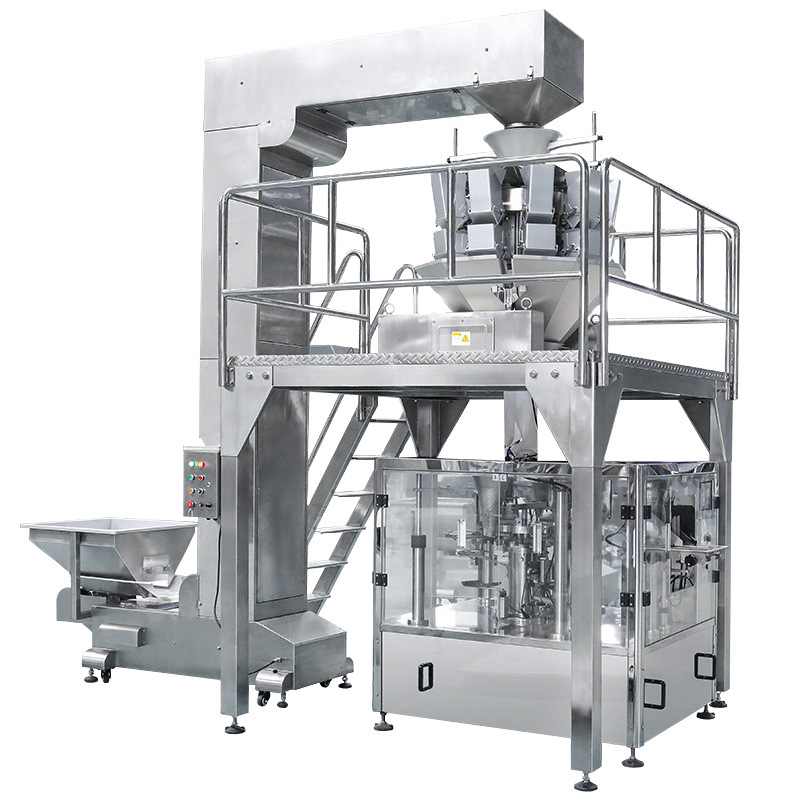
The supplied equipment image shows feeding, weighing and pouch-handling sections. It is suitable for discussing a premade coffee pouch project, but the photograph does not confirm one fixed coffee model, bag range or speed. The weigher, pouch system, valve bag and sealing conditions are selected after product and package review.
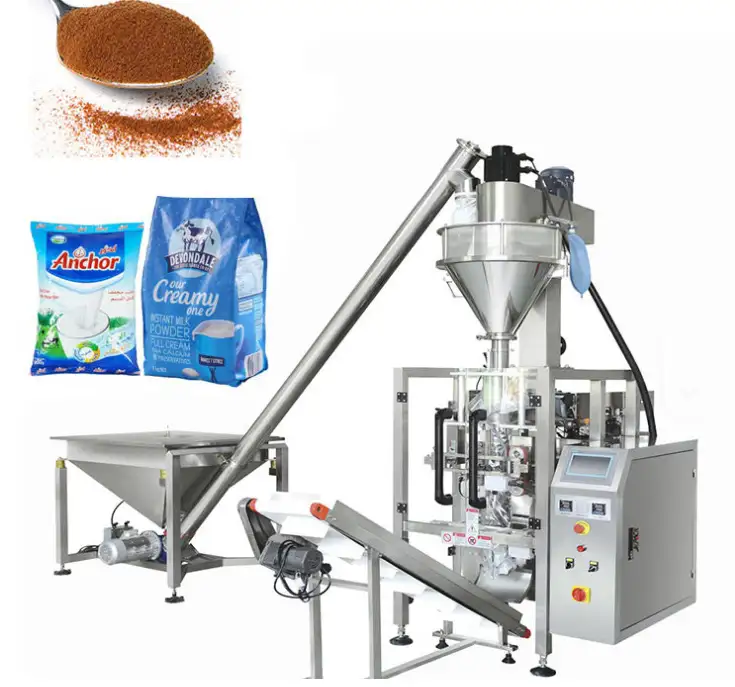
An auger and vertical bagging arrangement is one possible route for compatible ground or instant coffee. Powder behavior, desired dose, bag format, dust control and cleaning requirements determine the actual filler and machine configuration.
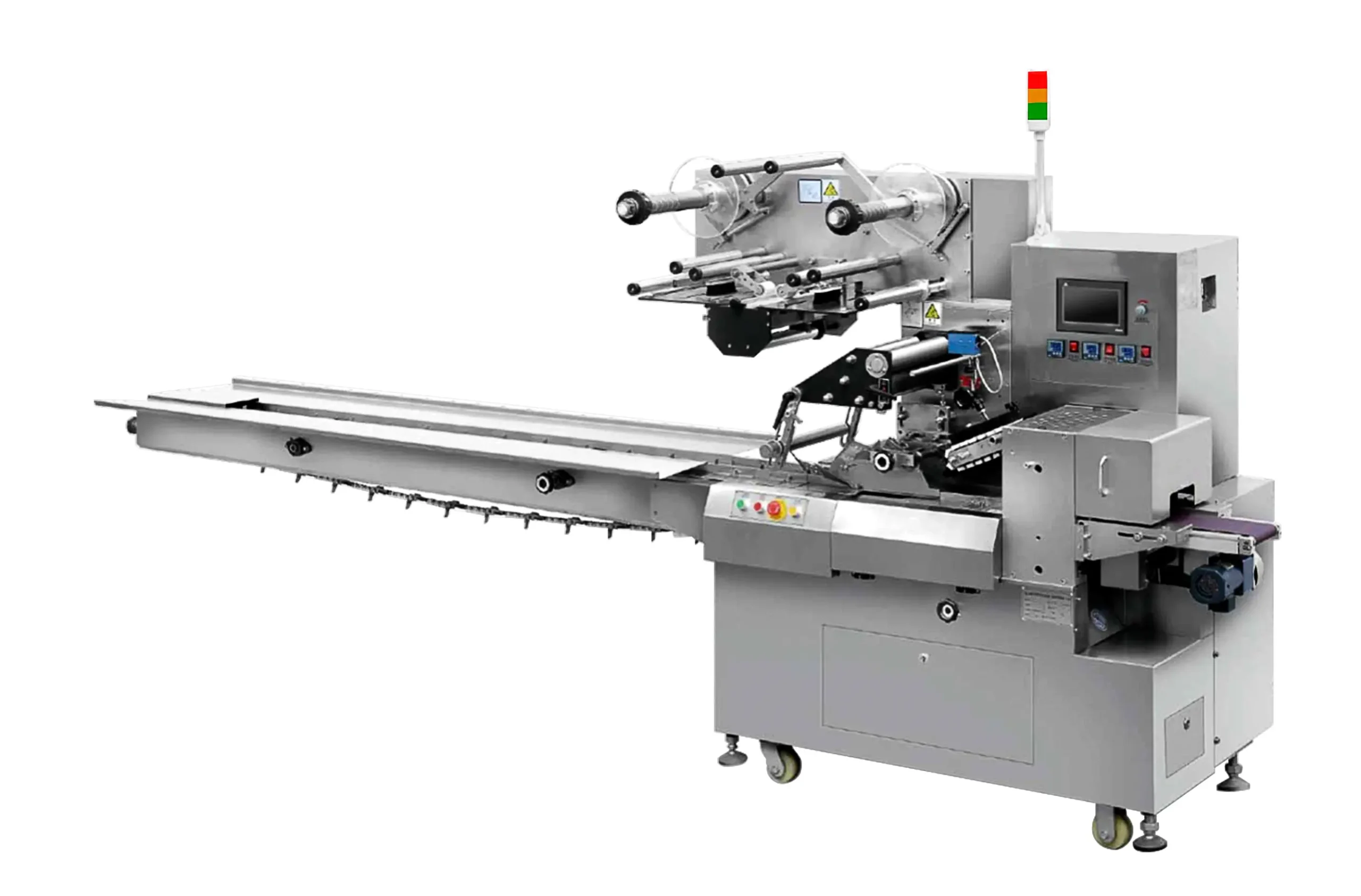
A horizontal flow wrapper can provide the barrier outer envelope for a compatible, already formed drip-coffee portion. The inner filter-bag forming and filling process must be specified separately, then synchronized with the wrapper and cartoner.
7. Build the Complete Coffee Packaging Line
The primary pack should be proven before downstream equipment is sized. A typical bean or ground-coffee line may include feeding, weighing or powder dosing, VFFS or premade-pouch packing, valve/gas/vacuum options, coding, inspection, cartoning, case packing and case sealing. A bottled-coffee line uses bottle feeding, liquid filling, closing, labeling, inspection and case handling.
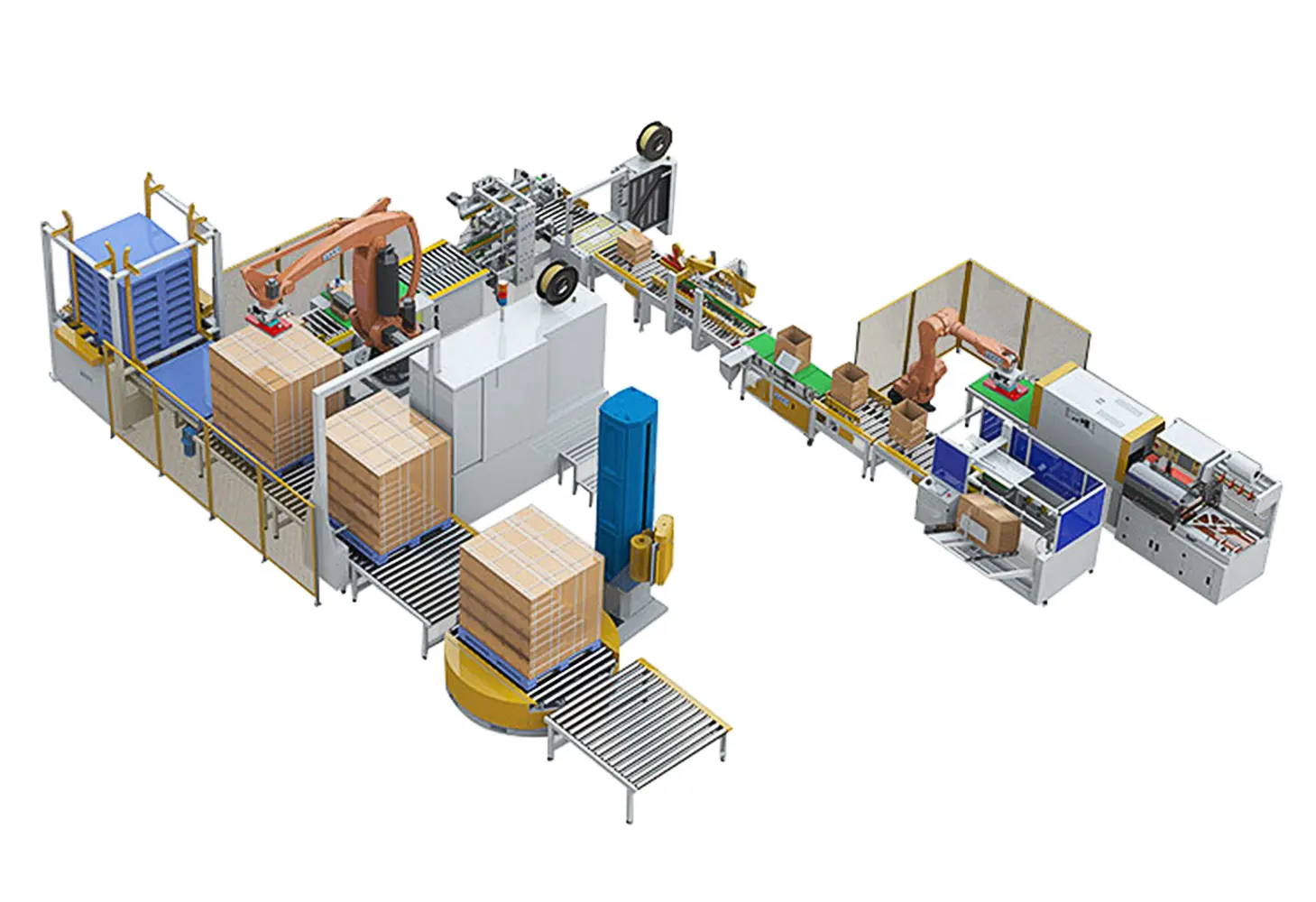
The line illustration represents one possible downstream arrangement. Actual projects may use fewer or different modules. Calculate case demand from accepted primary output: if a line produces 40 accepted bags/min and loads 10 bags per case, the downstream target begins at 4 completed cases/min before a capacity allowance is agreed.
8. Frequently Asked Questions
Can one coffee packing machine handle beans and ground coffee?
A common bagging platform may handle both when it can accept different fillers and suitable change parts, but beans and powder behave differently. Beans usually need weighing; ground coffee often needs an auger and better dust control. Send representative samples of both products for free testing. The result shows whether one base machine is practical or separate configurations will give cleaner seals and faster changeovers.
Should I choose VFFS or premade coffee pouches?
Choose VFFS when recurring volume and lower roll-film packaging cost are the priorities. Choose premade pouches when a higher-end bag, zipper, flat bottom or premium printed presentation supports a higher-value product. Compare both with the same coffee weight, valve requirement, accepted output and labor scope; then test the actual film or pouch before ordering.
Which coffee bag sealer should a small roaster use?
If weighing and filling remain manual, begin with a sealer matched to the bag laminate, filled weight, seal length and daily volume. An impulse unit can suit intermittent batches; a continuous band sealer can support a steadier flow. Send empty and filled bags so we can test the zipper/gusset cross-section and recommend seal temperature, pressure, dwell or conveyor support.
Do I need a degassing valve, nitrogen flushing or vacuum?
They solve different problems, so do not select them as interchangeable options. A valve releases gas from roasted coffee, nitrogen flushing displaces air before sealing, and vacuum removes air and can create a dense ground-coffee pack. Define roast age, coffee form, desired package shape and storage target, then validate valve function, seal integrity and any residual-oxygen requirement with the final material.
How do I prevent coffee powder from contaminating the seal?
Use a filler and discharge nozzle matched to the powder, control the cutoff timing and maintain enough clean headspace. Dust extraction or other containment may be needed. Test the finest and oiliest expected coffee, inspect powder trails across the seal and agree on a leak or seal-strength acceptance method before machine approval.
How fast is an automatic coffee bag machine?
Speed depends on dose, bag size, filler, valve or gas process, seal time and downstream equipment. Published examples reviewed include a compact VFFS system rated up to 28 packs/min and a premade-pouch supplier example up to 60 pouches/min under their own conditions. Request accepted bags/min with your coffee and package instead of treating either number as a universal rating.
What should I provide for an accurate proposal?
Send coffee samples, target weights, empty bags or roll-film specifications, finished-pack drawings, desired accepted output, valve/gas/vacuum needs, SKU count, utilities and layout. For a complete line, add carton and case drawings, counts, label data and inspection requirements. These inputs let us match the right equipment and define a meaningful sample test.
9. Testing, Installation and Support
We provide the most suitable packaging solution for your coffee, pack format, output and budget. Free sample testing checks feeding, dosing, sealing and appearance, and customers can visit a real factory to see relevant equipment running. Small machines include video guidance and remote video support. The machine warranty is two years, core components are covered for three years, and remote inquiries receive a response within 24 hours.
Ready to define your coffee packaging equipment? Send samples for testing or contact us with the dose, package, output and downstream scope. We will match the configuration and prepare a proposal.