A long Japanese nasu can go into a trayless pillow wrap if the fruit stays oriented across the infeed. For broader or more variable aubergines, or for a retail pair that must stay aligned, try a support tray inside the wrap. The choice depends on how the eggplant travels to the jaws and how the calyx sits against the film.

Choose trayless or tray-supported wrapping
| Incoming eggplant and pack | Starting route | When to change it |
|---|---|---|
| Long nasu, one fruit per pack | Orient the fruit in a guided infeed, support it through film entry and close a loose pillow wrap. | If curved fruit rolls or its calyx reaches the jaws, adjust support and pitch. Trial a fitted tray if orientation remains unstable. |
| Broad aubergine or a fixed retail pair | Place fruit in a fitted tray and wrap the whole tray on a compatible horizontal machine. | If fruit moves out of the pocket or shoulders press against the film path, change the tray geometry or pack format. |
Measure the fruit as it lies on the infeed
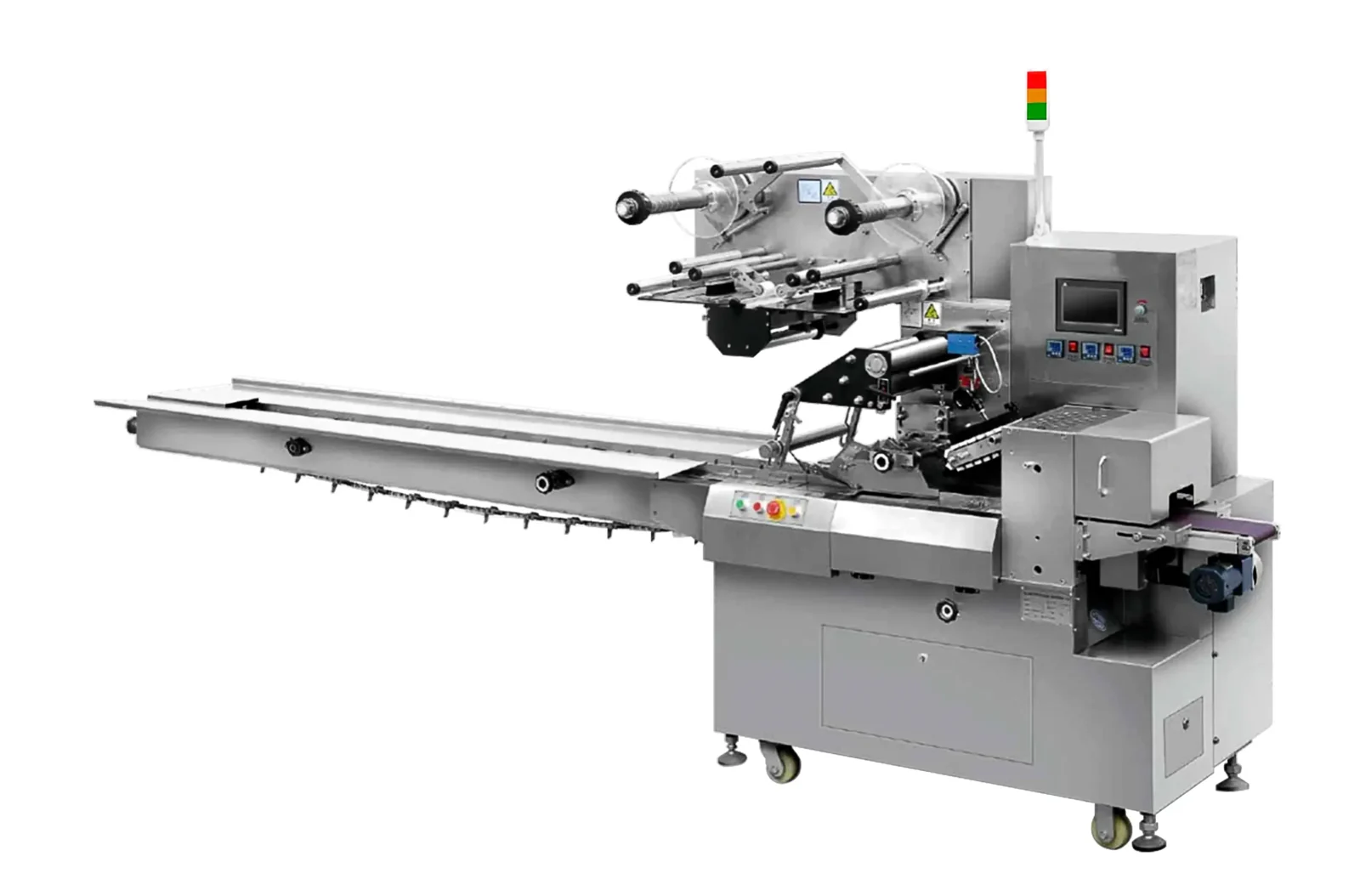
Record length including the stem, widest shoulder and sideways sweep with the fruit resting naturally. Put the most curved normal fruit through the guides. Check whether it keeps that orientation at the belt transition. A packing machine can have enough nominal film width and still rub the outside of a curved eggplant at the entry point.
Look at the film over the calyx after the sample cools and after normal handling. A puncture at the green cap suggests local contact or insufficient clearance. A mark along the skin at the same height on many fruit points to a guide or transfer worth inspecting. If the leaf cap or stem reaches an end seal, change product pitch or support before shortening the pack to save film.
Use the actual fruit to decide how much feeding to automate
Consistent long grade. Orient a single nasu → support through film entry → keep the calyx clear → inspect both ends.
Mixed shapes or a matched pair. Load the fitted tray → verify fruit stays seated → feed the complete tray into the wrapper → inspect film and pack fit.
Hand placement can accommodate variable stems and curves at modest output. With repeatable grading, a horizontal flow wrapper can be specified with a guided infeed and repeatable pitch. Trial a missed position and a restart with actual fruit. For changes between pack sizes, have the quotation list guide adjustment, bag length and pitch settings, film width and any forming parts to replace. On the tray route, assign tray supply and loading to the operator or quote those functions explicitly.
Approve the retail pack with the intended film
Check film thickness, any specified ventilation and end-seal margin with the actual produce and packaging supplier. A pillow pack encloses the entire tray and closes at the ends. A tray lid sealed directly to a flange is a separate pack and would require a different tool. Before approving a machine, record accepted output and the reasons for rejected packs after a representative run.
Share the longest, widest and most curved normal samples
Send fruit photos, dimensions in the packing position, pack count or tray drawing and desired output. Comwin can recommend a support and film path, then plan a trial that includes the difficult shapes and the real film. Discuss eggplant packaging with Comwin.