
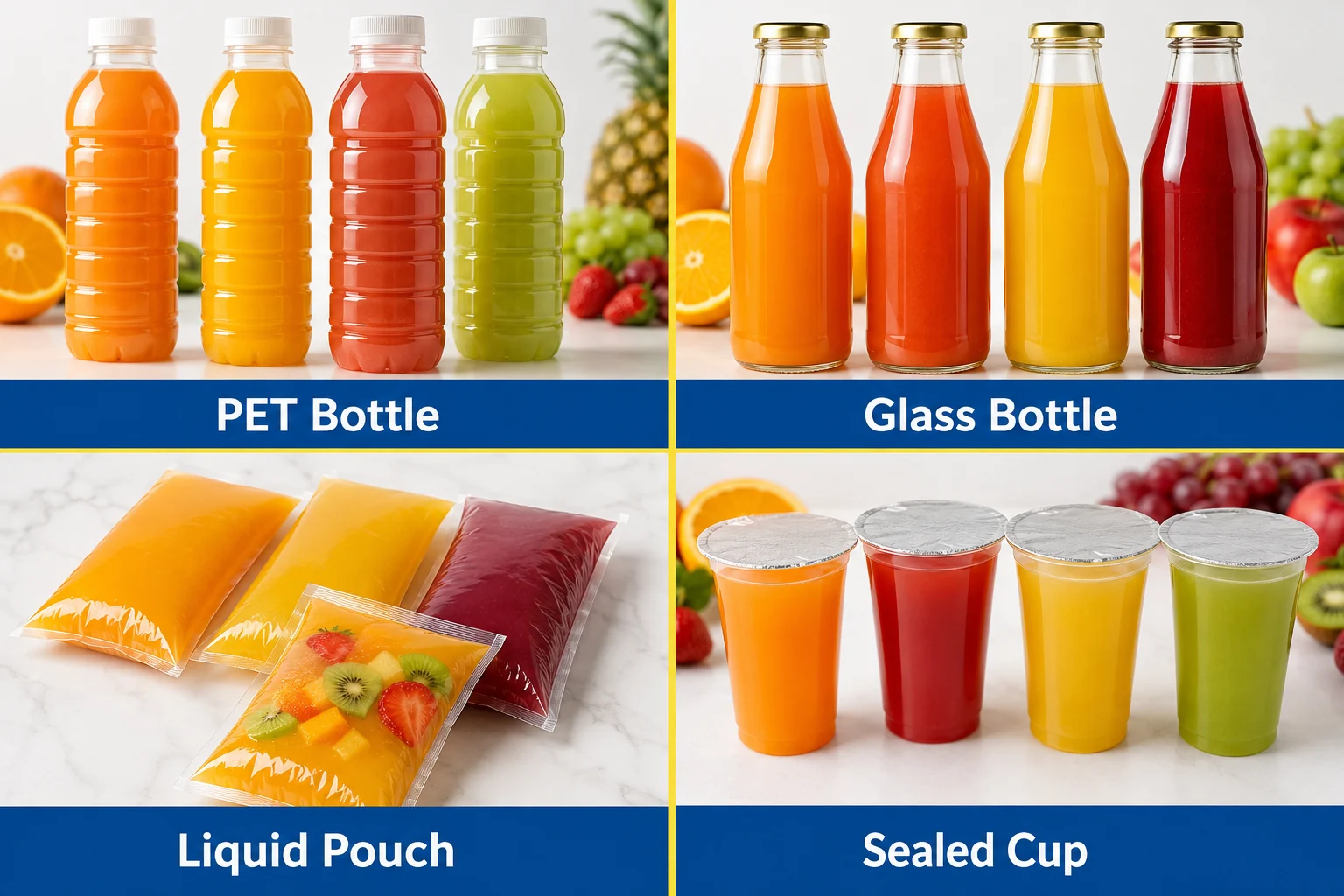
 Choose the sellable pack first: bottle filling and capping, liquid pouch form-fill-seal and cup filling-sealing are separate machine routes. The right route also depends on the recipe and shelf-life process.
Which Juice Packing Machine Fits Your Package?
The terms juice packing machine and juice packaging machine cover several machine families. Start with the package buyers will receive, then confirm the process that protects the juice.| Finished package | Machine route | Best fit | Confirm first |
|---|---|---|---|
| PET or HDPE bottle | Container preparation, liquid filling, immediate capping, labeling and optional multipacking. | Mainstream single-serve and family-size juice formats. | Recipe, preservation method, bottle heat resistance, cap, particles and accepted BPH. |
| Glass bottle | Bottle preparation, filling and closure application with glass-safe conveying. | Premium presentation and products compatible with the selected thermal process. | New or returnable bottle, closure, breakage control, fill temperature and cooling. |
| Liquid pouch | Roll-film form-fill-seal or premade-pouch filling and sealing. | Portion packs, low-viscosity juice and distribution systems designed for flexible packs. | Film structure, pouch volume, seal cleanliness, oxygen/light barrier and cold-chain or shelf-life plan. |
| Sealed cup | Cup denesting, filling, foil or film sealing and optional lid application. | Single-serve juice, fruit drinks and chilled products. | Cup material, rim, seal medium, headspace, date code and secondary pack. |
Hot Fill, Cold Fill or Aseptic?
The recipe and commercial shelf-life target control this decision. An acidic, heat-stable fruit drink may follow a validated hot-fill process; a chilled juice may use cold filling with appropriate hygiene and refrigeration; sensitive or low-acid products can require a validated aseptic system. These routes differ across product treatment, package sterilization or sanitation, filler environment, closure handling and acceptance testing.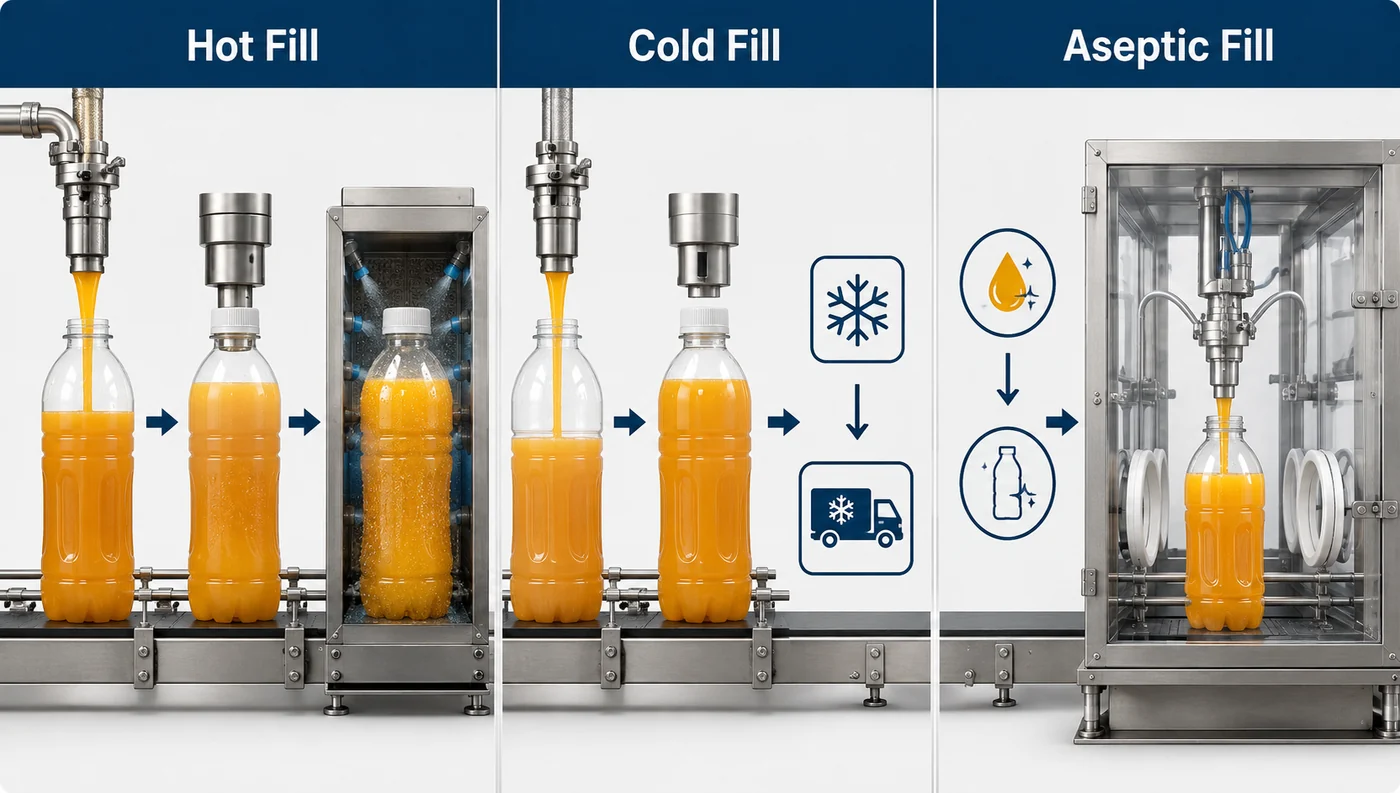 Preservation comes before filler selection: hot, cold and aseptic filling require different product treatment, package specifications and hygiene controls.
| Method | Typical use | What the line must control | Do not assume |
|---|---|---|---|
| Hot fill | Suitable heat-stable acidic juices and drinks intended for ambient distribution when the validated process supports it. | Product treatment, filling temperature, heat-resistant package, closure contact, hold/cool sequence and CIP. | A standard bottle can tolerate the process or every recipe uses the same temperature. |
| Cold or ambient fill | Fresh, pasteurized or refrigerated products and other recipes with a validated preservation plan. | Filler hygiene, product temperature, cold chain or ESL measures, cleaning and exposure time. | Cold fill alone creates ambient shelf stability. |
| Aseptic fill | Sensitive or low-acid products requiring a commercially sterile product/package environment and validated ambient shelf life. | UHT or treatment process, sterile zones, package and cap decontamination, monitoring and microbiological validation. | Aseptic is a filler option that can be added to an ordinary line without system validation. |
Juice Filling and Sealing Machine Routes
A bottle project normally combines filling with capping. A liquid pouch machine forms or feeds the pouch, doses juice and heat-seals it. A cup machine feeds cups, fills them and seals a foil or film lid. If pulp, fibers or fruit pieces are present, provide their maximum dimensions and concentration so the dosing path and shutoff can be selected and tested.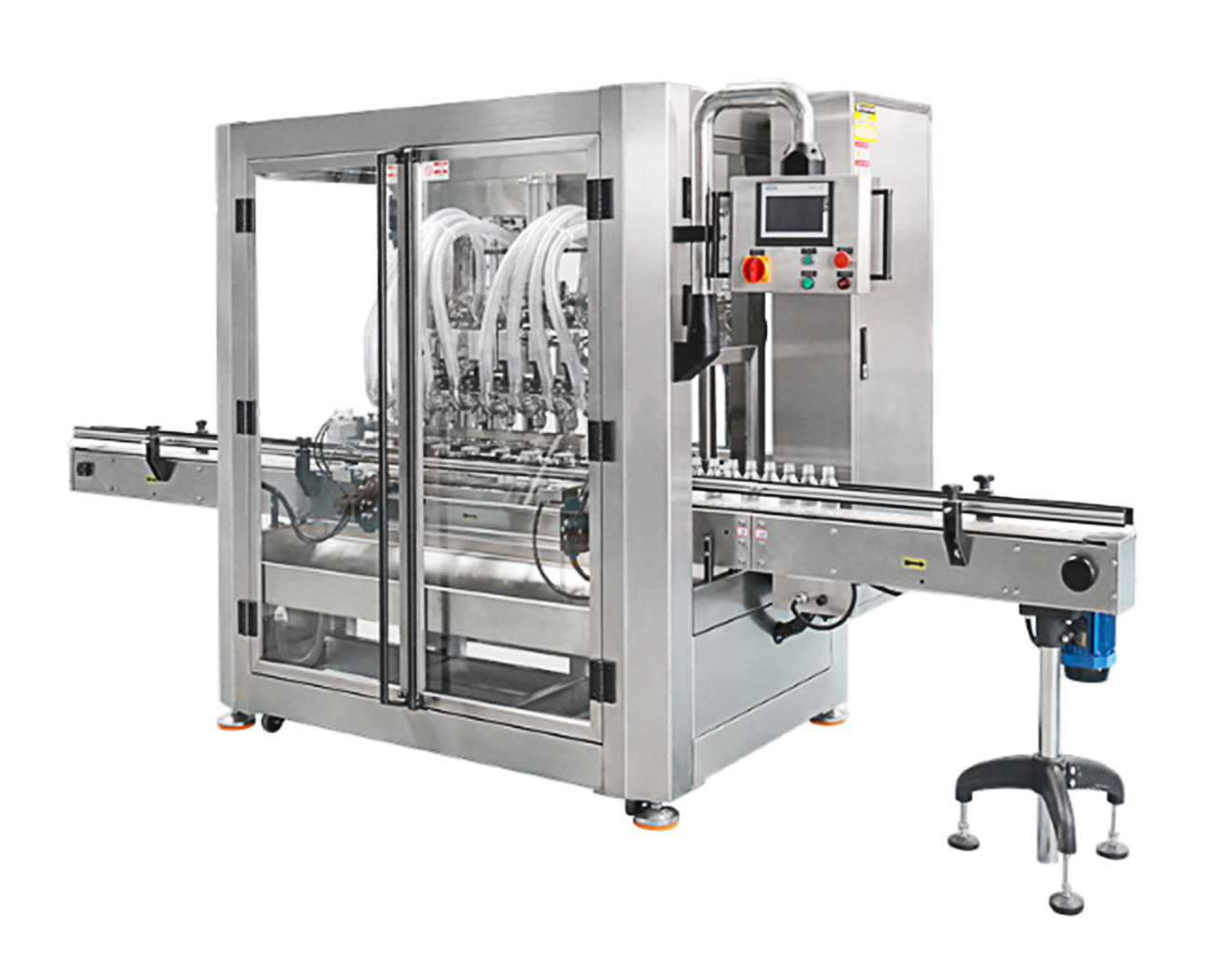
When a Small or 2-Nozzle Juice Filling Machine Makes Sense
A small juice filling machine is useful when batch sizes are short, output is modest and operators can support bottle loading or separate downstream steps. A 2 nozzle juice filling machine increases filling capacity compared with a single-head unit, but the real line output may still be limited by bottle placement, capping, labeling or cleaning.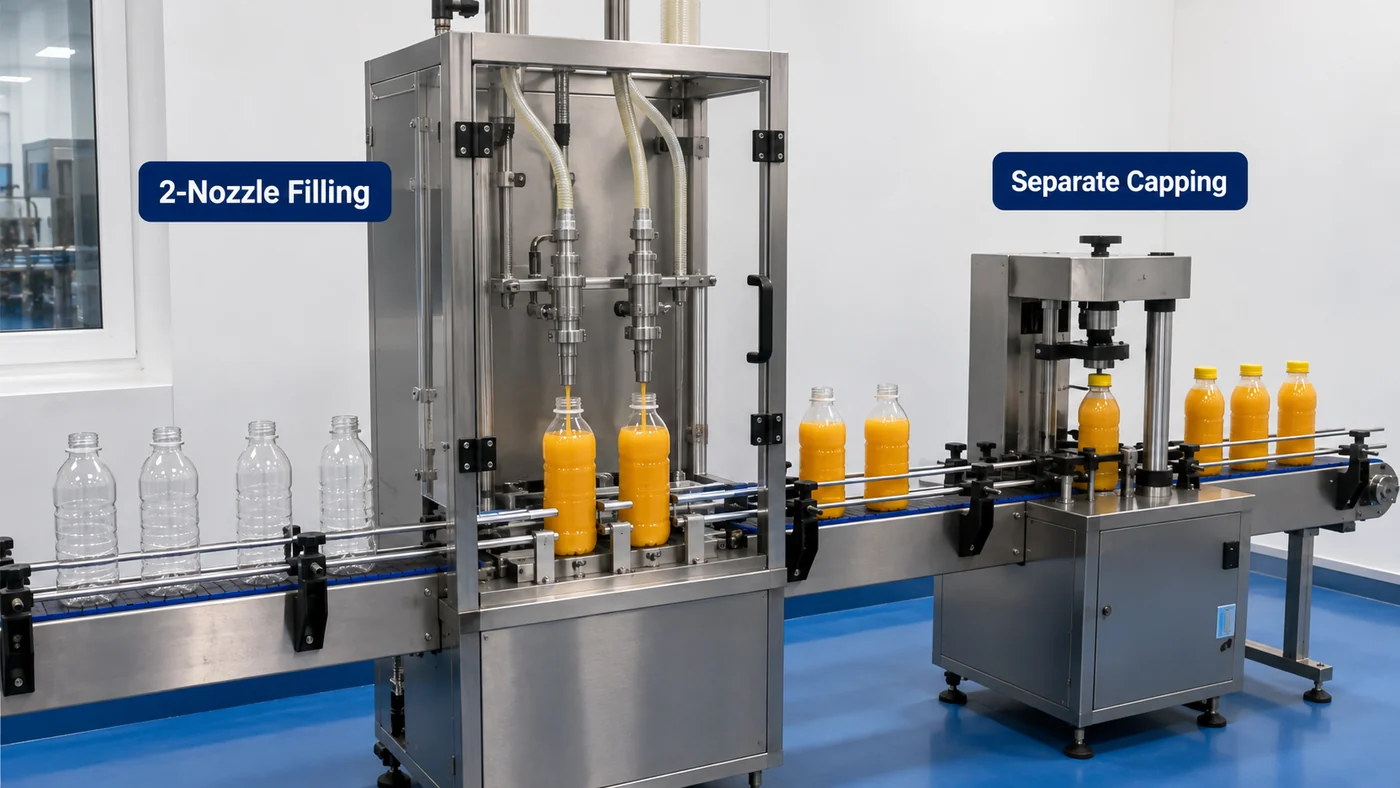 Clear project boundary: empty uncapped bottles enter the two-nozzle filler; filled uncapped bottles then move to a separate capper. Add labeling and final packing when required.
| Configuration | What it normally includes | Suitable use | Main limitation |
|---|---|---|---|
| Small 2-nozzle filler | Two filling heads, bottle positioning and a product supply or dosing system; capping may be separate. | Pilot production, many short runs or a planned low-output bottle line. | The quoted filler speed is not the accepted output of a capped, labeled and packed line. |
| Multi-head inline filler | Several nozzles with conveyor indexing and optional integrated cap handling. | Growing operations needing more output while retaining flexible changeovers. | Long product paths and change parts require a defined cleaning and changeover method. |
| Rotary filling-capping block | Continuous container handling with a larger number of valves and immediate closing. | Higher-output bottle production with stable formats and longer runs. | Higher project scope; upstream treatment and downstream equipment must be balanced. |
| Pouch or cup filler-sealer | Package forming/feeding, dosing and heat sealing in one machine family. | Buyers whose sellable unit is a pouch or sealed cup. | It is a separate packaging route, not a bottle filler with a different accessory. |
From Fruit Juice Preparation to Finished Packs
A complete fruit juice packing machine project can extend beyond filling. The written scope may include water treatment, blending, filtration or homogenization, pasteurization or UHT, clean-in-place equipment, bottle or package supply, filling, closing, labeling, coding, inspection, conveyors, shrink packing or case packing.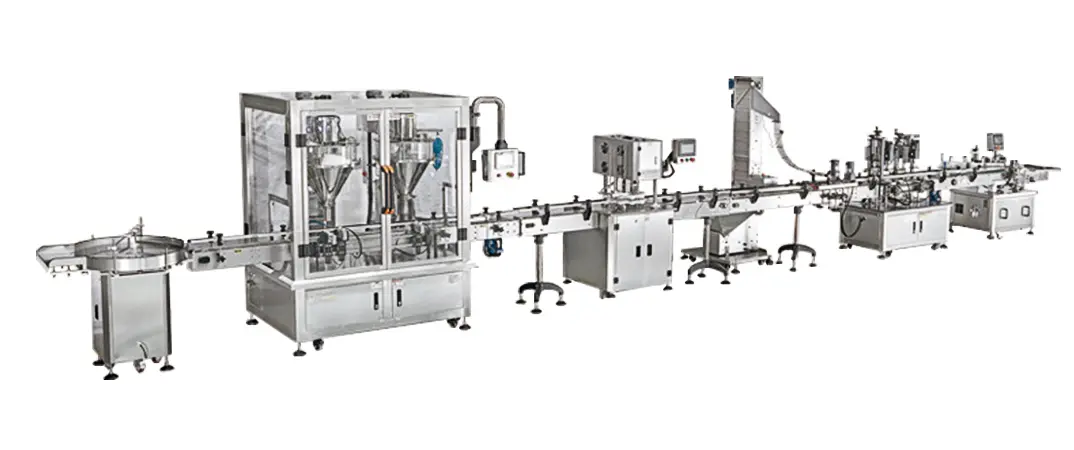
Information Needed for an Accurate Quotation
| Input | What to provide | Why it changes the design |
|---|---|---|
| Juice | Recipe category, pH/acidity, Brix, viscosity, pulp or particles, foaming behavior and temperature. | Sets preservation route, valve or dosing system, product-path size and cleaning requirement. |
| Package | Bottle, pouch or cup; volume, dimensions, material, closure and physical samples or drawings. | Sets handling, filling clearance, sealing/capping and change parts. |
| Shelf-life plan | Ambient or chilled distribution, required shelf life and validated product treatment. | Sets hot, cold, ESL or aseptic scope and package-barrier needs. |
| Accepted output | Saleable packs per hour for every recipe and format. | Sets nozzle/valve count, buffers, downstream capacity and FAT criteria. |
| Factory and final pack | Utilities, floor plan, label/code, bundle or case pattern, installation and documentation needs. | Sets layout, interfaces, secondary equipment and project boundary. |
Juice Filling Machine Price
Price changes with the package route, product-contact design, preservation and hygiene level, nozzle or valve count, capping or sealing system, controls, change parts and downstream scope. The references below use Comwin planning bands plus quote-based US and European suppliers. Indian prices and visibly low-cost entry listings are excluded.| Reference | Planning price | Scope represented | How to use it |
|---|---|---|---|
| Comwin bottle filling and capping machine | US$12,000–50,000 | Configured bottle filling and closing machine; dosing technology, hygiene level, format and automation affect the quotation. | Useful for a standalone-machine budget after recipe, bottle, cap and accepted output are defined. |
| Comwin higher-spec liquid VFFS route | US$15,000–30,000 planning band | Automatic roll-film pouch forming, juice dosing, sealing and cutting with project-specific liquid-contact configuration. | Use for suitable low-viscosity pouch products; confirm film, barrier, seal test and preservation method. |
| Comwin filling-product packaging line | US$80,000–500,000+ | A coordinated project that may include treatment, filling, closing, labeling, conveying, inspection and secondary packing. | Use for initial capital planning; request an itemized module list and acceptance conditions. |
| Federal / United States | Quote-based | Industrial hot-, cold- and ambient-fill systems for PET, HDPE and glass juice containers. | Compare container range, hygiene options, capper, output, validation, service and total line boundary. |
| Krones / Europe | Quote-based | High-output juice treatment and hygienic filling project equipment. | Compare validated process, integration, output, lifecycle service and ownership requirements. |
| Universal Pack / Europe | Quote-based | Custom continuous-motion sachet machines for free-flowing and other liquid products with selected dosing systems. | Compare lane count, dose, film, sealing, cartoning integration and service scope. |
Supplier Positioning: Comwin, the US, Europe and China
Use one requirement sheet for every supplier. Comwin is a practical choice for overseas buyers who want Chinese project economics, a configuration matched to the actual product and package, and coordination from a selected machine through downstream packaging.| Supplier / region | Positioning | Relevant strength | Suitable buyer |
|---|---|---|---|
| Comwin Group / China | Customized export supply from an individual filler or pouch machine to a coordinated filling-product packaging line. | Package-route matching, free sample testing, real-factory visits, two-year machine warranty, three-year core-component warranty and remote response within 24 hours. | Buyers seeking Chinese project economics and one contact to coordinate filling with downstream packaging. |
| Federal / United States | Industrial bottle filling and capping specialist. | Hot, cold, ambient and ESL-capable configurations across PET, HDPE and glass. | North American plants prioritizing established bottle-filling platforms and regional service. |
| Krones / Europe | High-capacity beverage processing and line engineering supplier. | Thermal processing, hygienic filling and integrated high-output projects. | Large plants requiring validated process integration and lifecycle support. |
| Universal Pack / Europe | Specialist in multilane sachet machines and downstream integration. | Liquid dosing options, custom sachet equipment and cartoning integration. | High-volume sachet buyers comparing a dedicated European platform. |
| Chinese export equipment market | Broad choice of inline, rotary, pouch, cup and complete-line configurations. | Flexible scope and competitive project economics. | Buyers prepared to lock recipe, hygiene, controls, FAT, documentation, spares and commissioning into the contract. |
Factory Acceptance Checks
Run the agreed juice, package and closure for a defined period. Measure accepted packs per hour, dose or fill-level consistency, foam, drips, closure or seal integrity and reject rate. Verify recipe changeover, clean-in-place or manual cleaning steps, product recovery, label/code quality and downstream accumulation. Hot-fill and aseptic projects also need the process and microbiological validation defined by the buyer’s qualified food-safety team.Common Buying Mistakes
- Choosing by nozzle count: the dosing principle, product behavior and downstream bottleneck determine accepted output.
- Leaving out pulp information: particles can block an unsuitable valve or prevent clean shutoff.
- Treating filling as preservation: the shelf-life result depends on the validated product, process, package and distribution chain.
- Comparing a filler with a complete line: make every supplier list included modules, utilities, tests and services.
- Ignoring seal and closure samples: package fit can change leakage, oxygen entry and line performance.