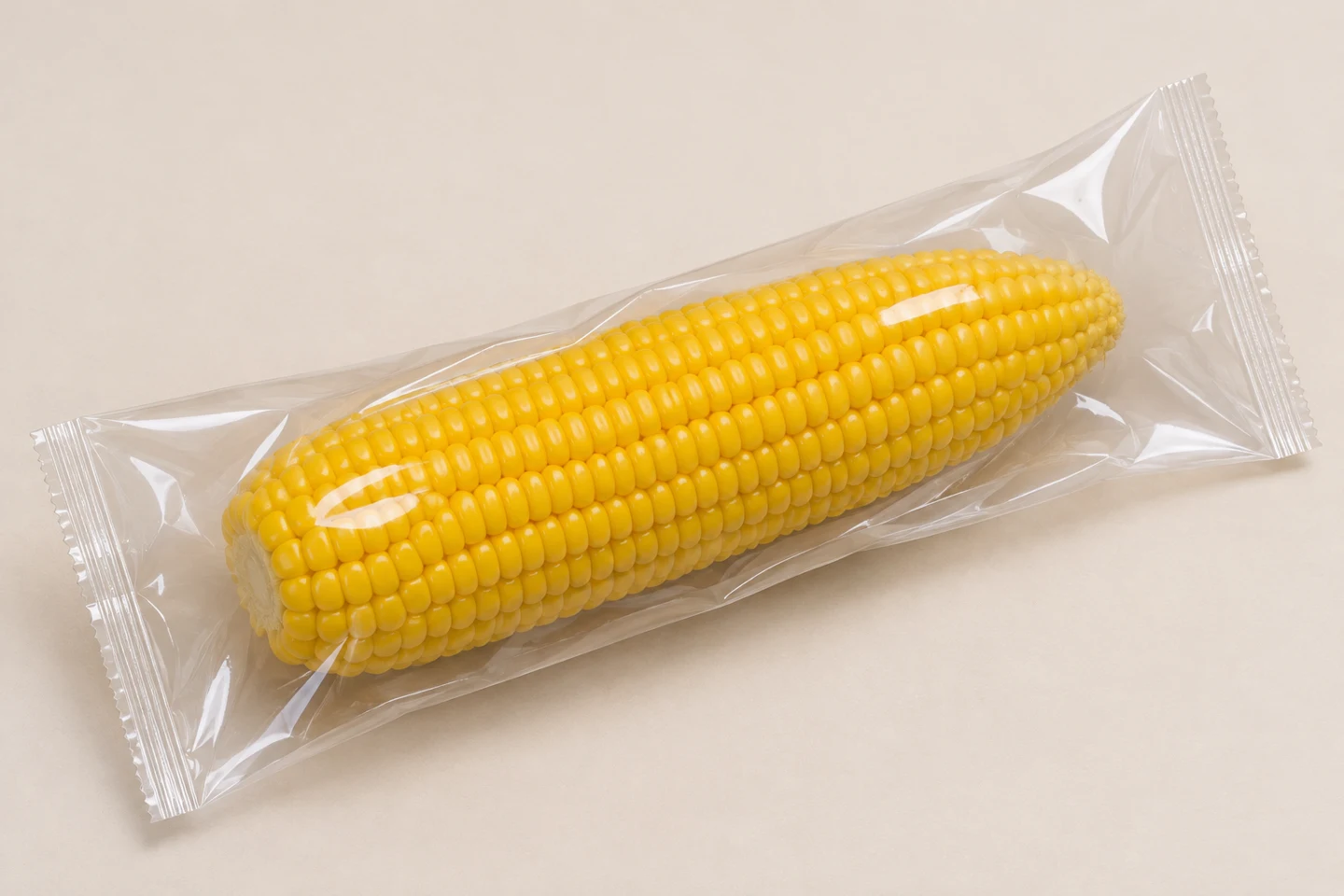
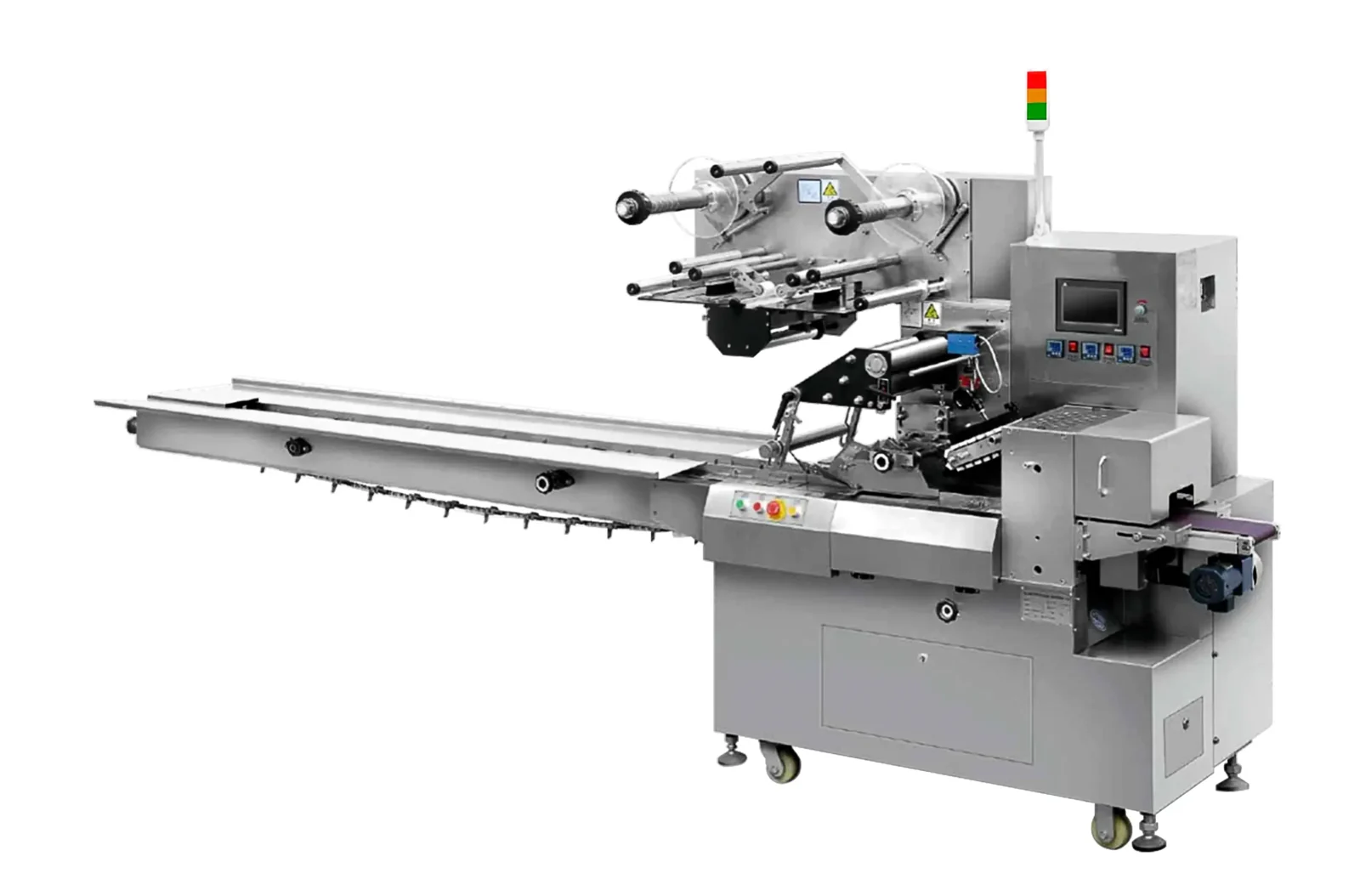
For fresh sweetcorn sold one cob at a time, feed each cob lengthwise into a horizontal flow wrapper. It makes one pillow pack per cob without a tray. Support the cob so it cannot roll into an end seal. Weigh loose dry or frozen kernels into a vertical bagger. With frozen kernels, check for clumps and moisture at the discharge after a stop.
Indicative equipment prices are US$20,000–65,000 for weighed frozen-kernel bagging, US$5,000–25,000 for a hand-fed fresh-cob wrapper and US$10,000–45,000 for basic weighed dry-kernel bagging. Vacuum packing of prepared cobs and sewing bulk sacks have separate equipment scopes.
Start with the corn and the bag supply
| Product and pack | Equipment route | Decision at the trial |
|---|---|---|
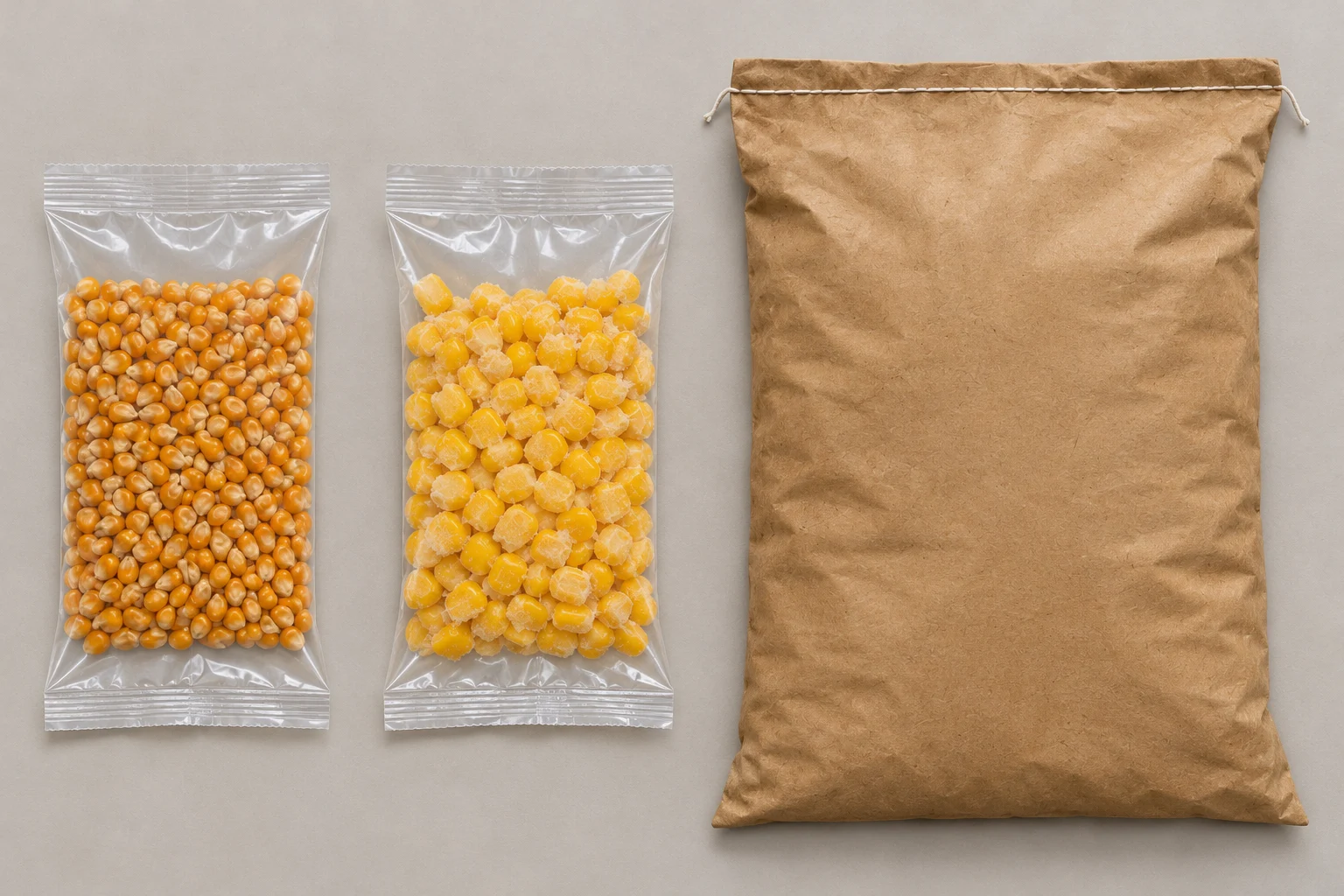
| Dry loose corn kernels in a retail pillow bag | Grain feed and a net weigher above a compatible vertical bagger. | Check spill, weight repeatability and film seal clearance at the smallest and largest dose. |
| Frozen sweet corn kernels in film | Controlled portioning with a cleanable feed and film sealing suited to the cold-product conditions. | Verify clump release and seal quality after a realistic stop and restart. |
| One fresh whole cob in a trayless pillow pack | Space cobs on a supported infeed and wrap each cob lengthwise on a horizontal flow wrapper. | Check for rolling, then run the longest cob to verify clearance at both end seals. |
| Prepared whole cobs in vacuum pouches | Load the specified pouches and use a compatible vacuum-sealing station. | Check pouch fit, liquid near the seal and the closure required by the validated food process. |
| Dry maize in a bulk sack | Net weigh, clamp the supplied open-mouth sack, support the load, then close it. | Test bag width, bottom support and the specified seam or seal at the heaviest size. |
How two weighing heads feed the bagger
Two independent weigh hoppers can alternate complete portions into one bagger. While head A discharges, head B prepares the next dose. This helps when weighing limits output and the bagger is ready for another portion. If film advance, sealing or bag settling sets the pace, the second head will wait.
| Cycle | Head A | Head B | Shared bagger |
|---|---|---|---|
| Bag 1 ready | Releases its complete dose | Prepares or holds the next dose | Accepts A only, then seals bag 1 |
| Bag 2 ready | Refills and weighs | Releases its complete dose | Accepts B only, then seals bag 2 |
| Bagger stopped | Holds discharge | Holds discharge | Requests the next selected dose after restart |
In this arrangement, A and B discharge through a shared transfer path into successive bags. The controls release only the selected head for each bagger-ready signal. If the quote instead shows two separate outlets, identify which packing station each serves and what happens when one stops.
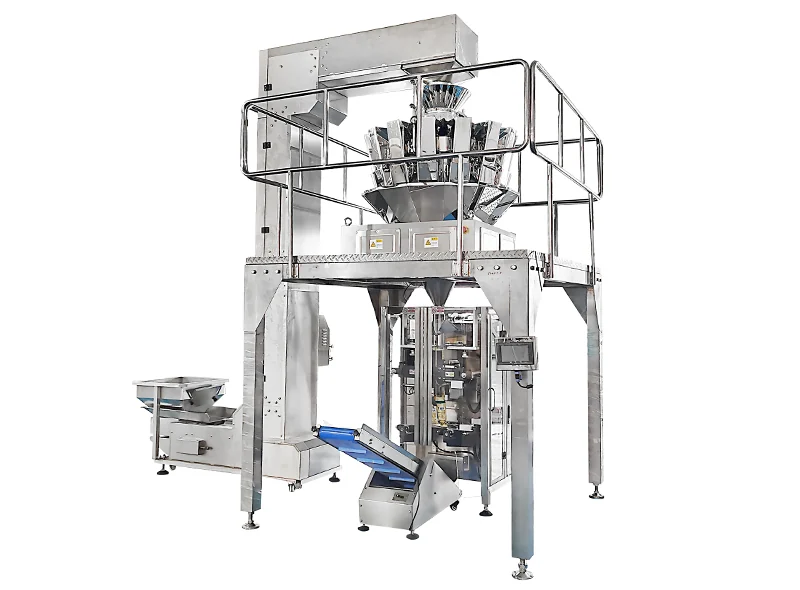
A coarse feed followed by a fine trickle into one hopper is one weighing path. A combination weigher uses multiple small weighed portions to form a target dose; the photo above shows that different option. Ask for the actual head and outlet layout with the quotation. Compare net weights and accepted packs over a run that includes a hopper refill.
Check which outlet arrangement is quoted
Head A ↘
Shared transfer → Bagger 1
Head B ↗
A and B alternate complete doses. Only the selected head discharges for the next bag.
Head A → Outlet 1 → Station 1
Head B → Outlet 2 → Station 2
Confirm the station served by each outlet and the response when either station stops.
Functional relationships only; this does not specify machine dimensions or a quoted mechanical layout.
Sweet corn kernels and whole cobs take different routes
Frozen kernels. Use portion weighing with a feed and discharge suited to the actual clump size, temperature and surface condition. Check gate release, cleaning access and condensate near the film after a stop and restart. The quoted bagging scope should identify the contact parts and environmental requirements.
One fresh cob per pillow pack
Feed the cob into a horizontal flow wrapper with the tips pointing along the belt. A cradle or guides hold the cob as the film forms around it. Leave clearance beyond both tips for the end seals. If the retail specification calls for two cobs, trial them together in a supported position and set the film and pack pitch to their combined footprint.
Hand placement can help when mixed sizes arrive together. For automatic feeding, check whether the infeed can separate cobs and control rolling at the transfer. Include an empty position and a restart in the trial.
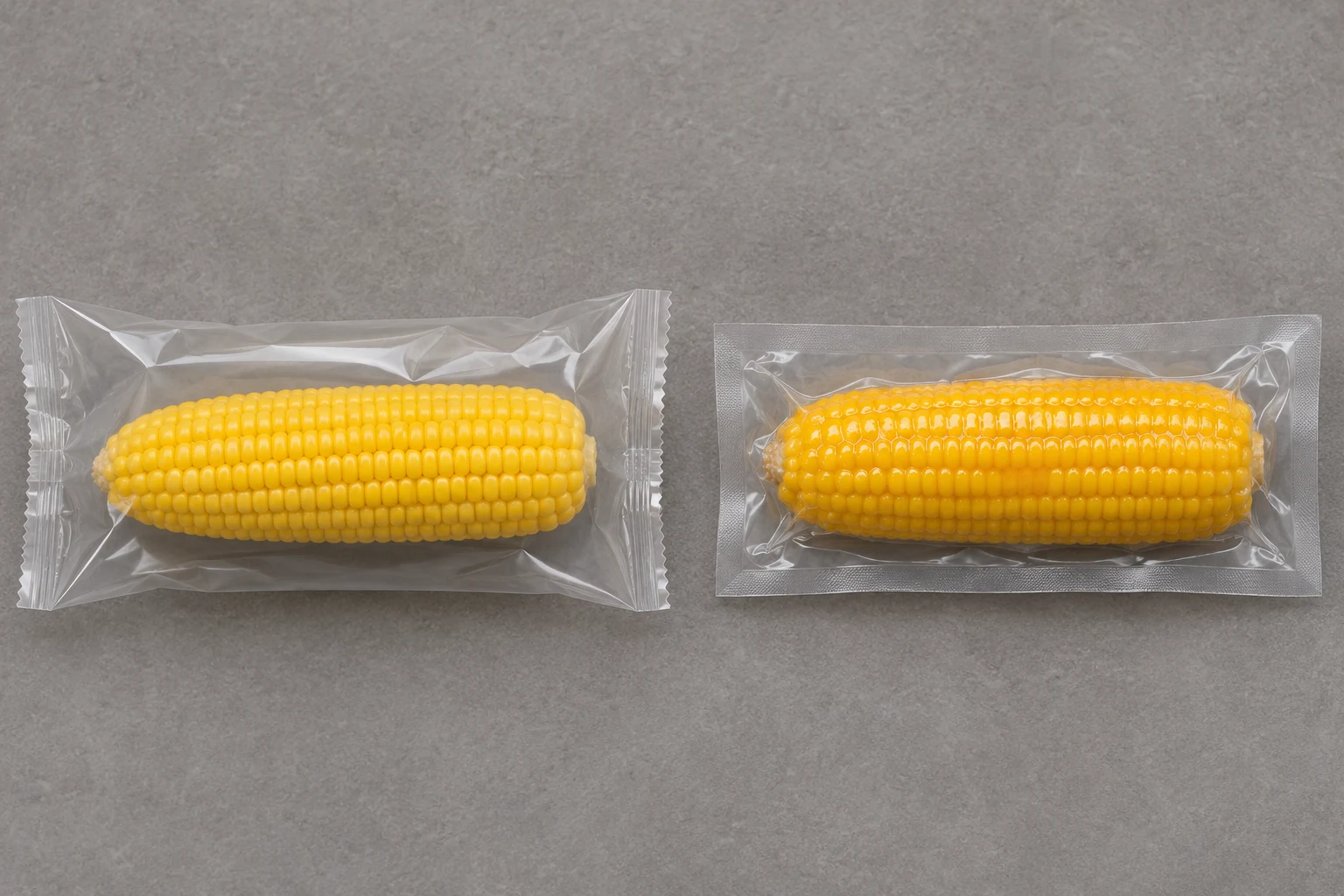
Prepared cobs requiring vacuum packaging. Use the producer’s specified food process and vacuum pouch. Staff may load pouches into a compatible vacuum sealing machine, or a repeated format can be evaluated for automated pouch handling. Keep cob tips and liquid clear of the sealing area. A sealed vacuum pouch does not establish storage temperature or shelf life; those remain part of the validated food process.
Check support and closure for 10, 20, 25 or 50 kg sacks
For intermittent orders, a semi-automatic station can weigh and release the dose while staff present the bag, engage the clamp and transfer the full sack to its closer. On a repeated format, automatic presentation and closing can remove those tasks. Select sewing, heat sealing or another closing method around the real sack material and load. Ask for a demonstration of your lightest and heaviest sacks. Wheat and corn may share a station after separate tests of flow, scale settings and residue at changeover.
Corn packing machine budgets by product and pack
These indicative November 2026 equipment budgets assume new China-supplied equipment and one agreed pack format. Compare the operator duties and the product entering the station as well as the amount. The configured ranges are preliminary allowances, not firm quotations.
| Product and equipment scope | Budget in US dollars | What the scope includes |
|---|---|---|
| Dry retail kernels, base VFFS bagger | 5,000–30,000 | Film forming and sealing; the weighing system, feed and transfer are separate. |
| Dry retail kernels, basic weighed bagging unit | 10,000–45,000 | Bagger, basic single-path weighing, feed and transfer. A dual-head upgrade is quoted against the actual bottleneck. |
| Frozen sweetcorn kernels, weighed bagging unit | 20,000–65,000 | Basic weighing, specified cleanable contact/transfer parts and VFFS bagging for the agreed cold-product conditions. Product freezing and cold storage are excluded. |
| Fresh whole cobs, manually fed flow wrapper | 5,000–25,000 | Wrapper and regular infeed for an agreed cob or prepared group. Staff place cobs; automatic orientation and specialist support tooling are separate. |
| Prepared cobs, manually loaded chamber vacuum station | 3,000–15,000 | Compatible chamber vacuum sealer. Staff load filled pouches and unload packs. Cooking, cooling and automatic pouch feeding are excluded. |
| Dry maize, manually presented sewn-sack station | 8,000–25,000 | Basic scale/spout, load support, simple transfer and compatible sewing closure. Staff present and guide the sacks. |
These are equipment-scope comparisons, not interchangeable machines. Extra formats, advanced inspection, special environmental construction, upstream processing, case packing, freight, duties, site utilities and overseas installation are separate. For automated whole-cob vacuum packing, quote the actual pouch supply, cob loading, vacuum and closure sequence; the chamber-station range does not cover it.
Corn powder and puffed corn need their own feeding trials
Corn flour and maize powder need a dosing and dust-control assessment for the actual powder; start with the powder packing equipment route. Corn flakes and puffs need separate checks of breakage and the volume occupied by each portion. Their packaging scope should be developed around that product, rather than the loose-grain settings described here.
Send the corn product and finished pack
Share the product state, target weight or cob count, bag material, closure and required output. For whole cobs, include the length and diameter range and the number of cobs in each retail pack. Comwin can propose the feed and packing sequence and set up a trial with your product. For kernel bagging, that trial can also establish whether a second weighing head would raise accepted output. Discuss your corn packing machine.