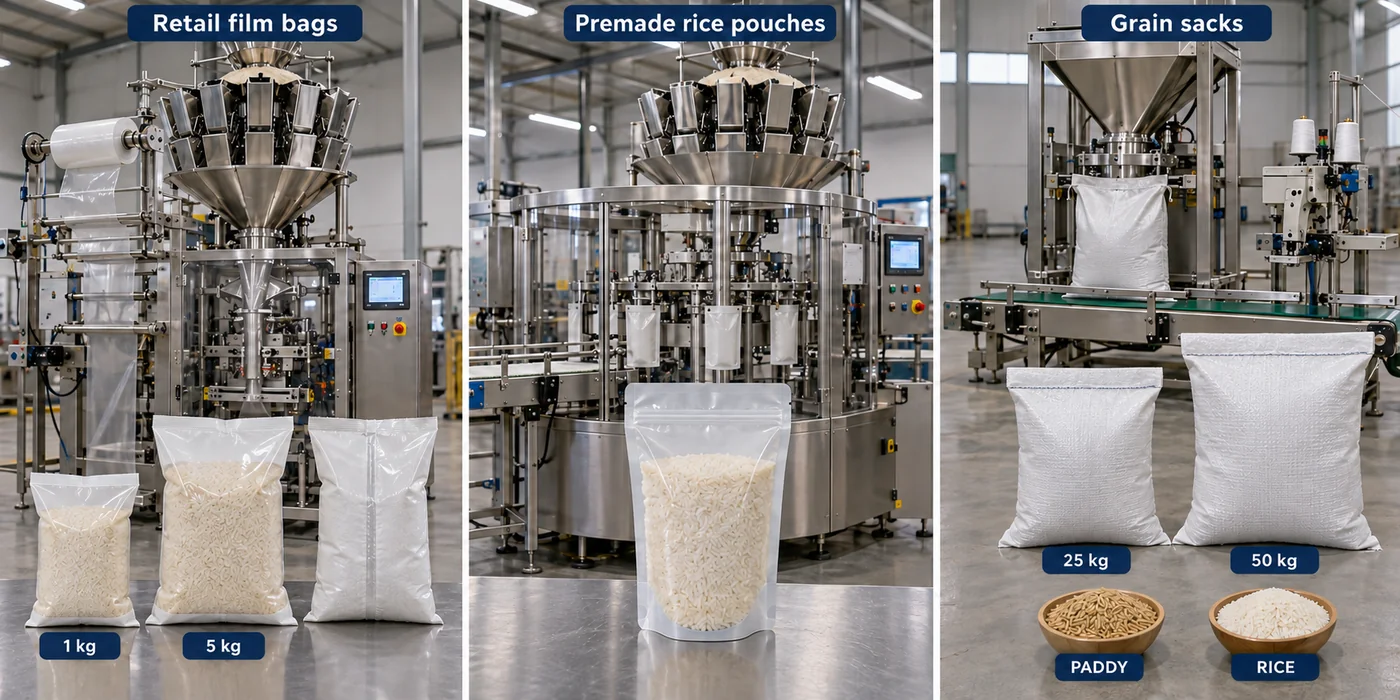
For regular rice orders in 1 kg or 5 kg roll-film bags, start with granular weighing and a vertical form fill seal machine (VFFS). Ready-made retail pouches need weighing with pouch handling. For 25 kg or 50 kg sacks, use a dedicated bagging station with support, closing and conveying. Light, fragile products such as poha need a different feeding and handling assessment from whole rice.
An indicative budget for a rice VFFS and weighing combination is USD 12,000 to 35,000, covering one selected 1 kg or 5 kg film-bag format with basic feeding and discharge. A semi-automatic wholesale sack station has a separate indicative budget of USD 10,000 to 30,000. Comwin matches the weighing, bag handling and closing process to your grain, pack and required output.
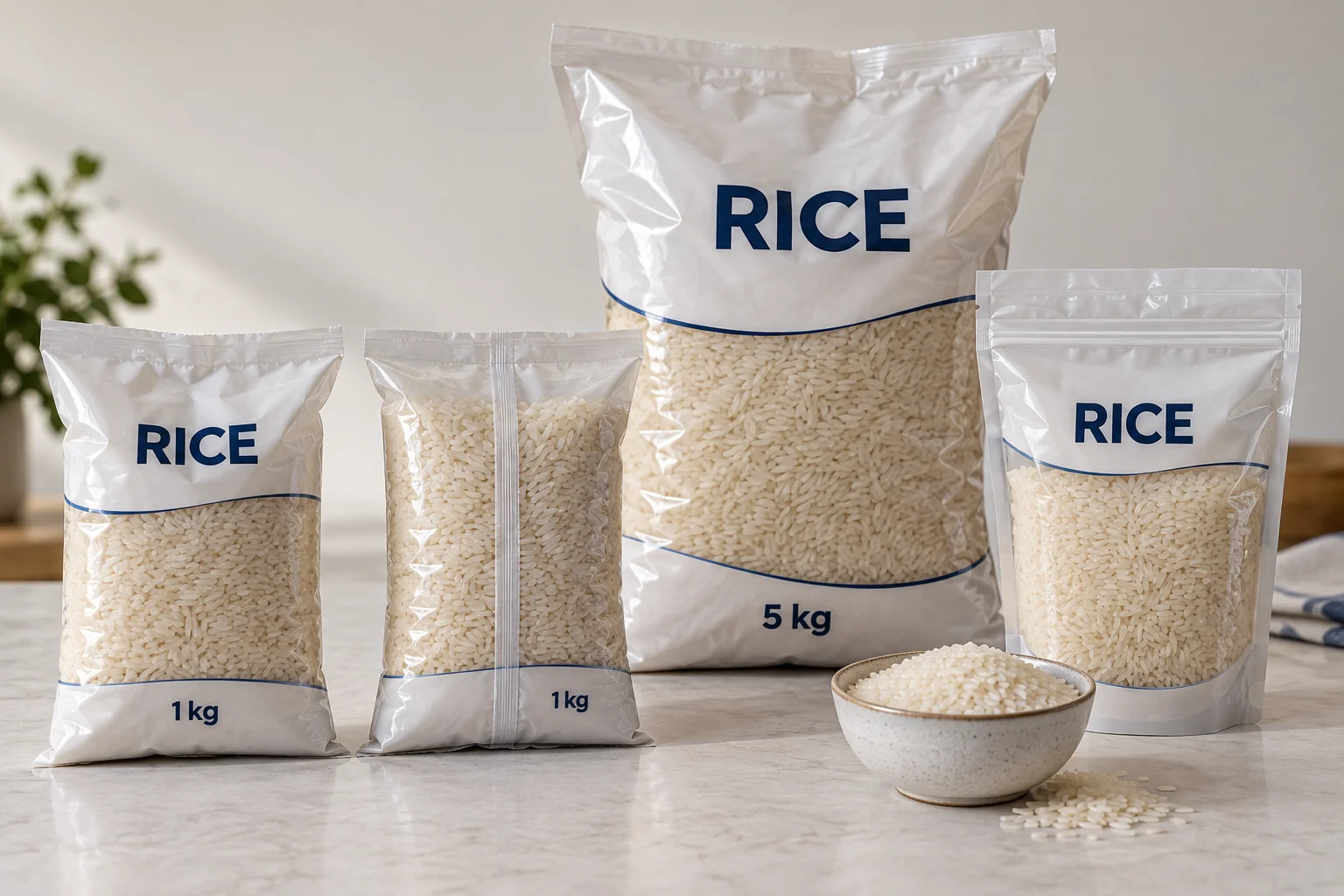
Choose a rice and grain packing route
A rice filling machine supplies the dose, but bag presentation, closure and transfer determine how that dose becomes a saleable pack. Choose the actual bag material and size with the weighing arrangement. This applies to rice and other dry grains; particle shape, density and fragility need product-specific checks. For a mixed-grain or cereal product, also compare ingredient distribution in filled bags after feeding and weighing. A suitable total weight alone does not establish the intended mix in each pack.
| Finished pack and production need | Equipment route | Why it fits | When to change the route |
|---|---|---|---|
| Short runs in ready-made retail bags | Operator-fed weigh filler and separate heat sealer | Retains manual bag presentation and allows frequent bag changes | Move to automatic handling when opening, transfer or sealing limits output |
| Repeated 1 kg or 5 kg film-bag orders | Granular weigher, VFFS and discharge conveyor | Coordinates weighing with continuous bag forming and sealing | Select premade-pouch handling when the chosen retail bag requires it |
| Heat-sealable stand-up or zipper rice pouch | Weighing with premade-pouch handling | Retains the selected pouch and provides opening, filling and top sealing | Compare film forming if it can meet the shelf and production requirements |
| 25 kg or 50 kg rice or grain sack | Controlled feeding, weighing, clamping, closing and conveying | Supports the large bag and its transfer through the closing station | Add automatic bag loading or pallet handling where those steps constrain output |
Roll-film retail rice bags
A VFFS machine forms the bag from film while a linear or combination weigher provides the dose. Choose the weighing configuration against weight distribution, output and product handling. A greater number of weighing heads is not automatically the best fit for every rice order.
For 1 kg and 5 kg rice bags, compare filled volume, forming width, drop path and load support. If both sizes are required, confirm the change parts and run each format with the chosen film. The budget for one selected format does not include every part needed to run both.
Premade retail pouches
A premade-pouch packaging platform can hold and open the bag while a matched granular weigher supplies rice. Check the usable opening, filling path and top-seal area. A zipper below the factory top seal allows the consumer to reclose the pouch.
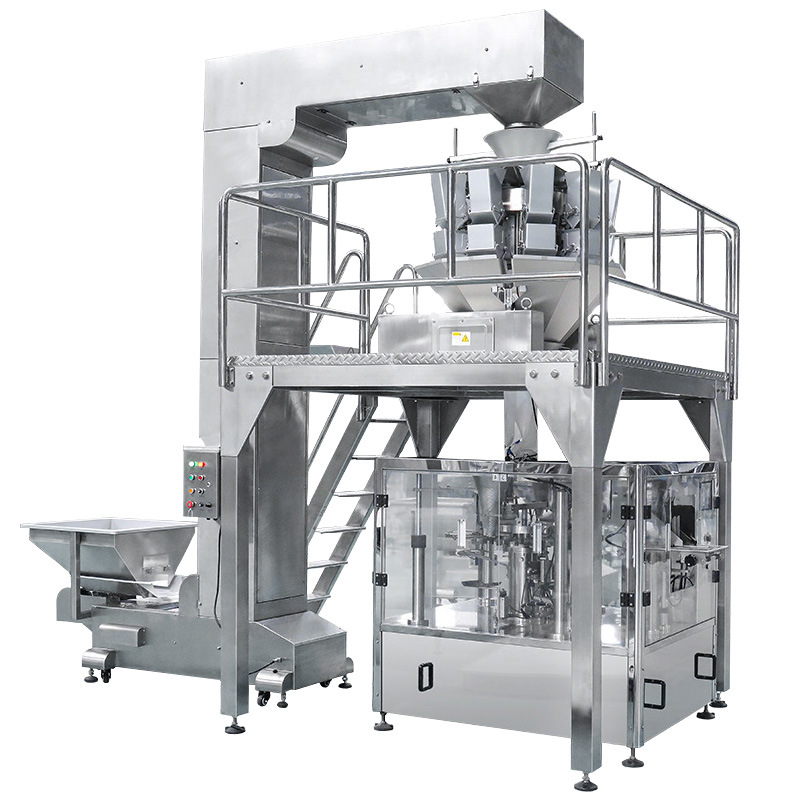
Match the pictured feeding, weighing and pouch-handling functions to the actual grain, pouch and production target. Vacuum is an additional process when required by the finished pack.
Industrial rice bagging
A 50 kg rice packing machine needs a supported open-mouth sack arrangement. Define the feed and weighing method, clamp, conveyor and closing operation. Net-weigh and gross-weigh systems have different sequences; compare complete good-sack output with the agreed bag and staffing.
Automatic sack loading depends on repeatable bags that can be picked, opened and presented reliably. Check the bag magazine and replenishment steps with the intended sacks. Large-bag weights alone do not establish bag compatibility.
Solve the problems that reduce good rice bags
| Packing problem | Likely mechanism | Configuration or operating response | What to verify |
|---|---|---|---|
| Weights vary between fills | Unstable feeding, material flow or dosing cutoff | Match coarse and fine feed control, hopper conditions and weighing | Net-weight distribution at representative feed levels and operating rates |
| Grain lodges in the top seal | Product reaches the closing area or falls after cutoff | Coordinate discharge and sealing; keep the seal strip clean | Seal condition and leakage after normal handling |
| A 5 kg retail bag slips or strains | Filled volume, film strength or support is unsuitable | Match the bag dimensions, bottom support and transfer path | Bag-bottom condition, sealing and load handling |
| Poha produces excessive fines | Drops, agitation, feed contact or unsuitable handling damage the flakes | Review gentle feeding, discharge height and available bag volume | Incoming and packed-product fines using the same agreed method |
| Filled wholesale sacks queue at closure | Mouth preparation, sewing or transfer is slower than filling | Match support, closing and conveying before increasing the dosing rate | Sustained closed-sack output and reliable transfer |
| An automatic line stops at collection | Case or pallet handling cannot absorb primary packs | Define buffers, counts and the next operation’s usable capacity | Continuous operation through the agreed endpoint |
Dry-grain packing also needs a cleaning and inspection plan suited to the product and market. An inspection unit requires a specified detection task and reject arrangement. Do not accept an inspection label as proof that the required contaminants can be detected in every bag material and size.
Match the equipment to a concrete grain packing scenario
| Product and business condition | Finished pack | Starting route | Condition that changes the selection |
|---|---|---|---|
| Whole rice, repeated retail orders | 1 kg or 5 kg film bag | Granular weighing and VFFS | Required bag presentation or a restrictive retail pouch moves the route to premade handling |
| Branded rice in an established zipper pouch | Heat-sealed stand-up pouch | Granular weighing and premade-pouch handling | Bag-opening failures or dirty seals require a pouch or discharge change |
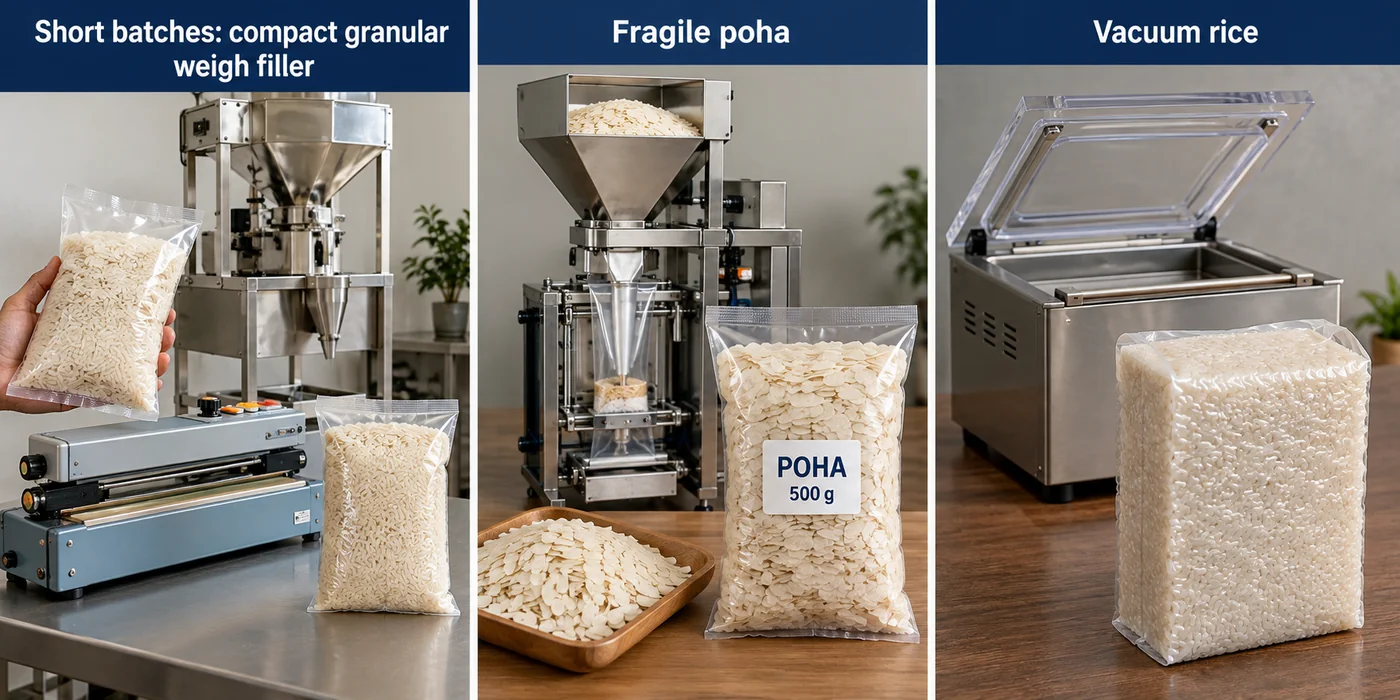
| Several grain products in short runs | Selected premade retail bags | Operator-fed weigh filling and separate heat sealing | Manual transfer becomes the reason to compare automatic bag handling |
| Wholesale rice or unhulled paddy | 25 kg or 50 kg sack | Dedicated weighing, supported filling, closing and conveying | Bag loading and pallet handling may justify added automation |
| Light, fragile flattened rice | 500 g or 1 kg poha film bag | Gentle granular weighing and appropriately sized VFFS | Excess fines or insufficient bag volume require a different feed or bag arrangement |
| Rice sold as a compact vacuum pack | Suitable barrier bag and vacuum-packed rice brick | Weighing, filling and a separate compatible vacuum process | Vacuum cycle, bag structure and output need their own equipment selection |
Example: retail rice changing from 1 kg to 5 kg
Assume one production plan requires both weights. Use the proposed weigher, bag formers and film to check both fills. Record net weights, filled-bag clearance, seal condition and the changeover procedure. The 5 kg setting must be checked under load, including the bag support and discharge conveyor.
If both formats work on the selected configuration, specify their change parts in the offer. If the larger bag needs a different forming or transfer arrangement, compare a separate configuration against the actual number of larger packs required.
Example: 25 kg rice sacks and an output target
As a hypothetical calculation, 25 kg multiplied by 6 good sacks per minute and 60 minutes gives 9 tonnes per hour. This is a rate conversion, not a machine rating. Determine whether the filler, bag loading, closing and transfer can sustain that good-sack rate, including routine replenishment and stops.
Paddy is unhulled grain. Its husks, dust, impurities and storage or transport purpose need a separate material assessment from milled food rice. Use representative paddy and the intended sack in a bagging trial; packaging equipment does not establish storage life or replace grain conditioning.
Compact vacuum rice bricks: filling, shaping and sealing
For short runs of rice bricks, Comwin starts with weighing, manual bag loading, a bag-support or shape fixture and a chamber vacuum sealer. Fill to the selected weight, position the bag so the intended shape and clean mouth are maintained, then evacuate and seal. This produces a different finished pack from an ordinary loose rice bag; the bag material, chamber space and vacuum cycle must match it.
When repeated bag loading and chamber cycling limit the order, compare a matched automatic filling, brick-forming and vacuum-sealing arrangement. Its scope includes the actual bag-handling and forming tasks. Changing an ordinary VFFS weight setting does not add vacuum processing or a brick shape. Use vacuum only when the required finished pack calls for it, and validate the rice, material and storage objective together.
For one selected rice-brick format, a manual-loading weighing and chamber-vacuum combination has an indicative equipment budget of USD 8,000 to 30,000. A basic automatic filling/brick-forming/vacuum arrangement is provisionally USD 40,000 to 110,000. These are complete alternative configurations under the general planning assumptions below, excluding milling, extra formats, inspection and case/pallet handling. A vacuum unit alone is not a complete filling arrangement.
Pack fragile poha with the right feed and bag volume
Poha is flattened rice, so it needs more attention to flake handling and usable volume than a whole-rice configuration. Assess feed contact, drop height, discharge control and hopper size with actual flakes. Choose a bag that provides the required fill and clean sealing area without forcing the product through an undersized opening.
For a trial, agree how to measure fines and use that method on incoming and packed samples. Compare the change during the complete packing process. Adjust feeding or transfer where the trial shows damage; no configuration should be accepted on an unsupported zero-breakage claim.
An indicative poha packing machine budget is USD 15,000 to 40,000 for one selected 500 g or 1 kg film-bag combination, including suitable basic weighing, feeding, forming, sealing and discharge. Higher-output configurations, premade-pouch handling and additional inspection need separate scopes.
Calculate poha pouch material cost separately
Poha packing pouch price is a packaging-material question. For a roll-film bag, estimate the film mass using the repeat length, web width and film weight per square metre. Use repeat length including end-seal allowance, full web width including the longitudinal-seam allowance, and the basis weight of the complete selected laminate. Then apply the film price per kilogram.
In a hypothetical example, a 0.30 m repeat multiplied by a 0.44 m web width and 90 g per square metre gives 11.88 g of film per bag. At an assumed USD 4 per kg of film, that is approximately USD 0.0475 per bag for film material only. These are calculation assumptions, not a quoted poha-pouch price or a confirmed bag specification.
Add waste, printing plates, order quantity, converting charges where applicable, taxes and delivery to compare material offers. A purchased premade pouch needs its own supplier price; this roll-film calculation does not represent a zipper pouch quote.
Match rice bag sealing to the actual material
| Bag construction | Suitable closing operation to assess | Scope to define |
|---|---|---|
| Filled heat-sealable retail bag | Continuous band sealing or another matched heat-sealing unit | Seal width, material, filled-bag support and manual or automatic presentation |
| Film bag made on VFFS | The selected machine’s longitudinal and transverse sealing arrangement | Film compatibility, clean seal area, timing and load transfer |
| Woven wholesale sack | Sewing or the specified outer-bag closing method | Mouth preparation, stitch arrangement, bag support and conveyor |
| Wholesale sack with heat-sealable liner | Liner heat sealing, plus outer-bag closure if specified | Two operations when both liner sealing and outer sewing are required |
An independent rice bag sealing machine closes an already filled bag. Check the offer separately for weighing and filling equipment. For food-contact and moisture protection, confirm the complete bag structure and its specified closure with the packaging supplier.
Rice packing machine prices by configuration
These indicative planning budgets in USD were prepared in October 2026 for new equipment supplied from China and ordinary non-aseptic food packing. Each row assumes one product and one selected weight and bag format. They are not formal quotations. Freight, taxes, overseas installation, grain processing and site works are excluded.
| Selected configuration | Indicative budget | Included planning scope | Main exclusions |
|---|---|---|---|
| Operator-fed retail weigh filling | USD 5,000 to 15,000 | Basic weighing, manual bag presentation and separate matched sealing for one retail bag | Automatic bag handling, extra formats and inspection |
| One 1 kg or 5 kg rice VFFS combination | USD 12,000 to 35,000 | Suitable basic granular weighing, feeding, film bagging and discharge | Higher-specification combination weigher, heavy-bag or high-output configuration, extra formats and inspection |
| Premade rice-pouch combination | USD 20,000 to 50,000 | Granular weighing, pouch handling and basic feeding for one heat-sealable pouch | Vacuum, extra zipper mechanisms, additional bag types and case packing |
| One 25 kg or 50 kg semi-automatic station | USD 10,000 to 30,000 | Weighing, manual bag loading, clamping, basic conveying and one closing method | Automatic bag loading, complex liner handling and palletizing |
| One 25 kg or 50 kg automatic arrangement | USD 40,000 to 100,000 | Consistent-bag automatic loading, weighing, basic closure and conveying | Complex multi-operation closing, additional formats, high-capacity multi-station layouts and palletizing |
| One 500 g or 1 kg poha film-bag combination | USD 15,000 to 40,000 | Basic matched gentle feeding, weighing, bagging, sealing and discharge | Higher-output configuration, premade bags and additional inspection |
| Independent retail band-sealing unit | USD 1,500 to 5,000 | One heat-sealable filled-bag format, manual presentation and basic support | Rice dosing, automatic bag handling, vacuum and industrial sack closure |
| Independent large-sack closing and basic conveying | USD 3,000 to 10,000 | One chosen sewing or heat-sealing method with basic support and conveying | Combined liner sealing and outer sewing, weighing and filling |
For a 25 kg rice packing machine price, specify manual or automatic bag loading and the actual closure. A 50 kg sack may also change support and transfer requirements. Weight alone does not define the difference in price.
The large-sack station budgets already include one closing method. Add the independent closing-unit budget only when that unit is outside the agreed station scope. A liner seal followed by outer sewing needs its own combined price, rather than an assumed single-method allowance.
Specialized pulse handling has a separate product assessment. Vacuum rice budgets refer to the filling, shape-forming and vacuum duties stated above, rather than ordinary rice bagging.
Compare rice packing automation by the work it removes
| Decision | Operator-fed weigh filling | Automatic retail bag packing | Automatic bulk-sack handling |
|---|---|---|---|
| Production pattern | Short orders and frequent bag changes | Repeated compatible film or premade bags | Consistent wholesale sacks in sustained runs |
| Manual tasks | Present, transfer and feed bags to the sealer | Replenish material and bags; collect packs unless further handling is included | Replenish sacks and supervise; pallet work depends on the scope |
| Changeover | Dose setup, feed settings and separate-sealer adjustment | Weigher recipes, forming parts or pouch settings, support and discharge | Sack magazine, clamps, weight and closing settings |
| Acceptance | Good filled and sealed bags with agreed staffing | Good bags per shift, weights, seals, grain damage and change time | Reliable bag loading, acceptable weight, closure and transfer |
Define the manual tasks that remain at each level. An automatic grain packing machine may still need an operator to replenish bags, clear collection points or supervise changes. Compare output with those tasks included.
Coordinate optional case packing and pallet handling
Retail rice bags can be grouped into transport cases. Closed wholesale sacks can be palletized. A bagged-product packaging line can match these steps to the primary packing output when handling is the bottleneck.
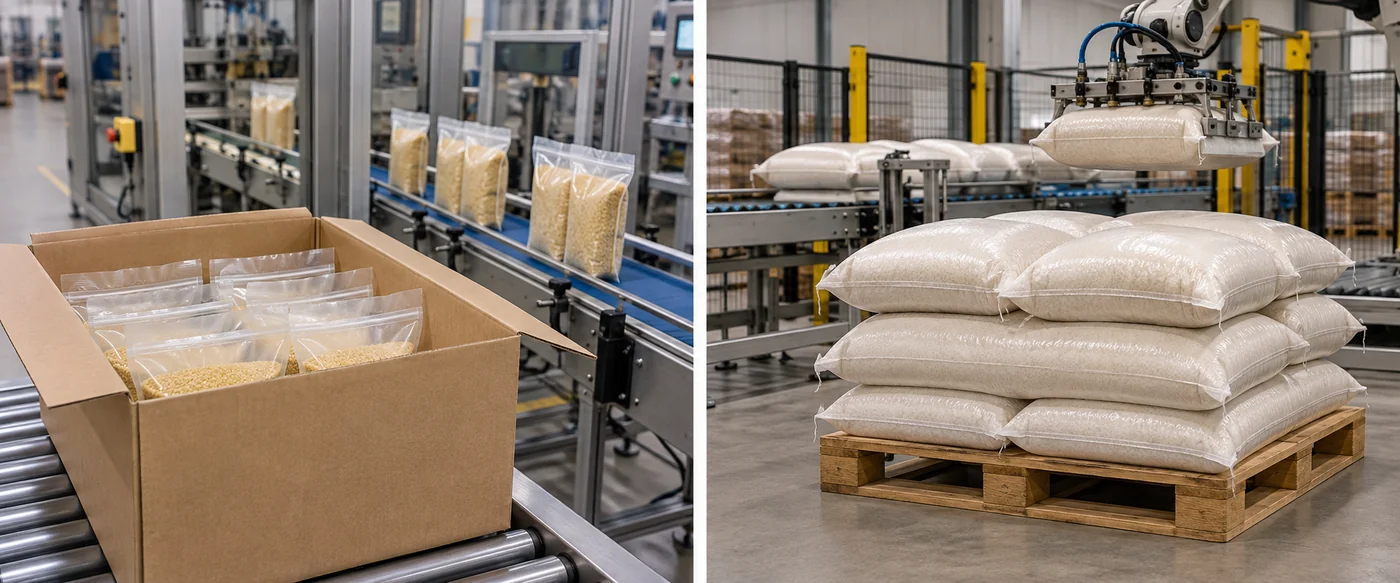
For example, 60 primary bags per minute divided by 10 bags per case gives a theoretical 6 cases per minute. Case formation, loading, closure, buffers and interruptions must be considered before specifying the usable case rate. Do not add bags per minute and cases per minute to describe line capacity.
State the packs per case, case dimensions, sack orientation and pallet pattern. Include these optional handling steps in the offer when they are required; the filling budgets above exclude them.
Compare rice and grain packing suppliers on five points
| Dimension | Evidence to compare | What to discuss with Comwin |
|---|---|---|
| Budget and scope | The same product, bag, weighing method and endpoint | Included filling and closing equipment with optional handling priced separately |
| Production | Good-pack output using the intended grain and material | Required bags per shift, replenishment and the capacity of closing and collection |
| Application fit | Grain shape, filled volume, bag opening, load and fragility | Matched feeding, weighing, support and change parts |
| Support | Testing, training, parts information and support responsibilities | How the selected configuration will be operated and maintained |
| Delivery | Approved samples, frozen configuration and acceptance milestones | A schedule tied to agreed equipment and material readiness |
Comwin develops grain packing solutions from weigh filling to coordinated bag handling. We offer free sample testing and factory visits. Equipment warranty is two years, with three years for core components; remote response is within 24 hours. Training, installation and spare-parts scope are agreed for the selected equipment.
Rice and grain packing questions
Can one rice machine run both 1 kg and 5 kg bags?
If both weights and bag dimensions fit the selected dosing, forming and support arrangement, specify the change parts and verify both formats. If the 5 kg pack needs different load handling, compare the required configuration separately. Include change time and good-bag output in the trial.
Does a rice filling machine include sealing?
When the offer is for a filler only, provide a separate bag presentation and closing arrangement. When it is an integrated bagging combination, confirm which sealing or sewing operations are included. Match the scope to the actual bag construction.
What should I budget for a rice bag sealing machine?
For a manually presented heat-sealable retail bag, the indicative standalone sealing budget is USD 1,500 to 5,000. For one large-sack closing method with basic conveying, use USD 3,000 to 10,000 for early planning. Confirm material, support and included operations before comparing offers.
Can a grain packing machine handle poha or cereal flakes?
For light or fragile flakes, test gentle feeding, drop height, weighing volume and the bag opening with the actual product. Compare incoming and packed fines using an agreed method. Whole-grain operation alone does not validate flake handling.
Is vacuum rice packing included in a normal bagging machine?
If a compact vacuum pack is required, specify suitable bag material and the complete filling, evacuation and sealing process. Compare the vacuum stage and output separately. Do not treat an ordinary heat-sealed rice pouch as a vacuum pack.
Can the rice configuration also pack pulses?
When pulses have compatible flow and bag requirements, assess them on the selected platform with the necessary recipes or parts. Mixed products, damage and cleaning needs may require a different configuration. Use a dedicated pulse assessment rather than assuming compatibility from the rice label.
Send the information needed for a grain packing proposal
- Product: rice variety or other grain, unhulled paddy or flakes, particle size, flow, moisture, representative samples and acceptable damage.
- Pack: roll film, premade pouch or sack; dimensions, laminate or liner, zipper position and finished-pack sample.
- Fill: selected bag weights, acceptable net-weight range, filled volume and any vacuum requirement.
- Closure: retail heat seals, sack sewing, liner sealing or combined closure; coding and inspection requirements.
- Production: good bags per shift, operating hours, product and format changes, current manual tasks and case or pallet needs.
- Site: incoming grain supply, conveyors, space, power, compressed air, handling route and destination market.
Comwin can return a matched configuration, a component and option list, and proposed sample-test acceptance criteria based on these inputs.
Arrange sample testing with your grain and packaging material, or send Comwin your required packing scope for an equipment proposal.