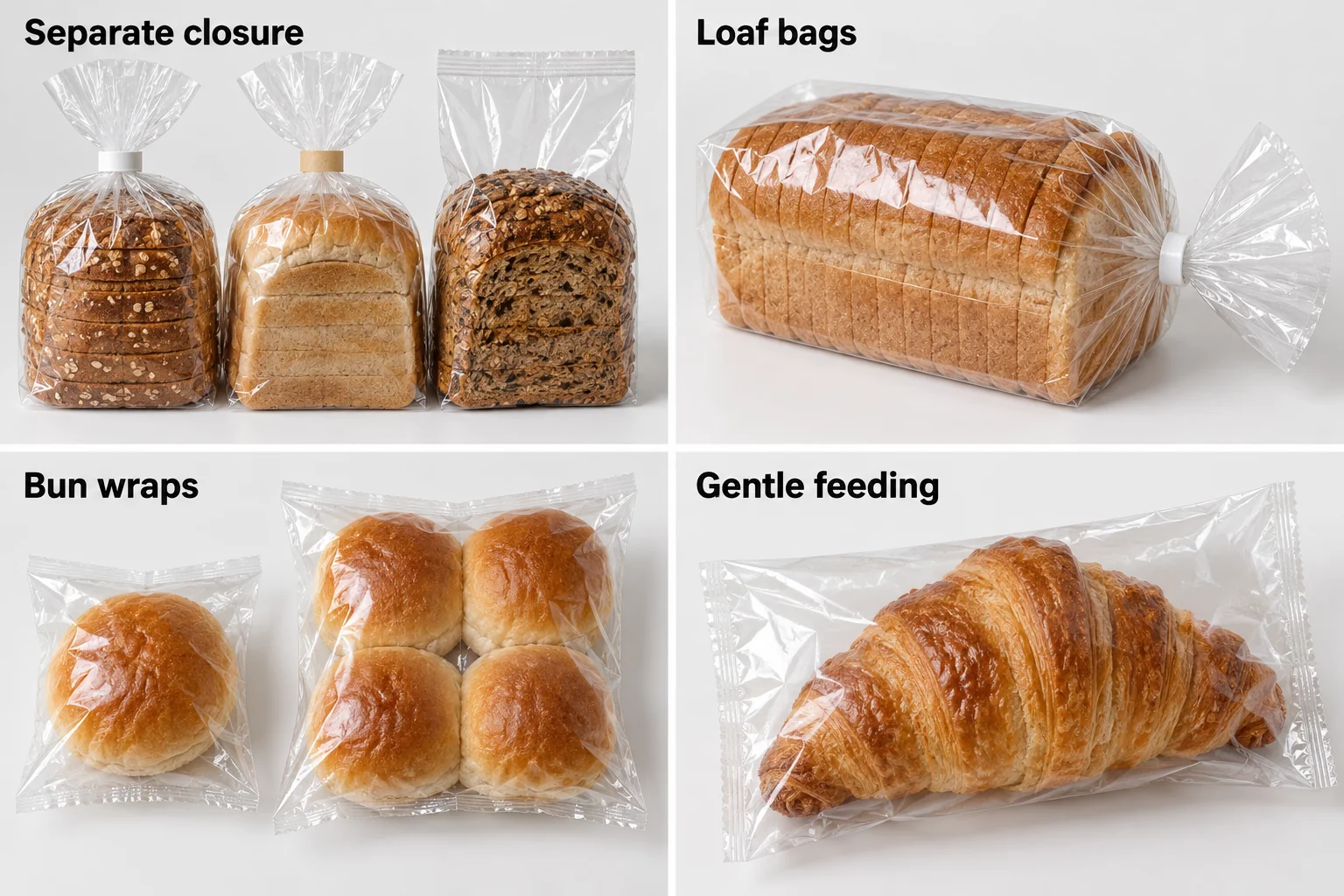
For sliced bread in a reclosable premade bag, choose a loaf bagger. For individual buns or an arranged group in a sealed film pack, choose a horizontal flow wrapper. For short bun runs, a suitable manual-feed bread packing machine can form and seal roll-film packs.
Indicative budgets are USD 5,000 to 25,000 for a manual-feed flow wrapper and USD 25,000 to 90,000 for automatic loaf bagging with one selected closure. A USD 500 to 2,500 clip or tape station closes a bag that someone has already filled. Comwin matches the bread support, bag handling and closure to your product and production schedule.
Choose the bread bag before the feeding system
Will the consumer reopen the bag? Will it hold a loaf, one bun or a counted group? A bread bagging machine opens a premade bag and loads the loaf. A bread wrapping machine forms a pack from roll film, then makes the longitudinal and end seals. The product arriving at either machine must have a defined shape and condition after baking and cooling.
| Finished pack and condition | Recommended equipment and work | Change the route when |
|---|---|---|
| Premade bread bags; short orders | Manual bag loading and a separate clip, tape or suitable heat-sealing unit. The operator loads and presents every bag. | Loading and presenting the bag consumes the available labor time. Add a bagger when this becomes the production constraint. |
| Whole or sliced loaf; reclosable retail bag | Automatic loaf bagging with reclosure: support the loaf, open and load the bag, then apply the selected clip, tie or tape closure. | A sliced loaf shifts under the loading force, or the required barrier needs a different bag and sealing process. |
| Individual bun or stable bakery piece; sealed film pack | Manual feeding with horizontal flow wrapping. Set product spacing, forming and seal positions around the actual bread. | Surface contact damages the product, or irregular supply prevents sustained feeding. Change the support or add gentle feeding. |
| Repeat bun or bakery orders; regular upstream supply | Gentle automatic feeding with flow wrapping. Coordinate buffering, spacing and wrapping after the agreed cooling stage. | Several lanes, frequent gaps or delicate shapes need a different distribution and support arrangement. |
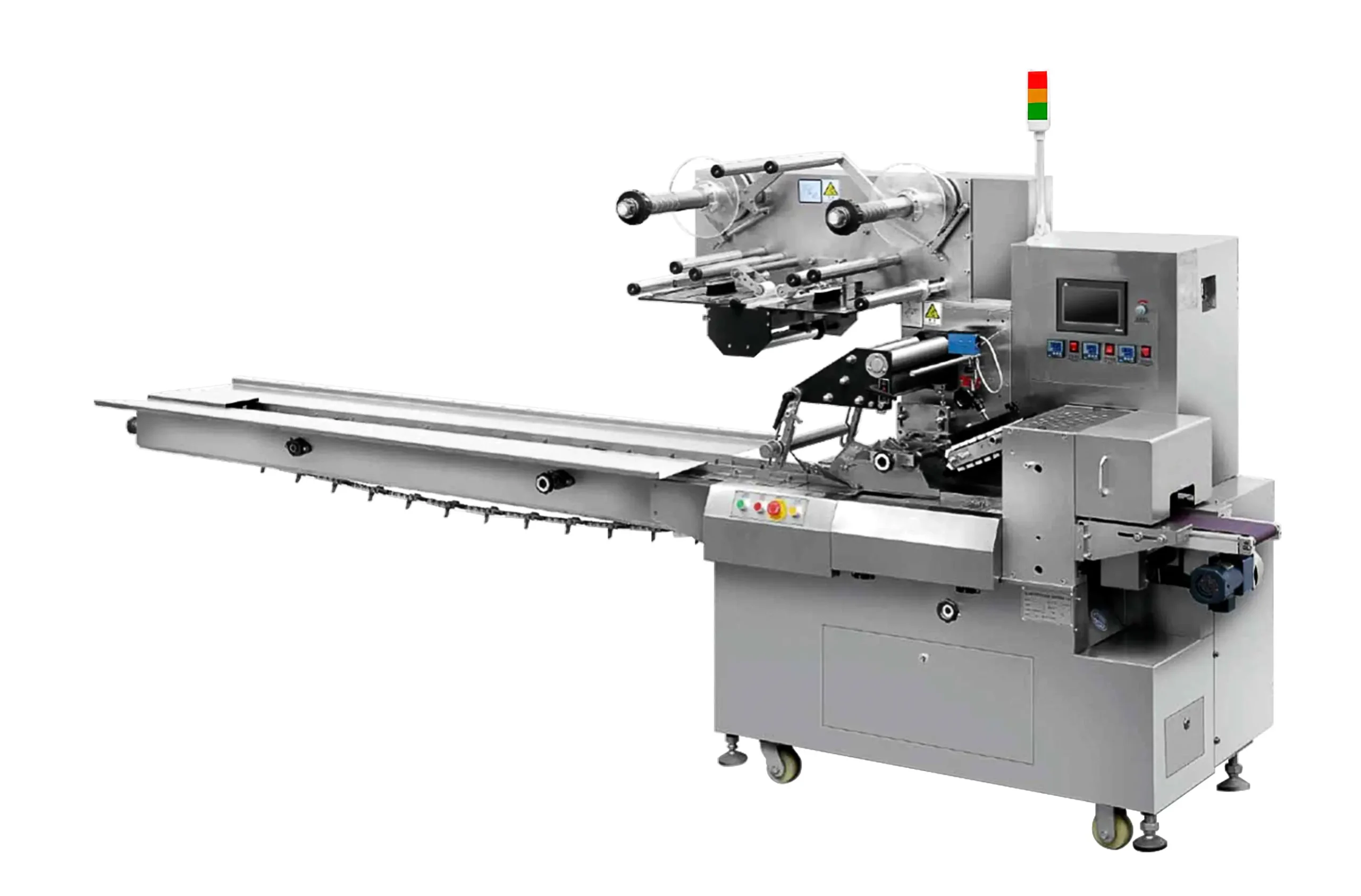
For a small bread packing machine, the useful comparison is the complete operator cycle. Loading, closing, replenishing bags and collecting packs all take time. Machine cycling speed alone leaves much of that work out.
Protect sliced bread and keep the closure task clear
| Problem and cause | Configuration response | What to inspect |
|---|---|---|
| Slices slide or the loaf compresses during loading; force and support are mismatched. | Use loaf support and a loading method matched to the bread firmness and bag opening. | Slice positions, loaf shape and loading behavior at startup, steady running and restart. |
| Condensation appears after packing; bread temperature and the packaging conditions are unsuitable. | Define the cooling handoff and pack the product in its agreed condition. Review film and storage conditions together. | Observe condensation with real bread and the intended environment. A wrapper does not perform the cooling step. |
| A clip or tape closure is treated as a barrier seal. | Specify reclosure and barrier performance separately. For a heat-sealed bag, match the sealable layers and sealing process. | Closure retention and reopening; leakage checks where the pack requires a barrier. |
| A new bag format jams, or the end seal catches a bun. | Change bag opening, guides, forming parts and product spacing as a set. | Run each actual format and inspect trapped product, cut position and first acceptable packs after changeover. |
Comwin defines the cooling-to-packing handoff with the bakery process. The bread must reach the loader at its agreed condition and spacing. When supply pauses, the feed and restart arrangement should preserve slice position or bun groups; the closure is selected after this loading task. This keeps an upstream supply or softness problem from becoming repeated bagging damage.
Match the bread and sales pack to the equipment
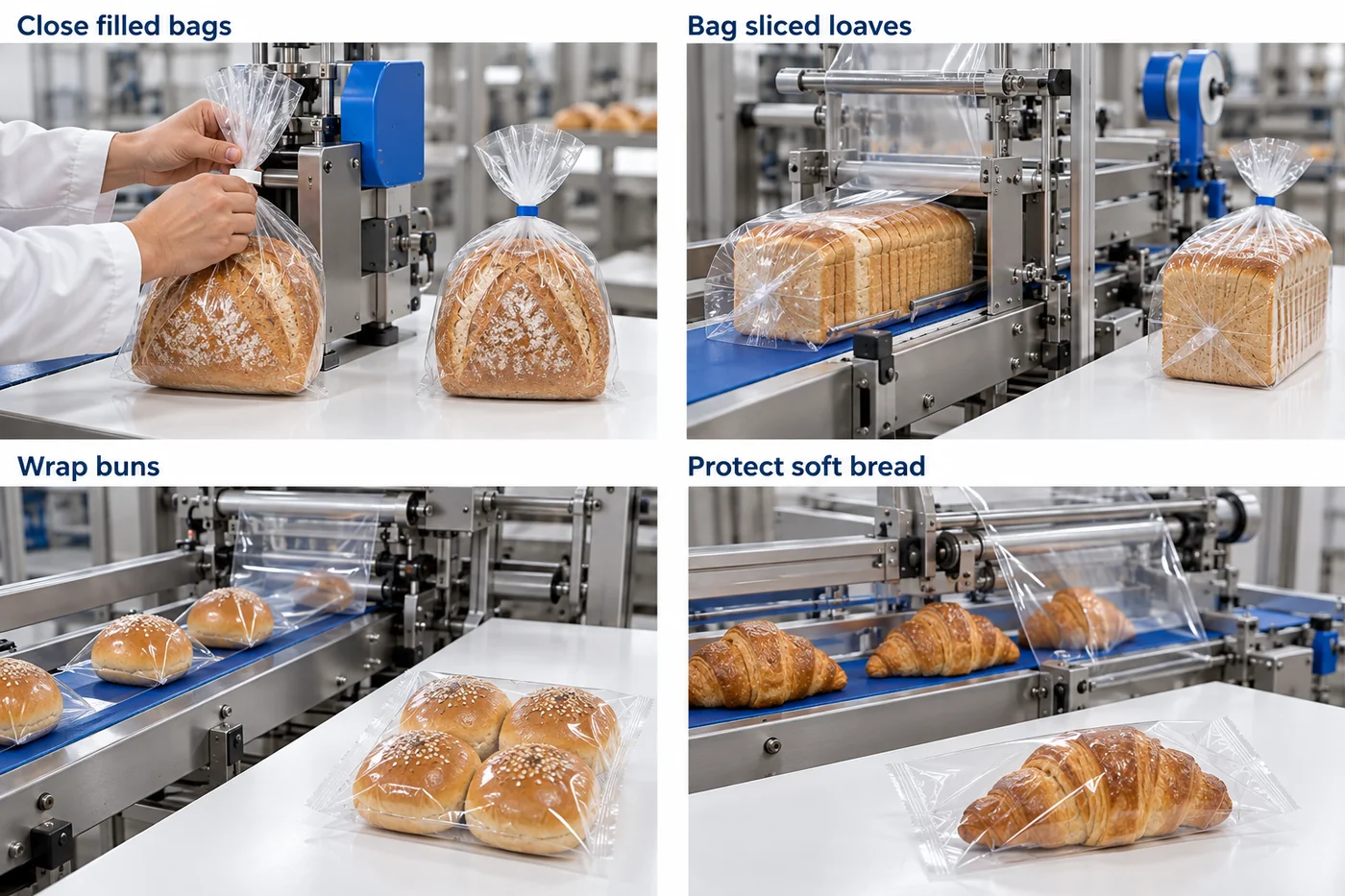
| Product and production situation | Finished packaging | Starting route and change condition |
|---|---|---|
| Sliced toast bread; repeat retail orders | Premade bag with the selected reclosure | Automatic loaf bagging. If a barrier seal is required, redefine the bag and closure before selecting the closing unit. |
| Whole loaves; short local orders | Hand-loaded premade bread bag | Manual loading and a closure station. Upgrade bag loading when the whole labor cycle limits output. |
| Individual soft bun | Single sealed pillow pack | Manual feeding or gentle automatic feeding into a flow wrapper; assess softness and cooling first. |
| Four buns for a family pack | Four arranged buns in one film pack | Counting and grouping with flow wrapping. Grouping is an added task beyond single-bun wrapping. |
| Croissant with a delicate surface | Film pack with suitable support | Gentle flow wrapping. Change the contact and support if the outer layers scuff or the shape deforms. |
Example: sliced toast bread in a reclosable bag
For a planning example, take a sliced loaf that must retain its stack and allow the household to close the bag again. Begin with automatic loaf bagging and one specified closure. Compare the loaf before loading and after bagging; check that end slices remain in position and the bag mouth reaches the closer consistently. If the loaf is too soft for the proposed loading method, change the support or product handoff. A different clip will not correct damage caused earlier in loading.
Example: a four-bun family pack
A bun packing machine for a four-piece pack needs a defined arrangement and a stable group at the wrapper infeed. As an illustrative calculation, four buns per pack at 40 good packs per minute require 160 buns per minute in the correct groups. These assumed targets define the grouping task; confirm the selected equipment capacity by trial. Test starts and stops with the actual buns, then inspect missing pieces, group movement and seals. When the group cannot remain stable, add suitable support or revise grouping before increasing wrapper speed.
Bread packing machine prices by included operation
For early budgeting in October 2026, use these USD ranges for new equipment supplied from China, ordinary non-aseptic food and one selected product and pack format. Freight, taxes, overseas installation, bakery processing, site work and additional formats are excluded. Inspection, gas supply and downstream handling are separate unless the proposal includes them. These ranges support planning; the selected scope determines the quotation.
| Equipment scope | Indicative budget, USD | Included and excluded work |
|---|---|---|
| Manual clip or tape closing tool/station | 500 to 2,500 | One selected closure with manual bag presentation; excludes automatic bag loading and barrier heat sealing. |
| Separate sealer for already-filled bread bags | 1,500 to 5,000 | One compatible bag material and basic support with manual presentation; excludes loading and automatic bread feeding. |
| Automatic loaf bagging with one closure | 25,000 to 90,000 | One loaf/bag format, bag handling, loading and the selected closure; excludes slicing, cooling and several closure systems. |
| Manual-feed flow wrapper | 5,000 to 25,000 | Wrapper for one compatible bread pack; excludes automatic alignment, cooling and inspection. |
| Gentle automatic feeding plus flow wrapping | 18,000 to 65,000 | Basic single-lane organizing and wrapping for one format; excludes complex lane distribution, cooling, inspection and case packing. |
A bread sealing machine price covers a different scope from a complete bread packaging machine. Compare quotations from the same product handoff to the same finished pack, with the remaining operator tasks listed.
When automatic bread packing removes the bottleneck
| Decision | Manual or separate operations | Automatic configuration |
|---|---|---|
| Production pattern | Short orders and changing loaf/bun formats with manual presentation. | Repeat orders with a defined bag format and regular product supply; automate the constrained operation. |
| Labor | Count loading, bag presentation, replenishment and collection. | Specify which loading, spacing and closing steps are automatic; replenishment and collection still need an assigned role. |
| Changeover | Record bag, guide and sealing adjustments. | Also record loaf-support, opening and feeding-part changes; time a real format change. |
| Acceptance | Check bread appearance, pack count and closure with the planned operators. | Also check replenishment, product accumulation, restart and good packs over the agreed run. |
Compare suppliers using the same bread-packing task
| Comparison | Useful evidence from a supplier | Comwin proposal focus |
|---|---|---|
| Budget and scope | The same loaf/bun, pack format and start/end points in the equipment list. | Separate loading, closure and flow-wrap costs; identify options and remaining manual tasks. |
| Output | Good packs with your softest loaf or bun, chosen bags and actual staffing. | Match feeding and closure to the required output and cooling handoff. |
| Adaptation | A credible loading/support arrangement and a format-change demonstration. | Select support, bag-opening and sealing configuration around the samples and factory conditions. |
| Support | Testing, cleaning instructions, spares and response responsibilities. | Define the support and test scope with the selected equipment. |
| Delivery | Agreed samples, material approval, configuration freeze and acceptance milestones. | Set project milestones after the bread, bag and equipment scope are agreed. |
Bread packing questions
Is a bread clip or tape closure airtight?
For a barrier requirement, select a compatible bag and heat-sealing process. Use clips or tape for the reclosure task described above.
Can warm bread be packed directly?
For warm bread, establish the cooling handoff before bagging. Check condensation and shape with the intended material and environment.
Does a bread bag sealing machine also fill the bag?
For a separate closer or sealer, the operator presents an already-filled bag. If you need automatic loading, ask for a loaf-bagging configuration with the closing operation expressly included.
Can bakery packaging machines run both loaves and buns?
If the products, pack formats and support requirements fit the selected configuration, specify the required change parts and demonstrate both formats. A reclosable loaf bag and a roll-film bun pack use different packing processes, so they may need separate machines.
Send bread, bag and production details for a proposal
- Product: whole or sliced loaf, bun or pastry; dimensions, firmness, temperature and compression sensitivity.
- Packaging: premade bag or roll film, opening/reclosure needs, actual bags and finished-pack sample.
- Pack quantity: single piece or group, arrangement, weight and any support.
- Closing: clip, tie, tape or heat seal; barrier requirements, coding and inspection.
- Production: good packs per shift, incoming lanes, cooling handoff, available operators and format changes.
- Factory: space, utilities, cleaning conditions, slicer/cooler interfaces and destination market.
Send your bread-packing requirements. We return a recommended configuration, equipment and option list, sample-test criteria and quotation for the agreed scope. For sealed bun packs, see our horizontal flow-wrapping equipment.
Comwin provides free sample testing and can arrange a real factory visit to see machines run. Whole-machine warranty is two years and core-component warranty is three years. Remote response is within 24 hours. Small equipment includes video tutorials and remote video-call support.