
BESS, or Battery Energy Storage System, refers to systems that store electrical energy in batteries for later use, such as stabilizing power grids, supporting renewable energy integration, or powering off-grid applications. Manufacturing BESS involves assembling battery cells into functional modules and packs, often in containerized formats for scalability and transport. The process emphasizes precision, automation, and compliance with safety standards like UL 9540 and IEC 62619.
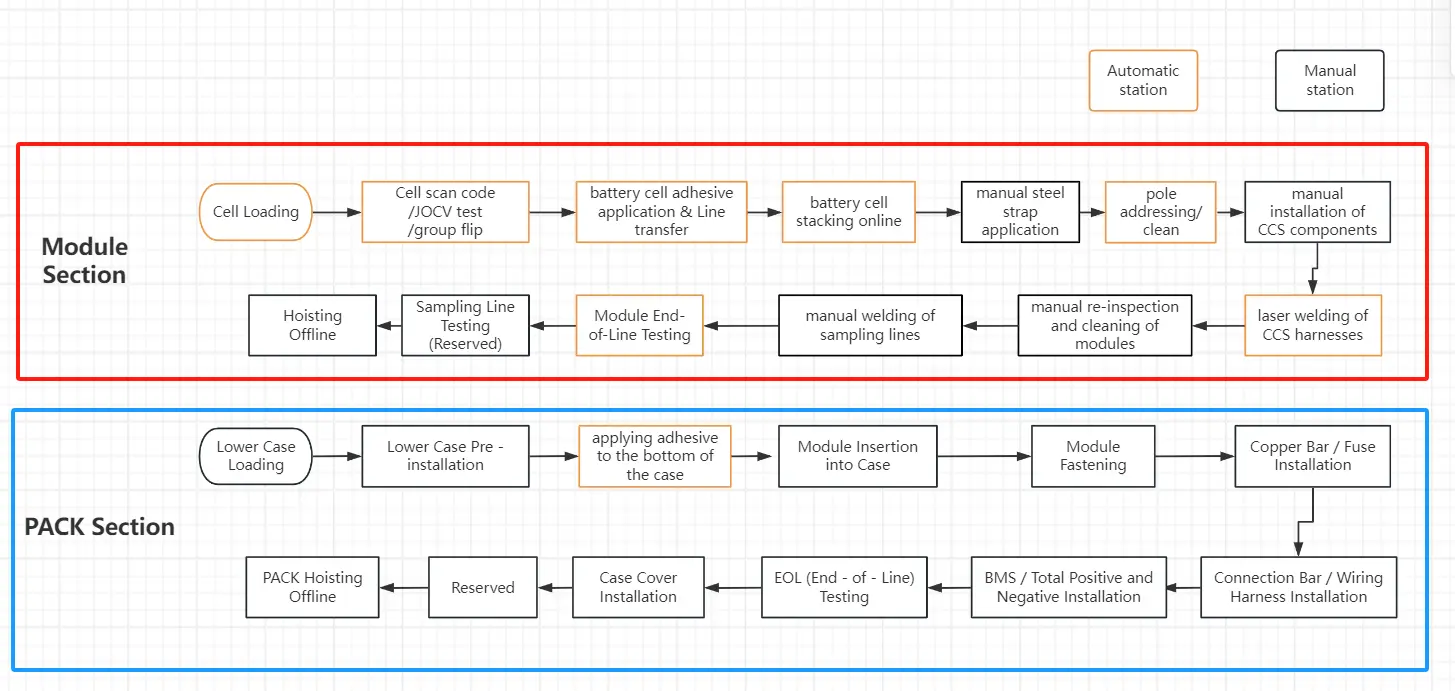
The core of BESS manufacturing is a structured assembly line that transforms raw battery cells into complete, ready-to-deploy systems. This summary outlines the key processes, typically divided into two main segments: Module Segment and PACK Segment. Modern lines, like Comwin’s BESS Container Assembly Line, incorporate hybrid automation to boost efficiency, reduce costs, and ensure high quality.
Key Manufacturing Processes
The BESS manufacturing workflow is streamlined to minimize errors, maximize throughput (e.g., up to 50 modules/hour), and incorporate real-time monitoring via systems like MES (Manufacturing Execution System) and IoT.
1. Module Segment: Cell-to-Module Assembly
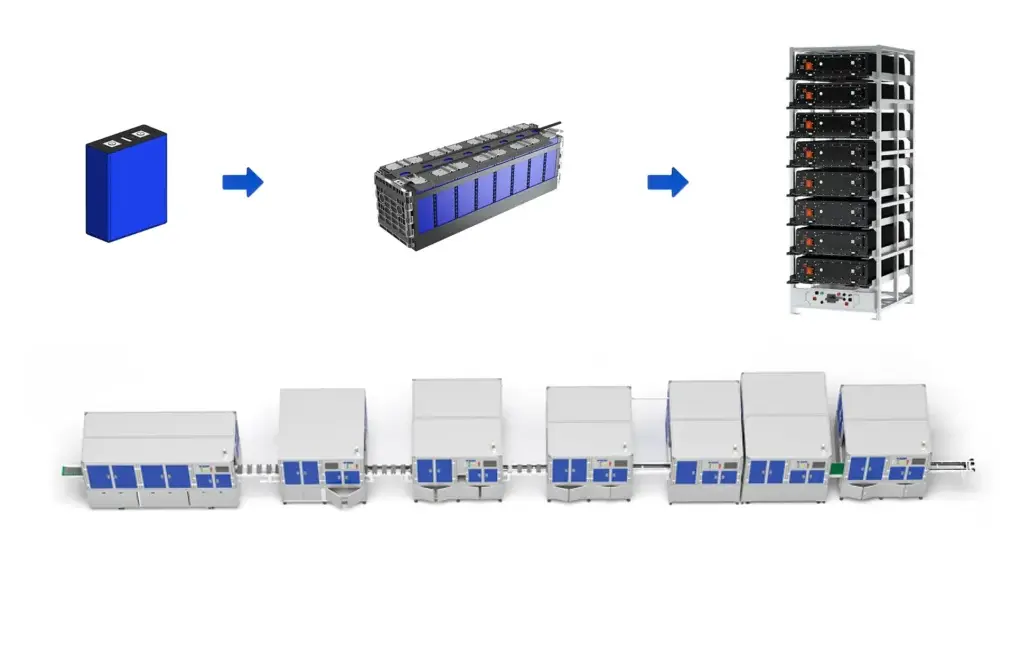
This initial phase focuses on building reliable battery modules from individual cells (e.g., LFP or NMC chemistries).
- Automated Cell Loading and Testing: Cells are loaded robotically, tested for Open Circuit Voltage (OCV), and grouped. AI sensors detect and reject defects with high accuracy (e.g., 99%).
- Stacking and Welding: Cells are stacked uniformly using robotic arms, followed by laser welding of connections (e.g., CCS – Cell Connection System). Manual stations allow for custom adjustments.
- Module Finishing and End-of-Line (EOL) Testing: Application of insulation, steel bands, and final checks for capacity, voltage, and thermal performance. Data is logged for traceability.
2. PACK Segment: Module-to-Container Integration
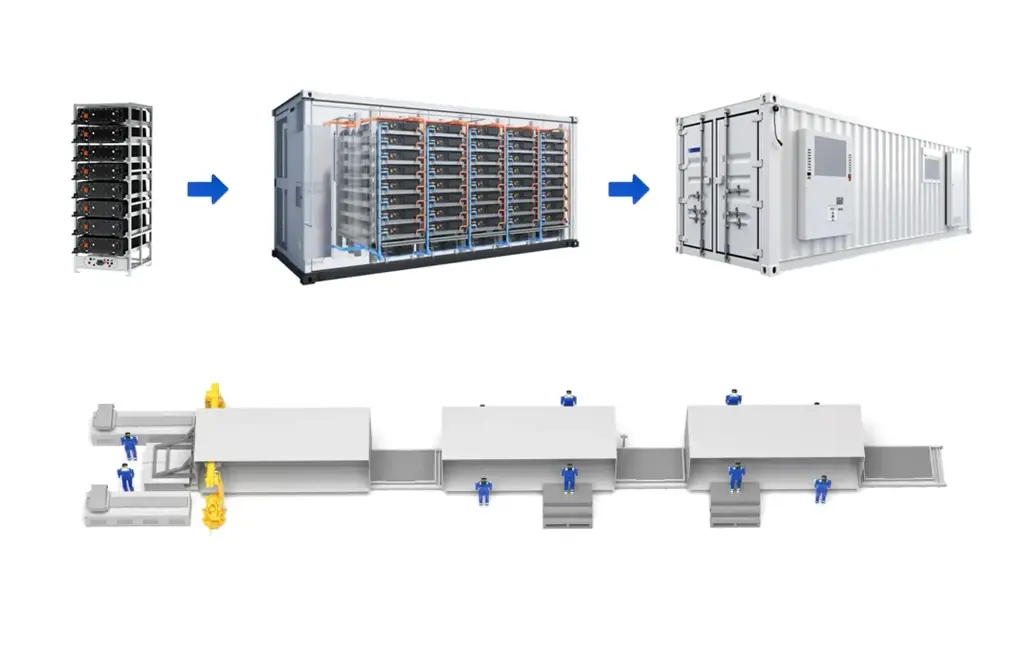
This phase integrates modules into a complete BESS pack, often within containers (e.g., 20ft or 40ft) for durability and easy deployment.
- Enclosure Preparation: Container frames are loaded, with automated sealing (e.g., IP65-rated adhesives) and airtightness testing.
- Component Integration: Modules are inserted, wired with Battery Management System (BMS), Power Conversion System (PCS), cooling, and fire suppression. Robotic fastening ensures secure assembly.
- Final PACK EOL Testing and Offloading: Units undergo simulations (e.g., thermal cycling, vibration tests). Passed units are offloaded, packaged, and prepared for shipment.
Total Cycle Time: Typically 4-8 hours per container, depending on size and complexity. The process supports scalability, with outputs from 1 MWh/year to 10+ MWh/year.
Benefits and Considerations
- Efficiency and Automation: Reduces production time by up to 40% and labor costs by 25% through robotics and hybrid designs.
- Quality and Safety: High yield rates (>95%), defect detection, and built-in safety features to prevent issues like thermal runaway.
- Sustainability: Energy-efficient operations cut waste by 15-20% and align with ESG goals.
- Customization: Adaptable to various applications, battery types, and regulatory needs.
Challenges in BESS manufacturing include scaling production, ensuring compliance, and managing costs. Solutions like Comwin’s modular lines address these by offering easy upgrades, global support, and proven ROI (e.g., 12-24 months).
Learn More
For detailed insights or to explore Comwin’s BESS solutions, visit our website or contact us:
- Website: https://auto-odm.com/energy-storage-battery-production-line/
- Email: [email protected]
- Phone: +86 199 2517 6745
Source: Based on Comwin’s BESS Container Assembly Line expertise. For tailored consultations, reach out today!