
What is a BESS Container Assembly Line
A BESS container assembly line (Battery Energy Storage System container assembly line) is an automated or semi-automated production line used to integrate battery modules, battery management systems (BMS), temperature control systems, fire suppression systems, and electrical equipment into standardized containers, forming complete, transportable battery energy storage units (BESS containers). Its core objective is to ensure the safety, reliability, and consistency of energy storage systems through standardized, large-scale production.
BESS Assembly Line Processing Flow
We will explain using Comwin’s semi-automatic BESS Assembly Line as an example.
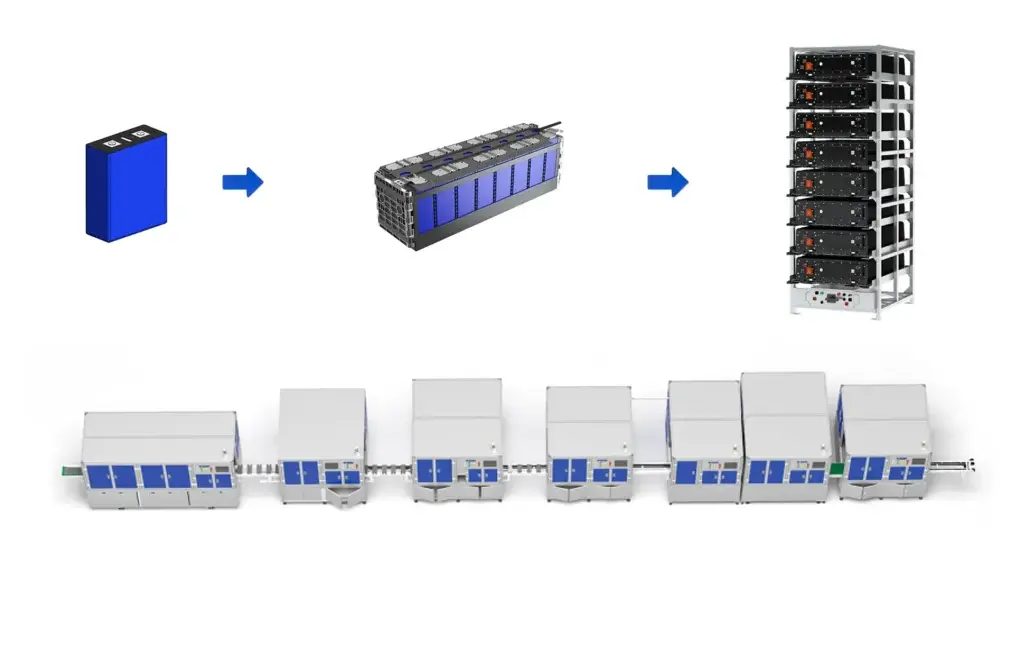
I. Module Section Process (Cells → Modules)
- Cell Loading (Automatic): Cells are automatically transported to the start of the production line via AGV or conveyor belt.
- Cell Scanning / OCV Testing / Grouping and Flipping (Automatic): Simultaneously performs cell QR code traceability, open circuit voltage (OCV) testing (screening cells within ±5mV voltage consistency), and adjusts cell orientation to match subsequent stacking requirements.
- Cell Adhesive Application & Transfer (Automatic): Automatically applies adhesive to fix the cells, then transfers them to the stacking station via conveyor belt.
- Cell Stacking Loading (Automatic): Robotic arm automatically completes cell stacking, with repeat positioning error ≤0.5mm.
- Manual Steel Band Installation (Manual): Workers manually install steel bands to secure the stacked cells, ensuring structural stability.
- Pole Detection / Cleaning (Automatic): Automatic equipment identifies the cell pole positions and cleans the oxide layer in preparation for subsequent welding.
- Manual Installation of CCS Components (Manual): Workers install the Cell Connection System (CCS) to achieve electrical connections between cells.
- CCS Harness Board Laser Welding (Automatic): Laser welding of CCS harness board, with welding strength ≥15N and yield rate ≥99.5%.
- Module Manual Re-inspection & Cleaning (Manual): Workers inspect the module appearance and remove surface impurities.
- Manual Sampling Line Welding (Manual): Welding of sampling lines for collecting module voltage and temperature signals.
- Module EOL Testing (Automatic): Automatically completes end-of-line testing, including insulation resistance (≥100MΩ), voltage balancing, etc.
- Sampling Line Testing (Reserved) (Manual): Reserved manual testing interface to verify sampling line functionality.
- Module Unloading or Boxing (Manual): Workers unload the module for temporary storage or directly transfer it to the PACK section.
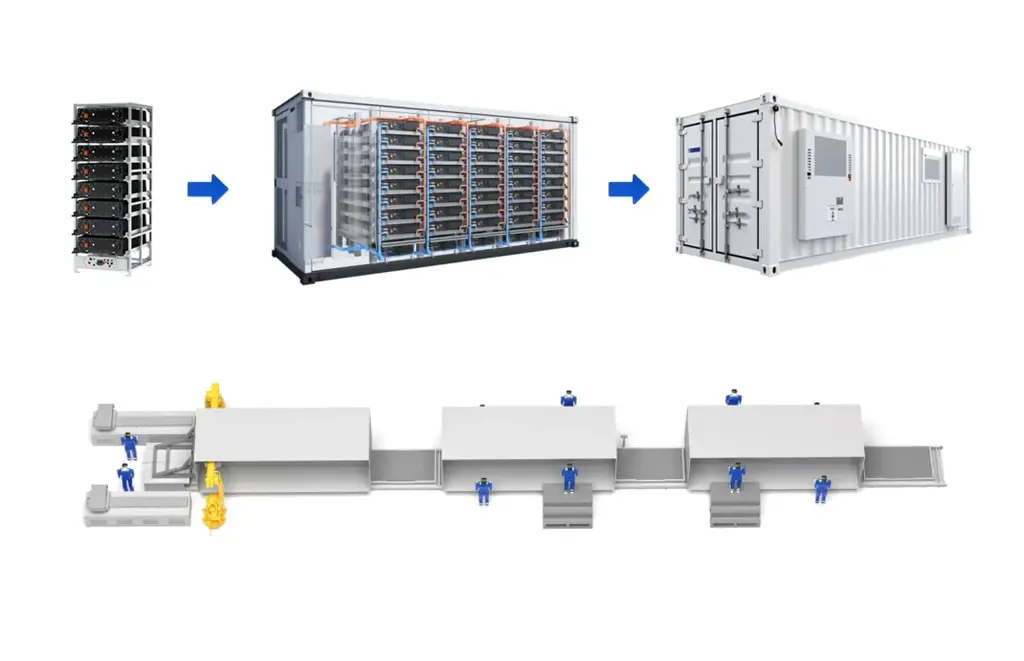
II. PACK Section Process (Modules → Container System)
- Container Loading & Airtightness Testing (Manual): After the container is loaded onto the line, workers perform airtightness testing (pressure ≥50kPa, hold for 5 minutes without leakage).
- Container Pre-installation of Components (Manual): Workers install internal structures such as guide rails and brackets in the container.
- Container Bottom Adhesive Application (Automatic): Automatic equipment applies adhesive to the bottom of the container for sealing and fixing modules.
- Module Insertion into Container (Manual): Workers use lifting equipment to place modules into the container.
- Module Fastening (Manual): Workers fasten the module fixing bolts, with torque ≥80N·m and error ≤±5%.
- Copper Bar / Fuse Installation (Manual): Install copper bars (current-carrying capacity matching system power) and fuses to ensure circuit safety.
- Connection Bar / Harness Installation (Manual): Connect inter-module bars and harnesses, with insulation rating ≥IP65.
- BMS / Main Positive and Negative Installation (Manual): Install the Battery Management System (BMS) and main positive/negative terminals to achieve system monitoring and power output.
- PACK EOL Testing (Manual): Workers complete system-level testing, including charge-discharge cycles, protection function verification, and more than 12 items, with a test pass rate ≥98%.
- Container Cover Installation (Manual): Install the container cover to complete the structural enclosure.
- Full Container Airtightness Testing (Manual): Perform airtightness testing on the entire container again to ensure IP65 protection rating.
- PACK Unloading (Manual): Workers unload the finished container, completing the final steps before delivery.
How to Select a BESS Container Assembly Line
Comwin BESS Container Assembly Line Selection Guide
—— A Comprehensive Decision-Making Framework from Process Adaptability to Scenario Implementation
The core of selecting a BESS container assembly line is to make the production line a “carrier of flexible manufacturing”—capable of matching the current iteration of cell technology (such as the trend of higher capacity from 314Ah to 628Ah) and supporting future scenario expansions (such as upgrades from commercial and industrial energy storage to grid-level storage). This article will provide you with actionable selection logic from three dimensions: process adaptability, automation and quality control, and scenario environment compatibility.
1. Process Adaptability: Enabling the Production Line to “Understand” Cell and System Design
The core value of the production line lies in its compatibility with current mainstream technologies while reserving space for future upgrades. The industry has formed a technical route of “high-capacity cells + high series design” (such as 104S series connection, which connects 104 batteries in series). This requires the assembly line to have the following capabilities:
- Cell Specification Compatibility: Supports square cells from 100-320Ah (covering mainstream models like 314Ah and 628Ah) and can adapt to battery packs of different sizes through quick changeovers (such as switching jigs within 2 hours).
- Core Process Coverage: Must include core processes such as cell sorting (ensuring capacity/voltage consistency), laser cleaning (improving welding yield), and busbar welding (key connection processes) to avoid system failures due to missing processes.
- Flexible Design: Achieve the switch between “small batch production of various types” and “large-scale mass production” through modular workstation combinations—for example, when transitioning from commercial and industrial energy storage to grid-level storage, only the module assembly workstation needs adjustment, without rebuilding the entire production line.
2. Automation and Quality Control: Safeguarding the “Safety Bottom Line” with Technology
The safety of BESS depends 90% on the quality control of the production process, and automation is the key means to reduce human error. Focus on the following three points during selection:
- Key Workstation Automation: The automation rate of the module section should exceed 70%, especially at core stations like bolt tightening (torque accuracy ±5%) and welding detection (adaptive laser welding technology), which must achieve full automation to prevent issues like loose connections or cold soldering caused by manual operation.
- Online Quality Inspection: Equip with AI visual inspection systems (to identify cell appearance defects) and EOL final testing (to simulate charge and discharge conditions to verify system performance), ensuring the product defect rate is below one part per million (1ppm)—a strict requirement for grid-level storage projects.
- Digital Traceability: Record each battery pack’s production data (such as welding parameters and inspection results) through MES (Manufacturing Execution System) and restore the production process using digital twin technology, achieving full lifecycle traceability from the cell to the system.
3. Scenario Environment Compatibility: Adapting the Production Line to “Complex Conditions”
BESS containers are often deployed in extreme environments such as outdoors, coastal areas, and high altitudes, requiring the production line design to consider box protection and environmental adaptability:
- Box Structure and Materials: Use high-strength weather-resistant steel or aluminum alloy with multiple layers of anti-corrosion treatments (such as salt spray-resistant coatings for coastal projects), with a protection level of at least IP54 (dust-proof and water-resistant).
- Temperature and Temperature Difference Adaptability: Supports a wide temperature range from -40℃ to 60℃ with pre-installed temperature control systems (like liquid cooling/air cooling modules) to ensure stable battery operation in extreme temperatures.
- Transport and Installation Convenience: The box should comply with ISO container standard sizes, with pre-reserved forklift holes or lifting points at the bottom for quick on-site installation— for example, Kehua Data’s energy storage box can “be connected to the grid upon delivery,” reducing installation time by 50%.
Final Decision Logic: Anchoring to “Long-Term Value”
Selecting an assembly line is not a one-time investment but a proactive layout for technology iteration and market expansion over the next 3-5 years. It is recommended to prioritize the following two points:
- Flexibility Priority: If your business covers multiple scenarios like commercial, grid, and off-grid, prioritize a “modular + quick changeover” production line to avoid scrapping the production line due to product iterations.
- Depth of Quality Control: Safety is the lifeline of energy storage; even small batch production lines need to be equipped with EOL testing and data traceability systems—this is the “ticket” to enter the high-end market.
When a production line can simultaneously meet the three requirements of “adapting to current technologies,” “compatibility for future upgrades,” and “ensuring safety and quality,” it transforms from a simple production tool into a “core asset” for your business growth.
Reflection: If future cell capacities exceed 1000Ah, can your production line adapt through local upgrades instead of complete reconstruction? This may be the most critical question to consider in the selection process.