
In the rapidly evolving world of electric vehicles (EVs) and renewable energy storage, understanding battery pack assembly lines is crucial for manufacturers aiming to optimize production efficiency, quality, and scalability. This comprehensive guide breaks down the core manufacturing processes, key technologies for enhancing performance, and essential differences between power battery PACK lines and energy storage PACK lines. Whether you’re in the automotive industry or energy sector, these insights will help you design automated assembly lines that meet global standards and demands.
1. Detailed Breakdown of Battery Pack Manufacturing Processes
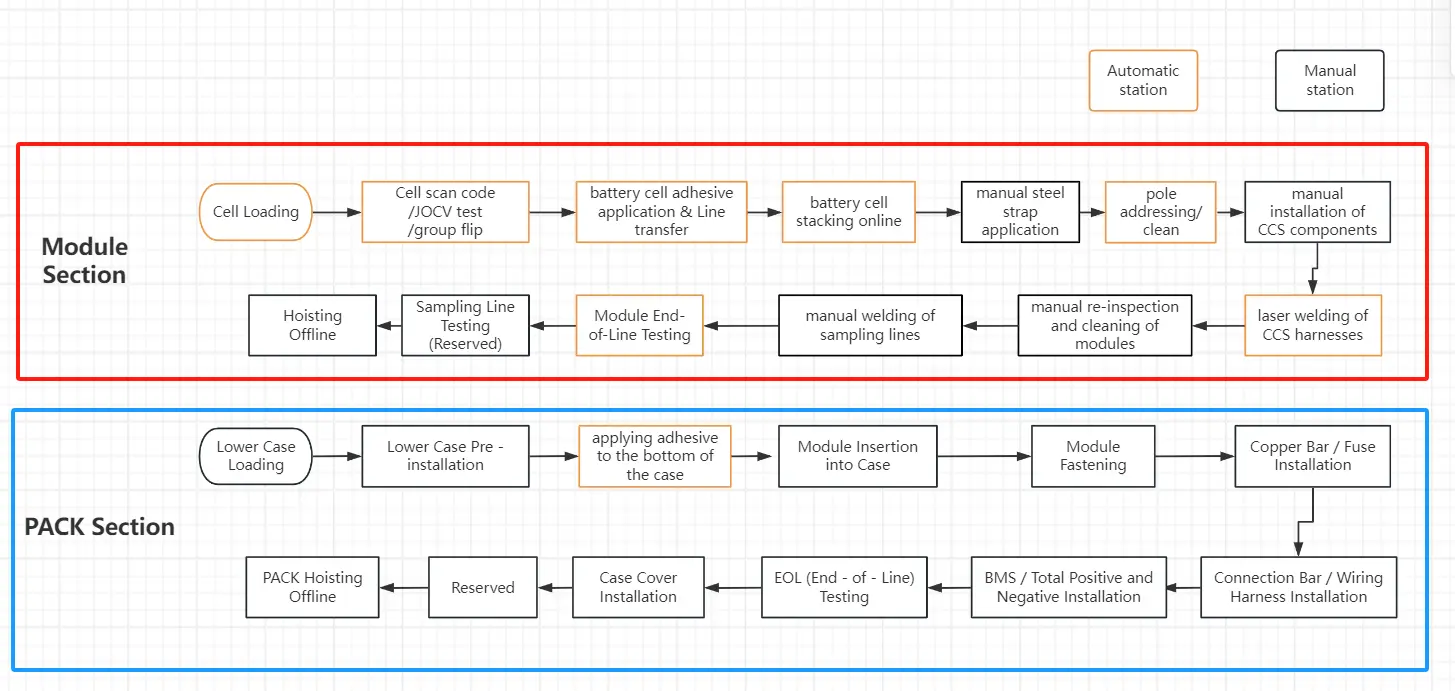
The outlined process provides a precise blueprint for an automated production line from individual cells to fully assembled battery packs. Each step is critical for ensuring quality, safety, and efficiency in battery pack assembly:
- Cell Feeding and Initial Inspection (Cell Feeding → OCV Testing)
- Cell Feeding: Cells are loaded via automated logistics systems like AGVs or conveyor belts. The line must support compatibility with various cell sizes and packaging (e.g., bins or trays), using vision systems for precise positioning and alignment.
- OCV Testing: This is the first quality checkpoint, involving 100% inspection of open-circuit voltage (OCV), internal resistance (ACR), and other parameters for each cell. Qualified cells are precisely sorted and grouped based on test data to minimize variations in voltage, capacity, and resistance within the same module—ensuring battery pack consistency and longevity.
- Module Assembly and Connection (Cell Adhesive Application → Busbar Welding)
- Cell Adhesive Application: Structural or thermal adhesives are applied to cell surfaces or side panels. Structural adhesives secure cells for mechanical strength, while thermal adhesives fill gaps between cells and cooling systems to optimize heat management. Precise control of adhesive volume, path, and curing is essential.
- Cell Stacking & Manual Strapping: Cells are stacked in series or parallel configurations to form modules. After automated stacking, manual or automatic strapping provides initial fixation. Stacking accuracy directly impacts subsequent welding quality and overall module structure.
- Addressing Cleaning: Cleaning the cell poles (positive and negative) removes oxide layers or contaminants. This key preprocessing step ensures high-quality laser welding by reducing resistance and minimizing risks of false welds.
- Busbar Welding: Laser welding connects busbars to cell poles, forming electrical pathways. As a core process, it demands strength, consistency (no false or over-welds), and low resistance for electrical safety and performance. Typically includes post-weld visual inspection (AOI) and online monitoring.
- Module Functional Testing and Offloading (Module EOL Testing → Module Off-Line)
- Module EOL Testing: After welding, modules undergo End-of-Line (EOL) testing, including insulation withstand voltage, direct current resistance (DCR), and voltage verification to confirm electrical safety and functionality. Test data is linked to a unique module code for full traceability.
- Module Off-Line: Qualified modules are offloaded and stored or directly transferred to the final assembly line via logistics systems.
- Battery Pack Final Assembly and Sealing (Box On-Line → Complete Package Airtightness Testing)
- Box On-Line & Liquid Cooling Plate Adhesive Application: The battery pack lower housing is loaded. Sealing adhesives or thermal pads are applied during liquid cooling plate installation to ensure system airtightness and heat conduction efficiency. This is followed by airtightness testing for the water-cooling system to prevent leaks that could cause short circuits.
- This stage integrates modules, BMS, high-voltage harnesses, and thermal management systems into the housing.
- Complete Package Airtightness Testing: After upper cover installation, the entire pack undergoes airtightness testing (e.g., helium detection) to meet high protection ratings like IP67 for waterproofing and dust resistance.
- Battery Pack Final Inspection and Offloading (PACK EOL Testing → PACK Off-Line)
- PACK EOL Testing: The most comprehensive pre-shipment inspection simulates real-world conditions, including charge-discharge cycles, BMS functionality (e.g., SOC calibration, balancing), insulation checks, and high-voltage interlock verification. Only packs passing all tests are approved for shipment.
- PACK Off-Line: Qualified battery packs are offloaded and packaged.
2. Key Technologies for Enhancing Efficiency and Quality
The efficient and stable operation of the above processes relies on the deep integration of several key technologies in battery manufacturing automation:
- Full-Process Automation and Flexible Integration: The listed processes exemplify high automation, linking stations with robotic arms, conveyors, and intelligent logistics (AGVs), integrated via MES systems. This synchronizes cycle times, minimizes downtime and human intervention, boosting Overall Equipment Effectiveness (OEE) to over 95%. Flexible designs allow quick switching between cell or pack models.
- Digitalization and Real-Time Control of Key Process Parameters: Digitizing parameters like welding energy, adhesive volume, and torque ensures consistency. For instance, laser welding uses vision positioning and closed-loop control for precise weld points; adhesive application employs precision metering pumps.
- Multi-Dimensional Online Inspection and Data Traceability: Embed online detection (e.g., visual AOI, electrical testing) in welding, Module EOL Testing, and PACK EOL Testing to catch defects instantly and prevent batch rework. MES systems bind cell data, process parameters, and results for precise traceability and rapid issue resolution.
- Proactive Consistency Management Based on Front-End Sorting: Line efficiency starts with cell uniformity. Strict OCV Testing and grouping control parameter variations at the source, reducing assembly challenges and improving yield rates.
3. Core Differences Between Power Battery and Bess Energy Storage PACK Lines
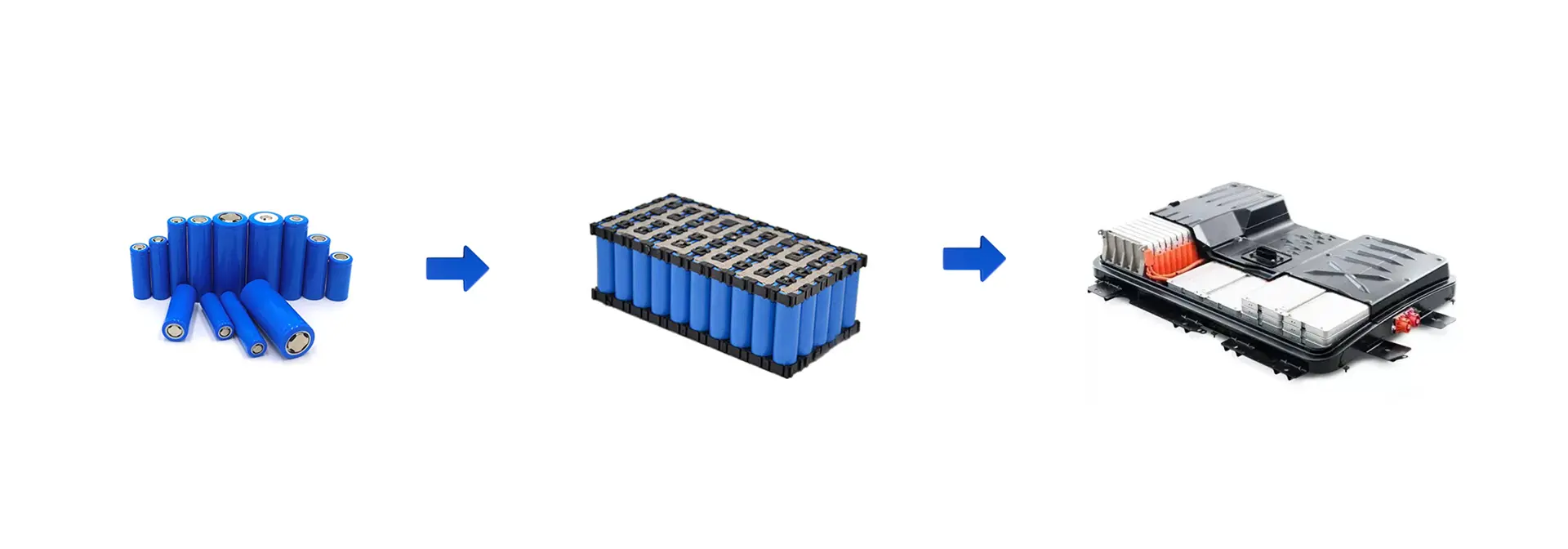
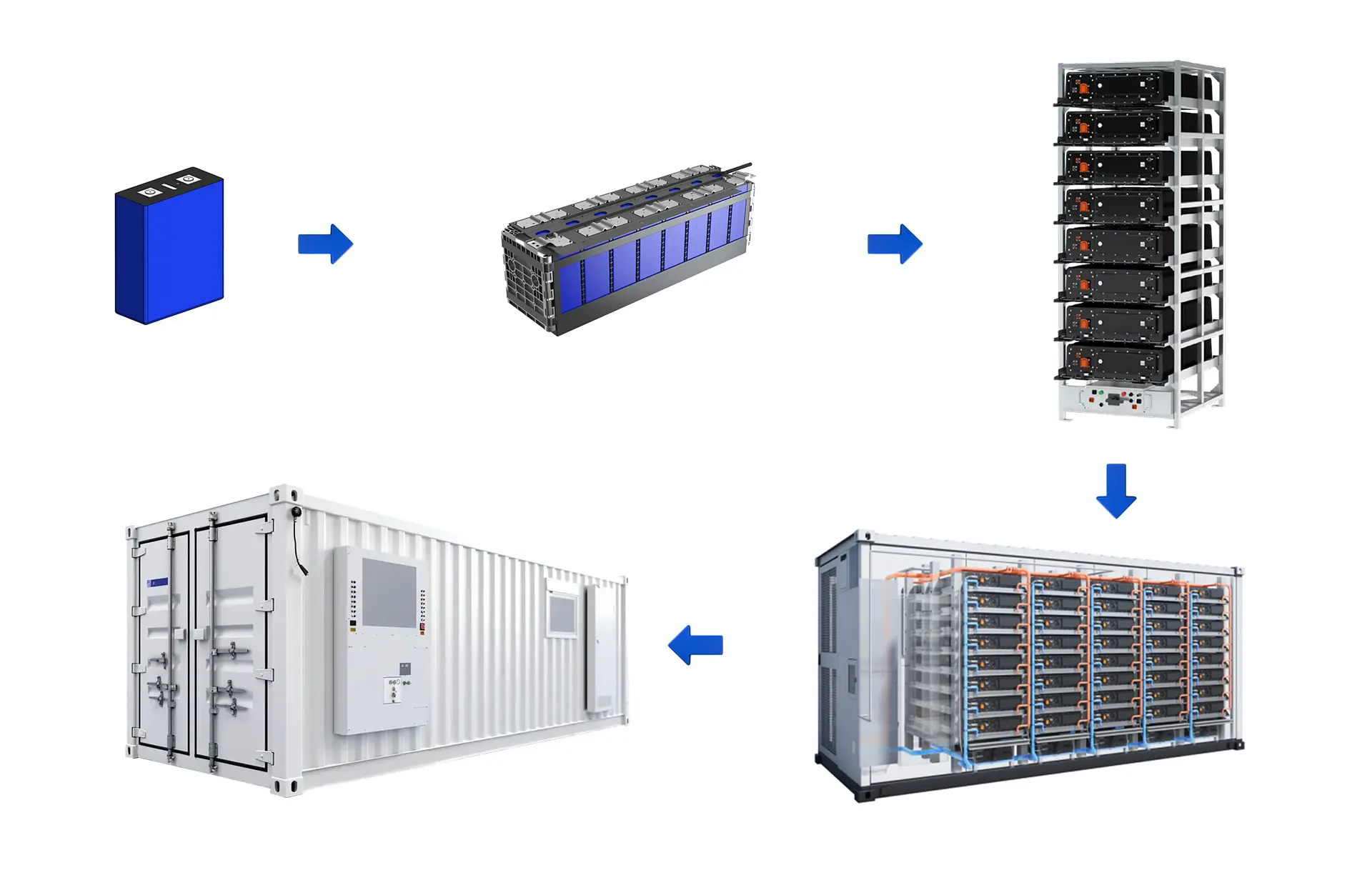
While core processes are similar, differences in applications lead to distinct designs in power battery vs. energy storage PACK lines:
| Comparison Dimension | EV Power Battery PACK Line | Energy Storage PACK Line |
|---|---|---|
| Product and Performance Focus | Emphasizes high energy density, power density (fast charging/discharging), and lightweight design to enhance vehicle range and performance. Extremely high demands on space utilization. | Focuses on cycle life, cost ($/kWh), inherent safety, and long-term reliability. More lenient on energy density and weight. |
| Thermal Management Requirements | Complex operating conditions with high peak power require extremely stringent thermal management. Liquid cooling is standard, with high precision in processes like Liquid Cooling Plate Adhesive Application. | Stable conditions with lower charge-discharge rates reduce thermal stress. Often uses air cooling or simpler liquid systems, with greater sensitivity to cost control. |
| Line Design and Rhythm | Deeply integrated with vehicle manufacturing rhythms, demanding high-speed, high-volume, ultra-consistent continuous production. Requires top-tier automation and intelligence. | Diverse models (residential, commercial, utility-scale) favor multi-variety, small-batch flexible production. Quick changeover capability is key. |
| Testing and Validation Focus | PACK EOL Testing simulates harsh vehicle conditions (e.g., vibration, impact), with strict safety standards (e.g., needle penetration, overcharge). | Testing emphasizes long-term cycle life, system efficiency, grid interaction, and specific energy storage safety standards. Larger capacity tests take longer. |
| Cost Structure | High cell cost proportion; PACK focuses on aggressive cost reduction while ensuring safety. | Balances low cell costs with overall system integration expenses, prioritizing value in BMS, thermal management, etc. |
Summary
For real-world implementation, tailor adjustments based on whether the product is for power or energy storage applications—focusing on process parameters, equipment selection, testing standards, and flexible designs. For example, power lines prioritize speed and lightweight processes, while energy storage lines emphasize modularity for varying capacities. Stay ahead in global battery manufacturing by integrating these insights into your operations.