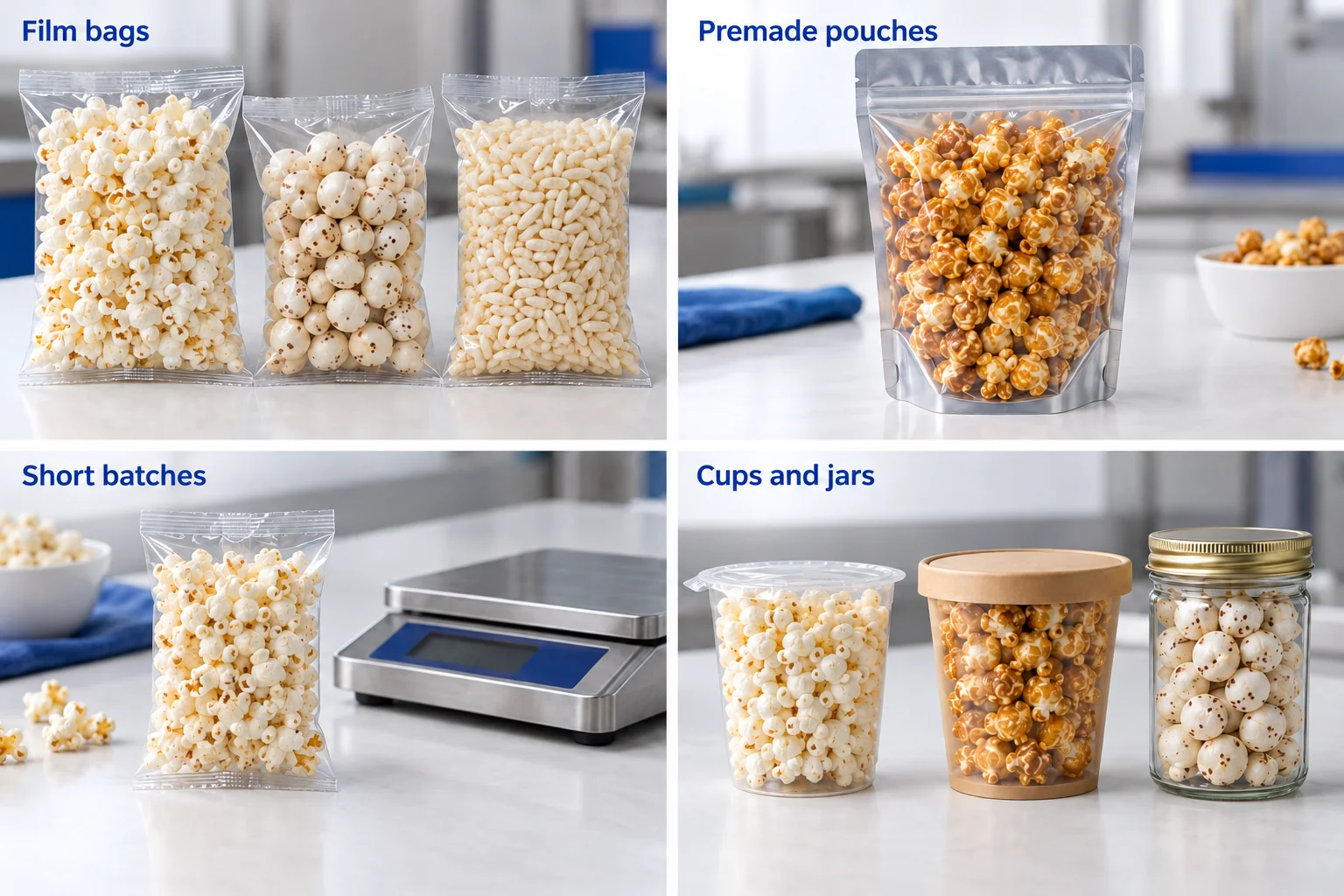
A popcorn packing machine should handle the volume of your finished snack as well as its weight. For repeat orders of ready-to-eat popcorn in film bags, start with gentle feeding, a suitably sized weighing system and vertical form-fill-seal packaging. A planning budget for this combination is USD 18,000 to 50,000. For printed stand-up pouches, consider a premade-pouch system with weighing, provisionally USD 25,000 to 60,000.
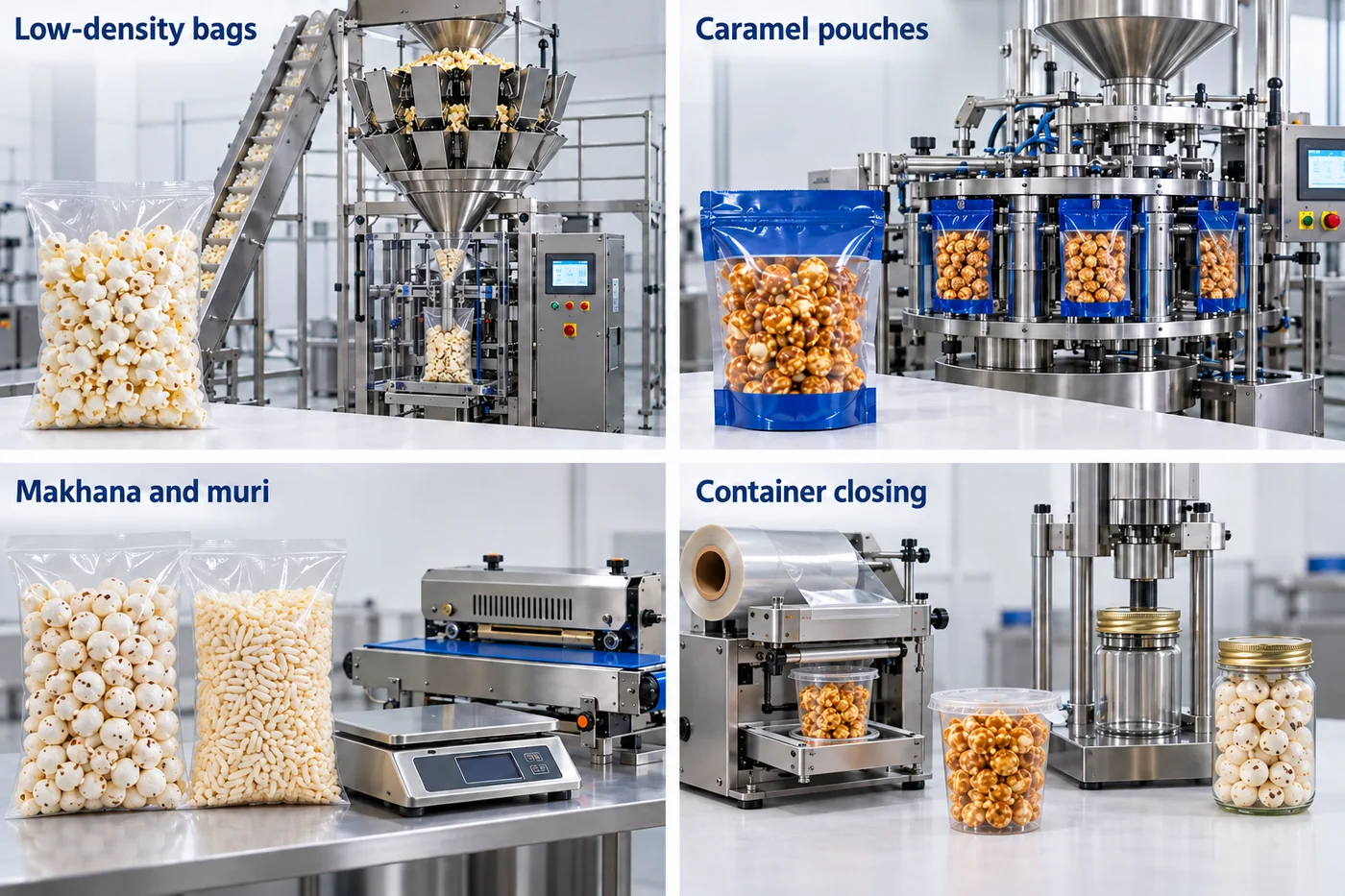
Comwin matches the product handling, bag or container and closing process to your finished pack and production target. Caramel popcorn, roasted makhana and puffed rice need different handling checks. Retail cups and glass jars also need their own filling and closing equipment. These budgets apply to the listed equipment. We price the selected configuration after reviewing your pack and trial requirements.
Choose the machine around the finished popcorn pack
Tell us what reaches the packaging station: popped and cooled, caramel coated, raw kernels, or a microwave cooking kit. Metering raw kernels and oil into microwave bags is a different process from filling large, fragile pieces of ready-to-eat popcorn.
| Finished pack | Equipment route | Why it fits | When to change the route |
|---|---|---|---|
| Ready-to-eat popcorn in roll-film bags | Gentle feed, large-volume weighing and VFFS bagging | Forms, fills and seals repeated bag sizes while dosing by weight | Change hopper capacity, discharge opening or handling when the largest pieces bridge or the required volume crowds the seal |
| Printed stand-up or zipper pouches | Weighing, premade-pouch opening, filling and top sealing | Uses the selected finished pouch shape and print | Widen the pouch opening or change the discharge path if pieces catch at the mouth; a zipper still needs the agreed factory closure |
| Short batches with hand-presented bags | Suitable weighing unit and separate heat sealer | Allows frequent products and limited orders with a clear manual transfer step | Add bag handling when presenting and closing bags limits good output |
| Retail cups, tubs or glass jars | Suitable dosing followed by matched lid-film sealing or cap closing | Supports a rigid retail pack and its actual closure | Change the closing system when the container material, rim or cap changes |
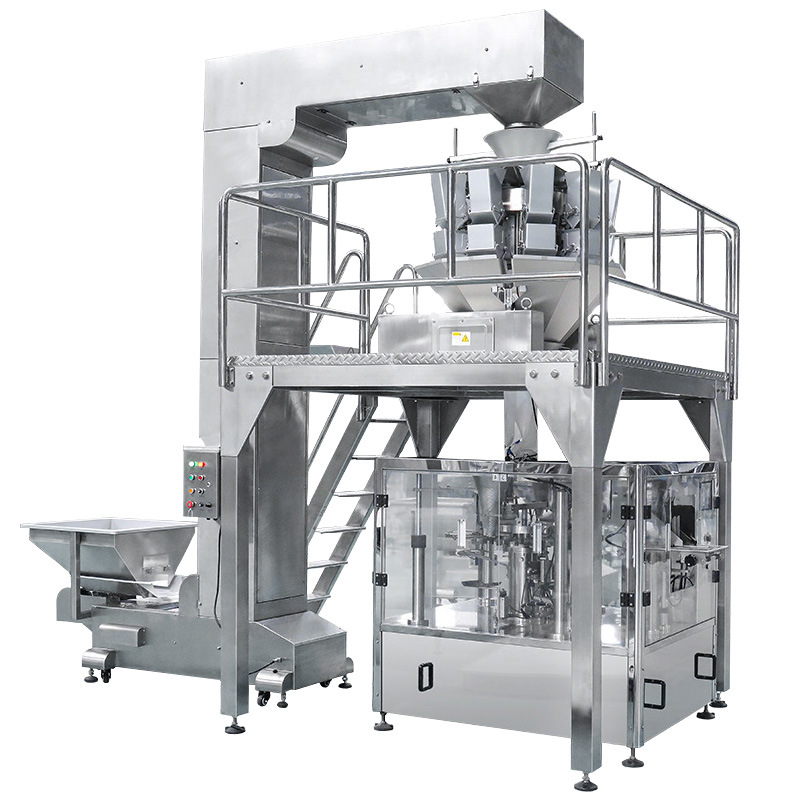
Our bagged packaging solutions cover the equipment selection behind the film-bag route. For an existing printed pouch, use the premade-pouch equipment route as the starting point and specify the required popcorn configuration.
Makhana, muri and murmura need their own handling trial
Roasted makhana, also called fox nuts, can occupy substantial space at a low pack weight. For a makhana packing machine, size the hopper and outlet around the actual pieces and loose volume, then check broken pieces after filling. Grams per bag alone cannot determine this fit.
Muri or murmura is puffed rice. Its lightness can create scattering during transfer, while rough movement can increase fines. Use a controlled drop and suitable feeding path, and compare the incoming and packed product. The same bagger may be suitable for several puffed snacks after format and handling checks; shared product names or a similar pack weight do not establish compatibility.
An illustrative 80 g makhana portion at an assumed 40 g/L occupies 2 L before headspace and closing allowance. Use measured batch density to size the hopper and bag. This calculation explains why a low-weight pack can require a large filling path.
Fix the cause of crushed snacks, sticky dosing and poor seals
| Problem | Likely mechanism | Configuration response | Trial check |
|---|---|---|---|
| A low-weight portion blocks the outlet | The dose occupies more volume than the hopper or bag mouth can pass | Match hopper volume, discharge opening and bag opening to the largest batch | Record bridging and missed doses with the bulkiest product |
| Caramel popcorn sticks to the hopper | Coating condition and packaging temperature change contact behavior | Test the cooled product and appropriate contact surfaces or feed adjustments | Observe residue and weight drift during sustained running |
| Puffed rice scatters or breaks | Light particles encounter airflow, excessive drop or mechanical pressure | Control transfer height, disturbance and product contact | Compare fines, spills and dose consistency before and after packing |
| Seasoning enters a seal | Powder or product crosses the closing area during filling | Adjust the discharge timing, settling allowance and closing area | Check finished seals with the actual seasoned product and film |
Agree the permitted damage and net-weight variation before the trial. Measure acceptable bags per shift with the actual product; cycle rate alone leaves out jams and rejected packs. If protective gas is required, include gas delivery, the pack barrier and a measurement method in the scope; no gas percentage or shelf life is implied by adding a connection.
A practical starting configuration for caramel popcorn
First establish the product condition at the packaging handoff. If coating behavior varies because product arrives before the agreed cooling stage, stabilize that handoff. If cooled popcorn still adheres during weighing, Comwin compares the hopper contact and discharge arrangement and provides access for removing deposits. Persistent bridging calls for a changed feed/outlet arrangement; growing residue calls for a defined cleanout procedure. Raising the closing speed while portions stick would increase interruptions rather than remove the restriction.
For makhana, large pieces and low density mainly determine capacity and outlet clearance. For muri or murmura, the transfer needs to limit scattering and fines. These are different handling decisions on a compatible bagging system; one shared bag weight is not enough to select the contact and discharge parts.
Match the product and sales pack to the route
| Product and order | Finished pack | Starting configuration | Decision that changes it |
|---|---|---|---|
| Cheese-flavored ready-to-eat popcorn | Example: 50 g film bag | Large-volume weighing with VFFS | Seasoning in the seal calls for revised filling and settling |
| Caramel popcorn for a branded retail range | Example: 100 g stand-up pouch | Premade-pouch handling with suitable weighing | Persistent sticking requires a trial of product condition and contact surfaces |
| Roasted makhana | Example: 80 g sealed bag | Gentle weighing and bagging | Large pieces or excessive breakage change the outlet and handling path |
| Muri or murmura | Example: 200 g film bag | Light-product feeding, weighing and VFFS | Batch density changes require a new volume and bag check |
| Sealed popcorn retail cup | Example: selected 300 mL cup | Suitable dosing and matched lid-film sealing | An open cinema cup or a capped glass jar needs a different closing scope |
Example: a cheese-popcorn bag
For a planned 50 g bag, first establish the portion volume and the space left above it. Trial weighing and filling with the seasoning present. If powder reaches the top seal, adjust discharge and settling first. Then measure good sealed packs under the agreed run conditions before raising the speed.
Example: a sealed retail cup
Send a filled container sample, its rim dimensions and the selected lid film. Check fill height and sealing on the full cup. If the sales pack changes to a glass jar with a screw cap, retain the product-dosing task but select the cap-handling process separately. These examples describe planning situations, not customer installations.
Popcorn packing machine prices by equipment scope
These October 2026 USD ranges are for early planning of new equipment supplied from China, ordinary non-aseptic food, one selected product and one pack format. Freight, taxes, overseas installation, food processing, site works and extra formats are excluded. Inspection, gas generation and downstream equipment are additional unless listed. Confirm commercial terms and the final itemized scope before ordering.
| Equipment scope | Indicative budget, USD | Included planning scope | Main exclusions |
|---|---|---|---|
| Short-run weighing and sealing | 5,000 to 15,000 | Suitable low-density weighing and separate sealer for one bag | Automatic bag handling, inspection and gas supply |
| Puffed-snack VFFS combination | 18,000 to 50,000 | Suitable hopper, weighing, basic feeding and bag forming/sealing | Special anti-stick treatment, high-speed distribution and gas generator |
| Premade-pouch combination | 25,000 to 60,000 | One pouch format, pouch handling, weighing and basic feeding | Special discharge arrangements, gas, inspection and case packing |
| Sealer for already filled cups or tubs | 1,500 to 6,000 | One compatible heat-sealable container and film, manual presentation | Filling, automatic cup supply and glass-jar cap closing |
| Popcorn cup filling and sealing | 18,000 to 55,000 | One cup/tub format, suitable dosing and matched lid-film sealing | Making cups, special gas/barrier arrangements and popping |
| Glass-jar dosing and cap closing | 20,000 to 65,000 | One actual jar/cap format, granular dosing and matched closing | Special vacuum/gas, glass inspection, labeling and processing |
Keep filling, sealing and container type separate
A popcorn filler meters product; a sealing machine closes the selected pack. The low budget for a prefilled-cup sealer includes no dosing. For a request described as “popcorn glass packing,” send a container photograph: a paper or plastic cup, a tub and an actual glass jar require different rim or cap handling.
Compare proposals on the same filled pack, personnel and good-output target. Send your product, container and production details for a price on the selected configuration.
Decide which handling steps to automate
| Comparison | Weighing with manual pack transfer | Automatic bag or cup handling |
|---|---|---|
| Production mode | Short batches, frequent products and an operator available for each transfer | Repeated orders with a stable product and finished pack |
| Labor steps | Present bags or cups, transfer the dose, close and collect | Specified feeding, bag forming/opening or cup handling and closing; replenishment and collection remain defined tasks |
| Changeover and cleaning | Reset the dose and closure; clean accessible contact areas | Adjust guides and format parts as well as dose and closure; measure cleaning and changeover with each product |
| Acceptance | Good packs per shift with actual operators, weight and damage checks | Sustained good output, jams, residue, seal condition and stop/restart recovery |
Keep manual transfer when it meets the order economically. Add automatic pack handling when that transfer repeatedly limits output. If weighing or sticky feeding is the constraint, correct it before expanding the closing equipment.
Compare suppliers on the same popcorn trial
| Dimension | Evidence to compare | Comwin proposal focus |
|---|---|---|
| Budget and scope | Itemized dosing, pack handling, closing and options | A configuration for the selected low-density product and finished pack |
| Output and scale | Good output with your sample, materials and personnel | Balance the actual bottlenecks and planned order volume |
| Adaptation | Hopper/outlet fit, caramel residue, rim or cap compatibility | Match these interfaces and show required changes or options |
| Support | Trial access, cleaning instructions, parts and response responsibility | Agree the support scope with the selected equipment |
| Delivery | Sample approval, configuration freeze and acceptance milestones | Define the supplied equipment and handover responsibilities |
Comwin provides free sample testing and can arrange a real factory visit. Our confirmed service terms are a two-year machine warranty, three years for core components and remote response within 24 hours. Final equipment scope and acceptance conditions are agreed for your project.
Questions about popcorn bagging and containers
Can a microwave-popcorn machine pack ready-to-eat popcorn?
If the machine doses raw kernels and oil into cooking bags, evaluate ready-to-eat popcorn as a separate product. Its loose volume, fragile pieces and pack structure need a compatible dosing and filling trial.
Can popcorn, makhana and puffed rice share a machine?
If the selected hopper, outlet, weighing range and bags handle all three products, a shared configuration can be considered. Test each product and its changeover; revise the handling when one bridges, scatters or breaks.
What should a caramel-popcorn trial include?
For persistent caramel residue, use the handoff, contact/discharge and cleanout sequence above. Check dose drift and seal contamination during the sustained run.
Does a cup sealer also fill popcorn?
If its scope is an already filled cup, it supplies only the specified closing operation. Request dosing and cup handling separately when you need a filling-and-sealing combination.
Send your product and finished pack for a configuration proposal
| Information | What to send |
|---|---|
| Product | Ready-to-eat, raw-kernel or microwave-kit state; coating, particle size, loose volume and packaging temperature |
| Packaging | Finished bag, cup, tub or actual jar sample; film, rim, lid or cap details |
| Fill target | Net weight or volume, fill height, headspace and acceptable broken pieces |
| Closure | Heat seal, lid film or cap; any gas requirement and coding |
| Production | Good packs per shift, products and changeovers, available operators and any later handling |
| Factory | Product arrival conditions, floor space, utilities and destination market |
Send your popcorn packaging requirements. We will return the recommended equipment and process, included items and options, sample-test conditions and a quotation for the selected scope.