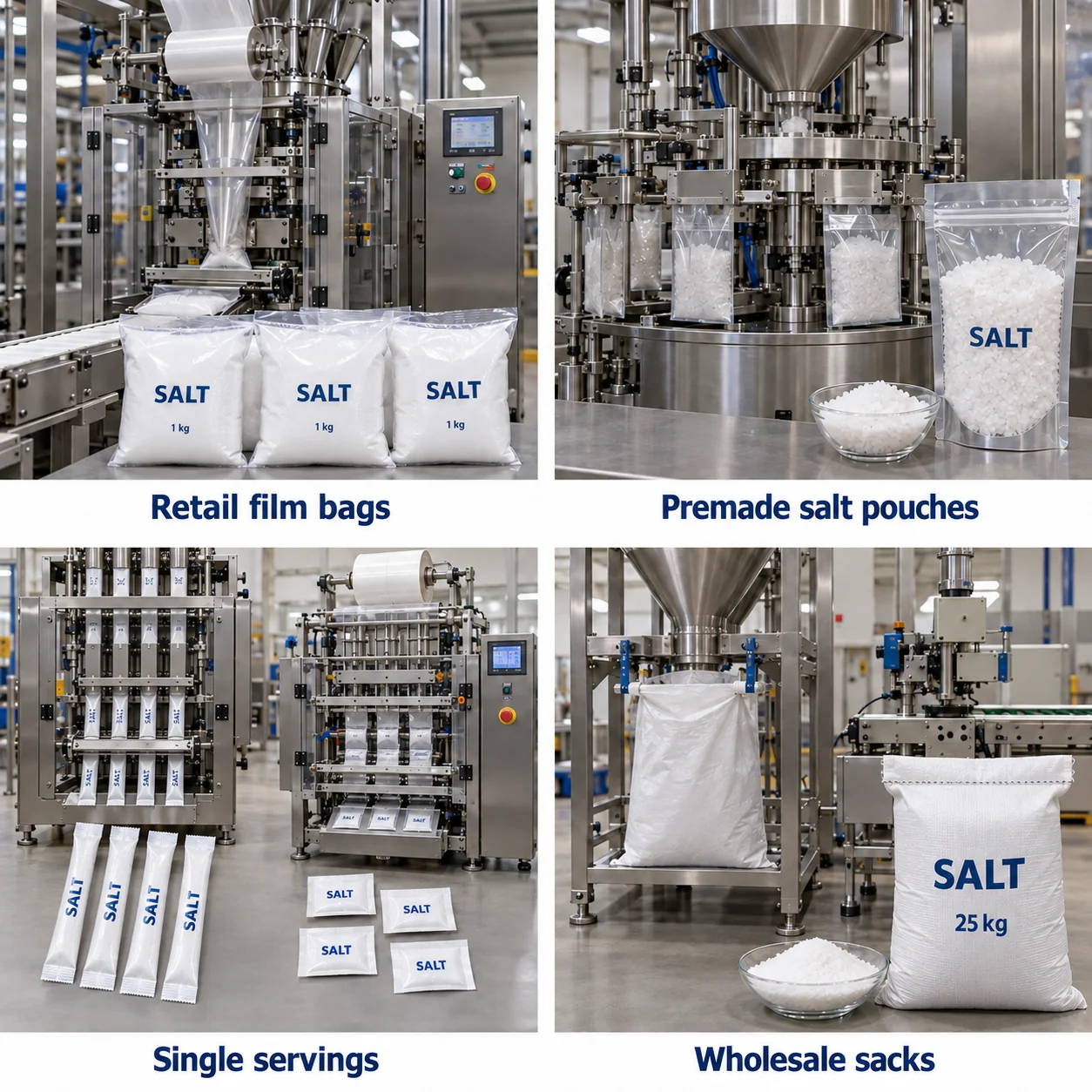
For dry, free-flowing edible salt, a salt packing machine can combine volumetric cups or weighing with vertical form fill seal (VFFS) bag making. Ready-made zipper pouches need pouch handling and a matched granular doser. Single-serving flat sachets and narrow stick packs use their own forming and sealing arrangements. For wholesale sacks, use weighing, bag clamping and a suitable closing station.
An indicative budget for a 1 kg salt VFFS combination is USD 10,000 to 30,000, including basic dosing, feeding and discharge for one selected film-bag format. The salt’s particle size, moisture and actual cleaning environment determine the feeding and material specification. Comwin matches these requirements before selecting the equipment.
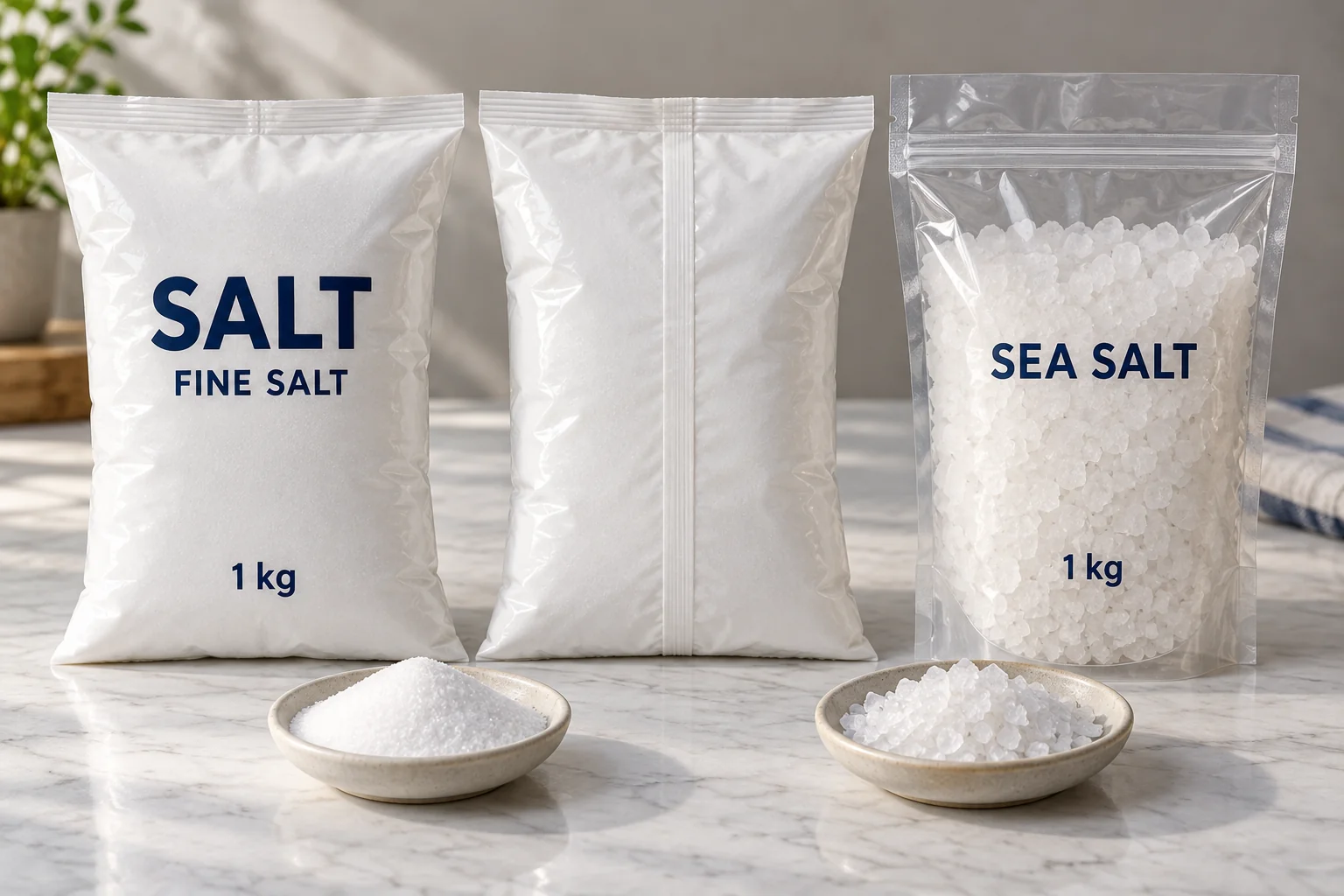
Choose a salt packing route from the product and bag
A fine-salt bag, a coarse sea-salt pouch and a restaurant portion require different handling. For edible salt or namak, provide a representative sample and the finished pack you want to sell.
| Finished pack and product condition | Equipment route | Why it fits | When to change the configuration |
|---|---|---|---|
| Dry, stable salt in a 1 kg roll-film bag | Cup or weighing doser with VFFS | Coordinates continuous bag making, dosing and sealing | Use weighing or weight feedback when density variation makes cup dosing unsuitable |
| Coarse salt in a heat-sealable stand-up pouch | Granular dosing with premade-pouch handling | Retains the chosen pouch and provides automatic opening and top sealing | Rework the discharge path if crystals bridge, damage the bag or contaminate the seal |
| One selected single-serving stick or flat sachet | Corresponding multi-lane stick-pack or sachet machine | Produces the specified small pack with coordinated dosing and sealing | Change the bag format or feed arrangement if particle size or moisture prevents reliable filling |
| 25 kg or 50 kg edible-salt sack | Controlled feeding, weighing, bag clamping and closing | Supports the sack and manages filling and transfer | Add automatic bag loading when bag consistency and output justify it |
Fine salt in retail film bags
Volumetric cups can suit salt that flows consistently and has stable bulk density. The cup delivers a volume; net weight changes if the material filling that volume changes. Weighing measures the dose by mass and may better suit density variation or a tighter giveaway target.
Control product supply to the selected doser. Check the hopper behaviour at different levels and how the feeder stops. A 1 kg salt packing machine should be accepted on filled and sealed bags, including their weight distribution, rather than on empty-machine cycling speed.
Coarse salt in premade pouches
For an established zipper pouch, match its opening width to the crystals and the discharge chute. Leave enough clean material above the zipper for the factory top seal. The zipper allows the consumer to reclose the pouch after opening; the top seal closes it for sale.
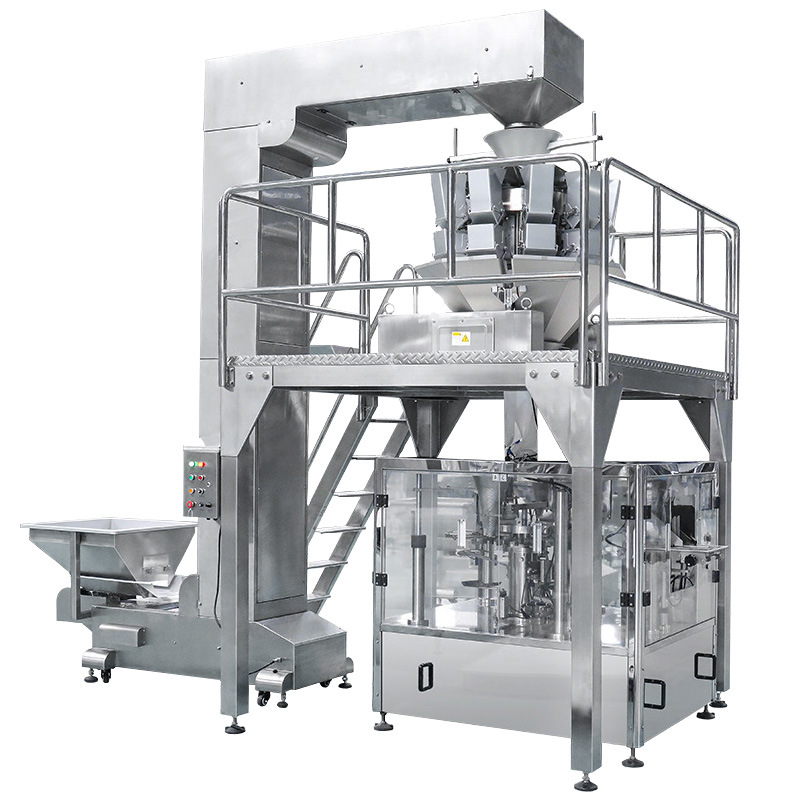
The premade-pouch platform provides bag handling. The feeder, doser and contact materials are specified for the actual salt. A stand-up pouch can also be made from film on a suitable dedicated arrangement, so the finished shape alone does not prove that premade bags are required.
Single-serving salt sachets and stick packs
A salt sachet packing machine makes the selected three-edge or four-edge flat pack. A stick-pack machine makes a narrower tubular pack with its corresponding seals. Fix the desired finished pack first; switching between these formats may require a different machine.
For narrow packs, check crystal size against the feed channel and usable bag opening. Compare good packs per shift, with collection included in the run. If the offered speed is already the total across all lanes, do not multiply it by the number of lanes again.
Wholesale edible salt in large sacks
Large bags need suitable support, weighing and closure. An auger may be used for controlled feeding into a weighing system where the product requires it. That feeding arrangement is different from using auger revolutions as the final volumetric dose.
Specify whether the bag needs sewing, heat sealing or liner sealing followed by outer-bag closure. Industrial deicing salt requires a separate review of product, bag and exposure conditions; it should not be substituted for the food-salt application.
Solve salt feeding, sealing and corrosion problems
| Problem | What can cause it | Practical response | Acceptance evidence |
|---|---|---|---|
| Net weight drifts or giveaway is high | Density, particle distribution, hopper level or damp clumps change the dose | Stabilize supply and compare weighing or weight feedback with cup dosing | Weight distribution across representative batches and hopper levels |
| Crystals appear in the seal | Product reaches the seal area during closure | Adjust discharge and cutoff timing, chute geometry and seal-area cleaning | Seal condition and leakage after normal handling |
| Salt bridges or sticks in the feeder | Moisture, clumps or unsuitable discharge geometry | Review incoming product condition, buffering, screening where appropriate and controlled feeding | A run with the most difficult representative batch |
| Parts corrode in a humid or frequently cleaned area | Chloride exposure, moisture retention and cleaning chemistry affect individual parts | Specify materials and protection by component; provide cleanable access and appropriate drainage | A component schedule and agreed cleaning and drying procedure |
| Portions accumulate after a multi-lane machine | Collection, counting or case handling cannot absorb the output | Match collection and any required grouping to good-pack output | Sustained operation through the agreed downstream endpoint |
SS304 or SS316 is not a promise of permanent corrosion resistance; stainless-steel corrosion depends on exposure and surface conditions. Review the product-contact parts, fasteners, conveyors, frame and electrical enclosure against their actual exposure. The cleaning method and how moisture is removed matter as much as the material label.
For wet or caking salt, correct the feed problem before accepting a dry-salt dosing demonstration as evidence. A proposed buffer or feeder needs to work with your material; it is not a substitute for defining incoming salt condition.
Put giveaway into a useful cost calculation
As a hypothetical example, an average extra 3 g in each of 100,000 bags adds 300 kg of salt. Calculate this from measured weights: extra grams per bag multiplied by bag count, divided by 1,000. The example does not predict savings from a particular machine. Compare the change in giveaway with equipment cost, labour and good-pack output using your own run data.
When humidity changes the salt feed
If salt bridges or forms clumps before the doser, Comwin starts with the hopper and discharge rather than raising bagger speed. The proposal can use controlled feeding and an accessible discharge path, with agitation selected only where it improves flow without creating an unacceptable product condition. When deposits build during running, removable contact parts and cleaning access become part of the equipment choice. For wet chloride exposure, specify contact parts, joints and exposed assemblies by the actual cleaning and moisture conditions; the basic dry-salt configuration is a different scope.
Match salt packaging to the selling and production scenario
| Product and production condition | Finished pack | Starting route | What changes the selection |
|---|---|---|---|
| Stable fine edible salt in repeated retail orders | 1 kg roll-film bag | Cup or weighing dosing with VFFS | Density changes or a demanding weight target favour weighing or feedback |
| Branded coarse sea salt | Heat-sealed zipper stand-up pouch | Granular doser and premade-pouch handling | Crystal size, bag-mouth restriction or damaged seals require a different discharge path |
| Restaurant or hotel portion salt | One selected stick or flat sachet | Matching multi-lane portion machine | Pack format, crystal size and collection requirements determine the configuration |
| Wholesale edible salt | 25 kg or 50 kg lined woven or heat-sealable sack | Weighing, manual or automatic bag loading, closing and conveying | Bag loading and pallet handling become automation candidates when they limit output |
| Fine salt in a humid plant or with recurring clumps | Pack selected for the sales channel | The corresponding route with reviewed feed and protection measures | Representative difficult salt must pass filling and cleaning trials |
Example: moving fine salt from cup dosing to weighing
Assume a 1 kg roll-film bag is already established, but batches vary in density. Keep the actual film and production target in the trial. Compare the current cup arrangement with a suitable weighing setup at different hopper levels. Review mean weight, low-weight bags, giveaway and good bags per hour together.
If both methods meet the specification, compare their cleaning, replenishment and maintenance needs. If the cups require excessive overfill to avoid low-weight bags, assess the weighing configuration using the measured cost difference.
Example: coarse sea salt in a zipper pouch
Use the largest representative crystals and the actual pouch. Check opening, filling, standing stability and the clean top-seal strip. A wide pouch opening can help filling, but the available sealing area still needs to match the jaws. Change the chute or pouch specification when crystals lodge at the mouth or leave the top seal unreliable.
Salt packing machine prices by scope
The following indicative planning budgets in USD were prepared in October 2026. They assume new equipment supplied from China, ordinary non-aseptic food packing, one salt product and one selected bag format and dose. The selected configuration determines the quotation. Freight, taxes, overseas installation, salt refining or drying and site works are excluded.
| Selected equipment scope | Indicative budget | Included planning scope | Main exclusions |
|---|---|---|---|
| 1 kg salt VFFS combination | USD 10,000 to 30,000 | VFFS, cup or suitable basic linear weighing, basic feeding and discharge | Higher-specification combination weigher, enhanced corrosion protection, inspection and extra formats |
| Premade salt-pouch combination | USD 20,000 to 50,000 | Bag handling, suitable granular dosing and basic feeding for one heat-sealable pouch | Extra zipper mechanisms, special coarse-crystal handling, additional formats and inspection |
| One 2 to 4 lane stick-pack or 2 to 4 column flat-sachet arrangement | USD 20,000 to 60,000 | Granular dosing, forming, sealing, cutting and basic collection for dry free-flowing salt | A second bag format or machine, five or more lanes, automatic counting and case packing |
| One 25 kg or 50 kg semi-automatic edible-salt station | USD 10,000 to 30,000 | Weighing and filling, manual bag loading, clamping, basic conveying and one closing method | Automatic bag loading, complex corrosion protection and palletizing |
| Automatic 25 kg or 50 kg dry-salt sack arrangement | USD 40,000 to 100,000 | One consistent sack, automatic bag loading, weighing/filling, one basic closing method and conveying | Wet/corrosive-duty engineering, complex closure, extra formats, inspection and palletizing |
The single-serving budget covers either the selected stick-pack arrangement or the selected flat-sachet arrangement. It does not include both machines.
For a salt packing machine price comparison, ask each supplier to identify the dosing system and list the material specification by part. A basic retail combination and a machine engineered for wet chloride exposure are different scopes, even when both are described as stainless steel.
Choose the useful level of salt packing automation
| Decision | Dosing with manual bag handling | Automatic retail or portion packing | Automatic wholesale bag handling |
|---|---|---|---|
| Production | Changing retail bags and short orders | Repeated film, pouch or single-serving orders | Repeated large sacks with consistent bag dimensions |
| Manual tasks | Present bags, transfer fills and feed the sealer | Replenish material and bags; collect packs unless further handling is included | Replenish empty sacks and supervise; pallet handling depends on the scope |
| Changeover | Adjust dose and independent sealing | Change film or pouch setup, dose, forming parts and collection | Adjust the bag magazine, clamps, weight and closing setup |
| Acceptance | Filled and sealed bags with agreed staffing | Good packs per shift, weights, seals and changeover time | Reliable loading, weighing, closure and sack transfer |
If bag presentation or collection limits output, automate that step first. List the tasks that remain manual, and compare good-pack output including replenishment, routine stops and collection.
Add case packing or palletizing to the required endpoint
Retail pouches can be grouped into transport cases; single-serving packs may need counting and grouping before case packing. Closed wholesale sacks can be palletized. A bagged-product packaging line can coordinate the selected steps where those tasks are a bottleneck.
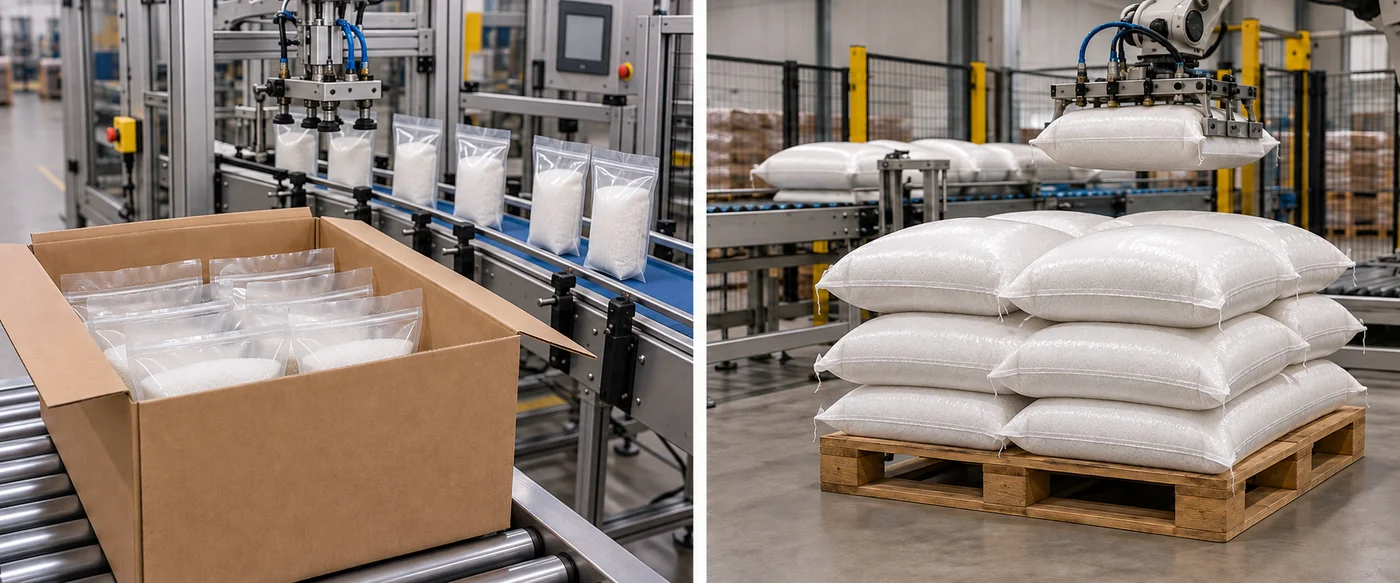
Define packs per case, case weight and the pallet pattern. Check bag surface, salt residue and exposure around the handling equipment. These downstream steps are optional and are not included in the filling budgets unless the offer lists them.
Compare salt packing suppliers with a clear specification
| Dimension | Evidence to compare | What to discuss with Comwin |
|---|---|---|
| Budget and scope | The same salt, pack and dosing requirements with a component list | Included filling and closing equipment, materials and separately priced options |
| Production | Good-pack output with representative salt and actual packaging | Target packs per shift, replenishment and collection capacity |
| Application fit | Particle size, moisture, cleaning and bag compatibility | Feed geometry, materials, protection and seal-area control |
| Support | Testing, training, spare-parts information and named support responsibility | How the selected equipment will be operated and supported |
| Delivery | Agreed samples, component specification and acceptance milestones | A schedule tied to configuration and material approval |
Comwin develops salt packing arrangements around the product and factory conditions, from dosing and bag packing to coordinated handling. Free sample testing and factory visits are available. Equipment warranty is two years, with three years for core components; remote response is within 24 hours. Training, installation and spare-parts scope are agreed for the selected equipment.
Salt packing questions
Should a salt packing machine use cups or weighing?
For dry salt with stable density, assess cup dosing against the required weights and output. When density or flow varies, compare a weighing system or suitable weight feedback. Decide from a representative run and the resulting giveaway, not from the dosing label alone.
Can one machine make salt pouches, flat sachets and stick packs?
If the forms require different bag-making and sealing arrangements, specify them as separate equipment routes. Confirm any proposed changeover with the selected machine and materials. A shared product does not establish that all pack forms are interchangeable.
Can the same machine pack wet salt?
When moisture causes bridging or adhesion, test the feed path and weighing arrangement with that salt. Review incoming condition and suitable handling measures before confirming the configuration. A dry-salt trial does not validate wet-salt operation.
Is SS316 enough to prevent corrosion?
For chloride exposure, specify the actual parts, cleaning chemistry, moisture retention and drying method. Assess materials and protection by component. No single stainless-steel designation establishes permanent resistance for the whole installation.
How should I compare a single-serving machine’s speed?
For a per-lane rate, multiply by active lanes once. For a total packs/minute rate, use that total directly. Compare accepted output with collection and routine stops included.
Send the information needed for a salt packing proposal
- Product: fine salt, coarse sea salt or another edible grade; particle range, moisture, additives, flow and clumping behaviour.
- Pack: film bag, premade pouch, stick, flat sachet or wholesale sack; dimensions, material and finished samples.
- Fill: portion or bag weight, permitted net-weight range and target good packs per shift.
- Closure: the required seals or sack-closing operations, date marking and inspection.
- Production: operating hours, SKU changes, manual replenishment and collection, counting, case or pallet needs.
- Site: salt exposure, humidity, cleaning method, incoming product supply, power, compressed air, space and destination market.
Comwin can return a matched configuration, a component and option list, and proposed sample-test acceptance criteria based on these inputs.
Use sample testing to check your salt and bags, or send Comwin the required packing scope for an equipment proposal.