Use a horizontal flow wrapper to pack firm, off-vine tomatoes in a fixed count, wrap a supported vine pack or enclose a filled punnet. When loose cherry tomatoes are sold by weight in a film bag, use gentle weighing and a vertical bagger matched to the fruit. Check the ripest fruit in the normal range during a line trial.
Budget US$5,000–25,000 for a compatible hand-fed horizontal flow wrapper for one agreed supported pack. Confirm the guides and spacing for trayless fruit in a sample run. Automatic group feeding and tray loading are priced separately.
Choose support around the product you sell

| Product and pack | Starting arrangement | Condition that changes the selection |
|---|---|---|
| A fixed count of firm tomatoes off the vine | Set the fruit into a repeatable group on a supported conveyor and feed it directly into the wrapper. | Check that small fruit stays with the group and larger fruit leaves both end seals clear. |
| Grape or cherry tomatoes in a retail punnet | Inspect and fill the punnet, then transfer it into a compatible flow wrapper. | The tray flexes, fruit stands in the seal path or loose tomatoes leave the punnet during transfer. |
| A repeated vine-tomato pack without a tray | Controlled placement and support into a wrapper configured for that product. | The bunch rolls, branches catch the film or the required fruit arrangement cannot be retained. |
| Loose cherry tomatoes sold by weight in film bags | Weigh the portion and release it gently into a vertical form-fill-seal bagger. | Check for impact marks, verify the net weight and watch for late pieces at the end seal. |
A punnet holds the portion together
A horizontal flow wrapper can form and close an outer film bag around the filled tray. Provide the complete filled dimensions, including fruit above the rim and any label or edge projection. Keep enough film clearance beyond both ends for the transverse seals.
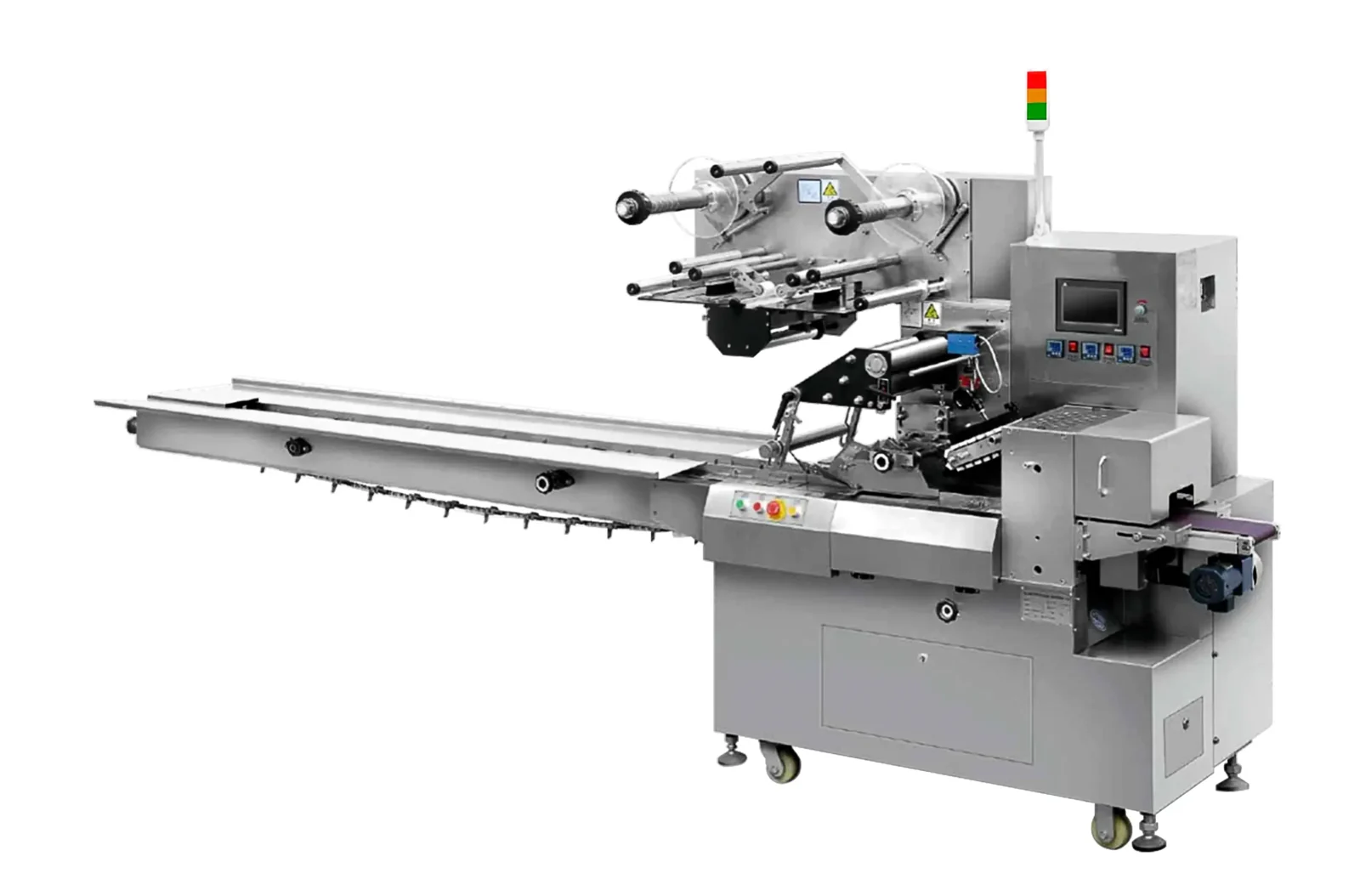
Trial the lightest or least rigid punnet as well as the largest one. Observe the handoff between surfaces and the way guides contact the tray. Increasing conveyor speed can expose a transfer problem that is less visible while an operator places trays slowly.
Trayless packs for tomatoes off the vine

For a fixed count, use fruit that sits securely in the infeed guides. Trial the smallest and largest grades at the same group pitch. Watch the handoff into the film and check for fruit that rolls into a gap. Where the buyer specifies one firm tomato per pack, run an individual sample to confirm orientation, film fit and end-seal clearance.
Trayless vine packs need controlled placement
A tomato bunch can move differently from a rigid tray. Assess the support surface, film entry and transfer around the actual bunch. Film supplied beneath the product or suitable belt support may be evaluated where the selected configuration calls for it; a tray-wrapper demonstration alone does not establish trayless performance.
Keep branches and stems clear of the longitudinal and end seals. Inspect for small film punctures after handling. Use normal awkward bunches in the trial, not only a neatly arranged sample that staff can place carefully one at a time.
Weigh loose cherry tomatoes into a film bag
For a retailer-approved film bag, use a low-drop weighing and discharge path above a vertical form-fill-seal bagger. Trial the ripest grade at the normal fill weight. Check for splitting or bruising after handling and set the timing so the last tomato clears the jaws before they close. Confirm the film ventilation, bag shape and storage conditions on the finished pack.

Separate fruit weighing from wrapping
Wrapping a filled punnet does not set its fruit weight. If trays are already filled to an agreed weight, retain that process and define how the wrapper receives them. If automatic weighing and filling are required, assess product dosing, drop height and distribution into the tray as a separate operation.
A fixed fruit count and a target pack weight are also different acceptance requirements. State both if they matter. The incoming fruit-size range and agreed weight tolerance determine whether the requested combinations can be produced consistently.
Check damage beyond the immediate outfeed
Inspect fruit before the trial and after each handling stage. Look for skin damage, stem marks and compression at the lowest fruit in a punnet. Retain packs for the agreed holding and handling assessment so that damage is not judged only at the moment the bag closes.
Choose the film and any required ventilation with the product owner and packaging supplier. Use the intended material in the trial. Validate the package under the expected storage and distribution conditions; a closed film bag is not a storage-life specification.
Two projects with different automation needs
Staff fill grape-tomato punnets
Inspect fruit → fill and verify the punnet → space the filled trays → flow wrap.
Start by improving the filled-tray handoff. Agree the operator’s loading work before adding a separate automatic weighing system.
One repeated vine-pack format
Prepare the bunch → place it with stem clearance → support the transfer → wrap and discharge.
Evaluate the placement method and normal bunch variation. Automatic spacing is useful only when it preserves the required product position.
Compare accepted packs with damage and stops included
Specify accepted packs per hour at the actual fruit and pack format. Include replenishment, supply gaps and rejects in the run. Record the incoming damage baseline, then the additional damage found after wrapping and handling.
Demonstrate the smallest-to-largest format change, a normal stop and restart, and removal of a tipped tray or misplaced bunch. Define how upstream equipment stops when the wrapper cannot accept more product. This keeps fruit from accumulating in an uncontrolled transfer.
A budget for a defined wrapping station
For a compatible manually loaded horizontal flow wrapper, use US$5,000 to US$25,000 as an indicative equipment reference. This assumes one defined supported fresh-product format and suitable rollstock. A dedicated trayless or automatic-feeding arrangement needs its own configuration and price.
Fruit sorting, grading, weighing, punnet filling, automatic bunch or loose-fruit placement, special atmosphere equipment and case packing are outside this basic wrapper reference. Freight, taxes, overseas installation and production consumables are also excluded. Compare a wrapper-only offer with another wrapper-only offer, then add the handling operations your project actually needs.
Vacuum, net bags and tomato seeds need separate decisions
The fresh tomato packs shown here are flow wraps, with space around the fruit. A vacuum-packed result applies a different pressure condition and may deform delicate fruit. Do not use vacuum as a default substitute for supported wrapping; assess any specific vacuum requirement with the actual food and package specification.
A tomato net bag requires suitable net handling and closing equipment, and the selected pack must protect the particular fruit through transport. That is a separate equipment assessment from film flow wrapping.
Tomato seeds need small-dose or counting equipment and packet control. They belong in a seed-packing project, separate from the handling of whole fresh fruit.
What to ask a tomato packing machine supplier to demonstrate
- The required varieties and normal firmness range, including the smallest fruit and the tallest loaded tray.
- Supported transfer, fruit position and stem clearance through the forming and sealing path.
- Film closure and puncture checks after representative handling, alongside fruit-damage inspection.
- Sustained accepted output, supply-gap recovery and a real format change, with operator tasks recorded.
Send the fruit arrangement and completed pack
Provide variety, normal fruit-size range, punnet or trayless-pack dimensions, portion weight or count and required accepted packs per hour. Include photos of the upstream delivery and any bruising, rolling or film-puncture issue. Comwin can then recommend the wrapping route and define the transfer trial around your product.
Comwin offers free sample testing, a two-year machine warranty and a three-year warranty for core components. Remote support responds within 24 hours. Training, installation and spare-part responsibilities are agreed in the proposal.