Gable Top Filling Machine Price: Assisted Stations and Automatic Machines
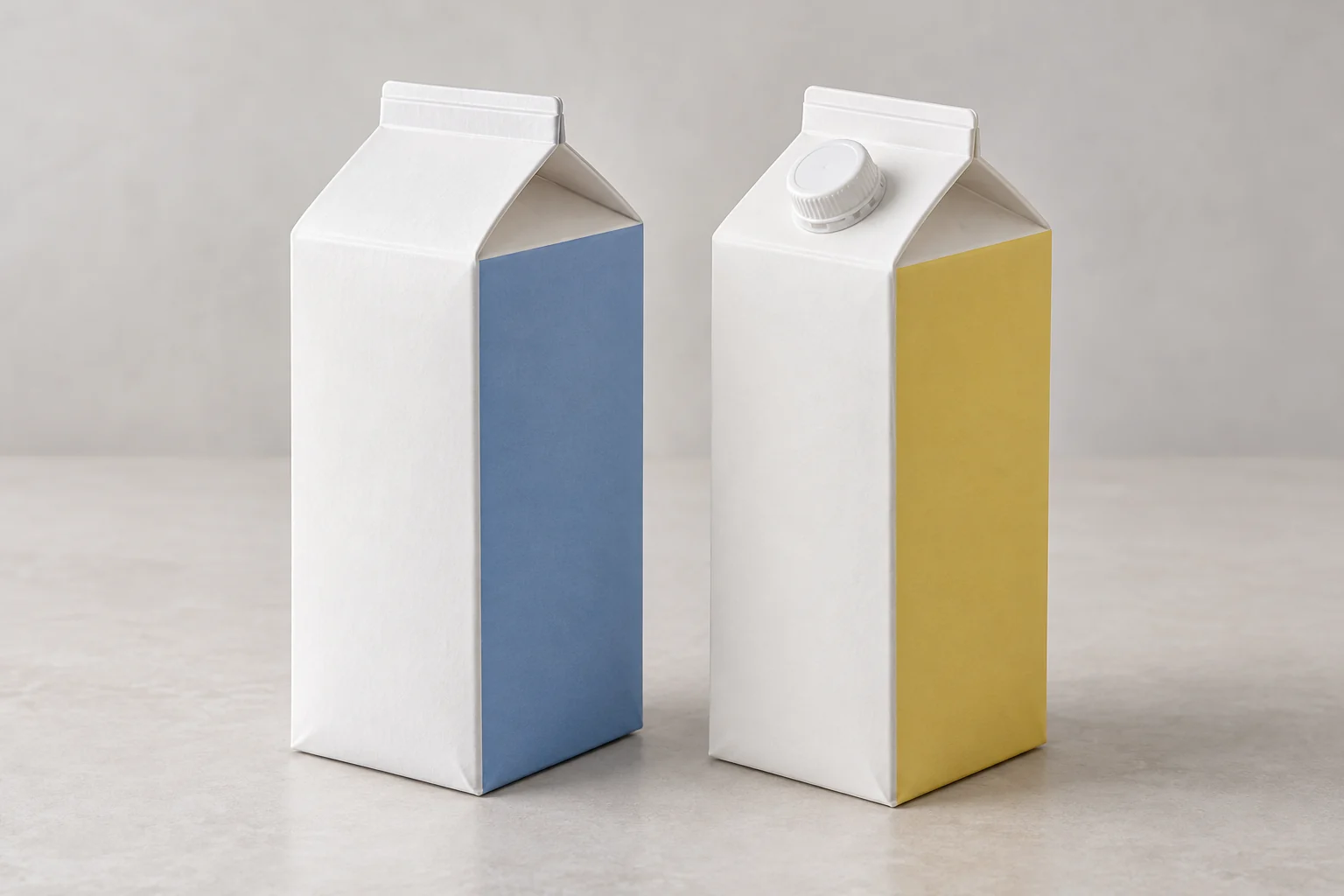
A gable top filling machine turns prepared paperboard blanks into filled, closed beverage cartons. Start with the drink and its storage conditions: a chilled product, a longer-life refrigerated product and an ambient product can require different processing and filling systems.For ordinary non-aseptic chilled filling, early equipment allowances are US$15,000–45,000 for separate assisted stations and US$60,000–180,000 for an automatic blank-fed machine. The reference task below is a one-litre ridge-closed carton. Upstream beverage treatment and refrigeration are separate.Ridge-closed cartons with and without a roof-panel cap (packaging illustration).
Set the product and storage conditions first
Product arriving at the filler
Work to specify at the filling section
Storage after packing
Treated drink delivered at its specified filling temperature
Protect the product path; define carton/closure handling, filling and sealing, and cleaning of wetted parts.
The specified cold chain remains necessary. Filling does not replace upstream treatment.
Drink intended for a longer refrigerated life
Review enclosure and air control, carton and closure treatment, cleaning and product-path hygiene as one process.
Refrigerated distribution under the conditions used to validate the complete product/package process.
Product intended for ambient distribution
A separately designed and validated preservation process; aseptic filling where required by that process.
Ambient conditions only after the product, treatment, package and filling system have been validated together.
For example, a treated chilled drink arrives from the upstream tank at its specified temperature. The carton section forms the pack, receives the dose and seals the roof. Cleaning must reach the wetted product circuit; carton and cap handling need their own hygiene measures. Neither the roof shape nor the presence of a cap establishes shelf life.Foaming drinks need a filling profile that leaves the roof sealing area dry. Viscous drinks or suspended solids also change the nozzle and product-transfer requirements. Include temperature and product condition with the sample.
Compare the work in an assisted and automatic setup
Here,
Compare both options using the same carton capacity and cap. Assisted stations suit shorter batches when staff can keep the opening, filling and sealing stations supplied. Automatic blank feeding cuts those transfers for repeat runs. For a change of size or cap, ask which guides, forming parts and closure tools must be changed.
assisted means semi-automatic work at separate stations. The operator transfers the carton; the station performs the specified forming, dosing or sealing action. The following comparison describes two example arrangements.
Step
Assisted station arrangement
Automatic blank-fed arrangement
Open the blank
Operator opens and places each blank.
Magazine-fed mechanism opens the blank.
Form and seal the bottom
Operator loads the bottom-forming/sealing station and removes the carton.
Carton passes through the included bottom-forming and sealing stations.
Fill
Operator positions the carton at the dosing station.
Transfer system positions the carton for dosing.
Close the roof
Operator moves the filled carton to the roof-closing station.
Machine folds and seals the roof.
Discharge
Operator removes and arranges the closed packs.
Machine transfers closed cartons to its discharge; collection is a separate handling task.
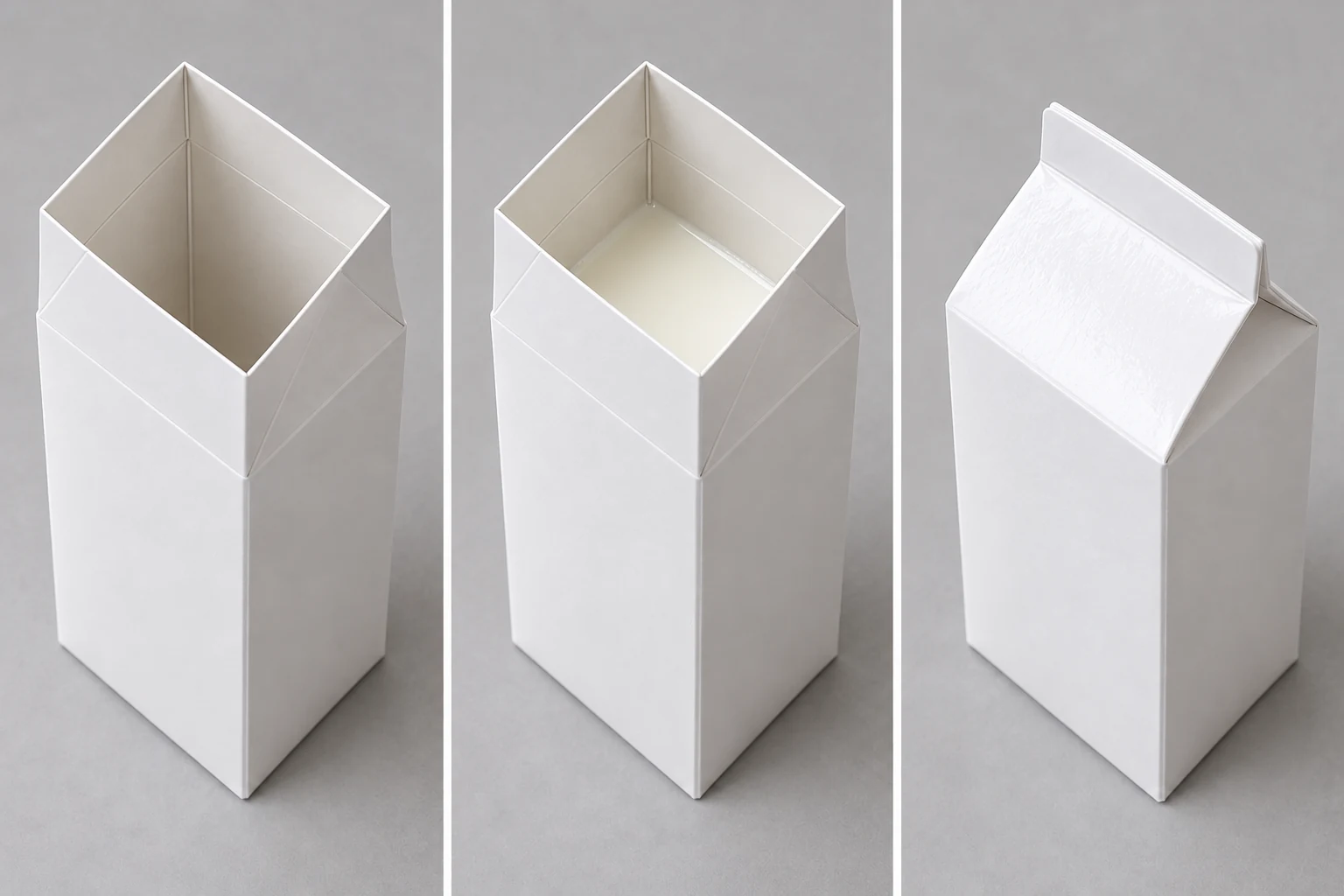
Open carton, filled carton and closed roof. Packaging-state illustration; machine actions are compared above.
Both arrangements still need blank replenishment, product supply and cleaning. Short batches may leave little filling time between cleans; long runs make repeated opening and manual transfers a larger share of the work.
Match handling to the batch pattern
For several small drink batches, compare time spent cleaning with time spent opening, moving and closing cartons. An assisted setup may be sufficient when carton-handling work fits the available shift. For a long run of one beverage, automatic transfer can remove repeated lifting between stations.If foam reaches the roof, first change the product delivery or filling profile. Compare dose and roof condition after a steady run and after restart. Higher carton-handling speed will not correct a wet sealing surface.
Carton size and cap changes affect different parts
Packaging change
Work to define in the equipment proposal
Carton height at the same cross section
Applicable handling and filling adjustments, roof position and any change parts required by the selected machine
A different cross section
Compatibility of carton supports, forming tools, transfer and sealing equipment; a machine’s approved format range must cover it
A different crease, coating or sealing construction
Forming behaviour and the sealing settings/tools for the actual carton supplier’s blank
A roof-panel screw cap
Opening and fitment design, whether the fitment arrives preinstalled, and any application or treatment operation needed on the machine
Send the blank drawing and production samples. Nominal capacity alone cannot establish compatibility: two one-litre cartons can have different geometry and sealing requirements. For each agreed format, the proposal should list the parts and adjustments that change.
Trace leaking packs to their operation
A damp bottom corner: dry the exterior and locate the leak. Compare the fold at that corner with a sound pack, then inspect blank alignment, forming and support at the bottom-sealing station. Run the same carton material after adjustment and compare closed-pack integrity using the agreed test method.Liquid on the roof sealing panels: observe the end of filling before the roof folds. Splash, foam or nozzle drips can leave product where the seal needs clean material. Adjust the filling action and headspace within the package specification, then inspect startup, steady-running and restart cartons.A recurring leak can also involve the carton material or coating; the equipment and carton suppliers need to review the affected samples together.
Budgets for ordinary chilled carton filling
For early planning, use a one-litre, ridge-closed carton with one approved cross section and blank drawing, filled with an ordinary chilled beverage. Product arrives already treated and at the required filling temperature. These October 2026 allowances cover new China-supplied, non-aseptic equipment; they are not model quotations. The 6,000-litre order below is a demand example, not a verified machine rating.
Planning allowance
Reference starting and finishing points
Manual work and scope
US$15,000 to 45,000
Assisted station arrangement
Prepared blanks become bottom-sealed cartons, then filled and roof-sealed packs through separate specified stations.
Manual blank opening/positioning and transfers. The station list must include bottom forming/sealing, dosing and roof sealing; an omitted station needs its own provision.
US$60,000 to 180,000
Automatic blank-fed machine
Blank supply through automatic carton forming, bottom sealing, filling, roof closing and discharge
Operators replenish blanks/product and perform the stated cleaning and intervention work. Included first-format tools are listed.
The automatic range varies with the required output, carton transport and first-format tooling, and the specified cleaning and enclosure arrangements. A nominal litre capacity does not determine those costs. These reference scopes assume a ridge-closed carton. For a capped pack, establish whether the carton arrives with a fitment and whether an application or treatment unit is needed. Include any required cap application and treatment equipment in the project price.Product treatment or UHT, upstream tanks, a central cleaning plant, cold storage, carton manufacture and secondary packaging are separate. Freight, taxes and overseas installation are additional unless stated. Higher-hygiene, ESL and aseptic projects require their own specification and budget.
Calculate capacity from available filling time
An illustrative order of 6,000 litres across eight hours averages 750 L/h if every hour is available for filling. If cleaning, changeovers and planned stops leave six filling hours, the requirement becomes 1,000 L/h.At one litre per carton, that six-hour example needs 1,000 cartons per filling hour. At 250 mL, it needs 4,000. Those are order requirements, not predicted machine outputs. Use the actual cleaning plan and product changes when determining available running time.For a connected packaging automation project, define product inlet conditions, discharge orientation and how filling responds to downstream stops. The agreed capacity should be measured as acceptable closed cartons.
Plan the carton path with Comwin
Send the beverage, storage requirement, carton sample and shift demand. Comwin can return a station-by-station proposal showing carton handling, filling and closure work, with the operator transfers and format parts identified. Product treatment, hygiene validation and storage remain part of the full process plan.Comwin offers free sample testing, a two-year machine warranty and a three-year warranty for core components. Remote support responds within 24 hours; installation and training are specified in the proposal.