Liquid packing machines

Single portions, refill pouches and bottles for your liquid product.

Comwin supplies liquid filling and packing equipment for sauces, oils and refill products. We select the dosing system for how your liquid flows, then bring filling and sealing or capping into one coordinated process.

  • Dosing selected for viscosity, foam and particles
  • Bag forming, pouch filling or bottle handling
  • Sealing and capping matched to the finished pack
Liquid sachets and stick, refill pouches, and a bottle and jar arranged in three groups
Left to right: single portions, refill pouches, and rigid containers. Each needs its own filling and closing arrangement.

Find the liquid pack you need

Choose how the customer will use the product. The three groups above lead to the equipment routes below.

Single portions: sachets and sticks
One serving of oil, honey or sauce, opened and used at once. A narrow stick and a flat sachet need different forming tools.
Refills and repeated pours
A refill pouch transfers product to another container. A capped spout also allows repeated pouring, with filling and cap handling designed around the spout.
Bottles and jars
A rigid container supports repeated use. A narrow bottle neck suits pouring; a wide jar opening suits spooning a thicker product.

For the wider choice of flexible packs, see our bag packaging solutions. The product and packaging specification must also establish the required storage and leakage performance.

Match the filler to the liquid

The liquid follows a product-contact path from supply vessel through the dosing equipment to the filling outlet. Its narrowest passage matters when the recipe contains pieces.

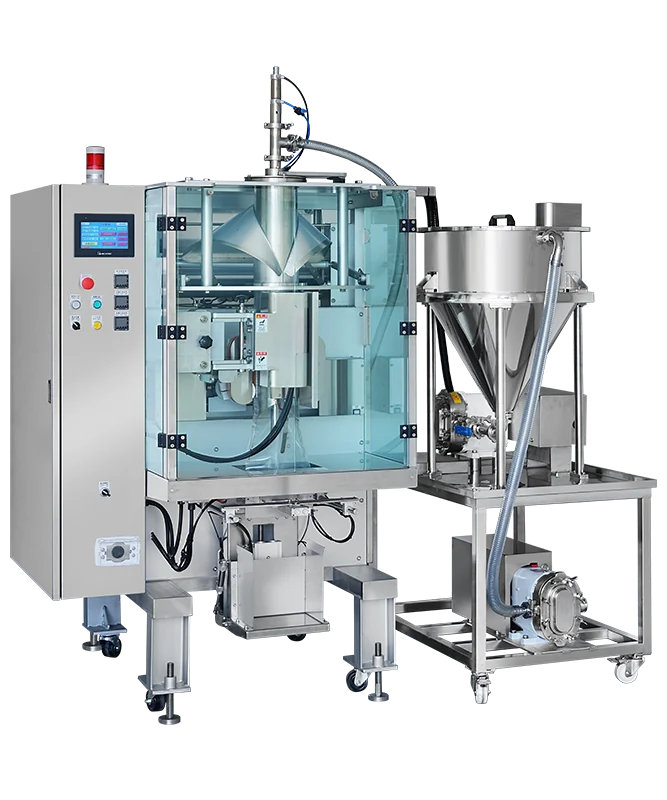
Liquid supply hopper, pump and hose beside a vertical bagger
A liquid supply hopper, pump and transfer hose beside the bagger. The dosing and shut-off parts are selected for the product.
Liquid behaviourFilling arrangement to considerWhat the product trial establishes
Thin liquid with stable flowA suitable pump, flow-based or weight-based dosing system.Repeatability at the intended temperature and supply conditions.
A liquid that foamsA controlled filling profile and suitable nozzle position, with settling time where needed.Fill quantity, foam level and space available for sealing or capping.
Thick sauce or liquid containing particlesA suitable piston or pump with valve and nozzle passages matched to the product.Consistent flow without blocking or unacceptable particle damage.
Consistency changes with temperatureProduct supply and any required temperature control matched to the filling range.How viscosity changes over the actual operating temperature range.

Select the pump, valves and nozzle as one product path. Include the actual recipe and filling temperature in the trial, especially when a sauce contains pieces.

See how recipe and temperature affect a thicker product in our peanut butter filling guide.

Plan cleaning around the actual product path

Before combining recipes on one filler, establish how the vessel, pump, valves, hoses and outlet will be emptied and cleaned.

Access and removal
Identify parts that open or detach for cleaning, and allow room to remove them. Product residues can remain in valves, hose connections and other enclosed passages.
Temperature at filling
Use the temperature range expected at the filler. A sauce that flows during preparation may thicken before it reaches the nozzle. Any heating or holding equipment belongs in the agreed scope.
Contact materials and cleaning chemicals
Review the product and site cleaning method together when choosing contact parts and seals.
Aseptic or other special processes
Define the process equipment, filling environment and validation responsibilities as a separate project requirement.

Single portions: liquid sachets and sticks

Sealed transparent sachets containing clear liquid, oil and sauce
Finished liquid sachets. Seal layout and film are specified with the filling equipment.
Liquid dosing and vertical forming and sealing equipment
Liquid dosing and vertical bag forming and sealing.

Liquid sachets made from roll film

Measured sauce, oil or other compatible liquids sealed into individual film packs.

  1. Form the bag from film
  2. Meter the liquid
  3. Stop the flow
  4. Seal and separate

The pictured machine combines a liquid dosing hopper with vertical film forming and sealing. The film forms around the filling tube, the liquid is dosed into the bag, and flow stops before the cross seal closes. The product supply, filling outlet and seal timing work as one cycle.

Pack geometry determines the sealing tools. Confirm the required rear seam or side seals from the finished sample; a film-bag machine does not make every sachet shape.

Explore sauce sachet configurations
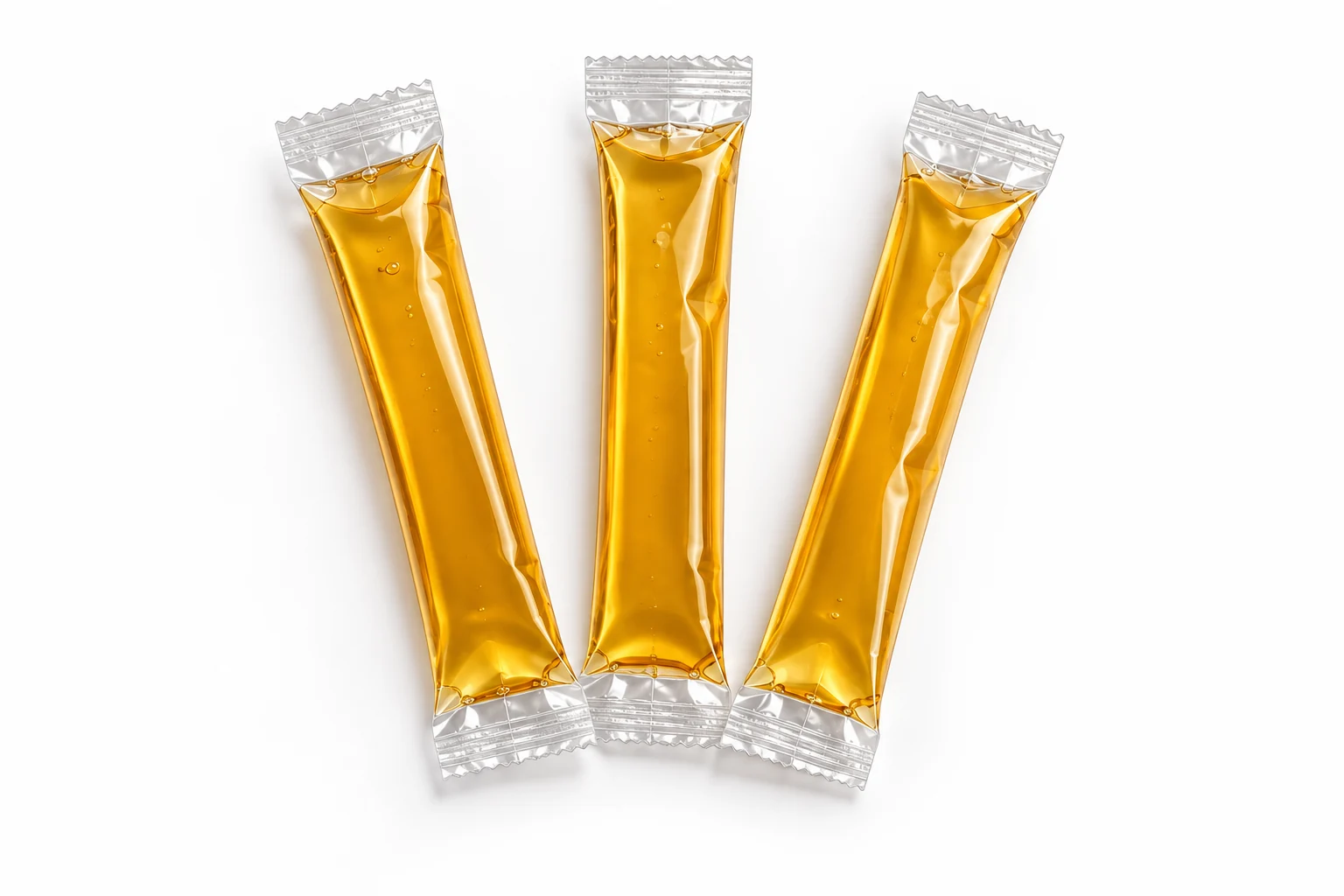
Three closed narrow stick packs filled with golden liquid
Narrow sealed sticks for single liquid portions.

Liquid stick packs

A slim portion of honey, oil or another suitable liquid, used in one serving.

  1. Form narrow packs
  2. Dose each lane
  3. Seal the ends
  4. Cut the portions

Narrow forming tubes shape the film while the dosing outlets fill each lane. End sealing follows the completed dose. For several lanes, the distribution system must supply them consistently and stop flow before the sealing jaws close.

Specify output as completed sticks at the intended portion and product temperature. Lane count alone does not establish the rate or fill consistency.

Explore liquid stick-pack equipment

Refill pouches and repeated pouring

The supplied pouch determines the filling opening. A bag filled through its open top is heat-sealed; a pouch filled through a fitted spout needs the matching capping operation.

Empty open-top pouch beside a similarly sized filled and top-sealed sauce pouch
Comparable pouch sizes before and after filling. Keep a clean area above the product for the top seal. Packaging illustration.
Rotary supplied-pouch handling machine with gripper stations
Pouch-handling platform. Liquid dosing is specified separately for the filling station.

Liquid in open-top premade pouches

For supplied refill or sauce pouches filled through the open mouth.

  1. Pick and open pouch
  2. Support and fill
  3. Stop drips and clear the mouth
  4. Heat-seal the top

The machine grips and opens a supplied pouch, holds it beneath the liquid outlet, then carries it to top sealing. A controlled cutoff keeps drips away from the mouth; support beneath the pouch carries the growing fill weight.

Leave enough clean space above the largest fill for a reliable seal. A zipper, if present, also affects opening clearance and nozzle access.

Compare premade sauce pouch routes
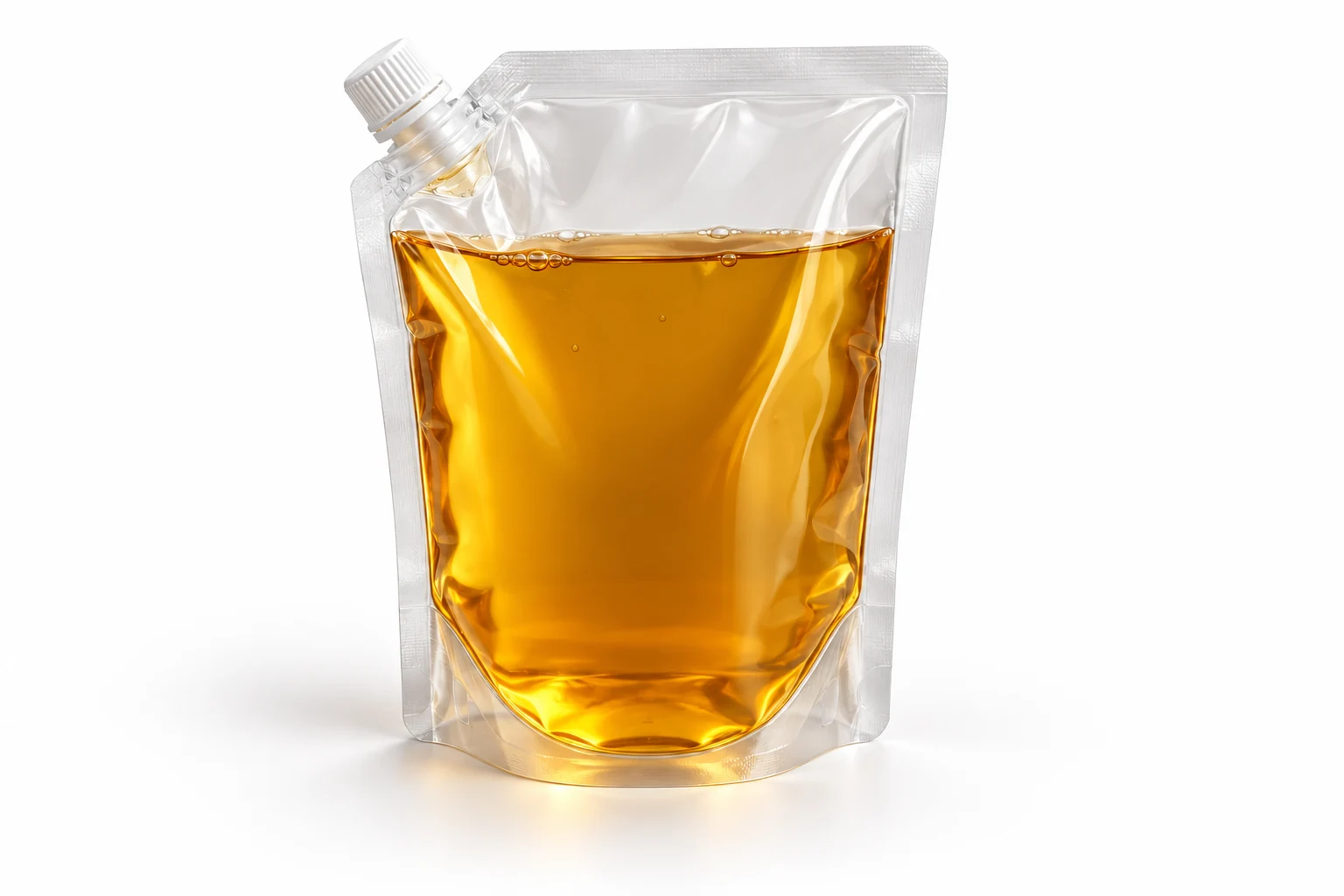
Closed clear refill pouch with a fitted corner spout and white screw cap
A capped spout pouch for repeated pouring. The filling opening is confirmed from the supplied pouch.

Filling through a fitted spout

For a supplied pouch whose filling opening is the spout.

  1. Locate the spout
  2. Fill through its opening
  3. Apply the cap
  4. Check the closure

A holder locates the supplied spout under the filling nozzle. After dosing, cap feeding and tightening close the pouch. The spout opening sets the available nozzle clearance and product passage.

For sauce with pieces, compare particle size with the narrowest passage. A different cap or spout can require new holders and capping parts.

Read the spout-pouch selection guide

Liquid filling into bottles and jars

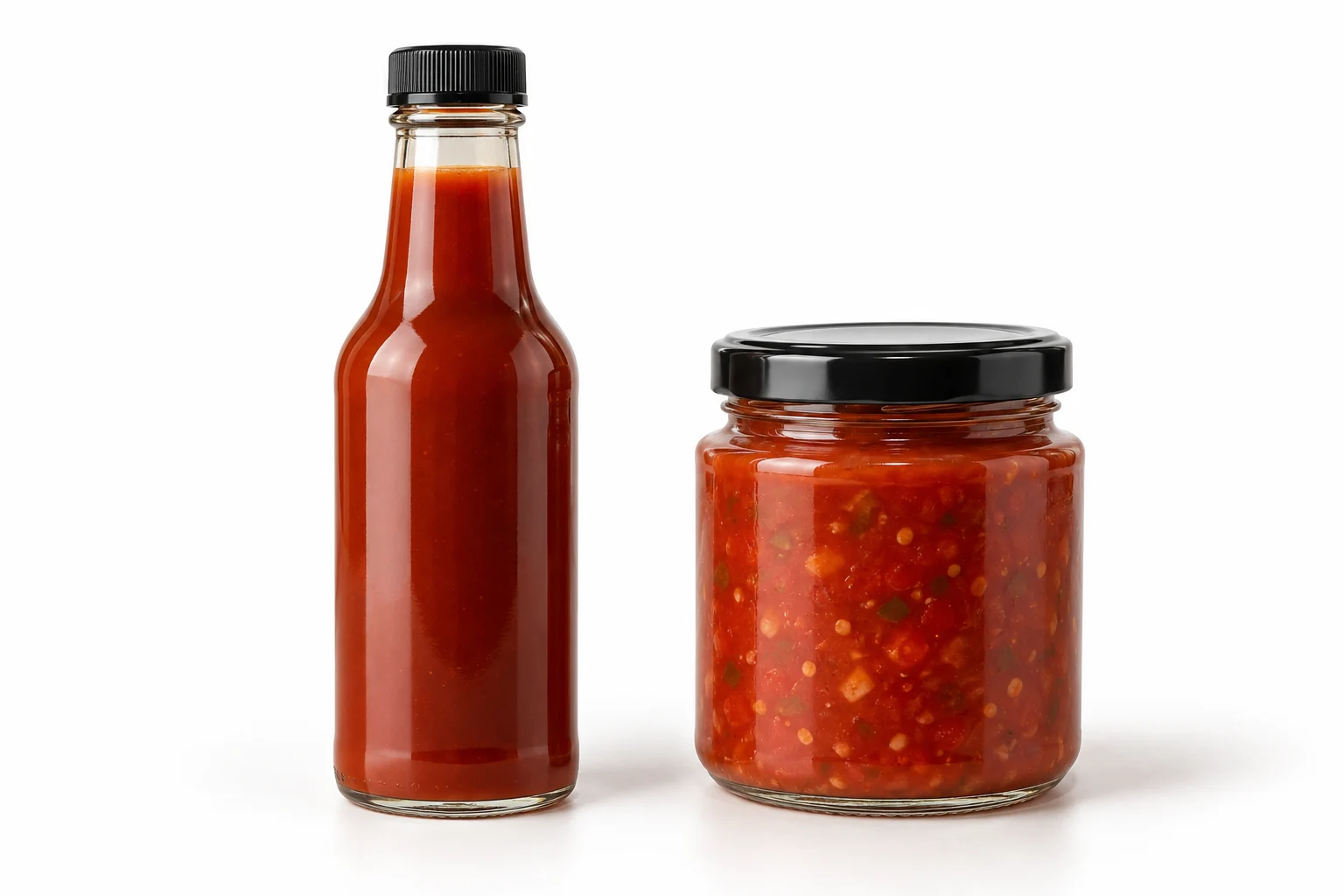
A closed narrow-neck sauce bottle beside a wide-mouth sauce jar
A sauce bottle and a sauce jar with their closures. Opening size changes nozzle access and closing equipment.
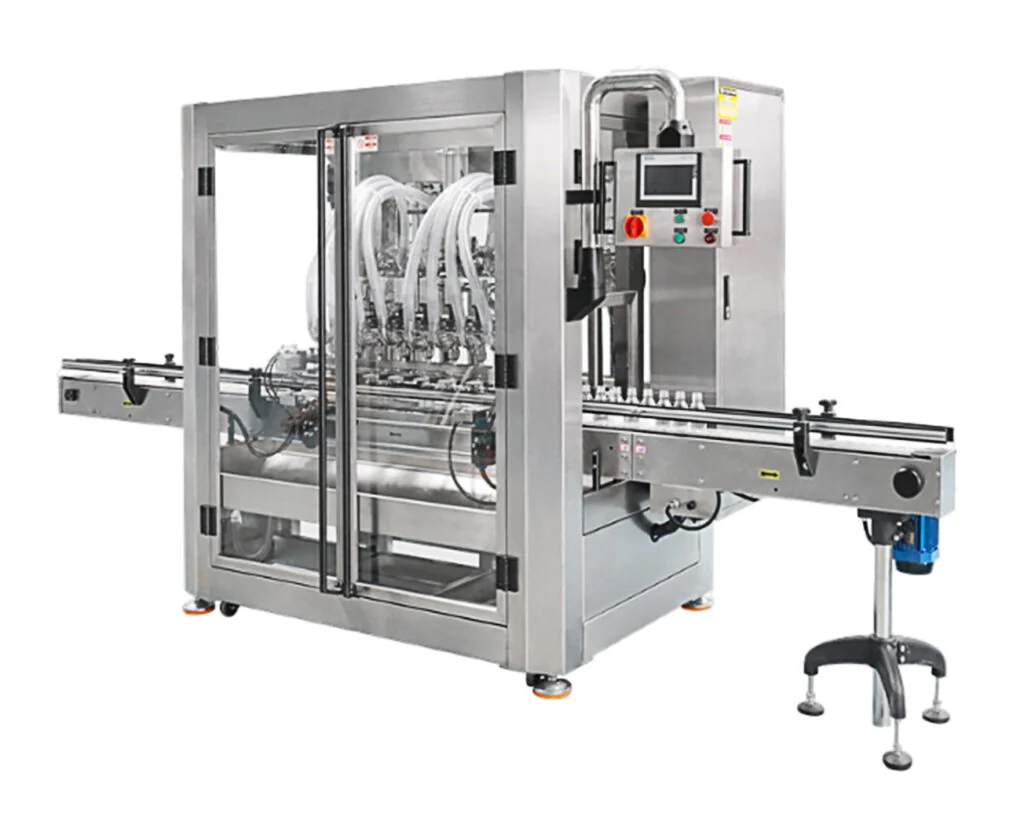
Enclosed bottle filling machine with filling heads and conveyor
Bottle filling equipment. Cap application is specified separately for the chosen closure.

Bottles and jars with matched closures

For oils, sauces and compatible liquids sold in rigid packs.

  1. Position the container
  2. Fill
  3. Apply the cap or lid
  4. Check the closed pack

The shown conveyor filler positions rigid containers beneath several filling outlets. Product supply and dosing are coordinated with container movement. A selected capper then applies the screw cap or lid; its handling and tightening parts follow the closure sample.

A wide jar mouth leaves more filling access than a narrow bottle neck. Foaming, drips around the rim and the time available for capping still affect the complete cycle.

See bottle filling and sealing

The same pouch, different sauce recipes

Smooth sauce or sauce with pieces

Smooth tomato sauce and particulate sauce in matching sealed pouches
Smooth sauce on the left; sauce with pieces on the right, in the same pouch format.

A smooth sauce and a sauce containing pieces may look suitable for the same pouch while needing different product-contact parts.

  1. Check the largest pieces
  2. Trace the narrowest passages
  3. Examine repeated fills and seals

Trace the actual recipe through the pump inlet, valves and nozzle. Pieces must pass through without blocking or unacceptable damage. The filling temperature affects the sauce around those pieces and the way flow stops at the outlet.

Trial both recipes at their intended filling conditions. Compare dose consistency, retained pieces and the cleanliness of the pouch mouth before approving shared filling parts.

Keep liquid away from the sealing and closing area

Production problemWhat we adjustWhat to examine
Drips reach a pouch seal or bottle neckNozzle shut-off, withdrawal and the timing of pack movement.Repeated fills at the working product temperature.
Foam slows down closingFill profile, nozzle position and the time before sealing or capping.Quantity and completed-pack output in the same run.
A flexible pouch moves as it fillsGrip position, pouch opening and support beneath the fill.Pack stability and sealing clearance at the largest intended fill.
Different lanes give different portionsProduct distribution, dosing settings and shut-off for each lane.Individual lane weights and seals, as well as combined output.

Compare complete filling and closing cycles

Production arrangementOperator workChangeover workOutput to establish
Operator-presented packsPlace and support the pack, start filling and move it to sealing or capping.Filling parts, supports and cleaning between liquids.Completed packs including filling, handling and closure.
Automatic filling and closingReplenish liquid and packaging, monitor fills and carry out checks.Nozzles, package tooling, closure parts and cleaning.Filled, sealed or capped packs meeting the quantity requirement.
Connected packaging operationsManage supply, transfers and coordinated changes between machines.Product-contact cleaning and package changes across the connected equipment.Sustained output with refills and routine stops included.

For a project that connects several operations, we plan the interfaces through our packaging equipment and production-line range. Cleaning access and liquid supply are included when sizing the layout.

From your sample to a working specification

Comwin turns your product and finished-pack requirements into an equipment recommendation. The proposal identifies the filling parts, package handling and output to be checked with your materials.

What we work throughWhat you receive
Product and packaging reviewA recommended equipment arrangement, with the required format parts and product-contact components.
Sample trialAgreed checks for fill quantity, pack condition and sustained output, with the test material and operating conditions identified.
Installation and changeoversA layout, utilities and access requirements, plus the parts and cleaning work involved in changing products.

Use our free sample-testing service to work through the product and packaging together. You can also arrange a factory visit to see equipment running.

Comwin provides a two-year machine warranty and a three-year warranty for core components, with remote response within 24 hours. Training, parts and installation responsibilities are set out in the proposal.

Liquid packing questions

Can the same machine fill thin liquids and thick sauces?

Some product ranges can share a filler with suitable parts and settings. We compare viscosity at the filling temperature, particles, foaming and cleaning before selecting the pump, valves and nozzles.

Can one machine fill both pouches and bottles?

The dosing principle may be shared, but pouch support and heat sealing differ from bottle movement and capping. The complete configurations need to be defined for both packs.

Is a spout pouch always filled through the spout?

No. The agreed pouch and process may use spout filling and capping, or filling through an open mouth followed by a top seal. Provide the supplied pouch sample so the correct sequence can be selected.

Can liquid sachets be made on a horizontal machine?

Yes, suitable horizontal form-fill-seal pouch machines can use liquid dosing. They are different from ordinary horizontal flow wrappers for solid products. The pouch geometry, filler and seal layout must fit the task.

What determines the liquid packing machine quotation?

The liquid, portion, pack, output, cleaning needs and closing operation determine the equipment. Send those details to compare proposals with the same scope.

Can you assess special liquids or processing requirements?

Yes. Provide the composition, contact-material requirements and process specification. Aseptic filling and other special processes need an assessment of the equipment and validation scope.

Tell us about your liquid and finished pack

Send the liquid or recipe details, a pack and closure sample, the fill quantity and required output. We will recommend the filling and closing arrangement and identify which product trials are needed.

Liquid

Product sample, viscosity at filling temperature, foam, particles and contact-material needs.

Pack

Film, open-top pouch, spout pouch or bottle; dimensions and closure sample.

Fill

Volume or net weight, tolerance, headspace and supply conditions.

Quality

Leakage and seal or closure requirements, cleaning and process specification.

Production

Completed packs per minute or shift, batches and product or format changes.

Factory

Space, utilities, environment, existing equipment and destination.